
Best Road Bikes Under 1000: A Fit-Aware Buying Guide
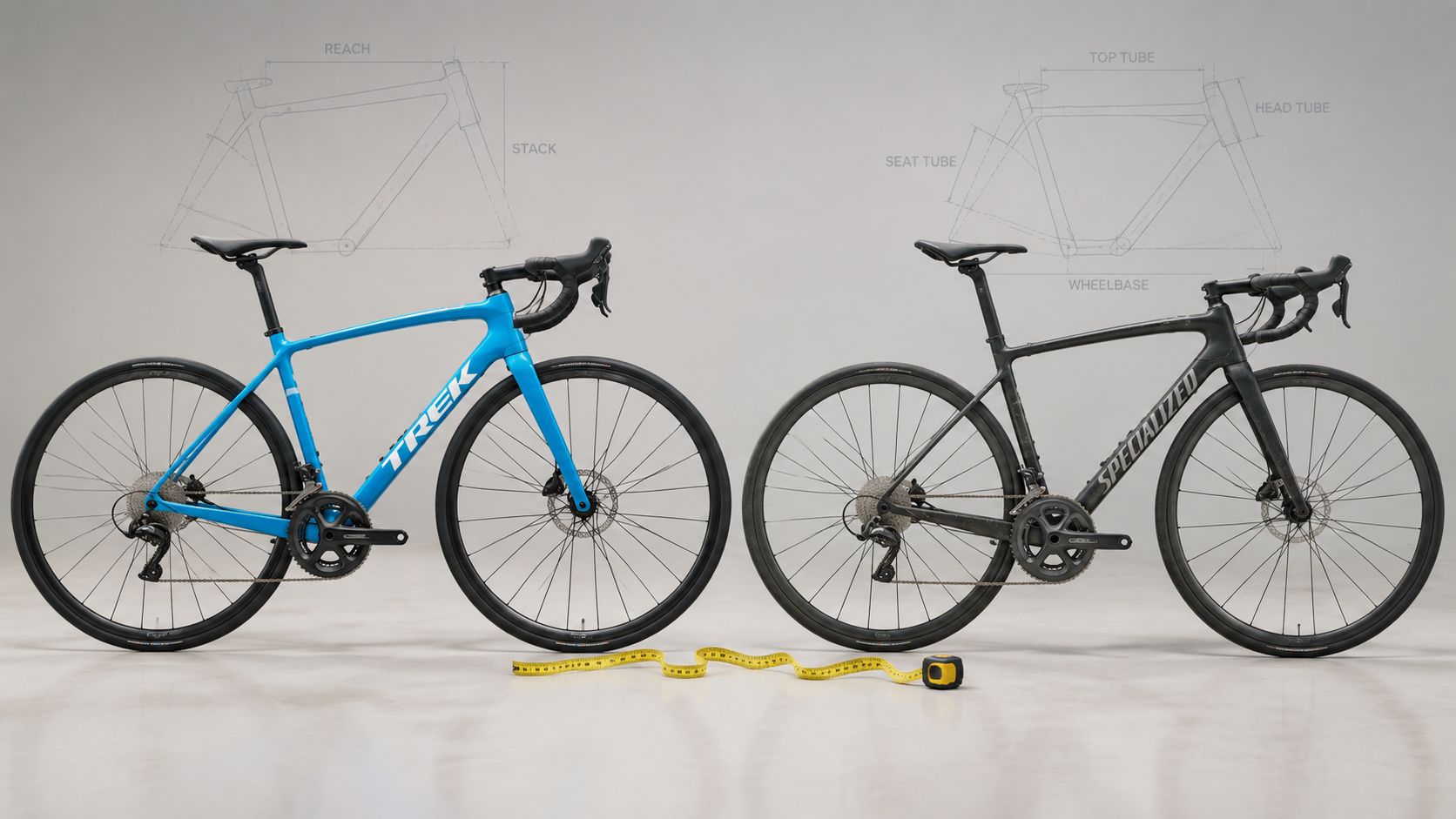
The most useful way to shop for the best road bikes under 1000 is not to chase the longest spec list. At this budget, small fit and setup differences can matter more than one step up in drivetrain branding. A bike with a better frame shape for you, a clearer size match, and a more complete listing can be the smarter buy than a flashier option with vague details.
This guide is built around a real shortlist plus a fit-aware buying framework. The goal is not to crown one universal winner. It is to help you compare a few credible bikes, understand what actually changes the ride, and avoid buying a road bike that looks good on paper but works poorly for your position.
Table of Contents
- Shortlist: Current New Road Bikes Worth Comparing Under $1,000
- Why Under 1000 Is a Budget, Not a Bike Category
- Fit Signals That Matter Before You Compare Specs
- New Versus Used at the Same Budget
- Component Priorities and Spec Traps
- What to Check in a Used Listing Before You Spend Time on It
- How SYCLR Helps You Shortlist Better-Fit Bikes
- A Practical Buying Framework Before You Click Buy
- Best Road Bikes Under $1,000 FAQs
- What is the best road bike under $1,000?
- Is the Triban RC520 the best value road bike under $1,000?
- Should I buy a new or used road bike under $1,000?
- What matters most when comparing road bikes under $1,000?
- Are stack and reach enough to choose the right road bike?
- Does standover matter on a road bike?
- How do I compare used road bikes under $1,000 quickly?
- Can SYCLR tell me which road bike to buy?
Shortlist: Current New Road Bikes Worth Comparing Under $1,000
If you want a practical starting point, these are three road bikes worth comparing in this budget conversation:
Decathlon Triban RC520
Cannondale CAAD Optimo 4
Giant Contend 3
These are not universal winners for every rider. They are useful comparison points because they differ in frame geometry, braking setup, component mix, and overall specification.
Models above $1,000 new may still appear below the cap used or on sale, but verify current price.
Decathlon Triban RC520
The Decathlon Triban RC520 remains one of the strongest bikes to compare first when its geometry suits you. Independent buying coverage has long treated it as a benchmark in this price conversation (Cycling Weekly). The key point is not that it wins automatically. It is that it often combines a practical aluminum frame, carbon fork, and Shimano 105 shifting in a package many riders will want to measure against.
Its value depends on whether you want its general road setup and whether the frame dimensions match your position. If its exact geometry and setup are a plausible match for you, it deserves a place near the top of the comparison list.
Cannondale CAAD Optimo 4
The Cannondale CAAD Optimo 4 is the bike to compare if you want an established aluminum road platform from a major brand. It provides a straightforward alloy-road-bike comparison point with published geometry and a clearly identified Claris-based specification.
The question is less about badge value and more about whether its fit, brake setup, and stock cockpit make sense for your riding. Compare its frame dimensions carefully against the Giant and Triban, because labels like small, medium, or 54 do not guarantee similar rider position.
Giant Contend 3
The Giant Contend 3 is a useful current under-$1,000 comparison option in the US at $850. It gives buyers a mainstream entry-level road bike with an ALUXX aluminum frame, Shimano Claris, and rim brakes.
That makes it a practical benchmark for comparing a mainstream alloy frame, entry-level Shimano drivetrain, rim brakes, published geometry, and current U.S. pricing. As with the other bikes here, the real question is whether the frame dimensions and stock setup suit your position.
How to use this shortlist
Use these bikes as comparison anchors, not as automatic answers.
For each one, check:
Your size range from the manufacturer
Frame stack and reach in the likely size
Current cockpit setup, including stem length and bar shape where listed
Brake type and drivetrain details
What is actually included at the asking price
How complete the listing or retailer page is
If one bike looks better on paper but its geometry is off for you, it is not the better buy.
SYCLR may earn a commission from qualifying purchases made through some retailer links, at no additional cost to you.
See Current Competitive Cyclist Sales
Why Under 1000 Is a Budget, Not a Bike Category
Under $1,000 is a spending cap, not a consistent product class. In this range, you will see entry-level aluminum road bikes, older alloy models, discounted stock, and used bikes with stronger components but less certainty around condition and setup.
That matters because two bikes with the same price ceiling can differ in ways that change the ownership experience more than the logo or drivetrain name. The real comparison is not just parts. It is fit, frame, current spec, model-year context, and how much confidence you have in what is being sold.
A basic but well-sized bike can be the better choice over a more impressive listing that will need changes before it works for you. That is why the shortlist should come first, then the fit check, then the deeper spec comparison.
Fit Signals That Matter Before You Compare Specs
Road-bike size is not universal. A 54 from one brand can place you differently from a 54 in another range. Before you compare components, get clear on which bikes are even plausible fits.
Start with height and inseam, then move to geometry
Your height and inseam are useful starting context. They help narrow the likely size range and reduce obvious mismatches. But they are still only the start.
When available, a known-good current bike or a professional fit is a stronger reference point than a generic size label. If you already ride a road bike that works well, use that as your baseline instead of restarting from a broad chart.
Use stack and reach to compare frames
Stack and reach are useful primary frame-level comparison signals. Stack describes front-end height at the frame level. Reach describes frame length at the same level. Together, they help you compare bikes across brands without relying on size labels that may not mean much across different ranges (DiDi Bike).
That said, stack and reach do not tell you your final hand position by themselves. Actual hand position depends on the full setup, including stem length, spacer height, handlebar shape, hood placement, saddle position, and saddle height. Treat stack and reach as useful primary frame-level comparison signals, not as the complete fit answer.
If you have a current bike that works well, compare the candidate bike's likely size against that bike's geometry. If you have a professional-fit reference, use it as additional comparison context.
Treat standover as practical clearance context
Standover is useful as a practical clearance check, especially for mounting and stopping. It is not the main signal that tells you whether a road bike's riding position will suit you.
You want enough clearance to stand over the bike comfortably and confidently in normal riding shoes. After that, the bigger fit questions usually come from frame dimensions and setup, not from the printed frame size alone.
| Signal | What It Helps With | How to Use It |
|---|---|---|
| Height | Initial size range | Use as first-pass context |
| Inseam | Initial size range and clearance context | Helps narrow sizes, not finalize them |
| Stack | Frame front-end comparison | Compare likely sizes across brands |
| Reach | Frame length comparison | Compare likely sizes across brands |
| Standover | Practical clearance | Confirm comfort when mounting and stopping |
| Current bike or fit report | Strong comparison reference when available | Use to validate frame choice before buying |
Use the broader bike fit guide when you need to work from body measurements or a current-bike reference.
New Versus Used at the Same Budget
New and used road bikes under $1,000 solve different problems.
A new bike may offer clearer sizing support, a retailer relationship, warranty coverage, and returns. Those factors can matter a lot when you are comparing close options or trying to reduce uncertainty.
A used bike can offer a stronger spec for the same money, but only if the details are clear enough to verify what you are actually getting. The potential upside is real. So is the need for more careful checking.
There is no universal rule that new is right for one type of rider and used is right for another. The right choice depends on how much you value support, how complete the bike information is, and how confident you are in the fit and setup.
| Factor | New Under 1000 | Used Under 1000 |
|---|---|---|
| Fit information | Usually easier to cross-check through current geometry charts | Depends on the exact model and seller details |
| Support | Warranty, returns, and retailer help may matter | Usually less formal support |
| Spec level | Often more basic for the money | Can be stronger if the bike is accurately represented |
| Verification needs | Lower, but still worth checking | Higher, especially for model-year and current spec |
| Risk | More predictable purchase path | More upside, more uncertainty |
If you want a deeper used-bike process after the initial shortlist stage, use the used road bike guide.
Component Priorities and Spec Traps
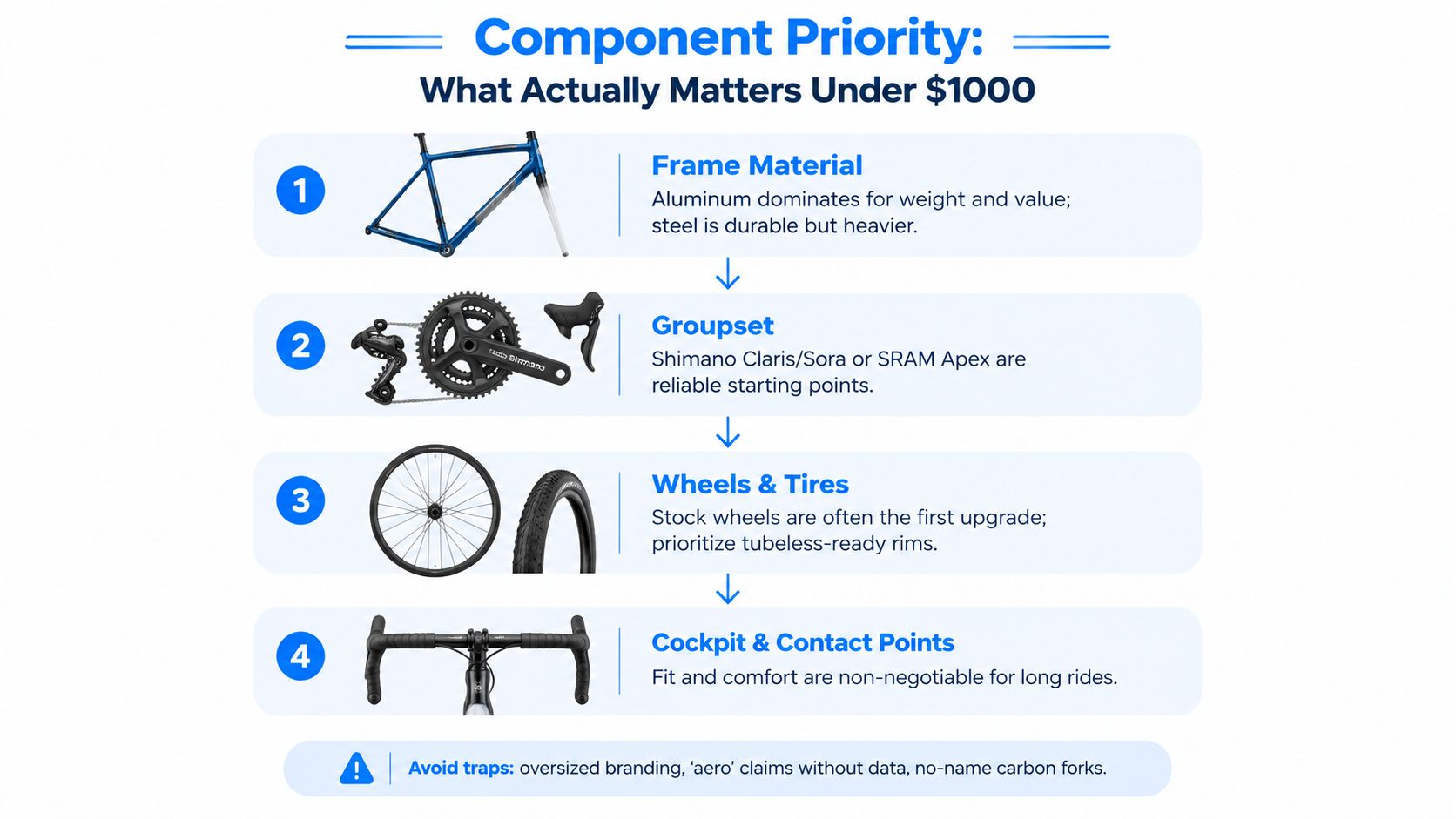
Spec sheets are useful only when read in the right order. At this budget, it is easy to get distracted by drivetrain naming and miss the more important questions about frame fit, fork, current setup, or whether the listing actually supports its own claims.
Frame and fork before drivetrain hype
The frame and fork deserve attention before drivetrain branding. This is where fit, tire clearance, mounting standards, and general use case begin.
Aluminum is common in this price range, while carbon may appear in forks or in some used bikes. Material alone should not determine the choice. What matters is whether the bike's frame design, geometry, and condition support the way you actually ride.
Drivetrain and brakes need context
It is still worth comparing drivetrain and brakes, just not in isolation. A bike with Shimano 105 shifting may be attractive, but that should not distract from questions about frame fit, current setup, or whether the rest of the parts match the listing description.
A common shortlist in this price range includes aluminum frames, mixed brake setups, and Shimano component tiers such as Claris or Tiagra (Dream Cycle). Compare the actual shifters, derailleurs, crank, cassette, and brakes rather than stopping at a single groupset label.
Rim brakes are still common in budget road-bike roundups (Cyclists Hub). Mechanical and hydraulic discs also appear depending on the model and year. The useful question is not which label sounds best. It is whether the brake system is appropriate for the bike, correctly represented, and easy for you to live with.
Ignore impressive-sounding shortcuts
Be cautious with vague claims like:
"Shimano 14-speed" without a full parts list
Broad groupset claims that do not match the visible parts
Model names without model year
"Upgraded" cockpit or wheels with no explanation of what changed
A coherent, clearly identified build is more useful than a better-sounding one with missing detail.
What to Check in a Used Listing Before You Spend Time on It
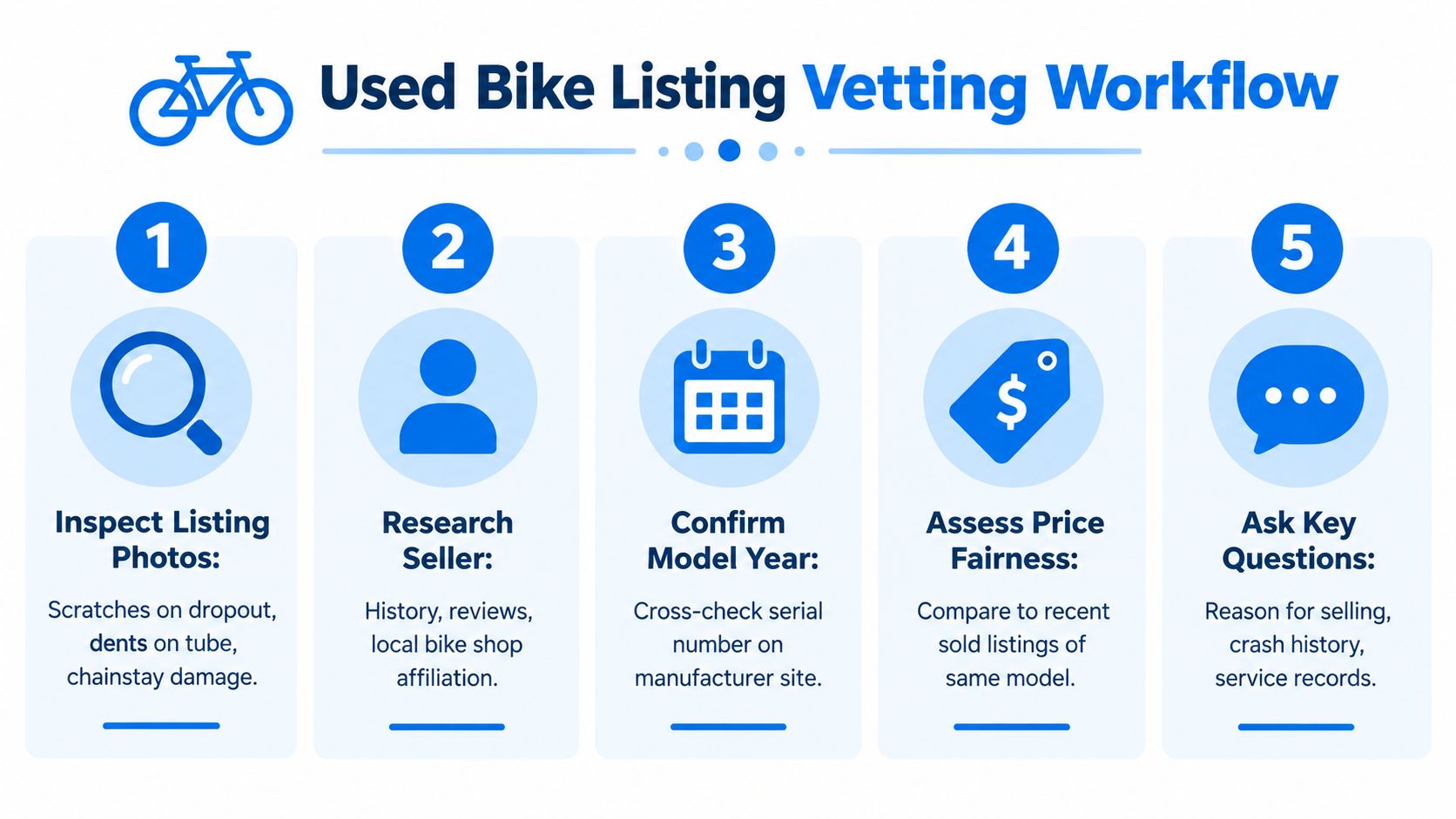
For a first-pass used-bike screen, keep the checklist simple.
Look for:
Exact model name
Model year
Claimed frame size
Manufacturer geometry for that model and year
Current cockpit setup, especially stem and bar details where possible
Current drivetrain and brake spec
Condition evidence in photos and description
Listing completeness overall
If a listing does not clearly establish the bike's identity, size, geometry, and current setup, it is harder to compare against the shortlist in any meaningful way.
That does not mean the bike is bad. It means you have less basis for judging value and fit. For a deeper inspection process after this first pass, use the used-bike checklist.
How SYCLR Helps You Shortlist Better-Fit Bikes
General marketplaces usually show inventory first and interpretation second. That leaves you to manually compare frame size claims, geometry charts, asking prices, model years, and listing quality across multiple tabs.
SYCLR helps organize that comparison around the signals that matter earlier in the buying process:
Fit signals
Geometry signals
Model-year context
Price context
Listing quality
Condition signals where available
Confidence signals
That makes it easier to filter a road-bike shortlist before you spend time chasing listings that are incomplete or poorly matched to your likely fit.
You can start with height, bike type, and budget, then add more detailed fit information when you have it. If you know your current-bike geometry or have measurements from a fit session, that gives the shortlist more value than relying on frame labels alone.
SYCLR does not perform a professional fit, physically inspect bikes, authenticate listings, verify ownership or seller claims, or guarantee fit or condition. It is a comparison layer that helps you narrow the field before the final buying step.
Use SYCLR to start a shortlist, or go directly to Advanced Fit if you already know more detailed fit inputs.
A Practical Buying Framework Before You Click Buy
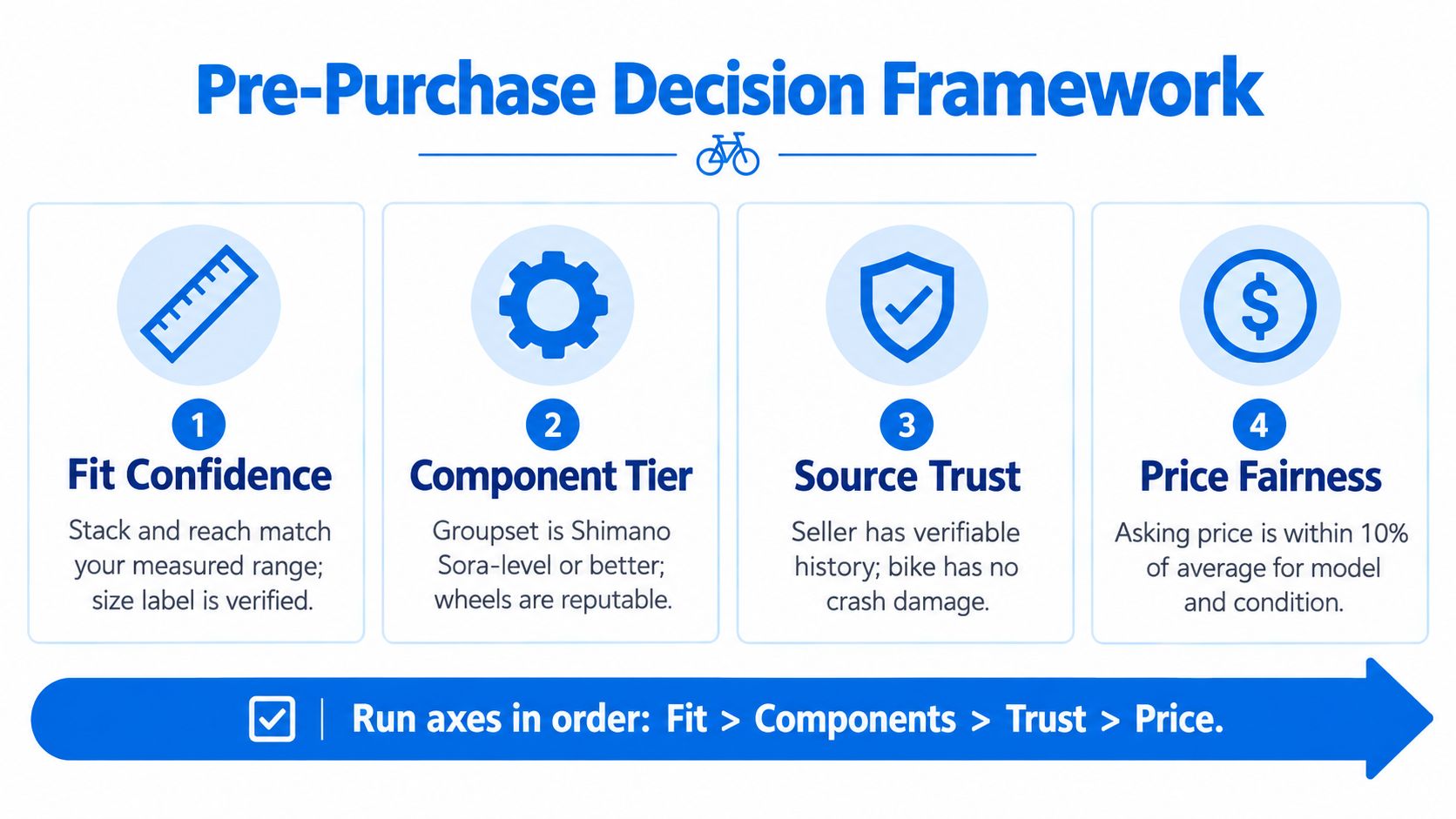
Before you buy, run each candidate through the same four questions:
Is the size plausible from height and inseam, and does the geometry still make sense when you check stack and reach?
Does the frame, fork, and current setup support the riding position you want?
Is the listed spec complete enough to understand what you are actually buying?
Does the asking price make sense once you account for model-year context, listing quality, and visible condition?
This framework works for new and used bikes because it keeps the focus on comparison quality rather than on one universal buying rule.
A stronger candidate is one whose fit and geometry are plausible, whose specification is clear, and whose total value makes sense for the asking price.
Use SYCLR to compare road-bike listings by rider details, bike type, budget, geometry, model-year context, price context, listing quality, and available condition signals before you contact a seller or place an order.
Best Road Bikes Under $1,000 FAQs
What is the best road bike under $1,000?
There is no single best road bike under $1,000 for every rider. The smarter approach is to compare credible options like the Decathlon Triban RC520, Cannondale CAAD Optimo 4, and Giant Contend 3, then narrow the list by fit, frame geometry, current spec, and price context.
Is the Triban RC520 the best value road bike under $1,000?
It is a strong comparison point in the category, especially because of its overall package and Shimano 105 shifting. But it is not an automatic winner. If the geometry does not suit you, another bike can be the better value.
Should I buy a new or used road bike under $1,000?
Either can make sense. A new bike may offer warranty, returns, and retailer support. A used bike may offer stronger specification for the same budget, but it requires more verification. The right answer depends on the specific bike and how complete the information is.
What matters most when comparing road bikes under $1,000?
Start with whether the bike is a realistic fit. Height and inseam can narrow the size range, while stack and reach help compare frames across brands. After that, look at frame and fork, current setup, complete spec, model-year context, and listing quality.
Are stack and reach enough to choose the right road bike?
No. They are useful primary frame-level comparison signals, but they do not define your final hand position on their own. Stem length, spacer height, handlebar shape, hood setup, saddle position, and saddle height all affect the result.
Does standover matter on a road bike?
Yes, but mainly as a practical clearance check. It helps confirm comfort and confidence when mounting and stopping. It is not the main measurement that decides whether the riding position will suit you.
How do I compare used road bikes under $1,000 quickly?
Start with the basics: exact model, model year, frame size, manufacturer geometry, current cockpit and drivetrain spec, visible condition, and overall listing completeness. If those pieces are missing, the bike is harder to compare with confidence.
Can SYCLR tell me which road bike to buy?
SYCLR helps you compare fit signals, geometry, model-year context, price context, listing quality, and available condition signals. It does not replace a professional fit, inspect bikes in person, authenticate listings, verify ownership claims, or guarantee fit or condition.