
Domane vs Madone: Which Trek Road Bike Fits You
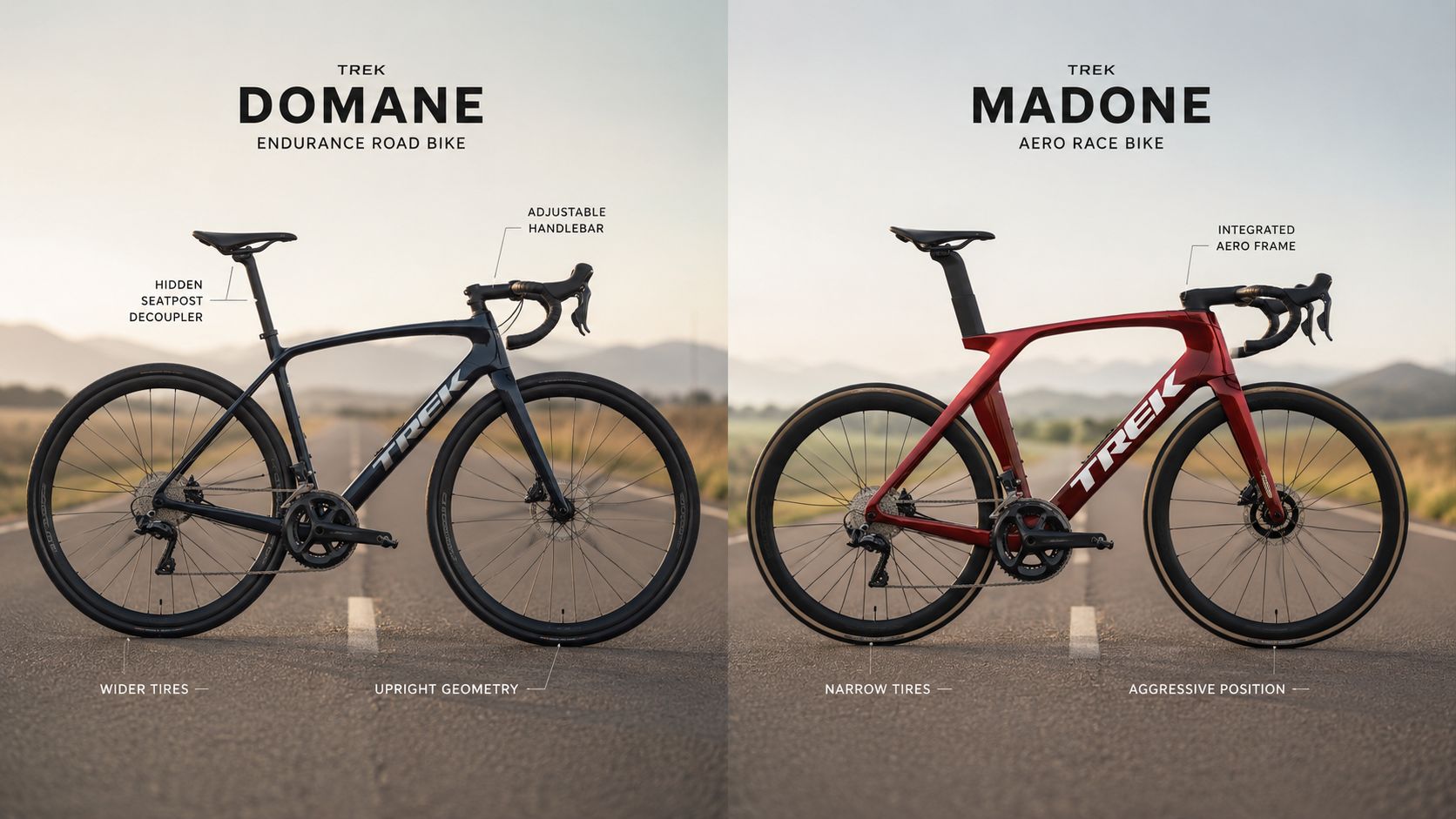
The common shorthand is still Madone for speed, Domane for comfort. That is too blunt to help with a serious purchase. A better comparison starts with the current generations, the exact frame size, stack and reach, cockpit, tire clearance, intended riding position, and whether the bike in front of you is actually the generation you think it is.
For this comparison, the useful current baseline is Domane Gen 5 versus Madone Gen 8. Older bikes need to be judged as generation-specific cases, not as if every Domane or every Madone rides the same.
Table of Contents
- Why Domane vs Madone Is Not a Better vs Worse Question
- Two Trek Road Bike Platforms at a Glance
- How Endurance and Race Geometry Change Your Position
- Comfort and Aero Tech Across Current Generations
- Tire Clearance and Setup Range
- Comparing a Domane and Madone Against Your Current Fit
- Used Domane vs Used Madone Buying Realities
- Choosing the Right Trek and Shortlisting With Confidence
- Domane vs Madone FAQs
Why Domane vs Madone Is Not a Better vs Worse Question
Domane and Madone are different starting points, not a simple better-versus-worse choice. In Trek's current range, Domane Gen 5 is the endurance road platform and Madone Gen 8 is the race platform. A useful comparison begins with position, intended use, cockpit setup, tire range, and model year.
That model-year point matters because current claims should stay attached to current generations. Domane Gen 5 uses Trek Road Endurance Geometry and no longer uses IsoSpeed. Madone Gen 8 uses Road Race Geometry, IsoFlow, and Full System Foil. Those facts help define the present comparison, but they should not be projected backward onto older Domanes or older Madones.
The platform names do not tell you enough
A Domane SL and Domane SLR are different buying propositions. The same is true for Madone SL and Madone SLR. Carbon layup, wheels, cockpit integration, drivetrain, seatpost, condition, and price context can materially change how two listings compare even when they share the same platform name.
For that reason, the first question is not which name sounds better. The first question is which platform is the better starting point for your current-bike position and intended position.
Practical rule: Choose the position and use case first. Choose the model badge second.
Two Trek Road Bike Platforms at a Glance
The current Domane and Madone are different fit and setup concepts.
Domane Gen 5 starts from Trek Road Endurance Geometry. It is aimed at riders who want a road position that begins taller, with broader tire and setup range. Trek's current Domane design does not use IsoSpeed. Trek says its comfort metric stays within 5% of the prior generation under Trek's own comparison method.
Madone Gen 8 starts from Road Race Geometry. It is aimed at riders who want a lower, race-oriented platform with Trek's current aero shaping. Trek attributes its current comfort approach to IsoFlow, and its aero strategy to Full System Foil. Trek says IsoFlow delivers 80% more vertical compliance than the previous version.
| Attribute | Domane Gen 5 | Madone Gen 8 |
|---|---|---|
| Platform purpose | Endurance road riding and broader road setup range | Race-oriented road riding and aerodynamic efficiency |
| Fit concept | Trek Road Endurance Geometry | Road Race Geometry |
| Starting position | Taller starting point | Lower starting point |
| Comfort-related frame tech | No IsoSpeed, Trek says comfort metric stays within 5% of prior generation | IsoFlow, Trek says 80% more vertical compliance than previous version |
| Aero approach | Less aero-led, more range-focused | Full System Foil |
| Tire clearance | Up to 40 mm, per Trek | 32 mm measured max tire clearance, per Trek |
| Generation caution | Do not apply older IsoSpeed assumptions to Gen 5 | Do not apply Gen 8 IsoFlow claims to older Madones |
Check the exact size, model year, build, cockpit, wheels, and condition. The name alone is not enough.
SYCLR may earn a commission from qualifying purchases made through some retailer links, at no additional cost to you.
See Current Competitive Cyclist SalesHow Endurance and Race Geometry Change Your Position
The biggest difference is not a slogan about comfort or speed. It is the rider position each platform is built to support.
Trek places Domane Gen 5 around Road Endurance Geometry and Madone Gen 8 around Road Race Geometry. In practical terms, Domane begins as the taller platform and Madone begins as the lower platform. That does not tell you which is correct for you by itself. It tells you which one is closer to the position you already ride well, or the position you intentionally want to move toward.
That is why stack and reach are useful primary frame-level signals when comparing exact sizes across the two platforms. The right comparison is your current bike versus the exact Domane or Madone size you are considering, plus the stock cockpit that comes with it.
Use geometry as fit context, not a shortcut
Stack and reach help describe the frame's front-end height and length. Head tube length, cockpit dimensions, spacer range, bar shape, and seatpost setup help explain how that frame may translate into your actual riding position.
Wheelbase and trail can add useful context when comparing two bikes, but they should not be treated as automatic guarantees about handling. The same applies to any single geometry number in isolation. Use the complete geometry chart and cockpit spec as a fit and setup reference, not as a shortcut to universal ride conclusions.
For a deeper explanation of how stack and reach describe frame position, use SYCLR's stack and reach guide. Avoid body-type rules and avoid generic assumptions. Your current-bike position, intended position, and the exact frame in question matter more.
Comfort and Aero Tech Across Current Generations
If you are comparing current Trek platforms, keep the facts attached to the current generations.
Domane Gen 5 does not use IsoSpeed. Trek's current Domane comfort story is tied to the frame design and complete-bike setup, and Trek says its internal comfort metric remains within 5% of the prior generation. That is a Trek claim about its own comparison method, not a universal comfort guarantee.
Madone Gen 8 uses IsoFlow and Full System Foil. Trek says the current IsoFlow design has 80% more vertical compliance than the previous version. That is a Trek claim about the current Madone platform, not proof that every Madone is comfortable for every rider or that current behavior applies to older generations.
| Generation | Domane current claim | Madone current claim |
|---|---|---|
| Current baseline | Gen 5, no IsoSpeed, Trek says comfort metric stays within 5% of prior generation | Gen 8, IsoFlow and Full System Foil, Trek says 80% more vertical compliance than previous version |
| What not to do | Do not apply old Domane IsoSpeed assumptions to Gen 5 | Do not apply Gen 8 compliance claims to older Madones |
The buying rule is simple: identify the exact generation before drawing conclusions from comfort or aero claims.
Tire Clearance and Setup Range
Tire clearance affects the range of tire and setup options available for different road surfaces and riding priorities.
For the current comparison, Domane Gen 5 offers up to 40 mm tire clearance, per Trek. Madone Gen 8 has 32 mm measured max tire clearance, per Trek. That does not make one bike automatically better. It means Domane Gen 5 provides a broader manufacturer-supported tire range, while Madone Gen 8 remains more road-race focused.
Older generations should be checked individually. Do not assume an older Domane has the same clearance as Gen 5, and do not assume an older Madone matches Gen 8.
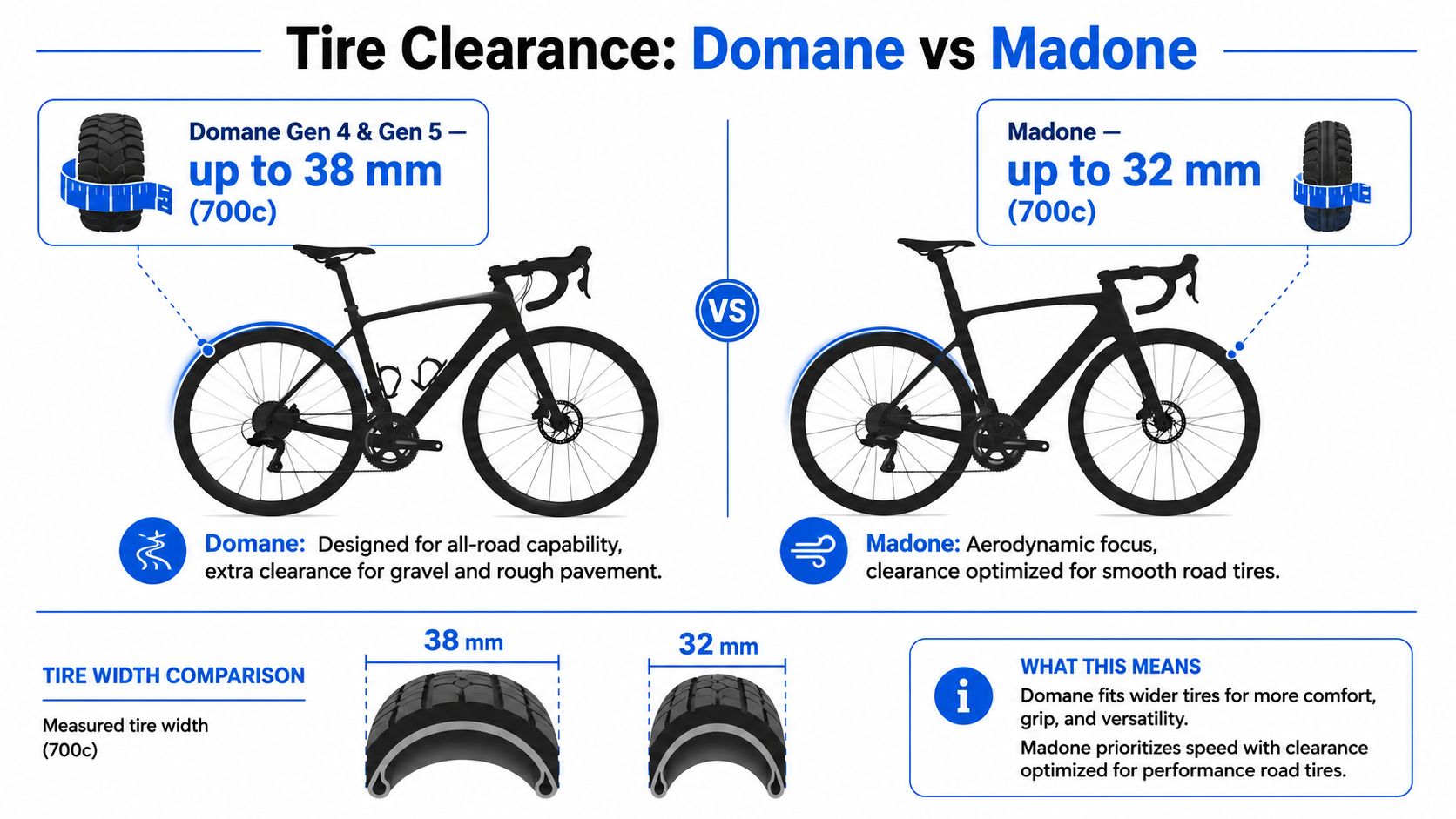
Verify clearance for the exact frame, wheel, and tire combination before buying. SYCLR's gravel-bike tire-clearance guide explains how clearance affects mixed-surface suitability.
Comparing a Domane and Madone Against Your Current Fit
A Domane or Madone should be judged against the position you already ride well, not by height or model name alone. The key questions are generation, frame size, stack, reach, cockpit shape, and how much adjustment is needed to reproduce or deliberately change your current position.
A hypothetical comparison
Consider this hypothetical example only. A rider's current road bike has a 570 mm stack and 385 mm reach. They are comparing one Domane and one Madone. These figures are illustrative, not measurements from a specific Trek model.
| Bike | Stack | Reach | Comparison context |
|---|---|---|---|
| Current-bike reference | 570 mm | 385 mm | Existing position to preserve or deliberately change |
| Representative Domane candidate | 575 mm | 383 mm | Similar horizontal position with a slightly taller front end |
| Representative Madone candidate | 555 mm | 388 mm | Lower front end with a slightly longer reach |
The Domane candidate starts closer to the rider's current front-end height. The Madone candidate starts lower and slightly longer. Neither frame is correct because of the name alone. The stronger candidate is the one that supports the rider's intended position without relying on substantial cockpit changes.
Use the frame as a starting point
Measure your current stack, reach, saddle height, bar drop, stem length, and handlebar dimensions where possible. Compare those with the geometry chart and stock cockpit for the exact Trek model and generation.
Cockpit changes can refine a plausible frame. They do not rescue a wrong frame. If a frame requires substantial cockpit changes to approximate your intended position, reassess whether another size or platform provides a better starting point.
A professional fit can help establish target contact-point coordinates and riding position, which you can then compare against the frame geometry and cockpit of each candidate. Then you can compare real listings against that target. If you are between sizes, use the dedicated /between-two-bike-sizes/ guide instead of relying on height alone.
Used Domane vs Used Madone Buying Realities
Used listings make this comparison harder because the model name covers multiple generations and build tiers. Keep the used-bike screen simple and shallow at first.
Check the generation, size, SL or SLR tier, cockpit, drivetrain, wheels, condition evidence, listing quality, and price context. Those factors usually matter more than broad assumptions about the platform name.
| Check | Why it matters |
|---|---|
| Generation | Current claims should not be applied to older bikes |
| Size | Fit context is an early screening factor |
| SL or SLR tier | Material, weight, spec, and price can vary meaningfully |
| Cockpit | Fit range and replacement cost can vary by build |
| Drivetrain | Spec level and compatibility affect value |
| Wheels | Wheel specification, condition, and compatibility can materially affect the comparison |
| Condition evidence | Photos, service detail, and visible wear affect confidence |
| Listing quality | Better evidence usually means lower uncertainty |
| Price context | Compare like-for-like bikes, not just model names |
For comparison support, use SYCLR to compare listings by fit signals, geometry signals, model-year context, price context, listing quality, condition signals where available, and confidence signals.
Choosing the Right Trek and Shortlisting With Confidence
The right Trek depends on your current-bike position, your intended position, the roads you ride, and the exact generation you are considering. Domane is not guaranteed comfort. Madone is not guaranteed speed. Both are starting points that need to be matched to the rider and the exact build.
Build the shortlist in four moves
Record the position you trust. Measure current stack, reach, saddle height, bar drop, stem length, handlebar shape, and tire setup. If some measurements are missing, use reliable geometry information instead of treating height as a complete sizing answer.
Compare exact geometry charts. Match size, generation, frame tier, and stock cockpit. A Domane may start closer to an endurance road position. A Madone may start closer to a race-oriented road position. Those are starting points, not guarantees.
Use fit context before component tweaks. Compare the frame and cockpit against your current-bike position and intended position. Use a professional-fit target if available. Remember that cockpit changes can refine a plausible frame, but they do not rescue a wrong one. For a more detailed fit-led search, use Advanced Fit.
Filter by evidence. Check generation, size, cockpit, drivetrain, wheels, condition evidence, listing quality, and price context. There is no universal used-market premium that always makes a Madone worth more than a Domane, or vice versa.
Recommendations by rider priority
Domane may be the stronger starting point when you want Road Endurance Geometry, more tire and setup range, and a platform that begins closer to a taller road position.
Madone may be the stronger starting point when you want Road Race Geometry, Trek's current aero-focused platform, and a bike that begins closer to a lower race-oriented road position.
In both cases, compare the exact generation, exact size, and exact cockpit against your current-bike position and intended position before giving too much weight to the badge.
Domane vs Madone FAQs
Is Domane more comfortable than Madone?
Not as a universal rule. Current comfort claims need to stay attached to the exact generation. Trek says Domane Gen 5 stays within 5% of the prior generation under Trek's own comfort metric, while Trek says Madone Gen 8 has 80% more vertical compliance than the previous IsoFlow version. Neither claim means one platform is automatically right for every rider.
Is Madone always faster than Domane?
Not in every real-world situation. Madone Gen 8 is Trek's race-oriented aero platform, but real-world speed also depends on rider position, fit, tires, course, conditions, and how the bike is used.
What matters more, geometry or components?
For fit, geometry and cockpit come first. Components matter for value and riding experience, but they cannot compensate for a frame that is poorly matched to the rider's fit and intended position.
Should I compare Domane and Madone by stack and reach?
Stack and reach are useful primary frame-level signals for comparing exact sizes. Add cockpit dimensions, current-bike position, and intended riding position before making a fit decision.
Does current Domane tire clearance make it a gravel bike?
Not by itself. More clearance broadens tire and setup options. Whether a specific bike suits gravel or mixed surfaces still depends on the exact frame, wheel and tire combination, and the kind of riding you actually plan to do.
What should I check first on a used Domane or Madone?
Start with generation, size, SL or SLR tier, cockpit, drivetrain, wheels, condition evidence, listing quality, and price context. Then go deeper only on the listings that still make sense for your fit and intended use.
Use SYCLR to compare road and gravel listings through fit signals, geometry signals, model-year context, price context, listing quality, condition signals where available, and confidence signals. Start with your current bike, your target position, and the exact Trek generation you want to compare.