
Unknown Is a Valid Result
A missing value is sometimes the most accurate representation of the evidence.
Engineering Note
Bike geometry can make online bike comparison much more useful — but only when the geometry belongs to the correct bike, generation, and size. When that evidence is incomplete, SYCLR would rather leave a field unknown than fill the gap with a confident-looking guess.
This note explains why that choice is deliberate, and how it protects the usefulness of a comparison rather than undermining it.
The Problem
A complete-looking geometry table looks authoritative. Every field is populated, the numbers are precise, and nothing signals doubt. But if that geometry belongs to the wrong model, generation, or size, the precision is misleading — it is a confident answer to the wrong question.
In that situation, a guessed value can be worse than a visibly missing one. A blank field tells you the truth; a wrong-but-precise field quietly hides it. A system should not turn uncertainty into certainty simply to raise its coverage.
Correctly unknown is better than confidently wrong.
Ambiguity
Real listings rarely arrive with a clean, unambiguous identity. Any of the following can make the correct geometry hard to establish:
None of these make a bike bad. They make its geometry uncertain, which is a different problem — and one that has to be handled honestly.
Alignment
A correct model name alone is not enough. The right model in the wrong generation is still the wrong table, and the right generation in the wrong size is still the wrong row. All three have to line up before a geometry figure can be trusted for a specific listing.
So SYCLR attaches manufacturer geometry only when the available evidence supports the match — the reasoning behind that is covered in how SYCLR verifies manufacturer geometry. This note is about what happens when the match cannot be supported.
The right model, the wrong generation, and the wrong size are three separate ways to be precisely wrong.
The Response
When the evidence does not support a geometry value, SYCLR would rather show less than invent more. In practice it may:
Missing geometry does not automatically make a listing useless. It changes what SYCLR can responsibly say about it.
In Practice
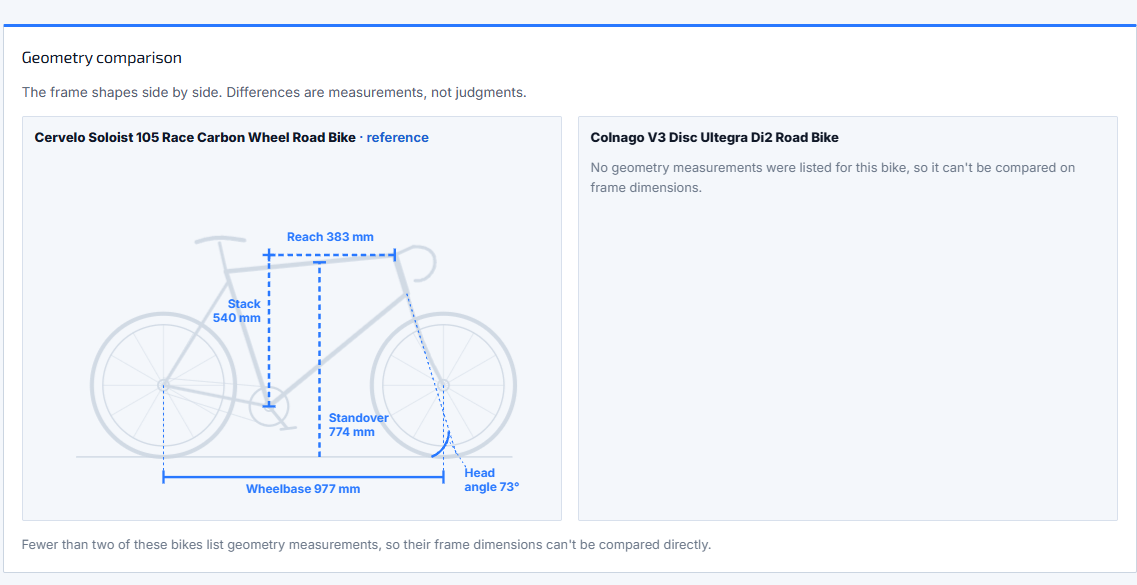
It is common for two listings to sit side by side where one shows full manufacturer-spec geometry and the other shows “Not listed.” Both bikes can still appear in the comparison. SYCLR does not invent the missing geometry just to make the two sides look symmetrical.
Here is that situation in the rider-facing product — complete geometry on one listing, absent on the other. The point is the design choice behind it: symmetry is not worth manufacturing when the evidence is not there to support it.
Coverage vs Quality
It is tempting to treat a high field-completion rate as a quality score. A dataset where every cell is populated looks finished. But completion percentage is not the same as accuracy, and enrichment that quietly attaches the wrong values makes comparisons look more trustworthy while making them less true.
Evidence quality has to matter more than cosmetic completeness. Chasing coverage for its own sake optimizes the appearance of the data rather than the decision it is meant to support — a theme that reaches well beyond geometry.
For Riders
In the app, some bikes carry richer geometry information than others, and that is expected. Where a field cannot be supported, it stays visibly unavailable rather than being filled in silently.
Better-supported geometry makes a comparison easier to reason about. Missing geometry does not mean a bike is wrong for you — it means SYCLR has less geometry evidence to work with for that particular listing, and it says so plainly.
The Principle
Five commitments sit underneath the way SYCLR handles uncertain geometry.
A missing value is sometimes the most accurate representation of the evidence.
A complete-looking record is not useful if the underlying match is wrong.
Names, years, generations, and sizes cannot always be treated as interchangeable.
SYCLR does not require every listing to fit a manufacturer geometry record.
Showing what is not known is part of responsible decision support.
Connections
The same idea runs through the rest of SYCLR’s public methodology. How SYCLR Works describes how evidence is weighed and why unknown stays unknown. Manufacturer Geometry Methodology covers how a geometry match is judged in the first place.
And Recommendation Integrity sets out the trust promises that keep those decisions honest — including that a listing is never enriched, ranked, or scored to look better than its evidence supports.
Keep Reading