
Bike Size Calculator for Road & Gravel Bikes
Bike sizing tool
Calculate your bike size
Estimate a starting Road or Gravel bike size from your measurements and riding preferences, then compare real bikes with fit, geometry, price, and listing context.
Your starting range
Enter your measurements to estimate a starting Road or Gravel bike size.
A bike size calculator can help you find a starting frame-size range, but it should not be treated as the final answer. Height and inseam can narrow the field, but stack, reach, standover, bike category, and the geometry of the actual bike decide whether a specific road or gravel bike is worth considering.
That is where many bike purchases go wrong. A rider sees “54cm” or “56cm,” assumes the label means roughly the same thing across every brand, and shops around that number alone. In practice, road and gravel bikes with the same size label can still ride very differently because their front-end height, frame length, and intended posture are not the same.
A better bike size calculator gives you a fit-aware starting point. It helps you narrow the range with height and inseam, then compare real bikes using geometry, listing quality, price context, and rider goals. That is the difference between getting a rough size suggestion and making a more confident buying decision.
Table of Contents
Why a Bike Size Calculator Is Only a Starting Point
The most common sizing mistake is treating a calculator output like a final verdict. It is not. A calculator can narrow the field, but it cannot tell you that every bike with the same size label will be a strong match. For what to do when you are between two bike sizes, see the full guide.
Traditional height-based sizing can be useful for narrowing the range, but it does not account for inseam, torso length, arm length, flexibility, riding style, or the difference between race, endurance, and gravel geometry. That is why a rider can match a chart and still end up on a bike that feels too stretched, too low at the front, or simply awkward to handle.
Practical rule: Frame size is a category, not a conclusion.
A road bike marked 56cm can be long and low, built around a more aggressive position. Another 56cm can be taller and shorter, closer to an endurance posture. Both can be accurately labeled. They still will not feel the same on the road.
This matters even more when you are comparing bikes online or sorting through used listings. A basic chart can eliminate obviously wrong sizes, but the actual decision should come from geometry and context. If you want a broader overview of the range before comparing specific bikes, SYCLR’s road bike size chart, gravel bike frame size chart, and what size road bike do I need guide are useful starting references.
Beyond Height: The Measurements That Matter Most
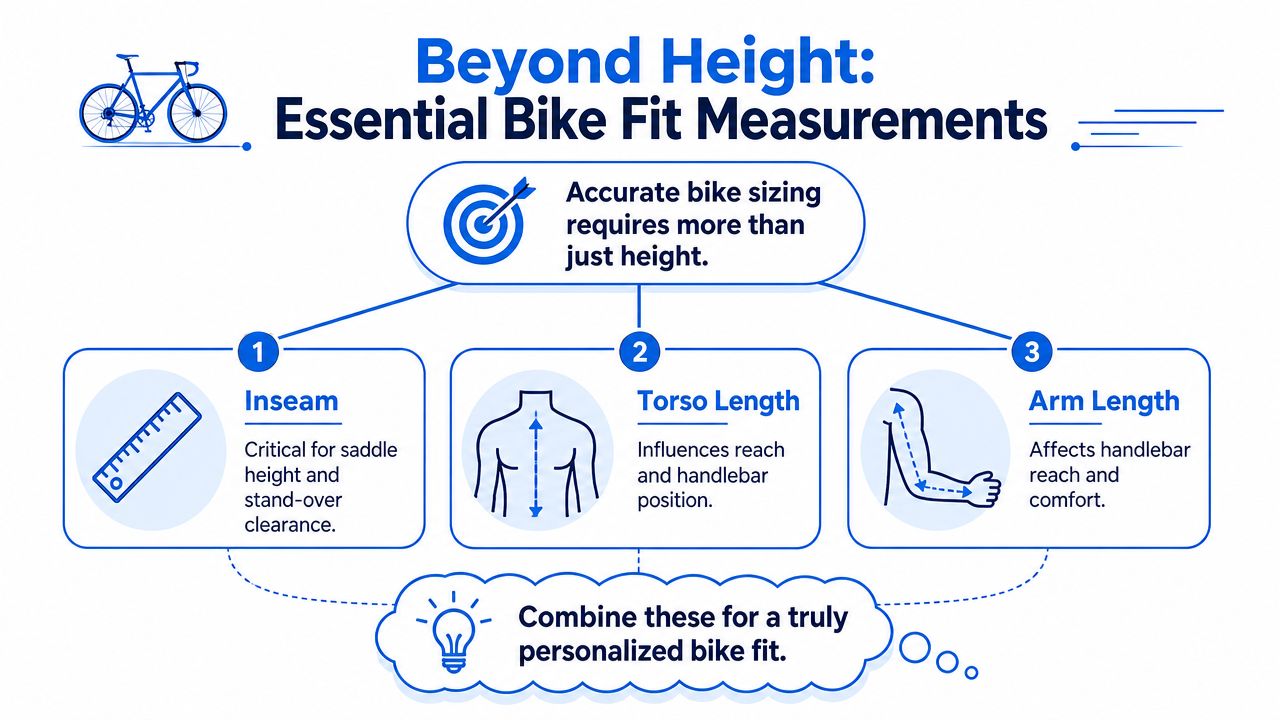
Height helps. It gets you into the general range. It does not tell you where to stop.
Why inseam matters more than most riders think
For an entry-level estimate, inseam is usually the most useful measurement after height. It helps you judge likely frame-height range, standover manageability, and saddle-height context. Many calculators use inseam-based formulas as a rough starting estimate, often multiplying inseam by a coefficient for road, gravel, or mountain bikes. That can be useful for narrowing the search, but it should not be treated as the final buying answer.
A commonly cited example is the method outlined by Origine Cycles’ bike sizing method, which uses inseam multiplied by 0.66 for road and gravel bikes and 0.59 for mountain bikes. That kind of formula can point you toward a reasonable starting range. It cannot tell you whether one brand’s 54cm endurance bike is a stronger match than another brand’s 54cm race bike.
When inseam is not available, some calculators estimate it from height. That is still weaker than using a real cycling inseam measurement, especially for riders whose leg length and torso length do not match the average.
Why stack and reach are the real comparison tools
Once you move from “What size am I?” to “Which bike should I buy?”, stack and reach matter more than the seat tube label.
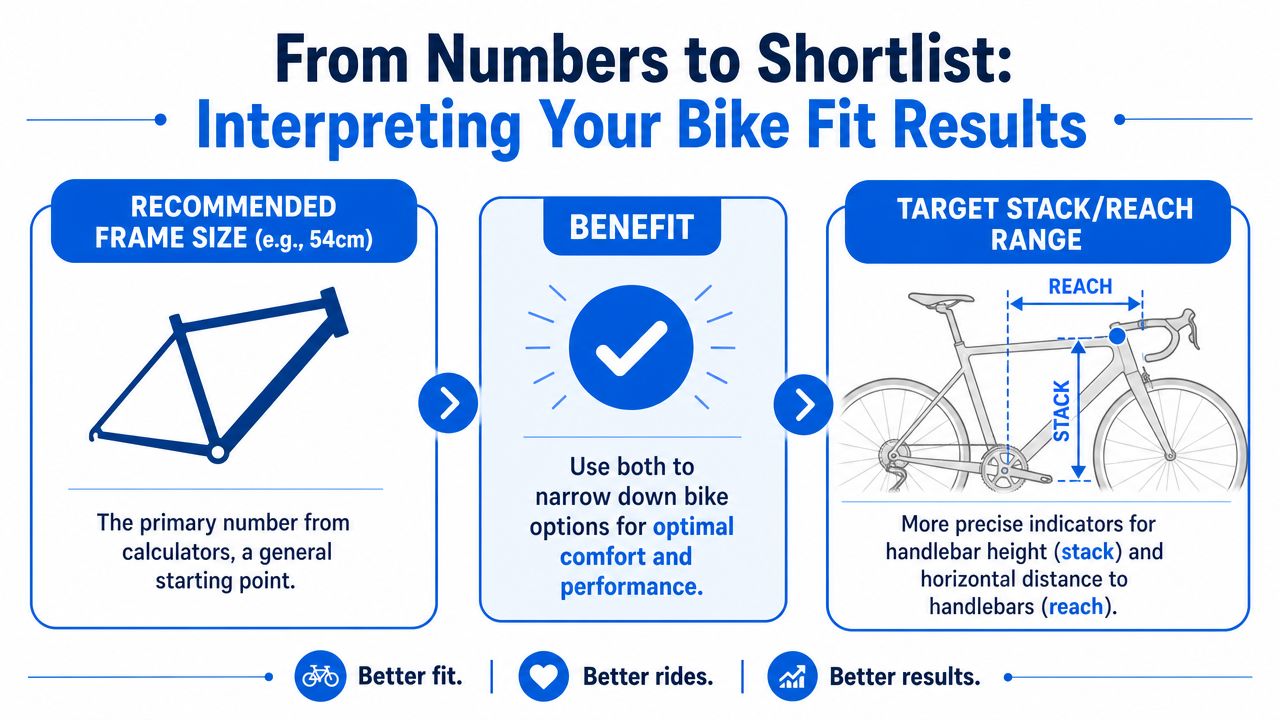
As defined by Canyon’s road bike geometry guide, stack is the vertical distance from the bottom bracket center to the top of the head tube, and reach is the horizontal distance from the bottom bracket center to the top of the head tube. Together, they give you consistent X/Y coordinates that are more useful than size labels alone when comparing bikes across brands.
That consistency is why stack and reach are central to any fit-aware comparison. Stack influences bar height and front-end posture. Reach influences how stretched or compact the bike feels. SYCLR’s stack and reach guide explains why these two numbers are often the clearest way to compare road, endurance, and gravel frames.
| Measurement | What it tells you | Why it matters |
|---|---|---|
| Height | Your total body height | Helps narrow the broad frame-size range |
| Inseam | Inner leg length from floor to crotch | Improves frame-height estimate, standover assessment, and saddle-height context |
| Torso length | Upper body length | Helps explain why riders of the same height may prefer different cockpit lengths |
| Arm length | Reach from shoulder to hand | Affects bar comfort and cockpit suitability |
| Frame size | Nominal size label such as 54cm or Medium | Useful for filtering, but not enough on its own |
| Stack | Vertical coordinate of the frame front end | Shows how tall or low the front of the bike is |
| Reach | Horizontal coordinate of the frame front end | Shows how long or short the bike feels in front |
| Standover | Top tube clearance when straddling the bike | Confirms confidence and manageability at a stop |
| Geometry | The bike’s overall frame shape and dimensions | Determines posture, handling, and how same-size bikes can fit differently |
Why standover still matters
Standover height is not the best number for comparing riding position, but it is still an important screening check. It tells you whether the bike feels manageable when you stop and stand over it.
According to SYCLR’s bike standover height guide, many road and gravel riders look for about 1 to 2 inches of clearance as a practical starting point. That is not a universal rule, but it is a useful confidence check, especially if you stop frequently or ride rougher surfaces.
A bike can have acceptable standover and still be too long or too low in front. That is why standover should be treated as a filter, while stack and reach do the heavier fit work.
If you are early in the process, start with your height, bike type, and budget in SYCLR to narrow the field before comparing specific road and gravel listings.
How to Take Your Key Measurements Accurately
Bad inputs create bad recommendations. A bike size calculator can only work with the measurements you give it, so it is worth taking a few extra minutes and doing them properly.

Height and cycling inseam
Start with bare feet, a wall, a tape measure, and a hardcover book.
-
Measure height against a wall. Stand upright with heels flat, back lightly against the wall, and eyes level. Place the book flat on your head, mark the wall, then measure from floor to mark.
-
Measure cycling inseam with pressure, not guesswork. Stand with your back to the wall and feet a natural distance apart. Pull the book firmly up into the crotch to simulate saddle pressure, then measure from the floor to the top edge of the book.
-
Repeat each measurement. If the numbers do not match closely, take a third reading and use the most consistent result.
A lot of riders measure inseam too loosely. That creates a larger number than they use when riding, and that can push them toward a larger frame than they need.
According to Bergfreunde’s bike frame size calculator guide, calculators rely heavily on inseam because height alone can create fit errors when riders have different body proportions. That aligns with the broader point here: use height to narrow the range, then add inseam and geometry before making a buying decision.
Do not measure for the chart you want. Measure for the bike you can actually ride comfortably.
A simple measurement checklist before you shop
Before you start comparing listings, use this quick checklist:
-
Measure height barefoot against a wall.
-
Measure cycling inseam with a book pressed firmly upward like a saddle.
-
Repeat measurements two or three times.
-
Record comfort notes from any bike that already feels good.
-
Use height and inseam to narrow the size range.
-
Use stack and reach to compare actual bikes.
If you want a broader framework for turning body measurements into buying decisions, SYCLR’s bike fit guide is a strong next step.
How Bike Size Calculators Work, and Where They Stop
Most bike size calculators do one of two things. They either apply simple sizing logic to one or two body measurements, or they use a broader fit model that includes more rider-specific context.
The rough math many calculators use
The basic version is straightforward. Enter height, sometimes inseam, select road, gravel, or mountain, and get a frame-size range such as 52cm, 54cm, or Medium. That is useful for excluding obviously wrong sizes and for giving beginners a practical starting point.
Some tools estimate inseam when the rider does not know it. Others use known inseam-based formulas like the coefficients mentioned earlier. These methods are common because they are fast and easy to apply.
The key point is not that the math is wrong. It is that the math is incomplete.
The gap between size range and buying decision
There is a meaningful difference between a bike size calculator and a more complete fit-aware comparison process. As explained in The Pro’s Closet’s comparison of bike fit calculators, more advanced tools consider variables such as torso length, arm length, flexibility, and riding style, not just a nominal frame size.
That distinction matters when you compare an endurance road bike to a race bike, or a stable gravel bike to a more road-like gravel frame. A simple calculator may point you toward the same labeled size for both. Your body and riding goals may not prefer both.
Here is the practical breakdown:
-
Basic size calculators narrow the size range.
-
Fit-aware tools add body proportions, posture goals, and bike-category context.
-
Geometry comparison tells you whether a specific listing is worth your time.
A size result answers “Where should I start looking?” It does not answer “Which of these bikes is the stronger match for me?”
That is also why changing parts can only solve so much. A stem, spacer stack, and saddle position can refine a bike that is already close. They cannot reliably turn the wrong frame shape into the right one.
If you already know your current bike’s geometry or have fit numbers from a fitter, use your fit details to improve your recommendations in SYCLR.
From Numbers to Shortlist: How to Read Your Results
A good calculator result should change how you shop. It should not become a single number you defend no matter what the listing says.
How to interpret a calculator result correctly
If your calculator points you toward a 54cm road bike, treat that as a range marker. It tells you where to start checking, not what to buy blindly.
A practical example looks like this. A rider around 5’9″ may get pushed toward a 56cm by a basic chart. But if that rider wants a more comfortable endurance road position, a 54cm or Medium endurance frame with a manageable reach and taller front end may be the stronger match than a long, low 56cm race bike.
That is not a contradiction. It is exactly why geometry matters more than the label.
If you need broader chart context before comparing models, SYCLR’s road bike size chart, gravel bike frame size chart, and road bike sizing explainer can help you narrow the range first.
What to compare in real listings
Once you have a likely size band, compare actual listings with a tighter checklist:
| What to compare | Why it matters |
|---|---|
| Nominal frame size | Tells you whether the bike is even worth opening |
| Model year | Geometry can change meaningfully between years |
| Stack | Higher stack often supports a taller front-end position |
| Reach | Longer reach often creates a more stretched posture |
| Standover | Helps confirm confidence when standing over the bike |
| Bike category | Endurance road, race road, and gravel bikes often fit differently even in the same labeled size |
| Listing quality | Clear photos, complete model info, and geometry details reduce guesswork |
| Price context | A cheaper bike is not better if the fit signals are wrong |
Use stack and reach to separate bikes that merely match your size from bikes that are more likely to be a better fit. This matters a lot with used inventory, where descriptions are often vague and sellers rely on old sizing assumptions.
Small stem changes can refine a bike that is already close, but large cockpit changes are often a warning sign that the frame itself may not be the right starting point.
Buyer check: If a bike only works in your mind after a dramatic cockpit fix, it probably is not the right starting frame.
The Used Bike Sizing Trap, and How to Avoid It
Used bike shopping punishes vague thinking. A seller writes “56cm, should fit 5’8 to 6’0,” adds three photos, and expects the size label to do all the work. That is exactly how buyers end up with bikes that are technically rideable and practically wrong.
Why used listings create sizing mistakes
The first trap is assuming the nominal size is enough. It is not, especially with older road and gravel bikes where geometry can vary sharply by brand, model, and year.
The second trap is trusting seller fit language. Most private sellers are not trying to mislead you. They are just describing the bike from their own experience, which may have little to do with your proportions or riding goals.
A bike can also be a good deal and still be a poor purchase. If the frame shape is wrong, better components or a lower price will not fix that.
A better way to vet a listing
Use a simple screening process before you message the seller:
-
Ask for the exact model year. Geometry often changes from one generation to the next.
-
Request the full model name. “Trek Domane” is not enough if several versions exist.
-
Look up the original geometry chart. Compare stack and reach against what suits you now.
-
Check cockpit changes. An unusually long or short stem can suggest the previous owner was compensating for fit.
-
Review listing quality. Clear details usually signal a more reliable buying process.
If you are buying online and want a broader framework for filtering listings, SYCLR’s guide to buying a road bike online is worth reading alongside your size research.
Used shopping rewards riders who compare evidence, not labels. A vague Medium with no geometry is often a riskier choice than a slightly pricier listing with complete information.
How SYCLR Helps You Compare Listings by Fit
Most bike size calculators stop after giving you a size suggestion. That is where the real shopping work starts.

SYCLR is not best understood as a simple calculator that guarantees an exact size. It is better understood as a fit-aware bike size calculator and comparison tool for road and gravel riders.
You can start with height, bike type, and budget, then improve the shopping decision with fit signals such as inseam, stack, reach, geometry context, listing quality, price context, and rider goals. That matters because two bikes with the same size label can still point you toward very different riding positions and very different levels of buying confidence.
One listing may have clearer geometry data, better source quality, and a stronger fit signal. Another may look cheaper or flashier but carry more uncertainty. SYCLR helps you compare those differences, not just sort by a frame-size label.
If you already know stack, reach, or current-bike fit details, SYCLR lets you use those inputs to improve how you compare bikes. If you do not, it still helps you reduce guesswork and shortlist better-fit bikes.
For riders actively shopping, compare road and gravel bike listings with SYCLR. If you already know your geometry targets, use your fit details to improve your recommendations.
Frequently Asked Questions About Bike Sizing
Is height enough to choose a bike size?
No. Height is a useful starting point, but it is not precise enough on its own. Inseam improves the recommendation, and stack and reach are better tools when comparing actual bikes.
What does a bike size calculator actually tell me?
It usually tells you a likely frame-size range based on measurements such as height and inseam. That helps narrow the field, but it does not confirm that every bike in that labeled size will fit the same.
If I am between two bike sizes, should I size up or down?
It depends on the bike’s geometry and the position you want. Riders seeking a more manageable or upright setup often prefer the option with more suitable stack and reach, which may be the smaller labeled size on some models.
What are stack and reach?
Stack is the vertical distance from the bottom bracket center to the top of the head tube. Reach is the horizontal distance from the bottom bracket center to the top of the head tube. Together, they are the most consistent geometry numbers for comparing fit across brands.
Can I fix the wrong frame with a different stem?
Only within limits. Small changes can help refine a bike that is already close, but large cockpit changes are often a warning sign that the frame may not suit you well in the first place.
Is a professional bike fit still useful?
Yes. A professional bike fit can be very valuable, especially for riders with known comfort issues, clear performance goals, or detailed position needs. Shopping tools help you apply fit information while comparing bikes, but they do not replace a qualified fitter.
Does the same 56cm size mean the same fit across brands?
No. Two 56cm bikes can have different stack, reach, posture, and intended use. That is why geometry-aware comparison is more reliable than size labels alone.
A bike size calculator is most useful when it helps you narrow the range, not when it pretends to give a final answer. SYCLR helps road and gravel riders start with height and inseam, then compare real bikes using geometry, fit signals, listing quality, and price context. You can start with your height, bike type, and budget, or, if you already know your measurements, use your fit details to improve your recommendations. For more practical sizing and buying guidance, browse the SYCLR blog and shortlist better-fit bikes before you buy.