
Bike Crank Length and Fit: How to Choose the Right Cranks
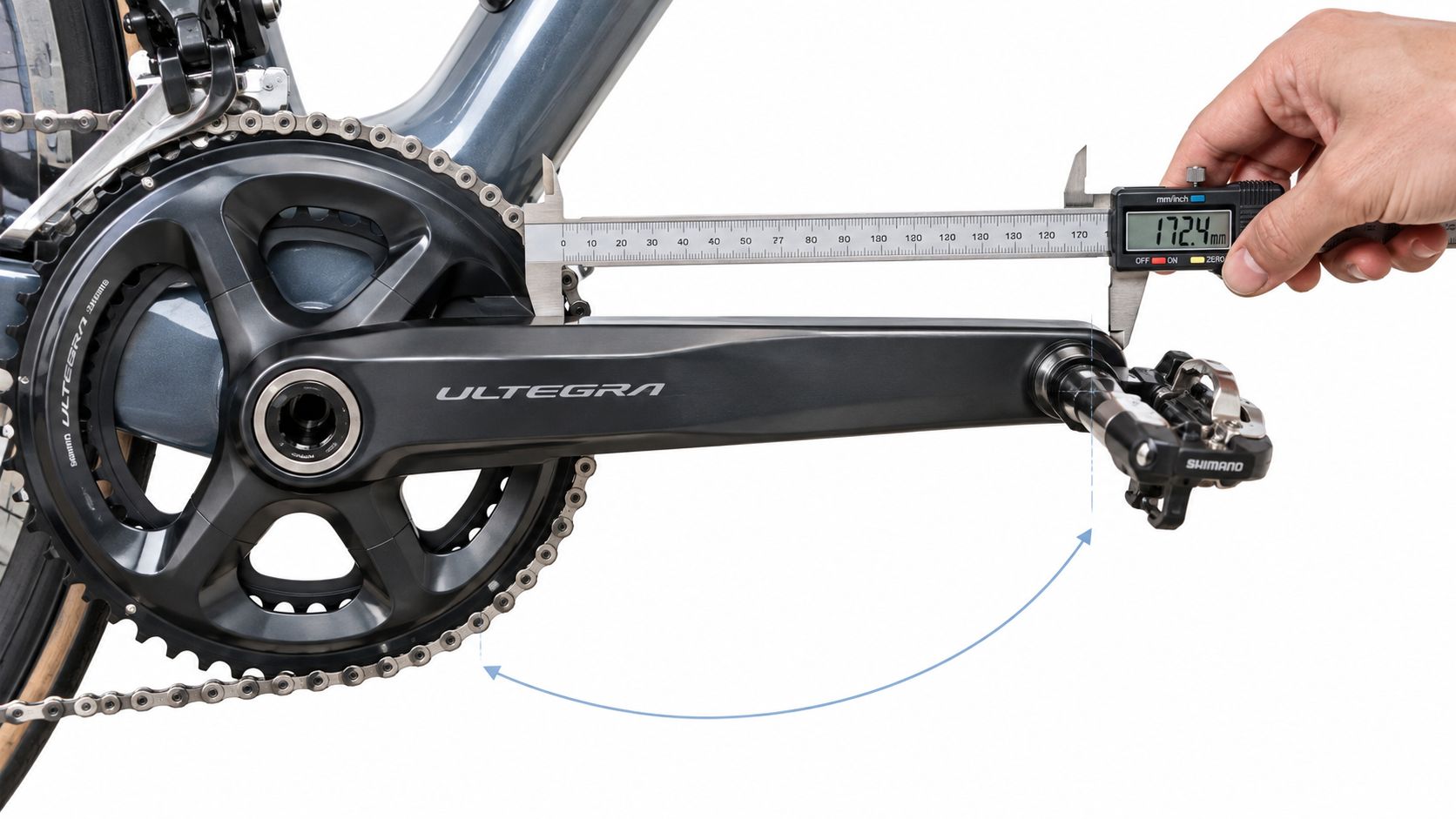
Most riders treat crank length as a fixed part of a bike, like the color or bottle-cage mounts. That misses what the part actually changes. Crank length is a component and fit variable that changes pedal-circle radius and can affect measured joint kinematics, saddle-position context, and pedal-clearance context. There is no universal evidence-based prescription here, so crank length should be evaluated as part of the overall setup rather than converted from a single body formula. This matters even more when you're comparing used bikes, where the crank fitted to the listing may differ from your current or known-good setup.
Table of Contents
- Why Bike Crank Length Belongs on Your Fit Checklist
- What Crank Length Is and How to Measure It
- How Crank Length Changes the Pedal Circle and Riding Position Context
- Why Standard Crank Sizes Exist, and Why They Are Not Prescriptions
- Shorter Versus Longer Cranks, Neutral Mechanical Effects
- How to Test and Fine-Tune Crank Length on Your Bike
- How SYCLR Helps You Compare Crank-Relevant Listings
- Crank Length Questions Riders Ask Most
Why Bike Crank Length Belongs on Your Fit Checklist
A bike can have the right frame size label and still arrive with a crank length that is different from what you expect or currently use. Buyers usually focus on frame size, saddle height, stack, and reach. They rarely ask what crank length is installed, even though the crank sets the radius of the pedal circle and changes where the pedals sit at the top and bottom of the stroke.
Crank length is not just a spec-sheet detail. It is primarily a component and setup variable. Longer and shorter cranks change the pedal-circle radius, which can change measured hip and knee flexion and can affect how the existing saddle position relates to the rest of the bike. It also affects static pedal clearance.
Practical rule: Don't reject a bike solely because its crank length is not your preferred starting point, but don't treat the crank as irrelevant either.
The buyer's problem is that listings often omit crank length, and manufacturer specifications may vary by frame size or model year. A used bike may also have replacement cranks, a different crankset fitted by a previous owner, or components that differ from the original build. That uncertainty belongs in your assessment alongside condition, model-year context, and price.
For a broad foundation, use the SYCLR bike fit guide to consider crank information alongside frame geometry and riding position. Height alone does not determine crank length. Current-bike measurements, present setup, and intended use give more relevant context than a single body formula.
The useful question is not “What crank length should everyone use?” It is “What crank length is installed here, what does it change mechanically, and what would it take to keep the rest of the setup coherent?”
What Crank Length Is and How to Measure It
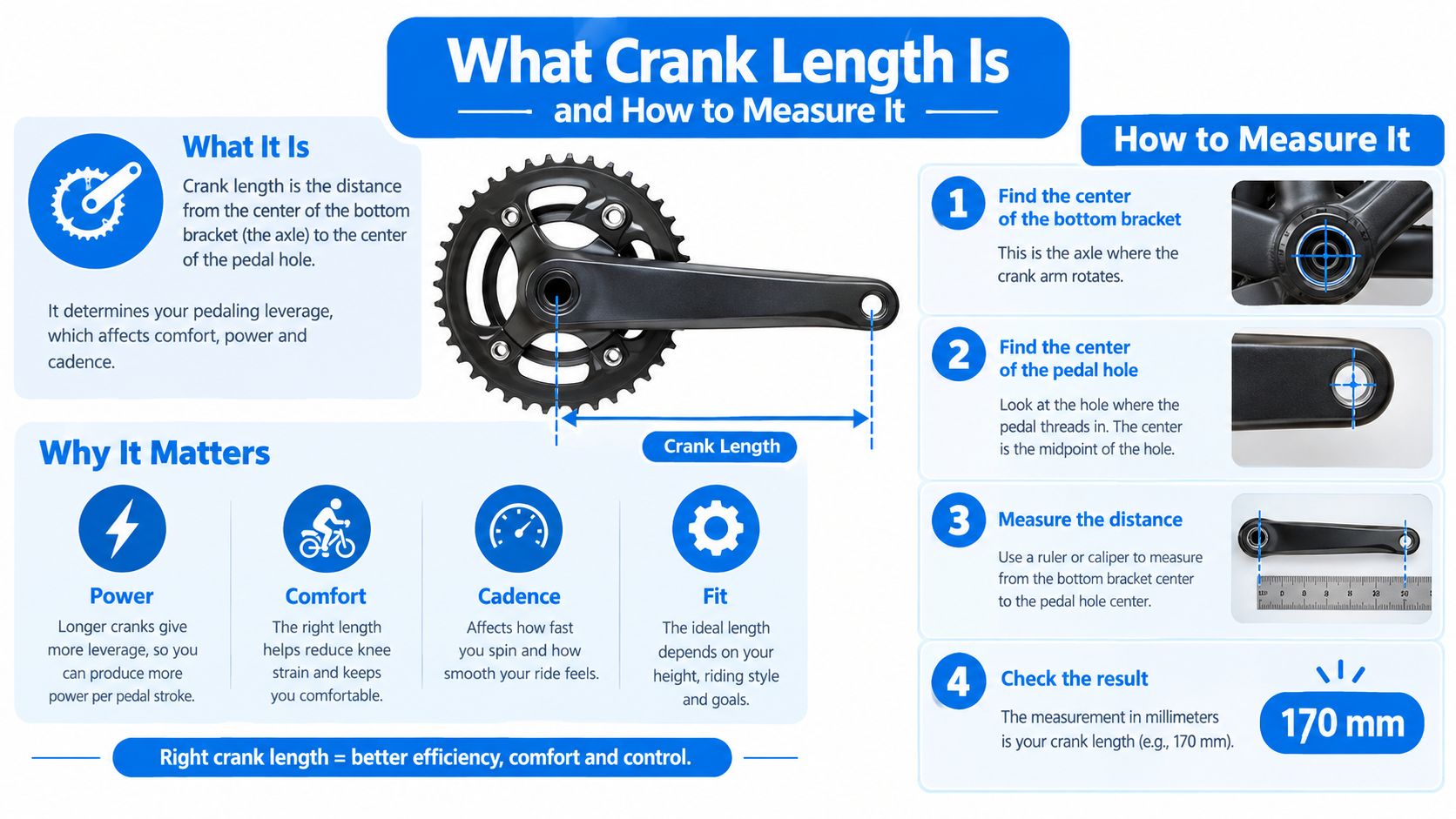
Crank length is the distance from the center of the bottom-bracket axle to the center of the pedal spindle. It is not the total length of the crank arm, and it is not the distance from the bottom bracket to the end of the arm.
Adult road and gravel cranks are sold in multiple production sizes. Listings commonly show numbers such as 170 mm, 172.5 mm, and 175 mm, and you may also see shorter or longer options on modified bikes, custom builds, or specific component lines. Those figures are product specifications, not fit targets by themselves.
How to check a bike in person
-
Find the crank marking. Look at the back or inside face of the crank arm. Manufacturers often stamp the length near the pedal thread or close to the spindle interface. A marking such as “170” indicates a 170 mm crank.
-
Measure the physical crank. Place the end of a tape measure at the center of the bottom-bracket axle. Measure to the center of the pedal spindle, not to the outer edge of the pedal body.
-
Keep the crank aligned. Rotate the crank until the bottom-bracket axle, crank bolt center, and pedal spindle form a straight line. This reduces the chance of measuring a diagonal that is longer than the actual crank.
-
Check both sides if the bike is unusual. A normal crankset should use matching crank lengths, but replacement parts and mixed components can create exceptions.
How to read a listing
A complete bike listing may bury crank information under “drivetrain,” “components,” or the original manufacturer specification. Search for the crankset model and inspect photographs for markings. If the seller has not supplied a clear image, ask for one before treating the specification as confirmed.
The rider's inseam can still be a body measurement you know, but it does not prescribe crank length by itself. If you're measuring your body, follow a reliable bike inseam measurement guide and use that information as general fit context rather than as a direct crank-length formula.
How Crank Length Changes the Pedal Circle and Riding Position Context
Think of the crank as the radius of a circle. A longer crank moves the pedal through a larger circle. A shorter crank moves it through a smaller circle. That simple geometric change alters where the pedal sits at the top and bottom of the stroke.
This is why crank length is best understood as a pedal-circle and setup variable. Changing the crank changes pedal position relative to the bottom bracket, which changes the context for the existing saddle position and changes static pedal clearance. It can also change measured lower-body kinematics, including hip and knee flexion, because the foot follows a different path.
Crank length should not be treated as a universal power shortcut. If gearing is adjusted appropriately, changing the crank does not automatically create more power or better performance. It changes the mechanical path of the pedal and can change how the rest of the setup should be assessed.
What controlled evidence shows
A 2025 controlled study of 14 amateur cyclists examined each rider's preferred crank length along with ±5 mm and ±10 mm conditions. Mean power in the submaximal protocol was unchanged while lower-body kinematics changed. The detailed results are available in the 2025 crank-length study.
That study is useful because it shows that commercially available crank-length changes can alter measured movement without automatically changing mean power in the tested submaximal condition. It should not be treated as a universal comfort, injury-prevention, or performance rule.
A separate crossover study involving 28 trained male cyclists compared 165 mm, 170 mm, and 175 mm cranks and reported minimal effects on performance and efficiency. Another study involving 14 riders found that changing crank length around each rider's preference altered lower-body joint angles and exercise tolerance more than mean power output. These findings are summarized in the BikeRadar crankset buying guide.
The buying implication: If a listing has suitable frame geometry but the crank length differs from your current or known-good setup, the bike may still be worth evaluating. But the total cost and setup work may change once crank replacement, compatibility, and re-setup are considered.
Why Standard Crank Sizes Exist, and Why They Are Not Prescriptions
Production bikes and aftermarket cranksets are sold in standard sizes because manufacturers need repeatable specifications, manageable inventory, and predictable complete-bike builds. That is useful for sourcing and replacement, but it does not turn any one size into a universal fit answer.
A 2024 systematic review found no evidence-based universal crank-length recommendation. It supports an individualized approach rather than a single leg-length formula, as discussed in this review-based crank-length guide.
Common production sizes are specifications, not targets
When a spec sheet lists a crank length, treat it as a factual component detail. It tells you what is installed now. It does not tell you, by itself, whether the length is ideal, whether the bike was modified, or whether a change elsewhere in the setup would be needed after a swap.
For SYCLR shoppers, the advertised crank should be treated as part of the buying decision, not a minor specification. Check whether it matches your current setup, whether the listing appears original or modified, and whether a replacement would create compatibility or cost uncertainty. A discounted bike can lose its appeal if changing the crank also requires other parts, compatibility work, or additional setup.
Shorter Versus Longer Cranks, Neutral Mechanical Effects
Shorter and longer cranks can both work. The important difference is mechanical.
A shorter crank creates a smaller pedal circle. A longer crank creates a larger pedal circle. Because of that, crank length changes where the pedals sit at the top and bottom of the stroke.
Crank length also changes static pedal clearance. On the same bike, a shorter crank increases static pedal clearance relative to a longer crank.
None of those statements prescribe a correct crank length for a given rider, body measurement, riding category, or terrain type. They simply describe what changes mechanically.
What changes beyond the crank arm
A crank swap is not only about the crank arm itself. Changing crank length changes pedal position at the top and bottom of the stroke, so saddle height should be reassessed rather than assumed unchanged. Cleat position, shoe choice, pedal stack, and the rest of the existing setup may also influence how the change feels in practice.
Cadence also deserves a careful explanation. A different crank length changes the pedal path, but gearing still controls resistance. That is why it is better to treat crank length as a setup variable than as a standalone power solution.
Q-factor is related but separate. Crank length describes the front-to-back radius of the pedal path. Q-factor describes the lateral distance between the pedal positions. A crankset can have one dimension changed without necessarily changing the other.
How to Test and Fine-Tune Crank Length on Your Bike
Start with evidence from your own bike, not a formula. Record the installed crank length and document the current setup before making changes.
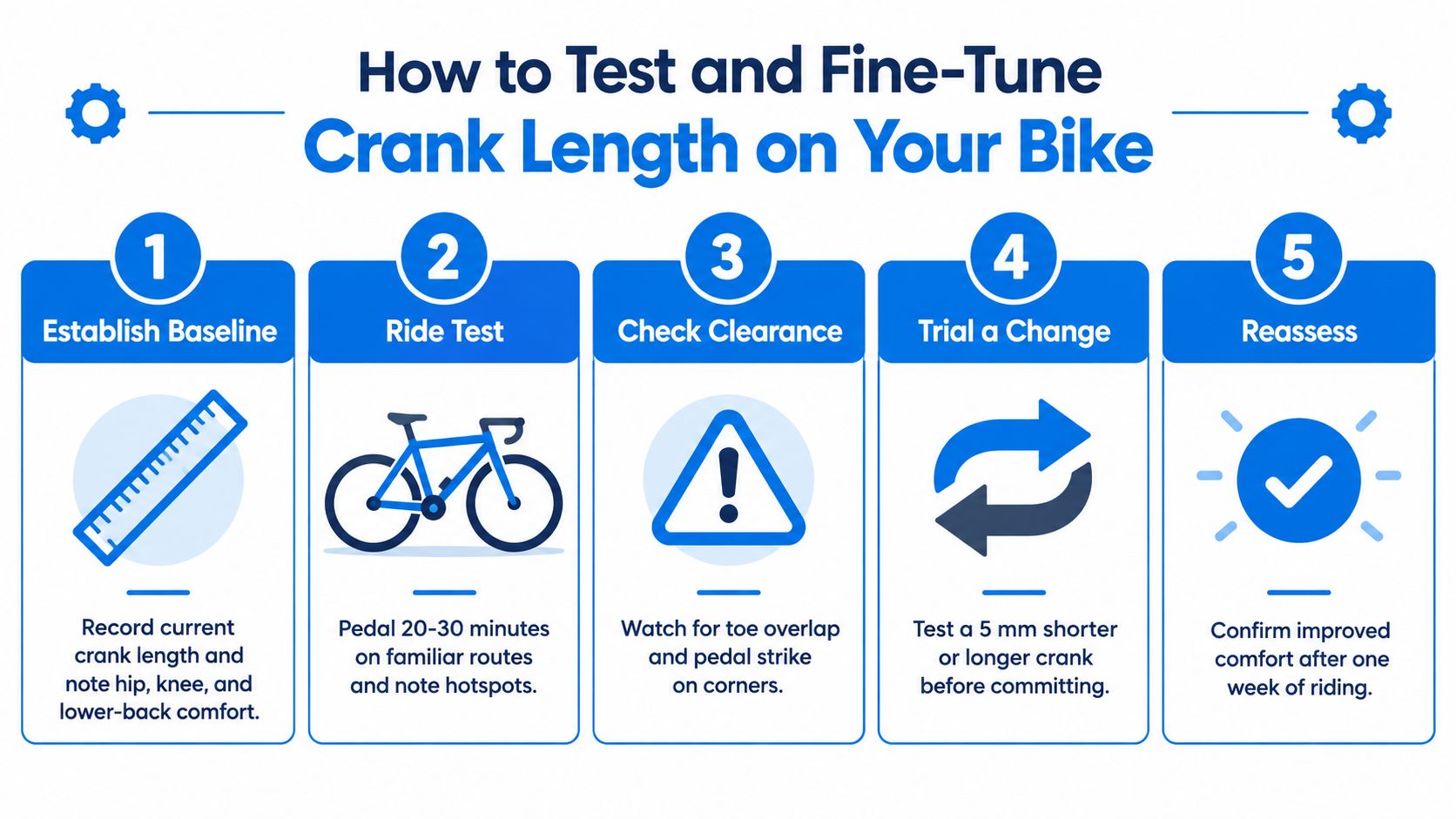
A controlled test process
-
Establish a baseline. Record crank length, saddle height, saddle setback, cleat position, and other setup details you may want to compare later.
-
Change deliberately. Avoid changing multiple major variables at once if your goal is to understand what the crank change actually did.
-
Reassess saddle position. Changing crank length changes pedal position at the top and bottom of the stroke, so saddle height should be reassessed rather than assumed unchanged.
-
Keep other variables documented. Shoe choice, cleat location, pedals, and tire setup can all affect the comparison.
-
Use familiar riding conditions. Use familiar riding conditions when comparing before-and-after setup changes.
-
Check clearance and compatibility. Inspect pedal clearance and toe overlap, and confirm that the crank, chainrings, spindle, and bottom-bracket interface remain compatible.
-
Reassess after repeated rides. One short ride may reveal an obvious issue, but it is not always enough to understand the full effect of the change.
Toe overlap is multifactorial. It can be influenced by crank length, shoe and cleat position, wheel and tire dimensions, front-center and fork geometry, fenders, and steering angle.
The studies available here involve controlled conditions and relatively small rider groups. Use them as reference points, not as a substitute for observing what changes on your own bike.
A short visual guide can help you remember the sequence. The following video is best treated as supplementary education, not as a personal fit assessment.
How SYCLR Helps You Compare Crank-Relevant Listings
Crank length is one component detail among several. A buyer still needs to compare frame size, stack, reach, standover, tire clearance, saddle position, model year, component condition, price context, and the confidence available in the listing itself.
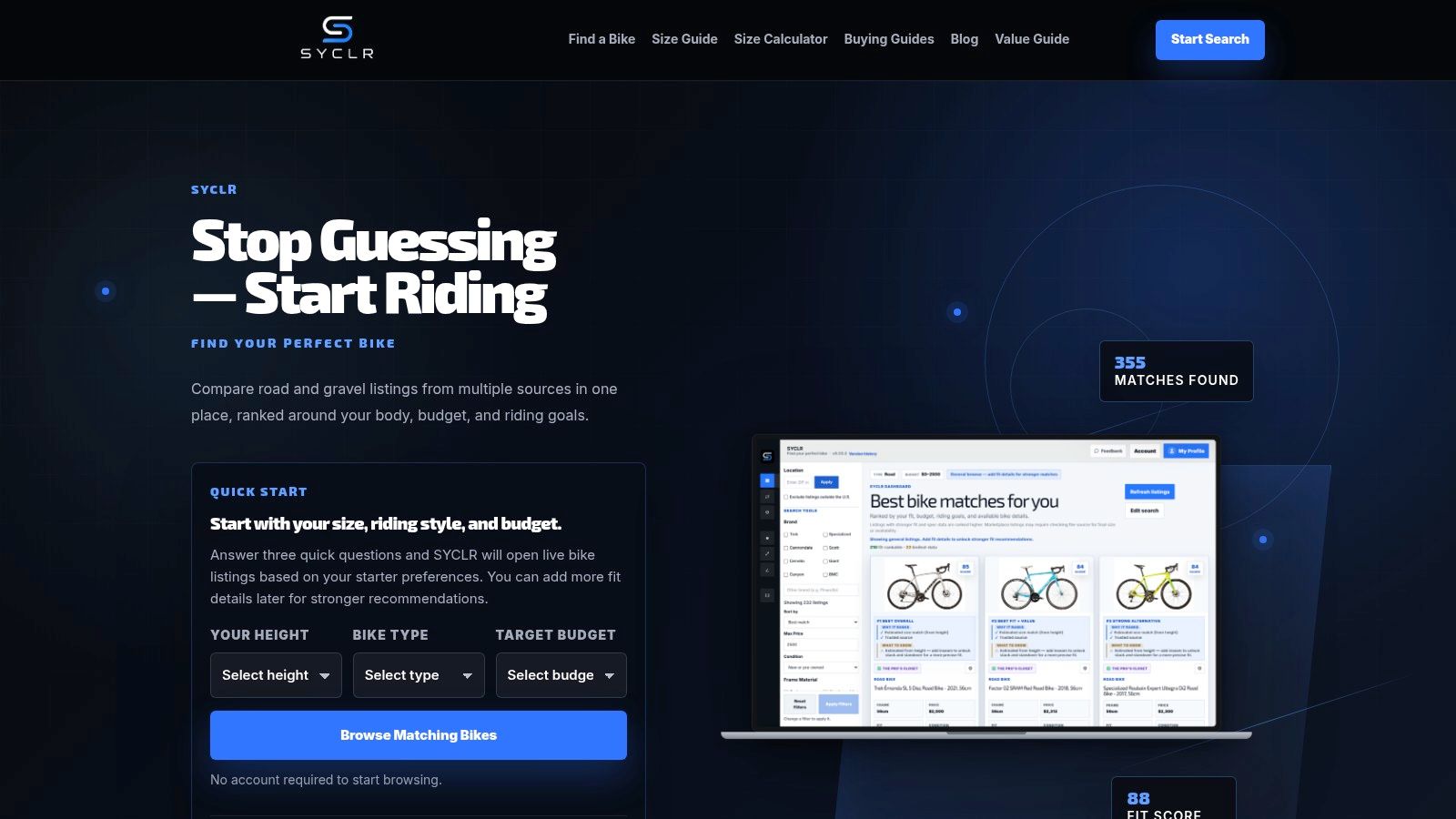
SYCLR compares road and gravel listings using fit signals, geometry signals, model-year context, price context, listing quality, condition signals where available, and confidence signals. The quick path starts with height, bike type, and budget, which is useful when you're early in the search. It does not make height sufficient for precise fit, and it does not turn crank length into an automatically resolved variable.
Riders who already know stack, reach, current-bike geometry, or fit-report details can use the advanced fit-details entry. That information can help place crank information in a broader shortlist, especially when you are comparing bikes that may already differ in cockpit setup, frame geometry, or component mix.
SYCLR does not perform a professional bike fit, physically inspect bikes, authenticate listings, verify ownership or seller claims, or guarantee fit or condition.
Treat a crank mismatch as uncertainty, not an automatic rejection
Cranks can often be replaced, but replacement depends on the bottom-bracket and axle standard, crank-arm interface, spindle system, chainring mounting standard, chainline requirements, drivetrain configuration, and part availability. Labor, tools, and the condition of the existing parts also affect the real cost of the change.
That means a crank mismatch belongs in the same conversation as incomplete photos, unclear model year, missing serial details, or vague component descriptions. A listing with a crank length that differs from your current or known-good setup, but has strong geometry and transparent specifications, may still be worth investigating. A listing with uncertain crank details, unclear condition, and incomplete measurements deserves more caution.
For a wider workflow around comparing seller information, use the guide to comparing used bike listings. The practical goal is to shortlist bikes whose overall signals make sense, then evaluate crank information in that wider context before spending time negotiating or arranging an inspection.
Crank Length Questions Riders Ask Most
Does crank length change my gearing?
It does not change the cassette or chainrings. It changes the pedal-circle radius and the path your foot follows. If a different crank length changes how the bike feels, gearing choice is still a separate issue.
Can I fix a used-bike fit problem by swapping cranks?
Sometimes, but crank length alone will not correct a frame-size or cockpit mismatch, and compatibility still matters. Check the bottom-bracket standard, axle interface, spindle system, chainring mounting pattern, drivetrain speed, front-derailleur setup where relevant, and available replacement parts. Include labor and setup time in the real cost of the listing rather than treating the advertised price as the finished-bike cost.
Are shorter cranks better for gravel?
Gravel use alone does not establish required crank length. Crank length remains a component and setup variable that should be evaluated in the context of the complete bike and the current setup.
How does crank length relate to Q-factor?
They describe different dimensions. Crank length changes the front-to-back pedal circle. Q-factor changes the lateral stance between the feet. Changing one does not automatically solve or explain the other.
Should crank length match my inseam?
Inseam alone should not be converted into a prescribed crank length. There is no universal inseam-to-crank formula supported here.
What should I ask about crank length in a bike listing?
Ask for the crank length marking or a clear photograph of the crank arm. If the bike has been modified, ask whether the crankset is original, whether the bottom bracket was replaced, and whether the seller knows the current setup history.
Start your search with SYCLR, entering your height, bike type, and budget, then compare fit and geometry signals alongside model-year, price, condition, and listing confidence. If you know your stack, reach, current-bike geometry, or fit-report details, use the advanced fit path so crank information becomes part of a more informed shortlist.
Use SYCLR to compare road and gravel listings with crank information considered alongside the frame and the rest of the setup picture. Start with your basic rider details, or enter advanced fit information when you have it, and build a better shortlist with less guesswork.