
Bottom Bracket Drop Explained: A Practical Guide for Riders
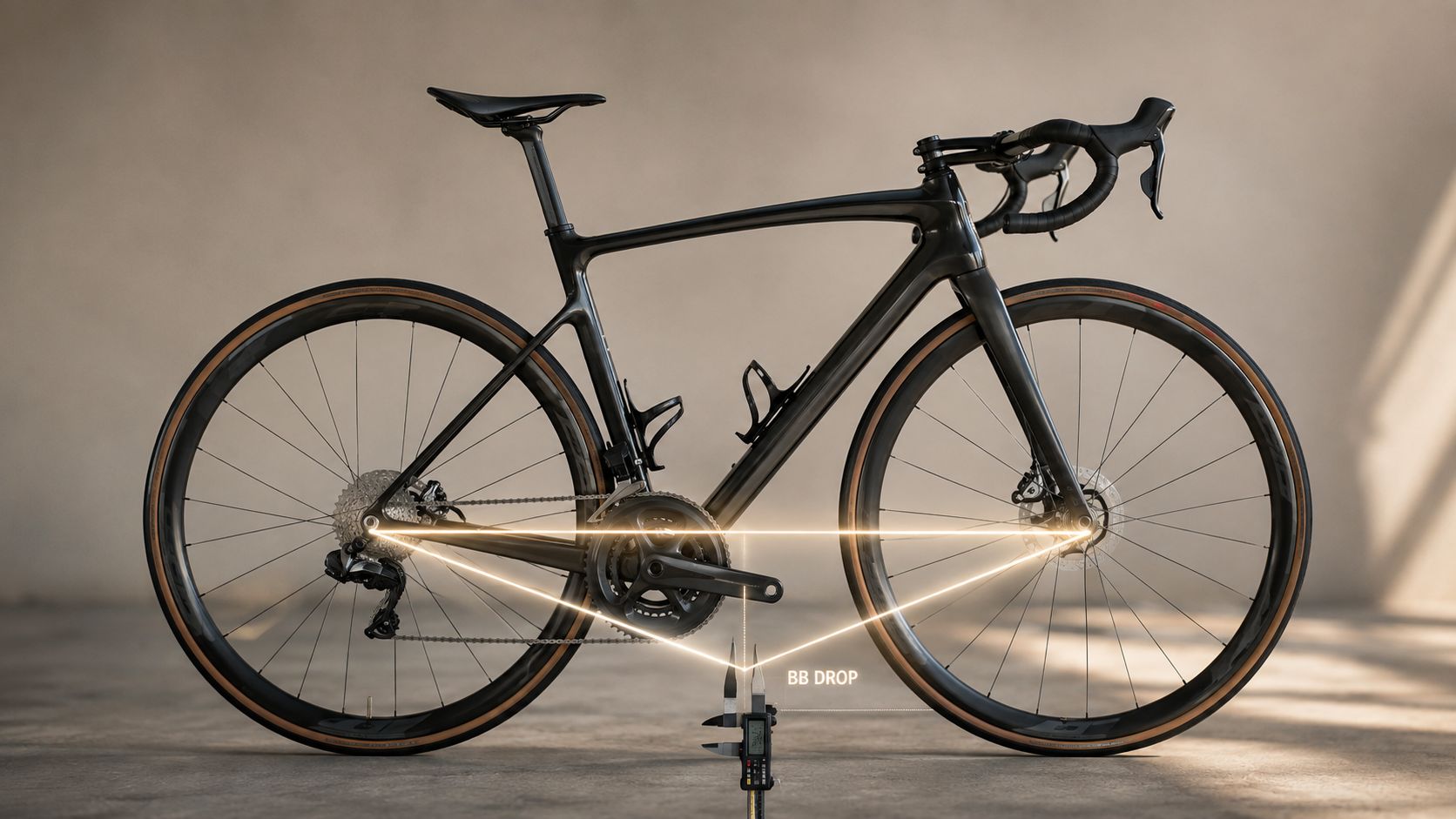
Bottom bracket drop is the vertical distance from the line through the wheel axle centers to the center of the bottom bracket. As broad reference context only, road bikes often appear around 65-75 mm of drop, gravel bikes often appear around 65-85 mm, and cyclocross bikes often appear around 50-65 mm. Those ranges are not standards or rider targets, and categories often overlap.
Why can two bikes with similar-looking geometry charts still differ in actual ride height and pedal clearance? Bottom bracket drop is one of the quieter frame-geometry variables. It contributes to ride height and clearance context, and it interacts with wheel and tire dimensions, crank length, overall frame geometry, and rider position.
For a buyer, the key point is simple: bottom bracket drop is not a scorecard. A single number does not tell you how a bike will feel on its own. It is most useful when you read it beside the complete bike setup and the kind of riding the bike is built for.
Table of Contents
- What Bottom Bracket Drop Actually Is
- How Bottom Bracket Drop Is Measured
- Why Drop Affects Bike Context
- Broad Reference Ranges for Road, Gravel, and Cyclocross
- How Drop Interacts With Other Geometry Numbers
- Reading Drop When You Compare Listings
- How SYCLR Helps You Compare Drop and Fit
- Bottom Bracket Drop Questions Buyers Ask Most
What Bottom Bracket Drop Actually Is
Bottom bracket drop is the vertical distance from a straight line connecting the front and rear wheel axle centers down to the center of the bottom bracket shell. If a geometry chart lists 70 mm, the bottom bracket center sits 70 mm below that axle line. This definition is the same whether you are looking at a road frame, gravel frame, or cyclocross frame.
A useful historical reference for road bikes settled around 68-70 mm, because that range often appeared in established road designs, as explained in this history of bottom bracket drop. Modern geometry references commonly show road bikes around 65-74 mm, so a buyer-friendly working range of 65-75 mm is best treated as broad context rather than a rule (road bike geometry ranges).
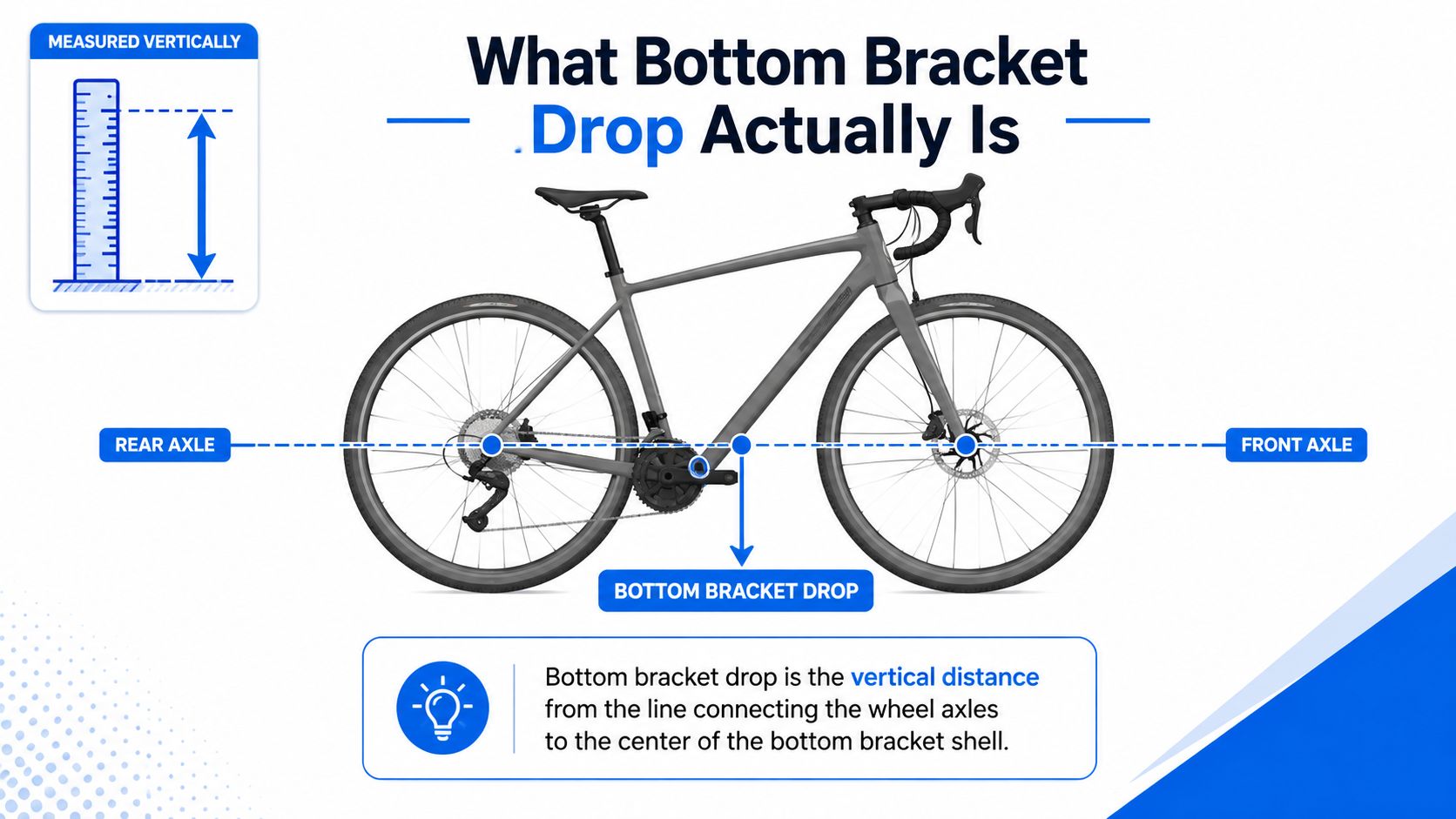
Drop is not bottom bracket height
Bottom bracket height measures from the ground to the bottom bracket center. Drop measures from the axle line down to the same center. They describe related positions, but they are not interchangeable.
For equal wheel diameters on level ground, a useful simplified relationship is:
BB height ≈ axle height – BB drop
That simplified relationship helps you compare charts, but the actual result depends on the bike as built. Actual mounted tire dimensions matter because they affect axle height and therefore the bike’s actual bottom bracket height above the ground. The listed drop itself does not change just because you install a different tire, but the assembled bike can sit differently in practice. Bike geometry guidance on bottom bracket drop highlights this difference, which is why buyers should not compare a drop number without checking the wheel and tire setup.
A representative comparison makes the distinction clearer. A road bike with 70 mm of drop and a gravel bike with 80 mm of drop may still end up closer than expected in actual bottom bracket height if their mounted outer diameters differ. The frame number is only one part of the picture.
How Bottom Bracket Drop Is Measured
To measure bottom bracket drop, start from a side view of the bike and identify the centers of the front and rear wheel axles. Draw a straight line through those two axle centers. Then measure vertically from that line down to the center of the bottom bracket. That distance is bottom bracket drop.
Identify the front and rear axle centers, establish the line through those two points, and measure vertically from that reference to the bottom bracket center. Manufacturers usually publish the figure from design data rather than from a tape measure on a complete bike, but the reference points are the same.
What often causes confusion is BB height. BB height is measured from the ground to the bottom bracket center, so it includes the wheel and tire setup on the assembled bike. Drop is measured from the axle line to the bottom bracket center, so it does not start at the ground. Because of that, changing to a different mounted tire can change actual BB height without changing the frame's published drop.
A simplified calculation example
Take a bike with an actual mounted outer radius of about 340 mm. If the bike's BB height is 270 mm, then the simplified relationship is:
340 mm minus 270 mm = about 70 mm
That gives the simplified calculation:
bottom bracket drop ≈ axle height − BB height
For this simplified example, axle height comes from the actual mounted wheel-and-tire radius.
This is why a geometry chart that lists only BB height needs wheel-and-tire context. If the chart lists bottom bracket drop directly, that value describes the frame's relationship to the axle line and can be compared independently from actual ground height.
| Measurement | Reference Point | Simplified Formula | Typical Reference Context |
|---|---|---|---|
| Bottom bracket drop | Wheel axle line to BB center | Axle height minus BB height | Often around 65-75 mm on road bikes in broad references (road geometry reference) |
| Bottom bracket height | Ground to BB center | Depends on actual mounted wheel and tire setup | Varies with wheels, tires, and frame |
| Effective pedal clearance | Ground to lowest pedal position | Depends on BB height, crank length, pedal shape, and bike attitude | Depends on complete setup |
Why published numbers can differ
Brands may round geometry figures or publish values for only one frame size at first glance. BB height can also vary depending on the mounted tire dimensions used for the published build. Load and tire deformation can affect the bike’s actual ride height in use, even when the frame’s published drop stays the same.
When you compare road or gravel listings, note the measurement type first, then confirm wheel format, mounted tire size, and frame size. That lets you treat drop as one geometry input instead of a standalone conclusion. Two bikes can share the same listed drop and still end up with different actual bottom bracket height and pedal-spindle clearance once the full setup is considered.
Why Drop Affects Bike Context
Bottom bracket drop matters because it helps describe where the bottom bracket sits relative to the axle line. That contributes to ride-height and clearance context, but it is not a complete handling summary.
Ride height context
A larger drop places the bottom bracket farther below the axle line. A smaller drop places it closer to the axle line. That changes the bottom bracket’s vertical relationship to the axle line, but it does not predict overall ride feel by itself.
To understand how a bike may actually sit and ride, you also need steering geometry, wheelbase, tire dimensions, crank length, stack, reach, and rider position. Bottom bracket drop contributes context, not a universal outcome.
Pedal clearance
Lowering the bottom bracket relative to the axle line can reduce static pedal-spindle clearance to the ground when other dimensions stay equal. Raising it relative to the axle line can increase that clearance. But actual pedal-strike risk depends on the complete setup and the riding situation, including crank length, pedal shape, lean angle, surface shape, tire size, suspension or tire deflection, and rider timing.
Practical rule: Check actual clearance on the complete bike, not just the frame's drop number.
Handling is never one number
It is tempting to treat bottom bracket drop as a simple handling shortcut, but that overstates what the number can do. A bike's steering geometry, wheelbase, tire construction, tire pressure, frame proportions, and rider position all influence how it feels on the road or trail.
A bike’s stack and reach help describe the frame-level position available to the rider, and that position affects how you steer, weight the tires, and move on the bike. Bottom bracket drop is useful, but it should be read as one geometry signal among several.
Broad Reference Ranges for Road, Gravel, and Cyclocross
Cyclocross is a useful comparison because it often appears with different geometry priorities than road bikes. Traditional cyclocross references often show roughly 50-55 mm of drop, while another geometry reference places popular examples around 55-65 mm (road and cyclocross geometry comparison).
Road geometry commonly appears around 65-74 mm, with many examples near 68-70 mm (historical road-bike context). Gravel frames spread farther because wheel and tire choices vary widely. Guidance places many examples around 65-75 mm, with some mixed-terrain designs reaching roughly 85 mm (gravel geometry guide).
These category ranges are only broad reference context. They are not standards, ideal targets, or buying rules. Real bikes overlap across categories, and the complete wheel and tire setup can matter as much as the frame's listed drop.
| Bike type | Broad reference range | What to keep in mind |
|---|---|---|
| Road | 65-75 mm | Compare the number with actual wheel and tire setup |
| Gravel | 65-85 mm | Category overlap is common, so check the complete build |
| Cyclocross | About 50-65 mm in traditional references | Use the number as context, not as a target |
A listed drop is only one geometry field. For example, a gravel bike with 650b x 47 mm tires can place the bottom bracket and pedals differently from a road bike with 700c x 32 mm tires, even if both frames list the same drop. Rim size alone does not determine BB height. Actual mounted tire outer diameter matters because it changes axle height and effective rolling radius.
How Drop Interacts With Other Geometry Numbers
Bottom bracket drop only describes the relationship between the bottom bracket and the axle line. It does not tell you the complete distance to the ground, where your hands will sit, or how the bike will feel by itself. Those details come from wheel and tire outer diameter, chainstay length, wheelbase, stack, reach, crank length, and the full build.
Wheel and tire outer diameter
A 650b wheel uses a smaller bead-seat diameter than a 700c wheel, but rim size alone does not determine actual BB height. Tire outer diameter matters too. Depending on the mounted tire size, a 650b setup and a 700c setup can end up closer than many buyers expect.
Mounted tire dimensions change axle height and effective rolling radius, which changes actual bottom bracket height above the ground. That does not change the geometry chart's drop value. It changes the assembled bike's effective BB height.
Chainstays and frame proportions
Chainstay length does not tell a complete handling story on its own. It interacts with rear-center length, wheelbase, weight distribution, tire clearance, and the rest of the frame layout. That is why it is better to read chainstay length as part of the bike's overall proportions rather than as a simple proxy for feel.
Stack and reach help describe the frame-level front-end position, while the cockpit and saddle setup determine the rider’s actual contact-point position. That changes rider position, which changes how weight is distributed and how the bike is managed in use. Use bike geometry comparison tools and measurements rather than treating a single drop value as a complete description.
Crank length is part of clearance
Longer cranks reduce static pedal-spindle clearance when other dimensions are equal. That is straightforward geometry. But actual pedal strikes depend on the full setup and the riding situation, including pedal shape, lean angle, terrain shape, and timing.
Buyer check: Compare drop, actual wheel and tire outer diameter, crank length, and the rest of the frame geometry together.
Reading Drop When You Compare Listings
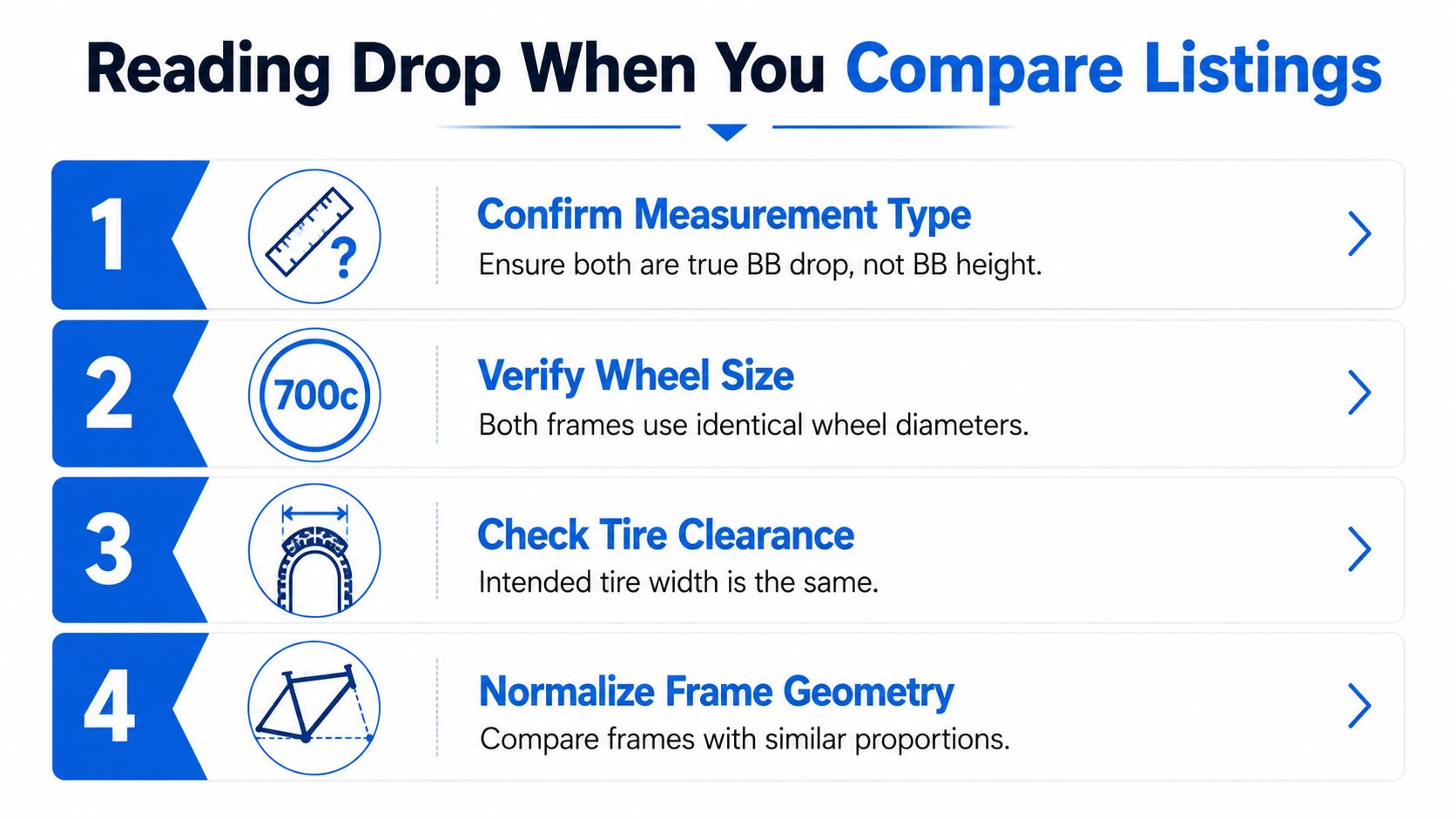
A geometry chart becomes useful only after you normalize the listings. Used-bike and retailer pages often mix measurement types, wheel configurations, and frame sizes, so start by confirming that both numbers are bottom bracket drop.
Write the comparison on one line for each bike:
Measurement type: Confirm that the number is drop, not BB height.
Wheel format: Record whether the bike is built around 700c or 650b wheels.
Tire setup: Note the tire currently installed and the tire size assumed by the geometry chart, if known.
Crank length: Check the crank specification because it affects static pedal-spindle clearance.
Frame size: Make sure both geometry figures apply to comparable frame sizes.
Overall use case: Compare the full build and intended purpose, not just one number.
A representative example shows why the raw number can mislead. A 78 mm drop on a 700c gravel bike with 45 mm tires will not necessarily place the bottom bracket at the same ground height as 78 mm on a 650b bike with 2.1-inch tires. The listed drop is identical, but actual mounted outer diameter changes axle height and the clearance you experience.
Use the number as context, not a verdict
A listed difference in bottom bracket drop may matter a lot in one comparison and very little in another. There is no universal meaningful delta. The number becomes more informative when you compare it alongside wheel and tire outer diameter, crank length, stack, reach, wheelbase, and the complete build.
Fast comparison method: List each bike's drop, wheel and tire setup, crank length, frame size, and intended configuration. Then compare the full package instead of trying to declare a winner from one geometry line.
How SYCLR Helps You Compare Drop and Fit
How do you turn a geometry chart into a useful buying decision? SYCLR helps compare the available signals together, so bottom bracket drop is not judged in isolation. Its road and gravel comparisons can surface fit signals, geometry signals, model-year context, price context, listing quality, condition signals where available, and confidence signals.
The platform can help narrow a search before a closer review. A similar drop may still lead to different choices once you compare the rest of the geometry, the model-year context, the asking price, the listing quality, and the available condition details.
You can see how SYCLR organizes these comparison signals before using the results. The goal is a clearer shortlist, not a guarantee. SYCLR does not guarantee fit or condition, and it does not inspect or authenticate bikes.
Riders with stack, reach, current-bike geometry, or fit-report details can enter them through SYCLR's advanced fit entry. Those details can provide more fit context than height alone, while the final decision remains with the rider and, when appropriate, a qualified fitter or mechanic.
Bottom Bracket Drop Questions Buyers Ask Most
Does wheel or tire size change how two bikes with the same drop sit?
Yes. Bottom bracket drop describes the relationship between the axle line and bottom bracket, while wheel-and-tire outer diameter affects axle height above the ground. Two bikes with the same 70 mm drop can therefore have different actual bottom bracket heights and pedal-clearance characteristics.
Is more drop always better?
No. More drop is not automatically better, and less drop is not automatically better either. Bottom bracket drop is one geometry variable among many. The better choice depends on the full bike setup, the actual ride height and clearance it creates, and whether the overall bike matches your needs.
How much difference matters?
There is no universal threshold that always matters. In some comparisons, a small difference in drop may be noticeable because other parts of the setup are similar. In other comparisons, a larger difference may be overshadowed by wheel and tire outer diameter, crank length, rider position, or steering geometry. Read the number in context.
Should casual riders care?
It can be useful to understand, especially when comparing bikes with different wheel, tire, or crank setups. You do not need to memorize every geometry term, but it helps to know that bottom bracket drop is part of the bike's ride-height and clearance picture. That can be relevant when you compare bikes that look similar on paper.
Does bottom bracket drop determine fit?
No. Height is only a starting point. Stack, reach, standover, saddle position, crank length, and your body proportions all matter, so a geometry chart cannot establish precise fit by itself.
Does crank length change pedal clearance?
Yes. Longer cranks reduce static pedal-spindle clearance when other dimensions are equal. But whether that leads to an actual pedal strike depends on the complete setup and the riding situation.
What should I ask a used-bike seller?
Ask for the exact model year, frame size, wheel and tire setup, and crank length. Then verify the frame's bottom bracket drop through manufacturer geometry documentation where possible. The current wheel-and-tire setup provides the additional context needed to understand actual bottom bracket height and clearance.
Compare road and gravel listings with SYCLR, starting with your height, bike type, and budget, then review fit signals, geometry signals, model-year context, price context, listing quality, condition signals where available, and confidence signals. Visit SYCLR to build a shortlist that reduces guesswork before you arrange a test ride or inspection.