
Saddle Setback and Bike Fit: A Practical Guide
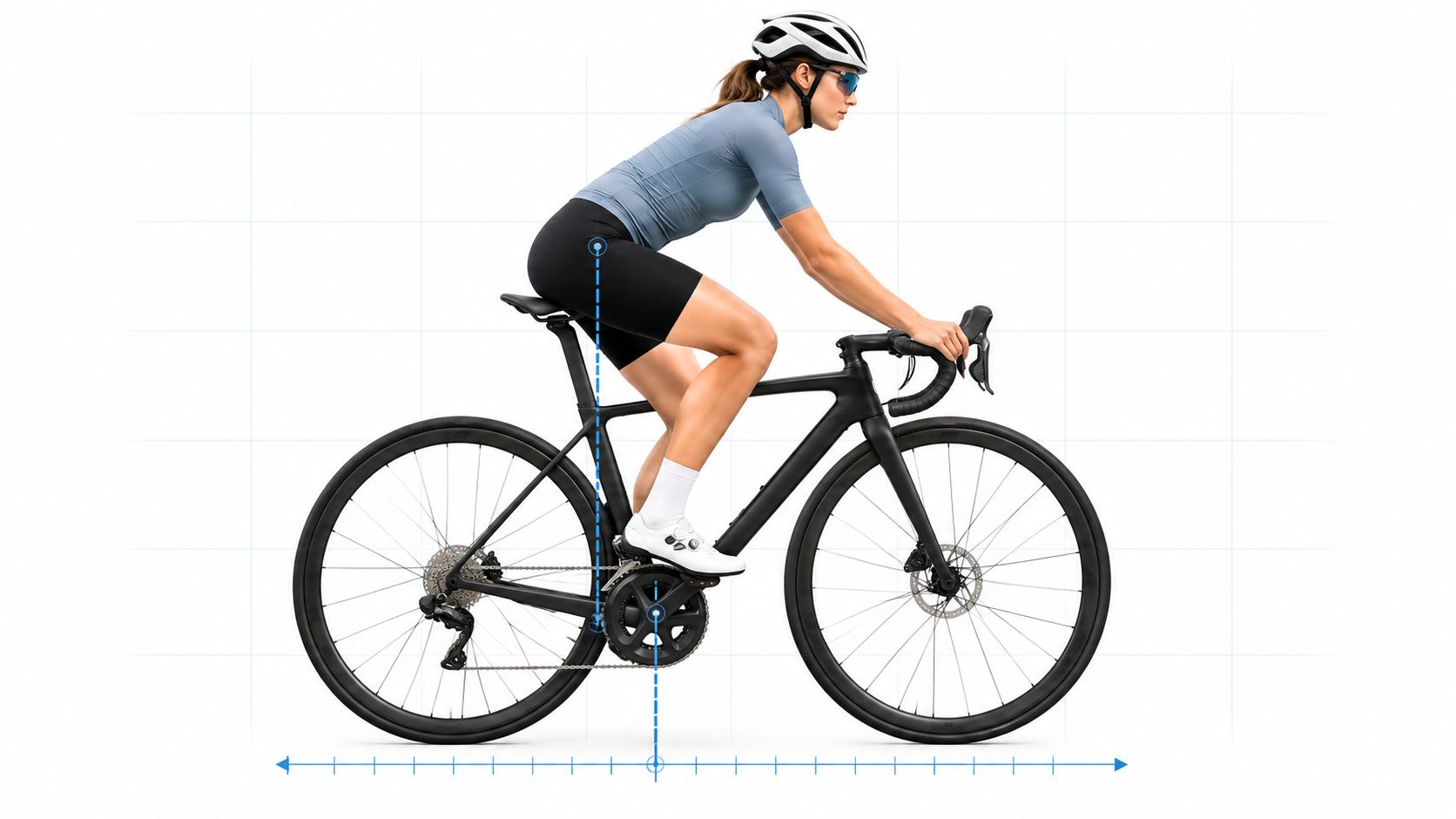
You've found two similar road or gravel bikes and want to know whether either one can reproduce your known-good riding position. Saddle setback, the fore-aft relationship between your saddle and bottom bracket, is part of that question, but it should be handled for what it is: a pedaling-position variable. It may change saddle-to-bar distance as a side effect, but it does not change frame reach. For buyers, the practical goal is to document a known-good saddle position clearly, then determine whether a candidate bike can reproduce it within normal component limits.
Table of Contents
- What Saddle Setback Actually Means
- Why Saddle Fore-Aft Primarily Supports Pedaling Position
- How to Document Saddle Setback Consistently
- Setback in a Larger Position System
- Reading Listings for Setback Compatibility
What Saddle Setback Actually Means
Saddle setback is the horizontal fore-aft relationship between the saddle and the bottom bracket. In other words, it is a bottom-bracket-relative measurement. That matters because the bottom bracket is the frame reference around which the rider pedals.
The critical point is that setback is only meaningful if the saddle reference point is defined clearly and reproduced consistently. Some riders and fitters document the saddle nose. Others use a manufacturer-defined point, saddle center, or another stated reference on the saddle. None of those conventions is automatically universal. What matters is using the same convention each time so a current bike and a candidate bike are being compared on equal terms.
The bottom bracket matters because it gives you a fixed frame-relative reference. Measuring only from the saddle to the seat tube or seatpost tells you where the saddle sits relative to those parts, not where it sits relative to the crank system. The Cycling Weekly explanation of saddle setback describes setback as a measurable fore-aft relationship rather than a vague impression of comfort.
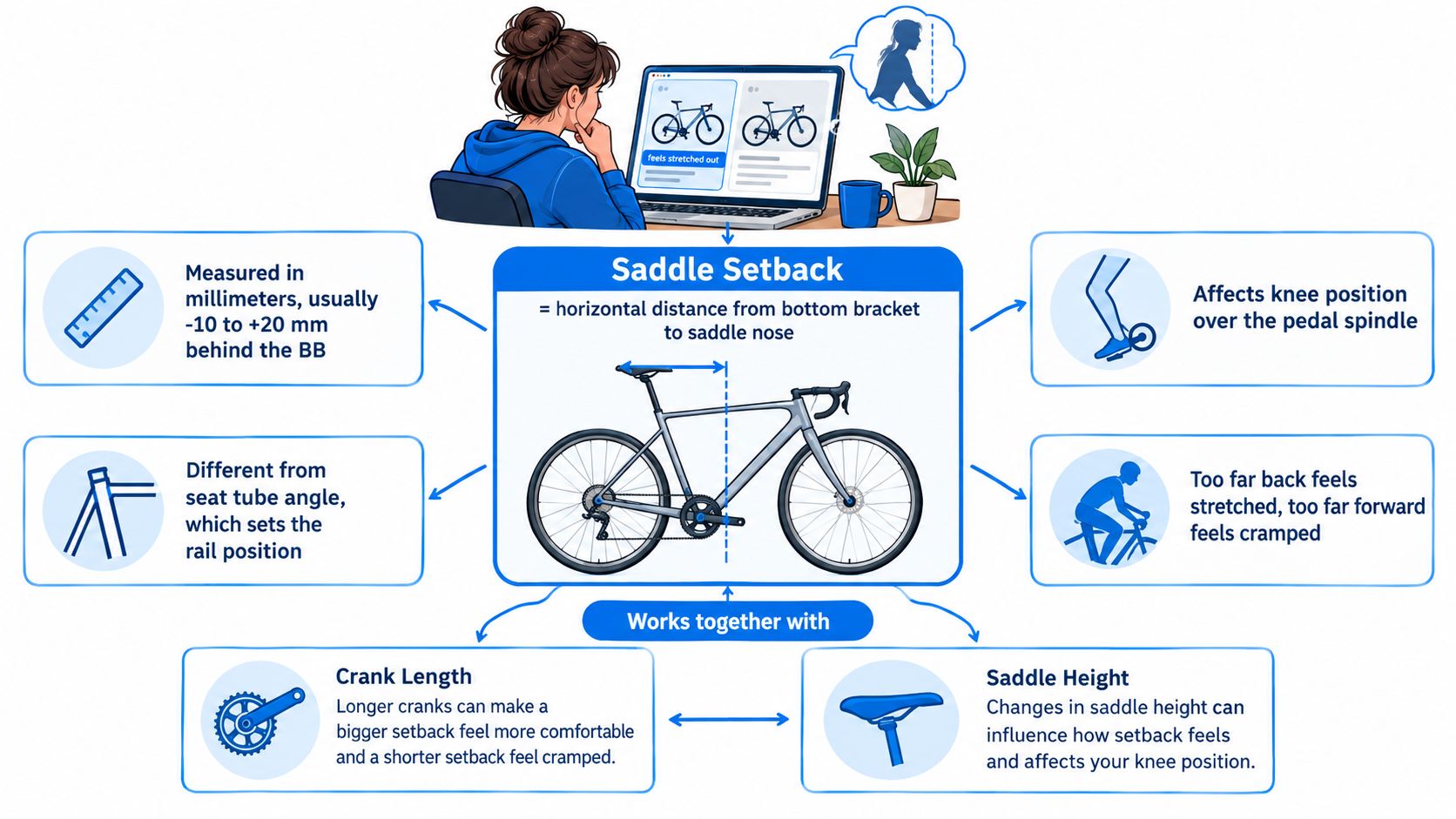
Setback is not the same as reach
Saddle-to-bar reach describes the distance from the saddle to the handlebar area. Setback describes where the saddle sits in relation to the bottom bracket. Moving the saddle backward may increase the distance to the bars, and moving it forward may reduce that distance, but the frame's reach measurement does not change.
That distinction matters when comparing bikes. Saddle fore-aft should primarily support pedaling position. It should not be used as a cockpit-reach fix. If the cockpit feels too long or too short after a correct pedaling position is established, that is a separate question involving frame reach, stack, stem, bar shape, hood position, and related front-end choices.
A saddle can also appear farther forward or farther back because of several interacting parts:
Actual or effective seat tube angle, including the manufacturer's measurement convention.
Saddle height, because the seatpost's angle projects differently as height changes.
Seatpost offset, which moves the clamp behind the post's centerline.
Saddle rail position, which fine-tunes the clamp location on the saddle.
Saddle model and reference point, because shape and length affect where the rider sits and where the measurement is taken.
Crank length, which changes the rider's relationship to the pedal circle.
That's why seat angle alone does not prescribe saddle position. A steeper or slacker seat angle changes the starting geometry, but the actual saddle location still depends on saddle height, seatpost offset, rail position, and the reference point being used.
Buyer's rule: Treat setback as a bottom-bracket-relative saddle position that must be defined with a stated saddle reference and reproduced consistently.
For a broader explanation of how saddle height, reach, and body dimensions interact before purchase, use SYCLR's bike fit guide. The key point is simple: a bike can have the right size label and still be unable to reproduce your known saddle position cleanly.
Why Saddle Fore-Aft Primarily Supports Pedaling Position
Saddle fore-aft changes the rider's relationship to the bottom bracket and the crank cycle. That is why it belongs to the pedaling side of bike setup first. When riders move the saddle forward or backward, they are changing where they sit relative to the pedals. Any change in saddle-to-bar distance is secondary.
This is also why comparing two bikes requires more than looking at one seat angle number. The question is not whether one bike is "more forward" or "more rearward" in the abstract. The real question is whether the frame, seatpost, saddle, rails, and crank setup can reproduce the same known-good saddle position relative to the bottom bracket.
What controlled research can and cannot tell you
Controlled research supports the basic idea that changing saddle setback can alter measurable pedaling and kinematic variables. A laboratory study of cyclists riding at controlled power and cadence found that changing saddle position affected measured force and work variables. You can review the methods and findings in the 2016 saddle-position laboratory study.
A later study of recreational road cyclists also reported that changing saddle setback altered measured lower-limb and trunk kinematic variables across riding conditions. The PubMed record for the study and the related Scientific Reports study are useful because they reinforce a narrower, practical point: changing setback can change measured pedaling-related variables.
What those studies do not provide is a universal fit prescription. They do not justify one fixed setback target for every rider, and they do not turn one research definition into a mandatory field rule for buyers. For purchase screening, the safest use of this evidence is simple: define your own known-good saddle position carefully, then check whether the candidate bike can reproduce it.
How to Document Saddle Setback Consistently
The best saddle-setback record is one you can reproduce on another bike without changing the definition halfway through. That means documenting both the measurement and the convention behind it.
Choose a reference point and keep it consistent
When documenting a known-good position, record the following:
Exact bike model, model year, and size.
The saddle model.
The saddle reference point used for the measurement. State whether you measured to the saddle nose, a manufacturer reference point, saddle center, or another clearly defined point.
The setback measurement relative to the bottom bracket.
Saddle height. A change in height changes the fore-aft result produced by the seat angle.
Seatpost offset.
Crank length.
Approximate rail position or remaining rail adjustment range.
This documentation matters because a setback number without its reference convention can be misleading. Two riders can both report the same nominal setback while using different saddles or different saddle landmarks. Likewise, two bikes can share the same published seat angle but place the saddle differently once saddle height, seatpost offset, and rail position are accounted for.
A practical record can be as simple as a short fit note or spreadsheet entry with one photo taken square-on from the side. The important part is not complexity. It is consistency.
KOPS is optional documentation, not a prescription
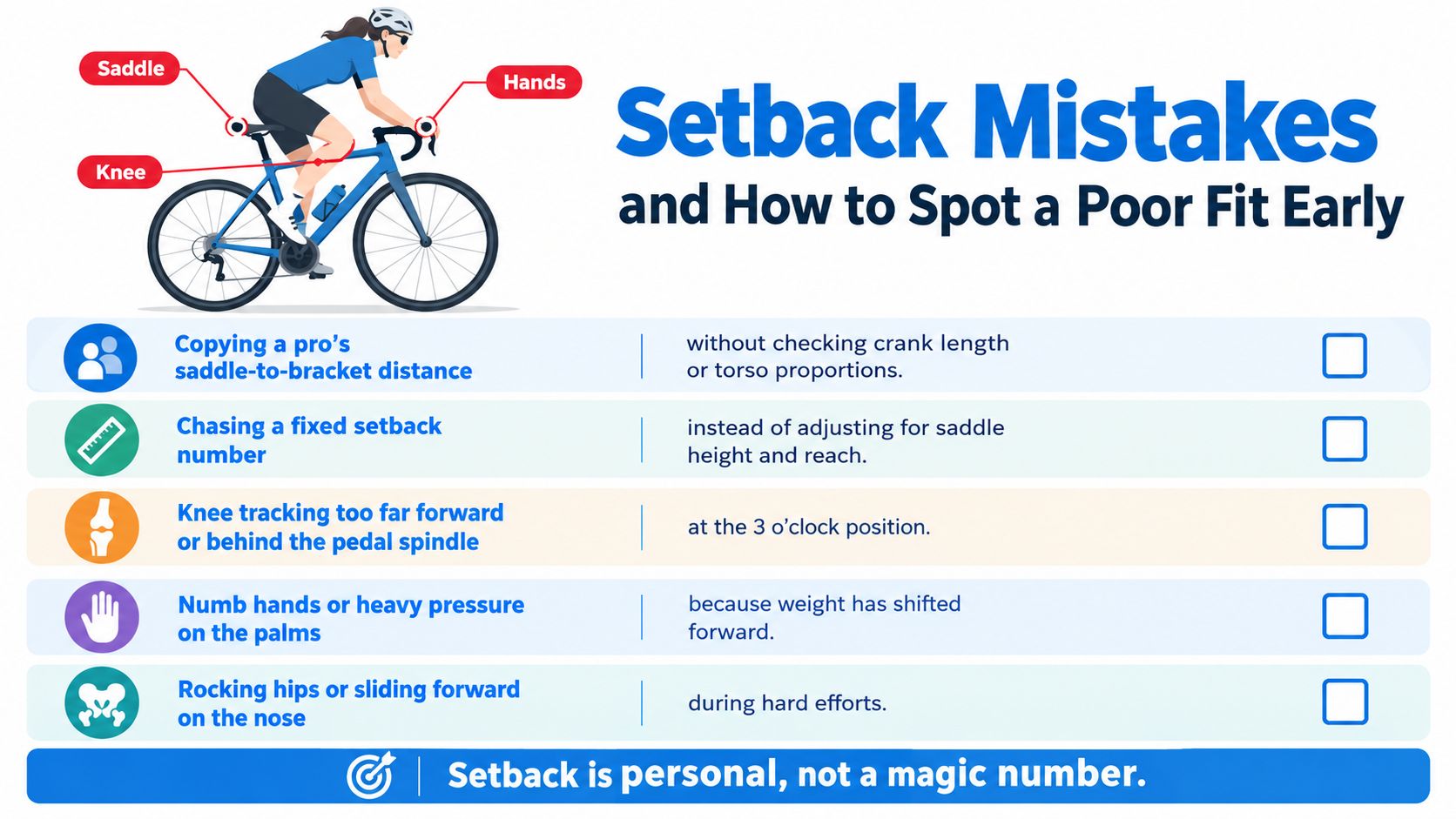
KOPS, or Knee Over Pedal Spindle, can be used as an optional way to document a current setup, but it should not be treated as a rule that prescribes the correct saddle setback.
If a rider or fitter already uses KOPS language to describe an existing position, that can be useful as a reference note. But for purchase screening, the more important question is still whether the candidate bike can reproduce the known saddle location relative to the bottom bracket using the same saddle reference convention and component constraints.
For a used-bike buyer, that means KOPS can sit in your notes if you want it to, but it should not replace the more direct record of saddle setback, saddle height, seatpost offset, saddle model, and crank length.
Setback in a Larger Position System
Setback does not exist in isolation. The actual saddle location achieved on a bike depends on several connected variables, and the most important ones are the ones that directly affect the saddle's bottom-bracket-relative position.
How the main variables interact
| Variable | Why it matters for setback |
|---|---|
| Exact model, year, and size | Establishes the frame and component context you are actually comparing |
| Seat-angle convention | Manufacturer methods vary, so the published angle must be interpreted in context |
| Actual or effective seat tube angle | Sets the seatpost's starting fore-aft path, but does not alone determine final saddle location |
| Saddle height | A higher or lower saddle changes where that seat-angle line places the saddle |
| Seatpost offset | Moves the saddle clamp rearward relative to the post centerline |
| Saddle rails | Provide the usable fore-aft adjustment range on the chosen saddle |
| Saddle model and reference point | Change both the measurement convention and where the rider effectively sits |
| Crank length | Changes the rider's relationship to the pedal circle and the comparison context |
| Manufacturer limits | Define the safe adjustment range for rails, clamps, and components |
With other variables held constant, a steeper seat-angle reference places the nominal saddle line farther forward, while a slacker reference places it farther rearward. Actual saddle position still depends on saddle height, seatpost offset, rail position, saddle shape, measurement convention, and the exact reference point being compared.
Crank length also matters when reproducing a known position across bikes. If the candidate bike uses a different crank length from your current bike, the pedaling context is different even if the saddle's measured location looks similar on paper. That does not automatically make the bike wrong, but it does mean the comparison should be made carefully and documented clearly.
Seatpost offset is often missing from marketplace listings. If you cannot verify it, treat saddle-position compatibility as uncertain rather than assuming the stock post will reproduce your current setup.
For a deeper explanation of the frame angle that establishes much of this relationship, see seat tube angle explained. The key takeaway is straightforward: published seat angle starts the conversation, but it does not finish it.
Reading Listings for Setback Compatibility
A marketplace listing rarely provides one clean saddle-setback number. In most cases, you have to reconstruct whether the bike can likely reproduce your known-good position from the frame details, seatpost configuration, saddle setup, and missing-information risk.
| Listing field | Why it matters for setback compatibility |
|---|---|
| Exact model, year, and size | Confirms the frame version you are actually evaluating |
| Seat-angle convention | Helps interpret how the published angle was defined |
| Published seat angle | Gives the starting seatpost line, not the finished saddle position |
| Seatpost offset | Shows how much rearward position the post itself provides |
| Saddle model | Affects both usable rail range and reference-point comparability |
| Saddle reference point used in comparison | Keeps your current-bike record and the candidate-bike estimate aligned |
| Rail adjustment range | Indicates whether the saddle can be positioned as needed without extreme clamping |
| Saddle height | Necessary for interpreting how seat angle translates into real saddle location |
| Crank length | Keeps the pedaling-context comparison honest |
| Manufacturer limits | Shows whether the needed adjustment stays within safe component use |
A practical pre-purchase workflow
Document your known-good saddle position using a clearly defined reference. Record the saddle model, the saddle reference point, the bottom-bracket-relative setback, saddle height, seatpost offset, crank length, and rail position.
Confirm the candidate bike's exact model, year, size, and seat-angle convention. Make sure you know what frame you are actually comparing and how its published geometry was defined.
Check seatpost offset, saddle rails and reference, and crank length. These details strongly affect whether the candidate can reproduce your position in a like-for-like way.
Determine whether your known-good saddle position can be reproduced within manufacturer and component limits. Do not assume success just because the frame size or seat angle looks close.
Establish the saddle for pedaling first. Saddle fore-aft should primarily support pedaling position.
Evaluate cockpit, stack, and reach separately afterward. If the bike can reproduce the correct saddle position, then assess whether the front end also suits you. Do not move the saddle to solve a reach problem.
For used bikes, ask the seller for side-on photographs, the seatpost model, crank length, saddle model, current saddle height, and any documentation that clarifies the setup. Treat complete answers as confidence signals, not guarantees.
How SYCLR helps
The SYCLR app lets riders compare road and gravel listings using fit and geometry signals before they commit time to a seller conversation. More specifically: SYCLR compares road and gravel listings using fit signals, geometry signals, model-year context, price context, listing quality, condition signals where available, and confidence signals.
Riders who already know their current-bike geometry or fit-report details can enter those measurements through the advanced fit details view, then use the results to reduce guesswork across candidate frames.
SYCLR does not perform a professional bike fit, physically inspect bikes, authenticate listings, verify ownership or seller claims, or guarantee fit or condition.
A promising listing is one you can explain. You should be able to say why its frame details, seatpost setup, adjustment range, and listing quality make it worth shortlisting.
Frequently asked questions
Is saddle setback the same as saddle height?
No. Saddle height describes the vertical relationship within the pedaling system. Setback describes the horizontal fore-aft relationship to the bottom bracket. They should be documented together because a change in saddle height can change the achieved setback relationship.
Does KOPS determine the correct saddle setback?
No. KOPS can be used as a reference for documenting a current setup, but it is not a prescription for correct saddle setback.
Should I use saddle setback to fix cockpit reach?
No. Saddle fore-aft should primarily support pedaling position. It may change saddle-to-bar distance, but it does not change frame reach.
Can a shorter stem fix excessive setback?
It may change the cockpit, but it does not resolve a saddle-position mismatch relative to the bottom bracket. Establish the saddle for pedaling first, then evaluate the cockpit separately.
How much seatpost offset do I need?
There is no universal target. The required offset depends on the frame, seat-angle convention, saddle height, saddle model, rail position, reference point, crank length, and the saddle position you are trying to reproduce.
Does the gravel category determine saddle setback?
No. A gravel label by itself does not determine the saddle position you need. The useful question is whether that specific bike, with its exact model, year, size, seat-angle convention, seatpost, saddle, rails, and crank setup, can reproduce your known-good position.
Can I screen setback before buying a used bike?
Yes, but what you are screening is setback compatibility. Document your current position clearly, compare it against the candidate bike's seat-angle convention, seatpost offset, saddle setup, rail range, saddle height context, crank length, and manufacturer limits, then judge whether the position can be reproduced.
Use SYCLR to compare road and gravel listings using fit signals, geometry signals, model-year context, price context, listing quality, condition signals where available, and confidence signals. Start with the bikes you're considering, compare whether each candidate appears capable of reproducing your documented saddle position within available component and manufacturer limits, and shortlist options that reduce fit guesswork before you contact the seller.
The embedded fit demonstration below can help illustrate how riders and fitters observe position, but it shouldn't be treated as a universal prescription.