650b vs 700c Gravel Bike: Which Wheel Size Should You Choose?
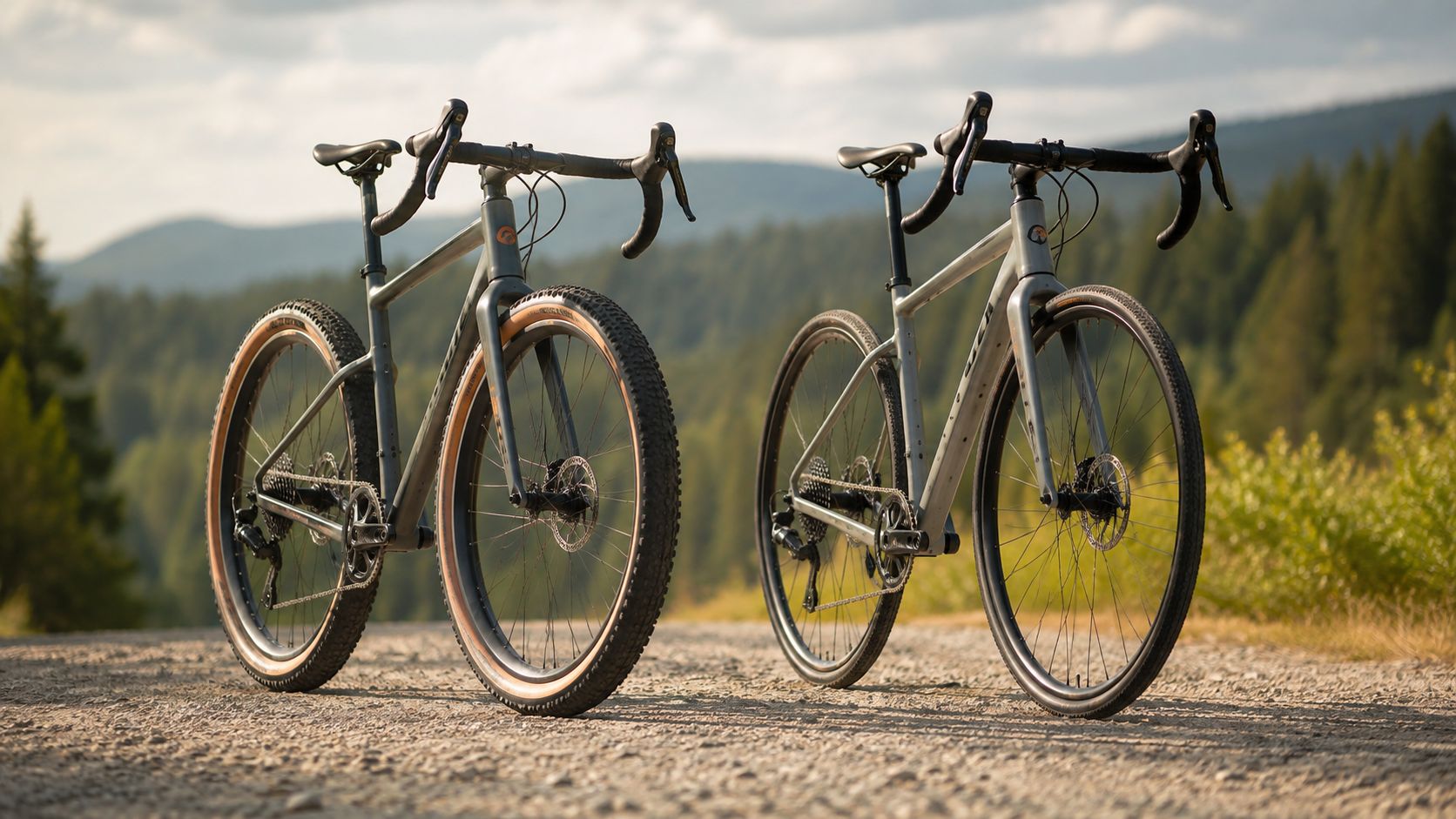
You’re standing in front of two gravel listings, or maybe your current bike already sits on one wheel size and you’re wondering if a swap will fix the ride. Don’t start with the wheel label. Start with fit, clearance, and the tire volume your frame can really run. On a gravel bike, 650b vs 700c is usually a question about what your body and frame can support, not a contest between comfort and speed.
Table of Contents
Why 650b vs 700c Is Really a Fit and Clearance Question
If you are comparing two gravel bikes or considering a second wheelset, start with frame compatibility and the complete wheel-and-tire diameter. The important questions are whether the frame officially supports the setup, whether it provides the tire volume needed for the terrain, and whether the resulting bottom-bracket height, pedal clearance, gearing, and handling remain appropriate. That’s why a smart buyer starts with body position and frame geometry, not with the popular shortcut that 650b equals comfort and 700c equals speed.
Start with the frame, not the slogan
The strongest buying decision is the one that matches your body, route, and frame clearance. Compact frames can face design constraints involving front-center, toe overlap, fork clearance, and tire capacity. Some manufacturers use 650b wheels on smaller sizes to manage those constraints, while others design successful small frames around 700c. A larger rider on a bigger frame may never need 650b at all, because the frame already gives enough room for the tire they want.
Practical rule: compare the complete wheel-and-tire setup, not the rim standard alone. Even when tire volume is similar, the resulting diameter can affect gearing, bottom-bracket height, pedal clearance, toe overlap, handling, and component compatibility.
That’s why geometry checks matter before wheel-size opinions. If you’re still sorting out stack, reach, and standover, use SYCLR’s bike geometry comparison guide as the deeper reference point, then come back to wheel size as the final fit and clearance layer.
What the buyer actually feels
On the same frame, wheel size changes more than appearance. It changes whether the bike can take a wider tire at lower pressure, whether the front wheel feels tight in the fork, and whether the bottom bracket sits at a sensible height for the terrain. Those are practical consequences, not abstract ones.
First, confirm the frame fits the tire you really want. Second, check whether the wheel standard leaves enough room for mud, flex, and real-world riding. Third, decide whether the route you ride most often rewards clearance and volume more than a slightly faster default setup.
If you do it in that order, the wheel choice gets much easier. The better wheel size is the one that lets you run the tires your terrain and body need, on the frame you have.
The Sizing Difference Between 650b and 700c
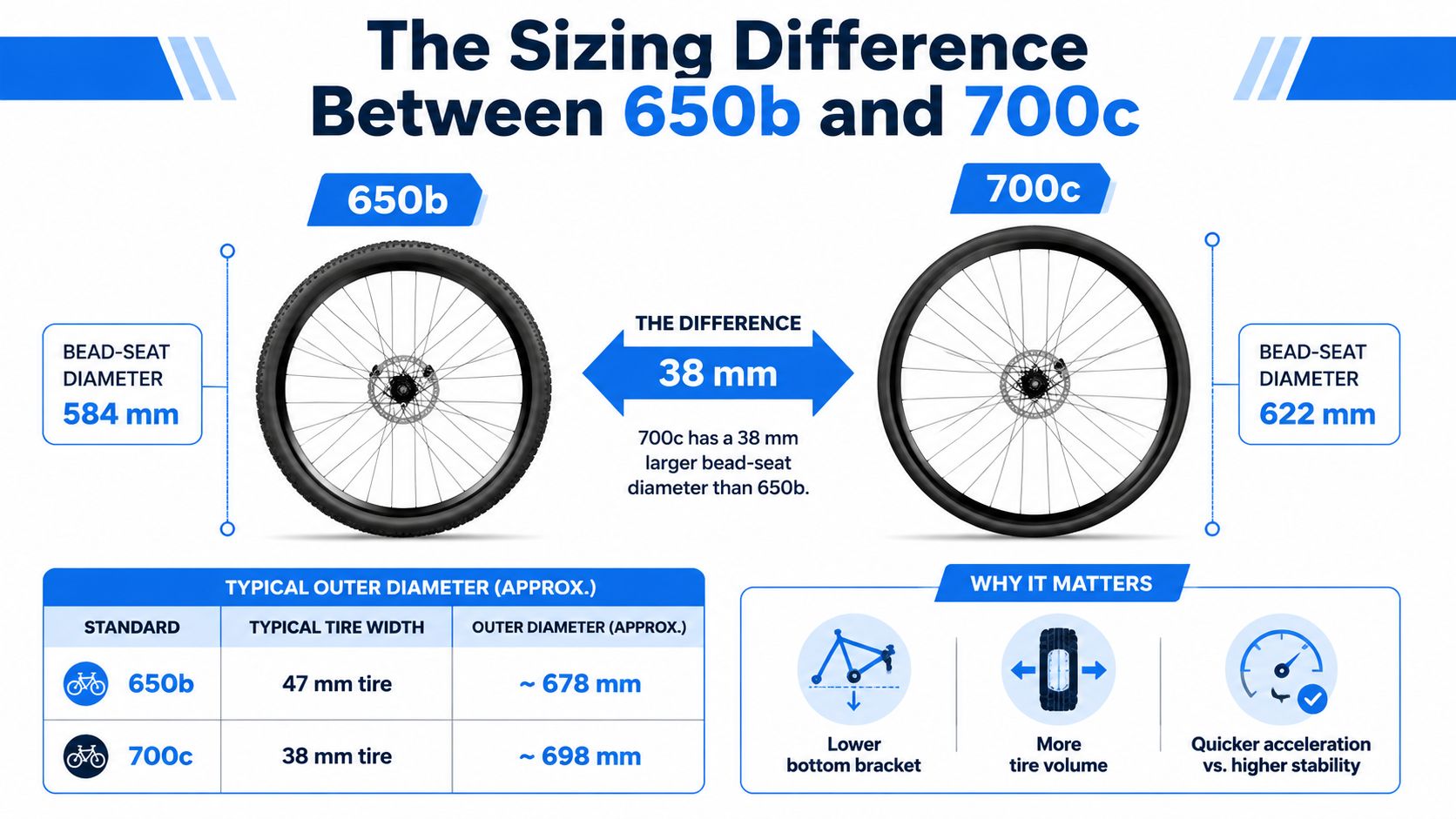
The foundation is simple. 650b is 584 mm at the bead seat diameter, while 700c is 622 mm. That 38 mm gap is the root of almost every downstream difference you care about in gravel-bike fit and tire clearance, from how much rubber you can fit to how high the bike sits off the ground. Canyon’s gravel wheel guide also ties the standards to 27.5 in / ISO 584 and 29 in / ISO 622, which is why both remain common in the same category.
What the number actually changes
A smaller bead-seat diameter lets you build a wheel that stays compact even when you mount a taller tire. That’s the whole reason 650b exists in gravel. You can increase tire volume without making the wheel physically huge, which helps on frames where 700c already pushes the limit.
A larger bead-seat diameter does the opposite. It gives you a taller wheel that pairs well with lower-profile tires, which is why 700c remains the default on many gravel bikes. It’s not just tradition. It’s a practical match for mixed surfaces, general availability, and the way most modern gravel frames are designed.
Why the standards coexist
The coexistence of the two standards makes sense once you stop thinking in road-versus-mountain terms. Gravel changed the buying question. After the mid-2010s, riders weren’t just choosing between fast and off-road, they were choosing between more tire volume for rough terrain and more clearance for quicker mixed-surface use. That’s why one standard didn’t kill the other.
The frame decides the ceiling, the wheel decides how close you get to it.
A good way to think about it is this. 650b isn’t a magic comfort upgrade. It’s a tool for getting a bigger tire into a tighter frame package. 700c isn’t a performance trophy. It’s the cleanest default when the frame, terrain, and tire choice don’t demand the extra volume 650b can deliver.
Ride Feel, Comfort, and Speed Between the Two Wheel Sizes
Wheel size alone does not determine speed, comfort, traction, or control. Those outcomes depend on the complete tire diameter, casing, tread, pressure, rim width, rider weight, surface, and bike setup.
A 650b wheel is often paired with a wider, taller tire, while a 700c wheel is often paired with a narrower tire. That can make the 650b setup feel different, but much of the change comes from the tire rather than the bead-seat diameter itself.
When two setups use tires that create similar outer diameters and volumes, their ride characteristics may overlap substantially. When 650b allows a meaningfully wider tire than the same frame can accept in 700c, the difference may become more noticeable on rough or loose terrain.
Use this distinction:
-
Rim diameter describes the wheel standard.
-
Tire dimensions determine much of the volume and surface interaction.
-
Complete outer diameter affects gearing, rollover, bottom-bracket height, and handling.
-
Tire construction and pressure strongly influence ride feel.
The useful comparison is therefore not 650b versus 700c in isolation. It is one complete wheel-and-tire setup versus another on the exact frame.
Comfort changes only when the tire changes enough
CyclingAbout’s testing found vibration differences of only 0.6% to 1.8% across individual comfort tests when comparing wheel and tire setups, and it concluded that tire model mattered more than rim diameter or tire width for comfort. That matters because lots of riders blame the wheel standard when the difference came from the tire casing, tread, or pressure choice. CyclingAbout tested the same idea from another angle and reached the same general conclusion.
When the setup changed more dramatically, the result changed too. On a bumpy forest track, CyclingAbout found 13% fewer vibrations for a 650B x 48 mm setup versus a 700C x 42 mm setup. But when the widths were kept closer, a 700C x 50 mm setup was 3.7% more comfortable on the forest track and 2.6% more comfortable on fast gravel. CyclingAbout makes the point clearly, the tire setup matters more than the label on the rim.
What that means in the real world
If your 650b setup only gives you a tire that’s about the same size as your 700c option, you may not feel much difference at all. If 650b lets you step up into a meaningfully bigger tire, the ride can soften, calm down, and grip better where the surface gets choppy.
A few real-world takeaways are worth keeping straight.
-
Smooth pavement: both sizes can roll at the same speed when the tire choice is sensible.
-
Rough gravel: the wheel that lets you run more tire volume usually feels better.
-
Comparable tires: the feel gap can shrink fast when the actual rubber is close in volume.
The short version is blunt. Tire choice drives the ride feel. Wheel size just opens or closes the door.
Fit, Geometry, and Clearance on the Same Frame
Wheel size changes the bike around you, not you on the bike. That’s the part many riders miss. If you swap from 700c to 650b on the same frame, your contact points stay in the same place, but the wheel’s physical relationship to the frame changes, and that affects standover, pedal clearance, and toe overlap. For frame-size context, use SYCLR’s gravel bike frame size chart before you get hung up on wheel diameter alone.
Why smaller riders often benefit from 650b
Some manufacturers use 650b wheels on smaller frame sizes to address front-center, toe-overlap, tire-clearance, and proportional-design constraints. Other brands use 700c across the full size range and adjust geometry, fork offset, and frame construction instead.
Do not choose wheel size from rider height alone. Compare:
-
the exact frame size and geometry
-
toe overlap
-
standover
-
front-center
-
fork clearance
-
official tire limits
-
bottom-bracket height
-
crank length
-
pedal clearance
-
the complete wheel-and-tire diameter
A smaller rider may benefit from a well-designed 650b frame, but a properly designed 700c bike may fit equally well. A taller rider may prefer either standard depending on terrain, tire requirements, and frame design.
Wheel size should support the frame’s intended geometry rather than compensate for a poorly fitting frame.
Matching Wheel Size to Terrain and Riding Style
Terrain matters, but it does not assign one wheel standard automatically.
A 700c setup may suit riders who prioritize wheel and tire availability, efficient mixed-surface use, and a larger-diameter wheel with the tire widths their frame supports. A 650b setup may suit riders whose compatible frame can use the smaller rim to accommodate greater tire volume while maintaining an appropriate complete wheel diameter.
For rough terrain, compare the actual tire volume, casing, tread, pressure, rim width, and outer diameter rather than assuming 650b is always more capable. Many 700c gravel frames now support tires suitable for demanding surfaces.
For pavement and smooth gravel, compare rider position, tires, wheels, pressure, and gearing rather than assuming 700c is always faster.
Choose 700c when:
-
the frame is designed around it
-
the available tire capacity suits the route
-
wheel and tire availability matter
-
the complete setup preserves appropriate handling and gearing
Choose 650b when:
-
the frame officially supports it
-
it creates useful additional tire volume
-
the resulting bottom-bracket and pedal clearance remain suitable
-
the desired tires and replacement parts are readily available
Neither standard is universally better for racing, bikepacking, smooth gravel, or technical terrain.
Converting Between 650b and 700c on an Existing Bike
If you already own the bike, don’t assume a wheel swap is automatically worth it. Start by checking whether the new setup really gives you something useful, not just a different number printed on the rim. The best place to begin is clearance, then brake compatibility, then whether the tire change moves the bike far enough to matter. A good reference point for tire and swap planning is the practical “10 millimeter rule”. If the difference between two wheel-and-tire setups is less than about 10 mm, many riders won’t gain enough to justify the cost of changing setups. This used rule is a decent threshold for real-world decision-making.
What to verify before spending money
-
Manufacturer approval: Confirm that the exact frame, fork, size, and model year support both wheel standards.
-
Complete outer diameter: Compare the mounted tire diameter, not only 584 mm versus 622 mm rim dimensions.
-
Tire clearance: Check the manufacturer’s limits and the tire’s measured dimensions on the intended rim.
-
Bottom-bracket height: A smaller complete diameter can lower the bike and reduce pedal clearance.
-
Brake compatibility: Confirm rotor diameter, rotor position, caliper alignment, and hub standard.
-
Axles and hubs: Verify axle length, spacing, freehub body, cassette compatibility, and rotor interface.
-
Gearing: A smaller complete wheel diameter lowers effective gearing and changes speed in each gear.
-
Wheel strength and limits: Confirm rider, bike, and cargo compatibility.
-
Tire and rim availability: Check whether replacement parts are practical to source.
-
Handling: Verify that the manufacturer intended the geometry to work with the alternative setup.
A conversion only makes sense when the new wheel lets you run a meaningfully different tire. If the swap doesn’t buy you more room, more control, or better clearance, a tire change alone is often the smarter move. That’s especially true if you’re shopping used wheels and can’t verify hub condition, true, or bearing health with confidence.
The hidden buyer risk
Wheel swaps can get expensive fast because you’re not just buying rims. You’re buying a whole new wheelset, and that means compatibility checks, possible brake issues, and a second round of fit uncertainty. If your current setup already fits your frame well. Swap wheels only when the new standard offers a better tire. If it doesn’t, you’re paying for a label.
Buyer Checklist for Choosing the Right Setup
If you’re deciding between two listings, run this checklist before you get attached to the photos. The wheel size matters, but only as a way to get the right tire volume on the right frame. If you need broader gravel-fit context while comparing listings, pair this with SYCLR’s gravel bike sizing guide and then compare the actual geometry and clearance numbers.
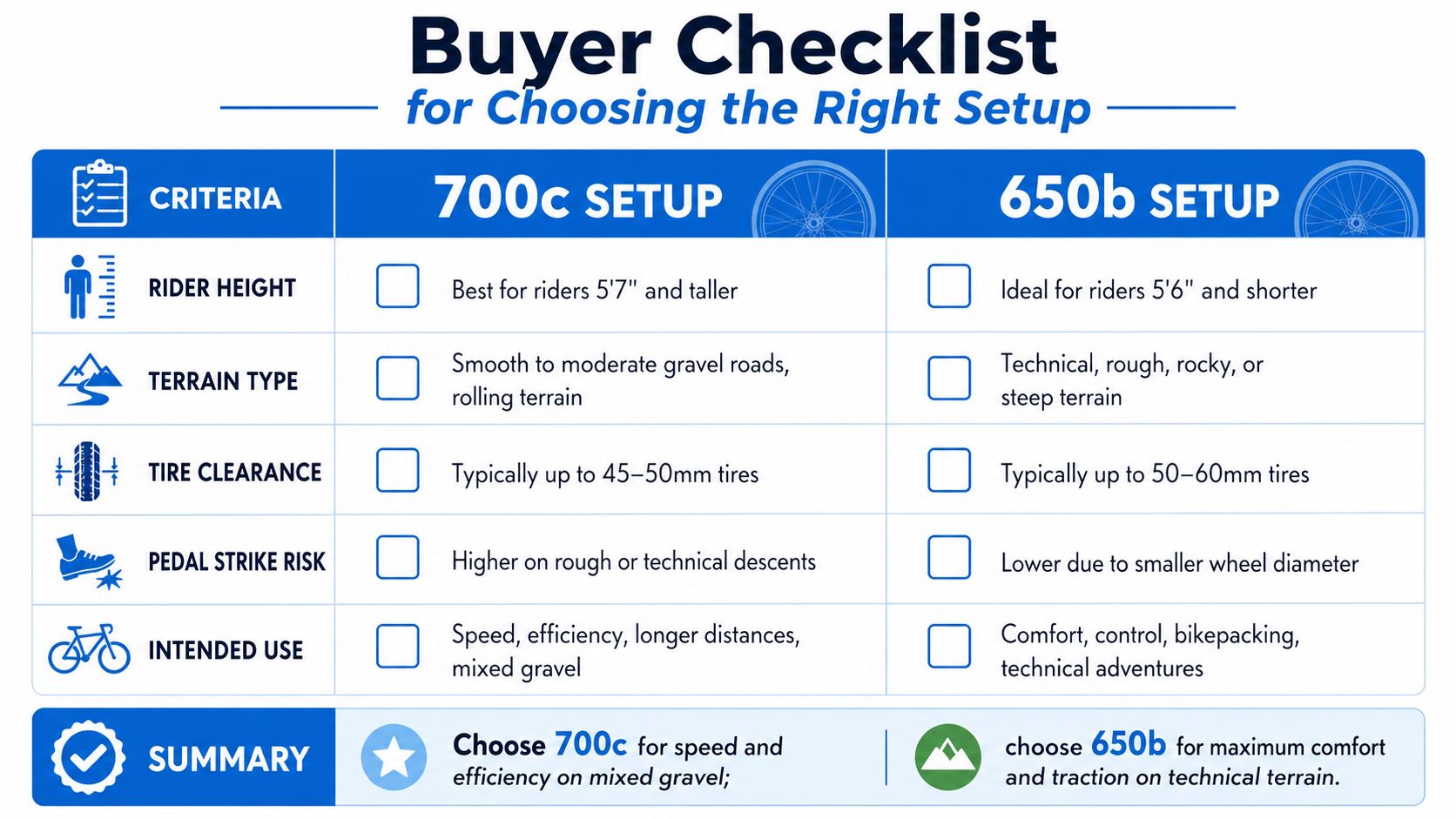
Quick checklist
-
Confirm your fit baseline. Height helps, but it’s only the starting point. Use your current-bike fit numbers if you have them.
-
Identify the tire you want. Don’t ask which wheel size is better until you know the tire width your frame can safely run.
-
Match the complete setup to the terrain. Compare tire volume, casing, tread, pressure, wheel diameter, gearing, and handling rather than assigning one rim standard to each surface.
-
Reject unsupported setups early. Use the manufacturer’s clearance and wheel-compatibility specifications rather than inventing a minimum remaining-clearance threshold.
-
Treat the wheel as a means, not a goal. The point is better clearance, better comfort, or better efficiency for your route.
| Decision factor | 650b setup | 700c setup | What should decide |
|---|---|---|---|
| Rim bead-seat diameter | 584 mm | 622 mm | Confirm the exact standard |
| Typical gravel use | Often paired with higher-volume tires | Used across a wide range of gravel builds | Compare actual tire dimensions |
| Complete wheel diameter | Depends on tire height | Depends on tire height | Measure or calculate the mounted setup |
| Tire volume | May allow more volume on some compatible frames | Can also support high volume on modern frames | Official frame and fork clearance |
| Bottom-bracket effect | May lower the bike if outer diameter decreases | May raise or preserve height depending on setup | Compare complete diameters |
| Effective gearing | Lower when complete diameter is smaller | Higher when complete diameter is larger | Route, cadence, and gearing needs |
| Toe overlap | May help on some compact frame designs | Depends on frame geometry and tire size | Exact front-center and crank position |
| Terrain | Can work across smooth or rough routes | Can work across smooth or rough routes | Tires, pressure, geometry, and rider skill |
| Availability | Market dependent | Often broadly available, but region dependent | Local replacement options |
| Conversion suitability | Frame and component dependent | Frame and component dependent | Manufacturer approval and full compatibility |
| Best choice | When it creates a useful, supported setup | When it creates a useful, supported setup | Compare the complete systems |
The useful buy decision is simple. Choose the wheel size that lets the bike fit your tire target with room to spare. If both options fit, let the terrain and your body position decide. If one option forces a compromise on clearance, that's the one to drop.
How SYCLR Helps You Compare the Right Wheel Setup
SYCLR is useful here because it lets you compare road and gravel listings around the stuff that changes the buy. Start with height, bike type, and budget, then compare the fit signals, geometry signals, model-year context, price context, listing quality, and confidence signals side by side. That's the right lens when you're trying to shortlist better-fit options instead of scanning a wall of inventory. The more detailed route is SYCLR's fit details entry, which is the better path if you already know stack, reach, or current-bike geometry.
The value is practical. A gravel listing can look good in isolation and still be wrong if the wheel standard limits the tire you want, or if the frame size doesn't match your position. Comparing listings with fit and geometry in view helps you reduce guesswork before you click through to the seller.
If you're still deciding between wheel standards, use the app to compare bikes with the actual tire and frame context in mind. Then use the broader SYCLR bike discovery platform to compare road and gravel listings, shortlist better-fit bikes, and check model-year and price context before you spend money.
650b vs 700c Gravel Bike FAQs
Is 650b more comfortable than 700c?
Not automatically. Comfort depends heavily on tire volume, casing, pressure, rim width, bike fit, and surface. A 650b setup may allow a wider tire on some frames, but the wheel standard alone does not guarantee greater comfort.
Is 700c faster than 650b?
Not universally. Speed depends on the complete tire diameter, tread, casing, pressure, aerodynamics, gearing, wheels, surface, and rider position. Compare complete setups rather than rim diameter alone.
Can every gravel bike switch between 650b and 700c?
No. The frame and fork must officially support both standards, and the hubs, axles, brakes, rotors, cassette, tire clearance, bottom-bracket height, and handling must remain compatible.
Does switching to 650b lower the bottom bracket?
It can. The change depends on the outer diameter of the mounted tires. A 650b wheel with a sufficiently taller tire may preserve a diameter close to the original 700c setup.
Is 650b better for shorter riders?
Sometimes, but not automatically. Some smaller frames use 650b to manage toe overlap, front-center, and tire clearance. Other small frames are designed successfully around 700c.
Which wheel size is better for rough gravel?
Either can work. Compare tire volume, casing, tread, pressure, wheel strength, geometry, and frame clearance. A large-volume 700c setup may outperform a smaller-volume 650b setup, and vice versa.
Can SYCLR help compare 650b and 700c gravel bikes?
SYCLR can help compare available listings using fit signals, geometry signals, model-year context, price context, listing quality, and confidence signals. Manufacturer specifications are still required to confirm wheel and tire compatibility.
If you are comparing 650b and 700c gravel bikes, start with your height, bike type, terrain, tire requirements, and budget in the SYCLR app. Compare available fit signals, geometry signals, model-year context, price context, listing quality, and confidence signals before building your shortlist.
Already know your stack, reach, current-bike geometry, or fit-report details? Use the advanced fit entry to improve your recommendations.
Confirm wheel and tire compatibility with the manufacturer before purchasing a bike or conversion wheelset.