Used Road Bikes: How to Choose the Right Fit, Price & Listing
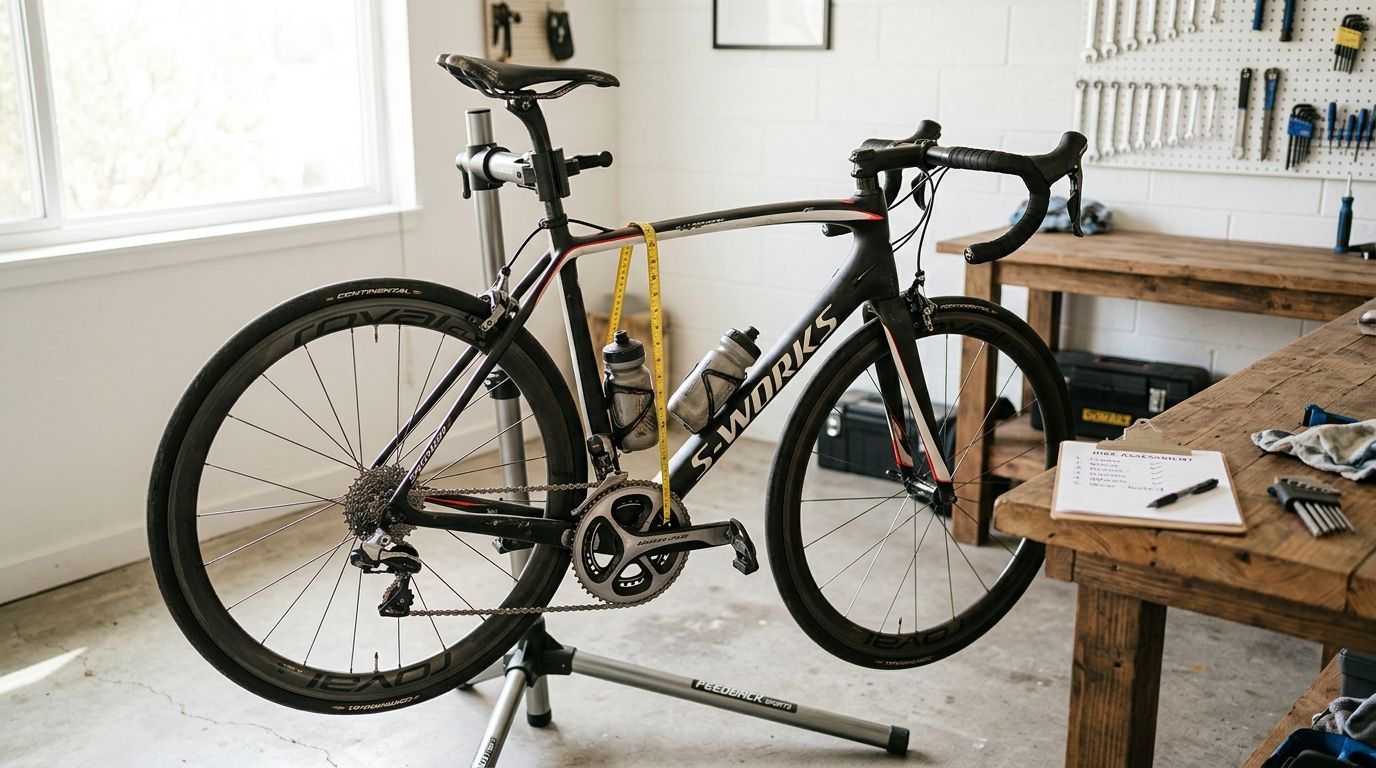
Buying a good used road bike means judging three things together: fit and geometry, mechanical condition, and listing transparency.
Most used-bike advice starts too late. It jumps straight to crack checks, chain stretch, and whether the wheels spin true. Those matter, but the first mistake usually happens before you ever meet the seller. Riders sort by lowest price, see a familiar size label, and convince themselves they’ve found a deal. Often, they’ve just found a bike with more uncertainty attached to it.
The smartest way to evaluate used road bikes for sale is to treat listing confidence as part of value. A cheap bike with vague details, no exact model year, weak photos, and no geometry context is not automatically a bargain. It’s a gamble. A slightly more expensive listing with a clear model name, known build, useful fit signals, and a transparent seller is often the better buy.
Table of Contents
-
The Used Bike Fallacy Why the Lowest Price Is Rarely the Best Deal
The Used Bike Fallacy Why the Lowest Price Is Rarely the Best Deal
The cheapest used road bike in your search results is often the one asking you to ignore the most risk. That risk usually hides in three places: wrong fit, hidden wear, and weak listing quality.
The used-bike market is large and still expanding. Market Research Future reports on the used bike market that the global used bike market was valued at USD 47.35 billion in 2024 and is projected to reach USD 94.69 billion by 2035, while the online marketplace segment is projected to grow from USD 47,046.9 million in 2025 to USD 72,366.3 million by 2035. That matters because more used road bike shopping now starts with screens, not shop floors.
A low asking price can distract you from the total cost of ownership. If the frame geometry doesn’t suit you, if the drivetrain is worn, or if the listing leaves out basic details, the “deal” can turn into immediate spending or a bike you never enjoy riding.
Practical rule: A good used road bike deal is one where the fit makes sense, the wear makes sense, and the seller’s story makes sense.
That’s why I’d rather see a buyer compare two similar used road bikes and choose the one with better documentation than just the lower price. If one listing has the exact model year, full model name, brake type, groupset details, clear side photos, close-ups of wear points, and a seller who answers direct questions, that bike carries less uncertainty. Less uncertainty has value.
The cost of uncertainty
When buyers focus only on price, they skip the questions that matter:
-
Does the geometry suit the rider? A labeled size alone doesn’t answer that.
-
Does the wear match the asking price? Clean photos can still hide drivetrain or bearing issues.
-
Can the bike be identified precisely? Without that, model-year comparisons get shaky fast.
-
Is the seller reducing guesswork or increasing it? Listing quality is part of bike value.
If you want to buy a used road bike well, shop for confidence first and price second.
Decoding the Listing First Look Red Flags and Fit Signals
Cheap listings get the clicks. Clear listings get the sale for a reason.
The first job is not checking whether the bike is a bargain. It is deciding whether the seller has made the bike identifiable enough to judge at all. If you cannot pin down the exact bike, you cannot price it well, compare its geometry, or spot parts that have been swapped for cheaper replacements. That is where listing confidence matters. A detailed, transparent listing lowers your risk. A vague one pushes that risk onto you.
The fastest red flag is a bike you can’t clearly identify
“56cm carbon road bike, great condition” is filler, not useful information. A buyer still has to guess the frame generation, intended use, brake standard, groupset level, wheelset, and whether the current build matches the original spec.
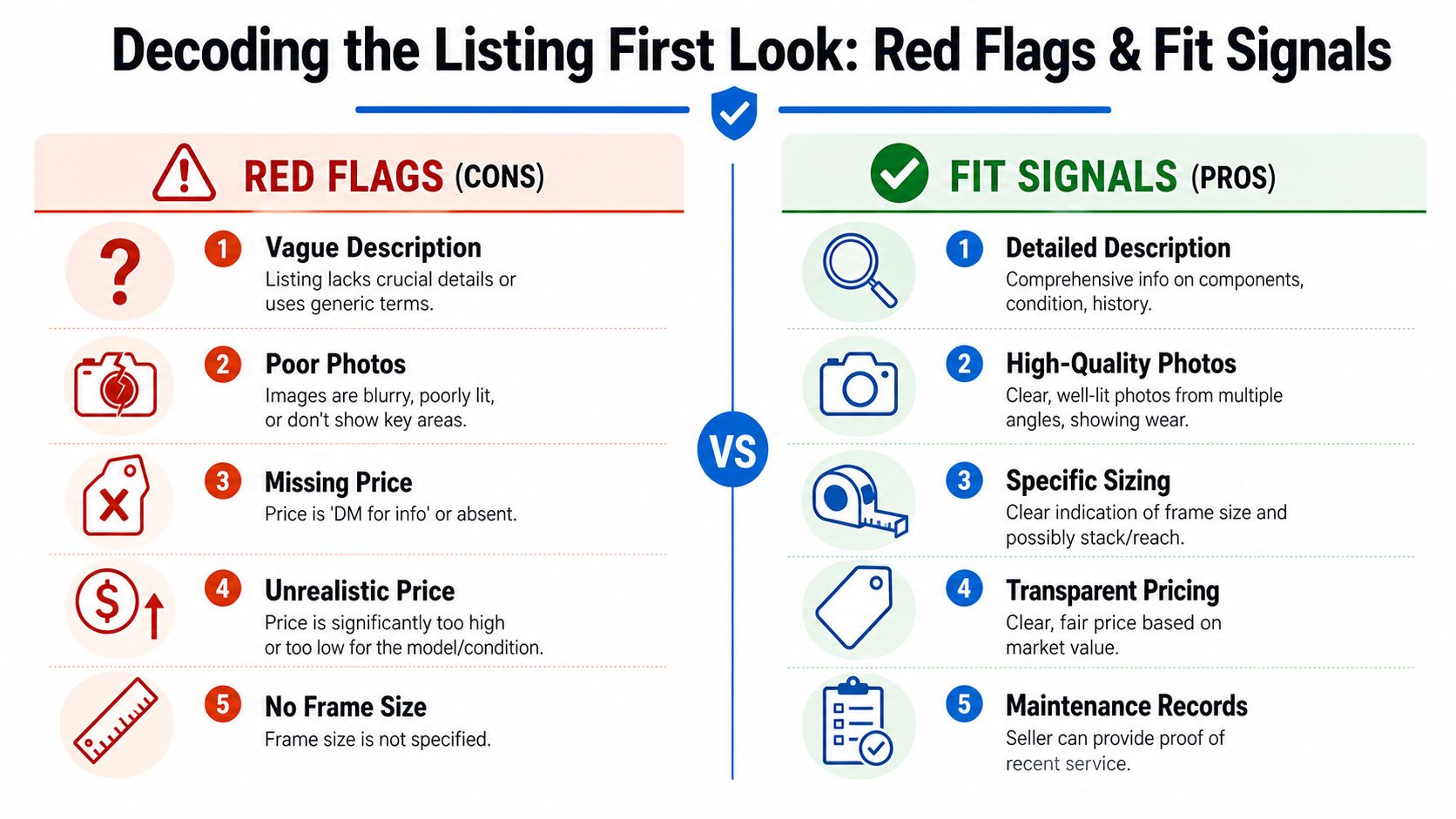
A listing is worth slowing down for if any of these are missing or unclear:
-
Exact model year
-
Full model name, not just the brand
-
Frame size plus enough detail to verify fit
-
Clear photos from both sides
-
Close-ups of drivetrain, brake calipers or disc rotors, shifters, fork, dropouts, and frame junctions
-
Brake and groupset details
-
Wheelset identification
-
Honest crash, storage, and service history
-
Explanation for a price that sits well below comparable bikes
Those points are not cosmetic. They tell you whether the seller knows what they own and whether they are trying to reduce your uncertainty. That affects value. Two bikes with the same asking price can carry very different risk.
A few listing patterns deserve extra caution:
-
“Upgraded” without part names or receipts
-
Photos taken only from far away
-
Drive-side photos missing
-
A frame size listed without the seller’s height or setup context
-
“Fits most riders” or “good for anyone around 5’8 to 6’1”
-
Refusal to send serial number photos, component photos, or underside frame shots
I treat those as confidence discounts. If the listing creates extra detective work, the bike is worth less until the seller clears it up.
A strong used road bike listing reduces uncertainty. A weak one leaves you paying for it later.
If you are comparing listings before contacting sellers, SYCLR’s guide to buying a road bike online can help you check fit, listing quality, and buyer confidence before you commit.
Fit signals matter before the in-person check
Size labels mislead buyers all the time. A 56 from one brand can fit very differently from a 56 in another model line, and even the same model can change shape across generations.
Cyclingnews’ used-bike buying guidance makes the same point in practical terms. Buyers get into trouble when they rely on the size sticker and ignore the geometry behind it.
Good listings give you enough information to make an early fit decision before you spend time arranging a viewing. Look for:
-
Published geometry, or at minimum a model year that lets you find it
-
Clear bike category, such as race, endurance, aero, or all-road
-
Stem length, spacer stack, and seatpost setback if the current setup matters to you
-
Saddle height from center of bottom bracket to saddle top, if the seller knows it
-
Photos that show bar height relative to saddle height
Those details help you separate a bike that is in your range from one that only shares your usual size label.
One practical tip from the workshop side. Sellers who photograph the bike carefully and answer direct fit questions clearly also tend to be better at describing wear accurately. Sellers who stay vague about fit often stay vague about everything else too. That pattern is common enough that I use listing confidence as an early filter, not an afterthought.
Beyond the Label A Practical Guide to Fit and Geometry
Fit is where a cheap used bike often stops being cheap.
A listing can look clean, the parts can be right, and the price can be tempting. If the frame shape is wrong for you, you either spend money trying to correct it with stems, spacers, and saddle adjustments, or you live with a bike that never feels settled. That is also where listing confidence matters. Sellers who know the model year, can point you to the geometry chart, and can answer setup questions usually understand what they are selling. That makes the true value easier to judge.
The label on the seat tube only gets you in the rough range. Stack and reach are what tell you whether the bike is likely to fit.
What stack and reach actually tell you
Competitive Cyclist explains stack and reach clearly. Stack is the vertical distance from the bottom bracket center to the top of the head tube. Reach is the horizontal distance to that same point.
Those two numbers describe the frame’s front-end shape far better than “54,” “56,” or “Medium.” They also give you something a seller cannot easily spin. If the geometry says the bike is long and low, no vague phrase like “should fit most riders around 5’10” changes that.
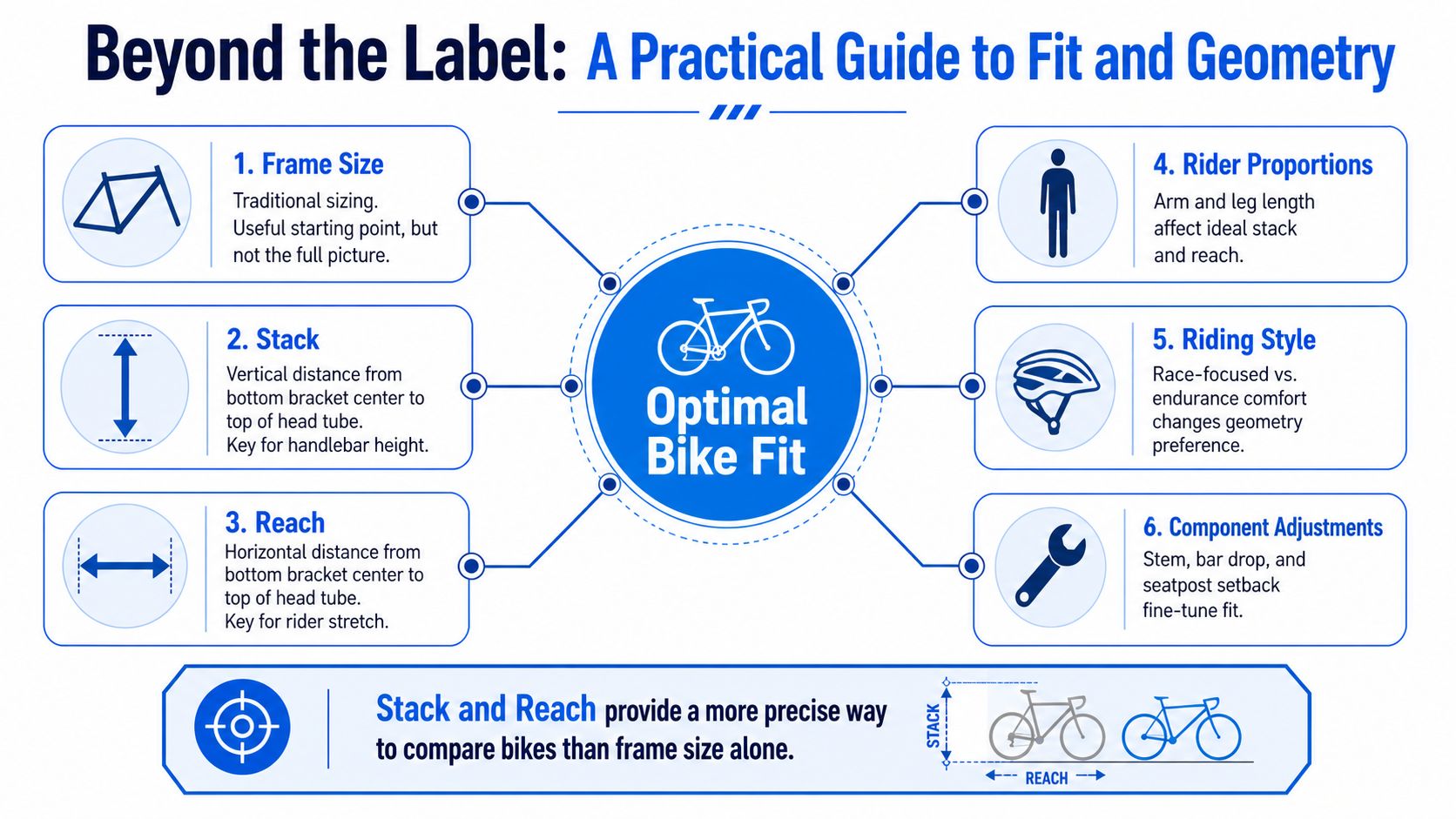
Use them like this:
-
More stack means a taller front end and an easier path to higher bar position.
-
More reach means a longer cockpit and more stretch to the bars.
-
Lower stack with longer reach usually points to a racier position.
-
Higher stack with shorter reach usually suits riders who want less drop and less weight on the hands.
If you are comparing more than one candidate, it helps to compare bike geometry side by side before you arrange a viewing.
Why two 56cm bikes can feel nothing alike
A 56cm race bike and a 56cm endurance bike can ride like two different categories of machine. One may put you low over the front wheel with a longer cockpit. The other may bring the bars up and back enough to feel calmer on long rides. The sticker does not tell you that.
I see buyers get caught here all the time with used bikes. They assume their current 56 means every other 56 is safe. Then they end up trying to fix a frame mismatch with a very short stem, a tower of spacers, or a saddle position that compromises pedaling.
Stack-to-reach ratio can help as a quick screen, especially if you already know you prefer an upright road position. A higher ratio usually means a friendlier front end. It is not a substitute for a proper fit, but it is a useful filter when a listing gives you limited information.
Buy the geometry that matches your position. Treat the size label as a rough sorting tool.
How to compare a listing to your current bike
Start with a bike you already know fits reasonably well. Compare the used bike’s stack and reach to that frame first. Then look at the parts that can shift the riding position, especially stem length, spacer height, handlebar reach, and seatpost setback.
Seller transparency affects value in a practical way. A confident seller will usually provide the model year, confirm whether the stem is original, mention if spacers were removed, and show a side-on photo that makes bar height obvious. A vague seller leaves you guessing whether the bike is suitable or just close enough to create expensive problems later.
Useful terms when comparing listings:
| Term | What it means | Why it matters |
|---|---|---|
| Frame size | The brand's labeled size | Good for shortlisting, weak for final fit judgment |
| Geometry | The frame's measured shape | Gives a much better read on fit and handling |
| Stack | Vertical front-end measurement | Helps predict handlebar height |
| Reach | Horizontal front-end measurement | Helps predict how stretched out the bike will feel |
| Endurance geometry | Taller front end, shorter feel | Often suits comfort-focused riding |
| Race geometry | Lower front end, longer feel | Often suits aggressive riding and strong flexibility |
| Fit details | Your known position or current-bike numbers | Makes it easier to rule bikes in or out before viewing |
If the exact chart is missing, published geometry from the manufacturer is still the standard to look for. You can estimate from other dimensions, but estimates are a fallback, not the first choice. On a used listing, missing geometry is not always a deal-breaker. It does lower listing confidence, and that should lower what you are willing to pay or how much time you spend chasing the bike.
The In-Person Inspection Your Complete Used Bike Checklist
A used road bike can look clean in photos and still need work the moment you bring it home. The in-person inspection is where you confirm whether the listing was honest, incomplete, or misleading.
What to inspect before you ride
Start with the broad stuff. Does the bike match the listing? Same model, same brake type, same wheelset, same condition story. Then inspect by system.
| Component/Area | What to Check | Why It Matters |
|---|---|---|
| Frame and fork | Look for cracks, dents, deep chips, ripples, repairs, and suspicious paint damage. Check fork legs, crown, dropouts, and underside of the down tube. | Structural issues matter more than cosmetic wear and can change whether the bike is worth buying at all. |
| Chain wear | Ask when the chain was last replaced. Use a chain checker if available, or at minimum inspect for rust, stiff links, and neglected condition. | Chain wear is the fastest early signal of maintenance quality and can hint at deeper cassette and chainring wear. |
| Cassette and chainrings | Look for hooked teeth, uneven wear, and dirty, neglected drivetrain parts. | A worn drivetrain can add immediate post-purchase cost and hurt shifting quality. |
| Brakes | Check pad life, rotor condition on disc bikes, or rim brake track wear on rim-brake bikes. Pull the levers and feel for firmness and smooth return. | Brake wear affects safety, feel, and near-term service needs. |
| Wheels | Spin both wheels. Check trueness, spoke condition, hub smoothness, and side-to-side play. | Wheel problems can range from a small tune-up to a costly repair. |
| Tires | Check tread, sidewall cuts, dry aging, and obvious flat spots. | Old or damaged tires are common and should affect value. |
| Headset | Apply front brake and rock the bike. Feel for knocking. Turn bars side to side for roughness. | Headset wear affects steering feel and can signal neglected maintenance. |
| Bottom bracket | Spin the cranks and feel for roughness or play. Listen for noise under light load if you can test ride. | Bottom bracket issues can be minor or annoying, but they should count in pricing. |
| Hub bearings | Rotate axles and feel for smoothness. Check for looseness. | Bearing wear changes ride feel and repair cost. |
| Shifters and derailleurs | Shift across the range if possible. Look for bent derailleur hangers, slow return, or sticky movement. | Functional shifting tells you a lot about maintenance and setup quality. |
| Cockpit and seat area | Inspect handlebar, stem, seatpost, saddle rails, and clamp areas for slip marks, over-tightening, or damage. | These areas often reveal crashes, poor assembly, or hidden replacement needs. |
| Pedals and contact points | Check for heavy scrape marks and asymmetrical damage. | They can reveal crash history or a hard life. |
If a seller describes the bike as “excellent” but the wear points say “overdue for service,” trust the wear points.
Why chain wear is the first wear metric to check
If I only get one quick maintenance clue on a used road bike, I check the chain first. A worn chain often means the cassette and chainrings may already be following it downhill. That doesn't make the bike a bad buy, but it changes what the asking price really means.
The same logic applies to the rest of the bike. Pads, rotors, tires, bearings, and cables aren't deal-breakers on their own. They're negotiation context.
A few in-person habits help:
-
Bring a small light to inspect dark frame areas and carbon junctions.
-
Wipe suspect spots with a clean rag so dirt doesn't hide damage.
-
Shift and brake under load if possible because stand-only checks miss problems.
-
Listen for seller clarity. Clear answers usually travel with clear maintenance habits.
What crash damage often looks like
Crash damage isn't always dramatic. On used carbon road bike listings, I pay close attention to the fork, head tube area, top tube junctions, and any sharp impact marks. On aluminum bikes, dents and paint distortion matter more than cosmetic scuffs.
Common clues include:
-
Scraped shifter bodies
-
Bar-end or lever scarring
-
Fork and dropout rash
-
Pedal grinding marks
-
Seat or saddle abrasion on one side
-
Mismatch between “never crashed” and visible impact signs
For fit adjustments after purchase, changes should stay controlled. Competitive Cyclist's road bike fit guidance recommends making saddle-height changes in 5 mm increments and stem or handlebar changes in 10 mm increments, then testing on a real ride before changing more. That's useful because it keeps buyers from trying to rescue an unsuitable frame with extreme setup choices.
Understanding Value Model Year Components and Fair Pricing
Used road bike value comes from specifics. The exact model year, frame material, groupset, brake type, wheelset, wear level, and listing confidence all shape what a fair price looks like.
Model year changes value more than many buyers think
A bike's model year does more than date the paint. It can affect geometry, tire clearance, axle standards, brake format, routing, and the generation of the frame itself. That's why “I think it's a 2021 or 2022” isn't a small detail. It weakens the entire comparison.
If the generation changed and the seller can't identify which one they have, you can't compare the listing cleanly against similar bikes. You also can't judge whether a used endurance road bike and a used race road bike are in the same category just because the seller says “road bike.”
Where the used road bike value sweet spot often sits
CycleSite's guide to used road bikes identifies a useful value range: used road bikes in the $400–$700 USD range (£300–£600 GBP) often represent a sweet spot, typically with 2–4-year-old aluminum frames and reliable Shimano 105 or Tiagra builds. That's a practical range because the bikes are often modern enough to ride well but already past the steepest early depreciation.
That doesn't mean every bike in that bracket is a smart buy. It means the category often contains strong value if the listing is clear and the condition checks out.
The best-value used road bike usually isn't the cheapest bike in the search. It's the one where the asking price matches the bike's age, parts, wear, and uncertainty level.
How to judge fair pricing without guessing
There's no single universal used-bike number that settles value. Fair pricing is a comparison exercise.
Start with the exact match criteria:
-
Same brand and full model name
-
Same model year or same frame generation
-
Same frame material
-
Same groupset tier
-
Same brake type
-
Same or similar wheel level
-
Same size, if possible
Then adjust for what you learned:
-
Price should move down if the listing is vague, the seller avoids questions, the chain looks neglected, the wheels need work, or key parts are mismatched.
-
Price can hold firmer when the seller provides the exact year, clear photos, useful maintenance records, and fit or geometry context.
-
Walk away when the bike might still be legitimate but the uncertainty is too high for the ask.
A used carbon road bike with weak seller details is often worse value than a slightly pricier aluminum bike with strong documentation and a better fit match. That's the difference between low price and real value.
How SYCLR Helps You Compare Used Road Bikes Smarter
Cheap used bikes get too much attention. The better signal is listing confidence, because a fair price only means something when the seller gives you enough detail to trust what you are buying.
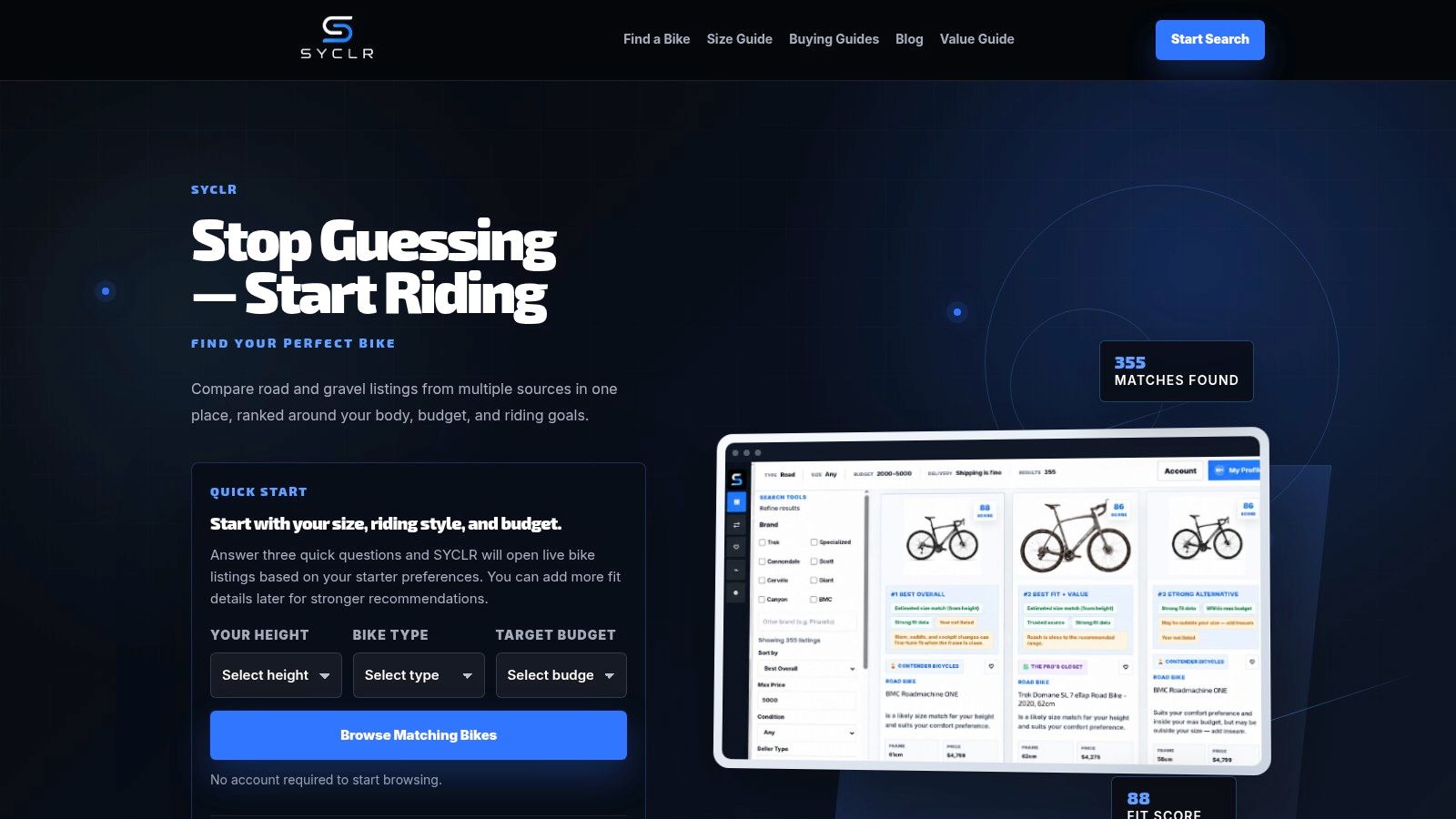
SYCLR helps sort used road bike options by the details that change real buying risk. That includes fit clues, geometry clues, model year context, asking price, and the overall quality of the listing itself. If you want a broader view of the platform, you can explore the bike search experience.
That last part matters more than many riders expect. Two bikes can share the same size sticker, groupset label, and price range, yet one listing gives clear photos, exact build details, and enough information to verify fit, while the other leaves you guessing. Those bikes should not carry the same confidence level, and they do not deserve the same offer.
General marketplaces are good at showing inventory. They are weak at helping you compare uncertainty. SYCLR is useful because it gives structure to the mess. Instead of bouncing between tabs and trying to remember which seller listed the crank length, which one hid the drive-side photo, and which one never stated the model year, you can compare listings with the right context in one place.
That can help buyers avoid paying full price for uncertainty.
It also helps prevent a common mistake I see all the time. Riders chase the lowest asking price, then end up buying the listing with the worst documentation, the hardest fit to verify, and the highest chance of surprise repair costs. A slightly higher-priced bike with a clean, specific listing is often the safer buy because the risk discount is smaller from the start.
A quick walkthrough helps show how that buying flow works in practice.
If you are actively shopping, use SYCLR to compare used road bike listings side by side, then treat the shortlist as a filter before you message sellers or set up a viewing. Add your height, bike category, budget, and, if you know them, your fit details from a current bike. The goal is simple. Spend time on listings that show strong fit alignment and strong seller transparency, and avoid paying full price for bikes that still come with too many unanswered questions.
Frequently Asked Questions About Buying Used Road Bikes
A used bike purchase usually goes wrong before the test ride. It starts with a vague listing, missing photos, fuzzy model details, or a seller who answers simple questions with half-answers. That is why listing confidence matters. It changes how much risk you are buying, not just what shows up on the price tag.
Is a professional pre-purchase inspection worth it?
Yes, especially on higher-value bikes and any carbon frame. Your own review should catch listing issues and obvious red flags, but a mechanic can spot expensive problems such as hidden crash damage, worn bearings, misaligned hangers, or parts that are close to replacement.
Is it safe to buy a used road bike that needs shipping?
It can be. The standard should be higher.
Ask for clear drive-side and non-drive-side photos, close-ups of wear points, the full model name, confirmed size, and a clear packing plan. Shipping removes your chance to notice small problems in person, so weak documentation should lower your offer or end the conversation.
What if the seller has no original proof of purchase?
That does not automatically end the deal, but it does reduce confidence. A credible seller should still be able to explain when they bought it, what the exact model is, what parts have been changed, and why they are selling it.
If the story stays vague, treat that as part of the valuation.
How much should I budget for immediate repairs on a used road bike?
Assume there will be some cost unless the listing and inspection both say otherwise. Tires, chain, cassette, bar tape, brake pads, cables, sealant, and a basic tune-up add up fast.
A cheap bike with unclear wear can become an average-priced bike within one service visit.
What matters more, frame material or fit?
Fit usually matters more. A carbon frame with the wrong stack and reach is still the wrong bike. An aluminum bike that matches your position, has a clear ownership story, and shows honest condition can easily be the better buy.
A carbon frame with the wrong stack and reach is still the wrong bike. An aluminum bike that matches your position, has a straight ownership story, and shows honest condition is often the better buy.
Can I trust a size label like 54cm or 56cm?
Use it as a filter, not a decision. Size labels are too blunt on their own because two 56cm bikes can fit very differently at the front end.
If the listing includes geometry, compare it. If the seller cannot confirm basic fit details, confidence drops.
Should I buy the cheaper bike if the parts look better?
Only if the full picture holds up. Better parts do not cancel out uncertain fit, missing model-year details, poor photos, or a seller who avoids direct questions.
The stronger deal is usually the listing with fewer unknowns.
If you are comparing used road bikes now, start with your height, bike type, and budget in the SYCLR app. SYCLR helps you compare used road bike listings by fit signals, geometry, model year, price context, condition signals, listing quality, and confidence signals so you can shortlist better-fit bikes before you message sellers. Already know your current-bike geometry, stack, reach, or fit-report details? Use your fit details to improve your recommendations.