Aero Bike vs Climbing Bike: Which Is Faster for Your Riding?

You're probably staring at two used road bikes right now. One has deeper tubes, integrated cables, and a lower front end. The other is lighter, simpler, and looks easier to live with. The right choice in the aero bike vs climbing bike debate usually isn't about a universal “faster” bike, it's about whether your route, position, and fit tolerance match the bike you can ride well. On real climbs, the crossover isn't fixed, and on mixed terrain the aero bike can still win overall, which is why buyers need to look at geometry signals, complete-bike weight, and listing confidence instead of just the category label.
Table of Contents
What the Aero vs Climbing Choice Really Comes Down To
The fastest answer is simple. Choose an aero bike when you can hold speed, stay in the intended position, and spend most of the ride on flatter or rolling paved terrain. Choose a climbing bike when repeated elevation changes, quick accelerations, and easier fit adjustment matter more than drag reduction.
That's why two riders on the same course can land on different bikes. One rider may have the flexibility and torso position to stay low on an aero frame, while another needs more stack, more spacer room, and a cockpit that can still be adjusted after purchase. A cheaper listing can still be the riskier buy if it locks you into the wrong front-end height or a proprietary stem you can't change easily.
Core thesis: the best deal is only a good deal if the bike fits your body, your route profile, and your tolerance for adjustment risk.
The important shift is to stop thinking of this as a simple flat-versus-hills question. The decision lives at the intersection of route profile, position sustainability, and fit-adjustment flexibility. If you're comparing used bikes, that means the listing with the cleaner geometry and clearer specification often deserves more weight than the one with the flashier frame shape.
If you already know your fit targets, compare fit and geometry signals in SYCLR before you chase a deal.
Defining Aero Bikes and Climbing Bikes
Aero bike means drag reduction first
An aero road bike is a race bike built to reduce drag, preserve speed, and stay efficient when the rider can hold a forward, low position. That usually shows up as deeper tube shaping, tighter integration around the cockpit and cables, and a frame that's designed around fast paved riding rather than minimal mass alone.
What the rider feels is pretty specific. On fast stretches, an aero bike tends to reward steadier pressure on the pedals and a position that stays planted. On exposed roads, the frame can feel calmer at speed because the whole package is built to hold momentum rather than chase the lightest possible build.
Climbing bike means low mass and responsiveness
A climbing bike is a lightweight performance road bike designed to feel lively on repeated rises, steep efforts, and technical course changes. The emphasis is usually on lower complete-bike weight, easier acceleration, and geometry that feels easier to manage when the pace changes often.
That doesn't mean it's slow on flat roads. It means the design priorities are different, and that matters when you're shopping used. A climbing bike with a straightforward cockpit and standard parts can be easier to fit, easier to service, and less awkward to own if you don't want a bike that's locked into one riding position.
A useful way to think about the two is that design intent matters more than the label. Modern race bikes often borrow from both camps, which is why exact model year, build, and geometry matter more than category shorthand. That's also why the cleanest comparison is always a complete-bike comparison, not just a frame naming exercise.
Geometry and Rider Position Compared
Aero and climbing bikes separate most clearly in stack, reach, cockpit shape, and how much adjustment the front end allows. Head tube length can hint at the bike’s shape, but it’s not a clean classifier because fork design and frame construction affect that number. Stack is the more honest vertical-fit signal, and reach tells you how long the rider triangle really feels. Use the road bike geometry comparison guide to place those measurements in the broader context of race, endurance, aero, climbing, and all-road frames.
For a buyer, that matters more than brand reputation. An aero bike often sits lower and longer, while a climbing bike is often slightly taller and shorter for the same general size class. That doesn't make one universally more aggressive, it just changes how easy it is to hold the intended position over time.
Here's a representative geometry example, not a universal rule or a SYCLR average. It's a simple illustration of the pattern riders usually see:
| Measurement | Aero bike (illustrative) | Climbing bike (illustrative) |
|---|---|---|
| Stack | 545 mm | 555 mm |
| Reach | 395 mm | 390 mm |
| Weight | 8.1 kg | 7.2 kg |
The pattern is more important than the exact numbers. The aero bike is lower and longer, while the climbing bike is lighter and slightly less aggressive in the front end. Actual results vary by size, build, wheels, and model year, so you can’t classify a bike from one measurement alone.
What to compare beyond stack and reach
A good geometry read also includes head tube angle, wheelbase, front-center, chainstay length, bottom bracket drop, stem length, bar reach, spacer allowance, and cockpit integration. Those details influence steering feel, weight distribution, and whether the bike still works after setup changes.
Use a broader geometry comparison tool to compare shapes side by side. It’s especially helpful when two listings have the same size label but very different rider positions.
Practical rule: if the cockpit leaves you no spacer room and no realistic stem adjustment, treat that listing as a higher fit-risk option even if the frame itself looks right.
Weight, Aerodynamics, Acceleration, and Handling
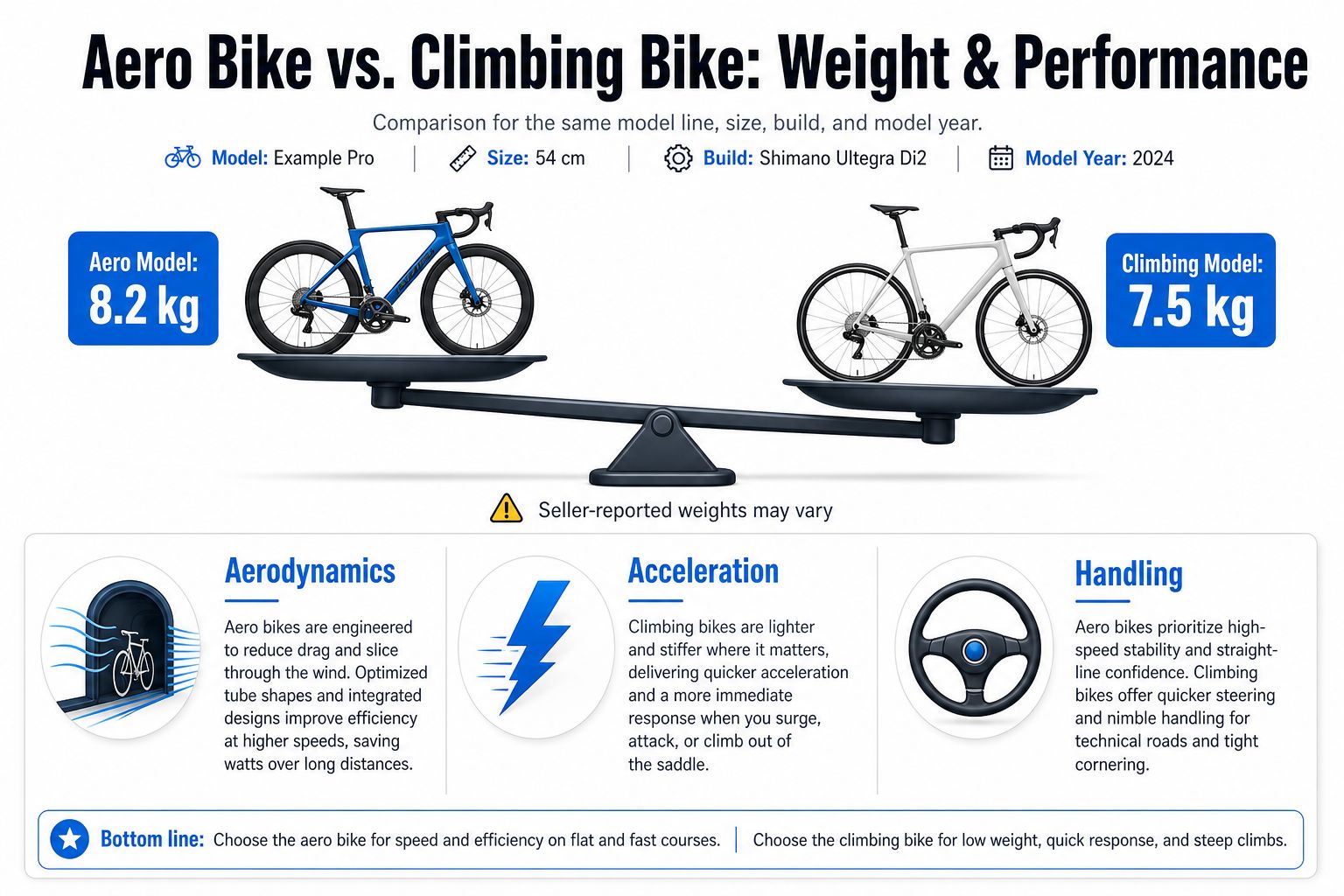
Weight only means something useful when it is tied to the exact model, size, build, and model year. Seller-reported weights can hide pedals, cages, wheels, power meters, and other accessories, so a listing weight is not always a clean apples-to-apples number. A modern aero bike can still come in lighter than an older or lower-spec climbing bike, depending on the build.
Aerodynamics and speed retention
Aero bikes can hold speed better on fast, exposed sections because the frame, cockpit, and wheel choices are shaped around drag reduction. That makes the aero-versus-lightweight decision more complex than a simple weight check. On real routes, the bike that preserves momentum more effectively can feel easier to ride even if it is not the lightest option.
Acceleration and handling
Climbing bikes often feel more responsive when the road keeps changing. Short climbs, repeated punchy efforts, and quick speed changes can make a lighter frame feel more lively under the rider. Handling can also feel more direct, although that depends on the exact geometry rather than the category name alone.
Aerodynamic design can matter at sustained road speeds, especially when the rider can maintain the intended position. A lighter climbing bike may feel more responsive during steep climbs and repeated accelerations. The practical difference depends on total system weight, rider position, power, wind, wheels, tires, gradient, and the exact bikes being compared.
Avoid treating one speed, wattage, gradient, or crossover point as universal. The better choice is the bike whose advantages align with the route and whose position the rider can sustain.
Buyer consequence: if the frame shape does not match the rider’s position or cockpit needs, the owner may end up chasing fit changes that the bike was not built to accommodate easily.
Matching Each Bike to Flat, Rolling, Mountain, and Technical Terrain
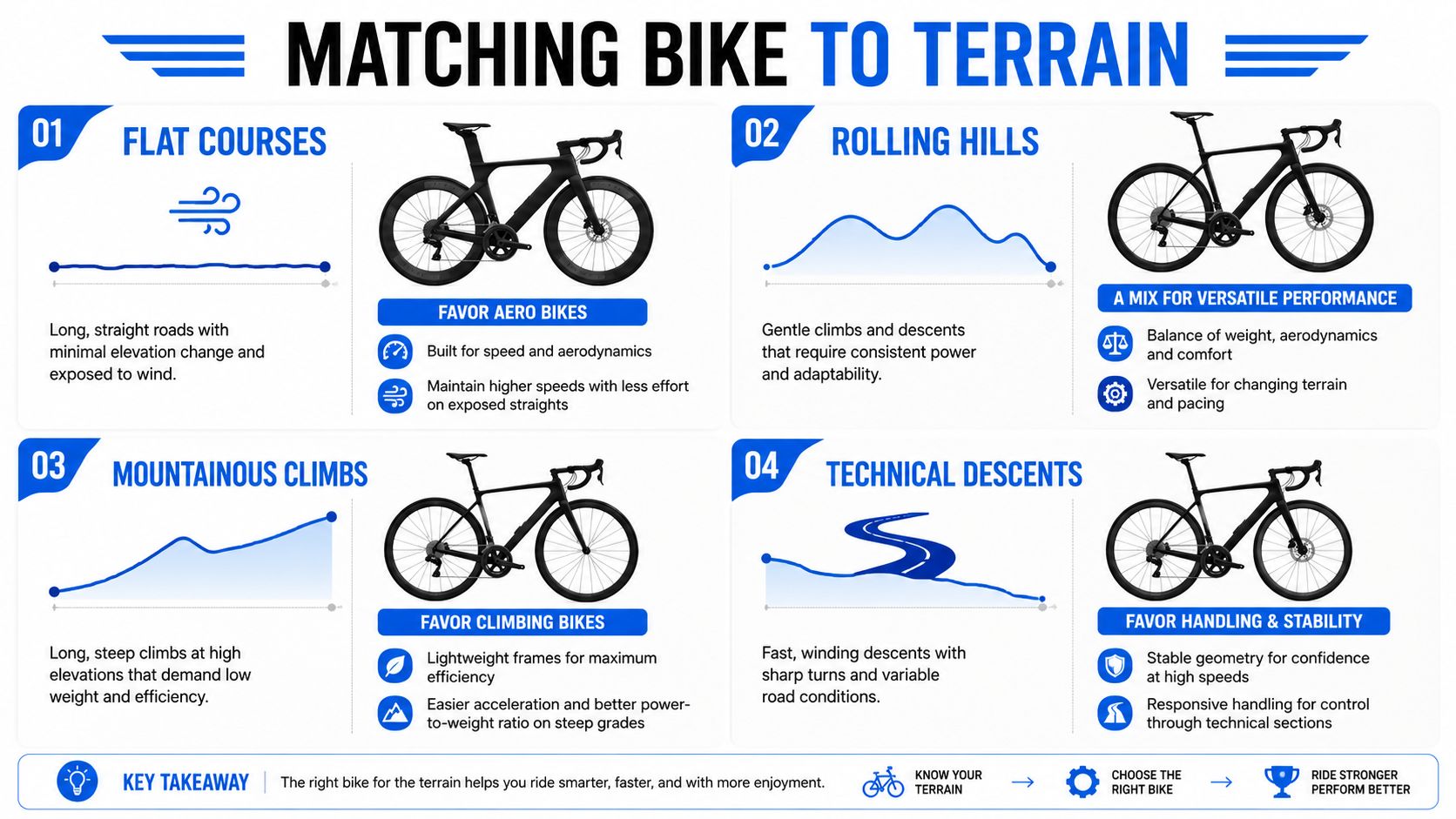
Flat courses are the clearest win case for the aero bike. If the rider can stay in position and the route has long exposed straights, the frame’s drag reduction and speed retention matter more than shedding a small amount of mass. That’s the kind of ride where the bike’s intended posture and front-end shape can be worth more than a few hundred grams.
Rolling terrain is where the decision gets messy. The aero side still helps on faster sections, but every short rise, corner, and re-acceleration starts to favor lower mass and easier handling. This is why many riders overbuy aero for rides that look fast on paper but never settle into one steady rhythm.
| Decision factor | Aero bike | Climbing bike | Better choice when |
|---|---|---|---|
| Primary emphasis | Aerodynamic efficiency and speed retention | Lower weight, acceleration, and climbing responsiveness | Match the bike to the route’s dominant demands |
| Rider position | Often designed around a low race position | Model dependent and sometimes easier to adapt | Choose the position you can sustain |
| Complete-bike weight | May be higher because of shaping and integration | May be lower, but not universally | Compare verified weights for equal sizes and builds |
| Flat terrain | Often the stronger specialization | Capable but less aero-focused | Speed is high and sustained |
| Long climbs | Can still climb very well | May benefit from lower mass | Gradient and elevation dominate |
| Rolling terrain | Strong when fast sections are sustained | Strong when climbs and accelerations repeatedly interrupt pace | Choose based on the route rhythm |
| Acceleration | May prioritize speed retention | May feel more responsive during repeated changes of pace | Surges and short climbs are frequent |
| Handling | Depends on complete geometry | Depends on complete geometry | Compare wheelbase, trail, front-center, and tires |
| Cockpit integration | Common | Increasingly common | Verify the exact system rather than the category |
| Fit adjustment | May be restricted by proprietary parts | May be easier or equally restricted | Confirm stem, bar, spacer, and steerer options |
| Service complexity | Can be higher with internal systems | Model dependent | Replacement availability and service access matter |
| Used-listing risk | Fit, integration, and proprietary parts require careful verification | Weight claims, condition, and cockpit details require verification | Favor the clearer, better-documented listing |
| Best overall match | Fast paved routes and sustained speed | Elevation-heavy routes and repeated accelerations | Choose by fit, terrain, price, and listing confidence |
When climbing bikes can surprise you
A climbing bike can be the stronger choice on mountainous routes and on technical rolling courses with short climbs, sharp corners, and repeated accelerations. That kind of terrain rewards a rider who can keep changing speed without feeling locked into one aggressive front-end position for hours.
A representative scenario makes the tradeoff clearer. A rider heads into a hilly gran fondo and first chooses an aero bike because the event includes exposed sections. After comparing the listings, the rider sees that the aero bike has a lower front end, a more restrictive integrated cockpit, and a higher complete-bike weight than the climbing bike. The climbing bike matches the rider’s known position more closely, feels easier to accelerate on repeated climbs, and is simpler to adjust, so it becomes the more practical choice for that route.
That doesn’t mean climbing bikes always win in the hills. It means terrain interrupts matter. If the route keeps breaking up any aero rhythm, the lighter, more responsive bike can be the smarter ride even when it isn’t the obvious climbing weapon.
Common rider scenario: the route isn’t a pure mountain stage, it’s a rolling course with short climbs, technical descents, and constant accelerations. In that setting, the climbing bike can be the better overall buy.
Integrated Cockpits, Proprietary Parts, and Fit Risk
Some climbing bikes use separate handlebars and stems, while others use the same integrated systems found on aero bikes. Verify the cockpit, seatpost, routing, spacer limits, replacement-part availability, and service requirements on the exact model.
The fit risk shows up in ownership, not just purchase. If the bar has been cut, the steerer is already short, or the stem is a brand-specific part, your options shrink. That matters when a used bike looks almost right but sits a little too low, too long, or too aggressive for the rider’s current position.
What to verify in listing photos
-
Bar and stem spec: Check whether the cockpit is OEM or replaced, because that changes both fit and future replacement cost.
-
Spacer stack: Look for the number of spacers under the stem, since that tells you how much front-end adjustment is still available.
-
Steerer height: A short steerer can limit future changes even if the current fit seems close.
-
Cable routing and part standardization: Internal systems may look neat, but they can complicate service and part sourcing.
Practical rule: if the listing hides the cockpit details, assume the fit risk is higher until the seller proves otherwise.
For broader context on race-bike cockpit tradeoffs, the race bike versus aero bike comparison page is the right place to start.
Used Listings Model Year, Value, and Buyer Confidence
Model year matters because bike design changes don’t show up evenly across the market. An older aero bike may lack current integration standards or the braking setup you prefer, while an older climbing bike may still feel light but show more wear in bearings, wheels, or other components. The category label alone doesn’t tell you enough about the bike’s actual ownership risk.
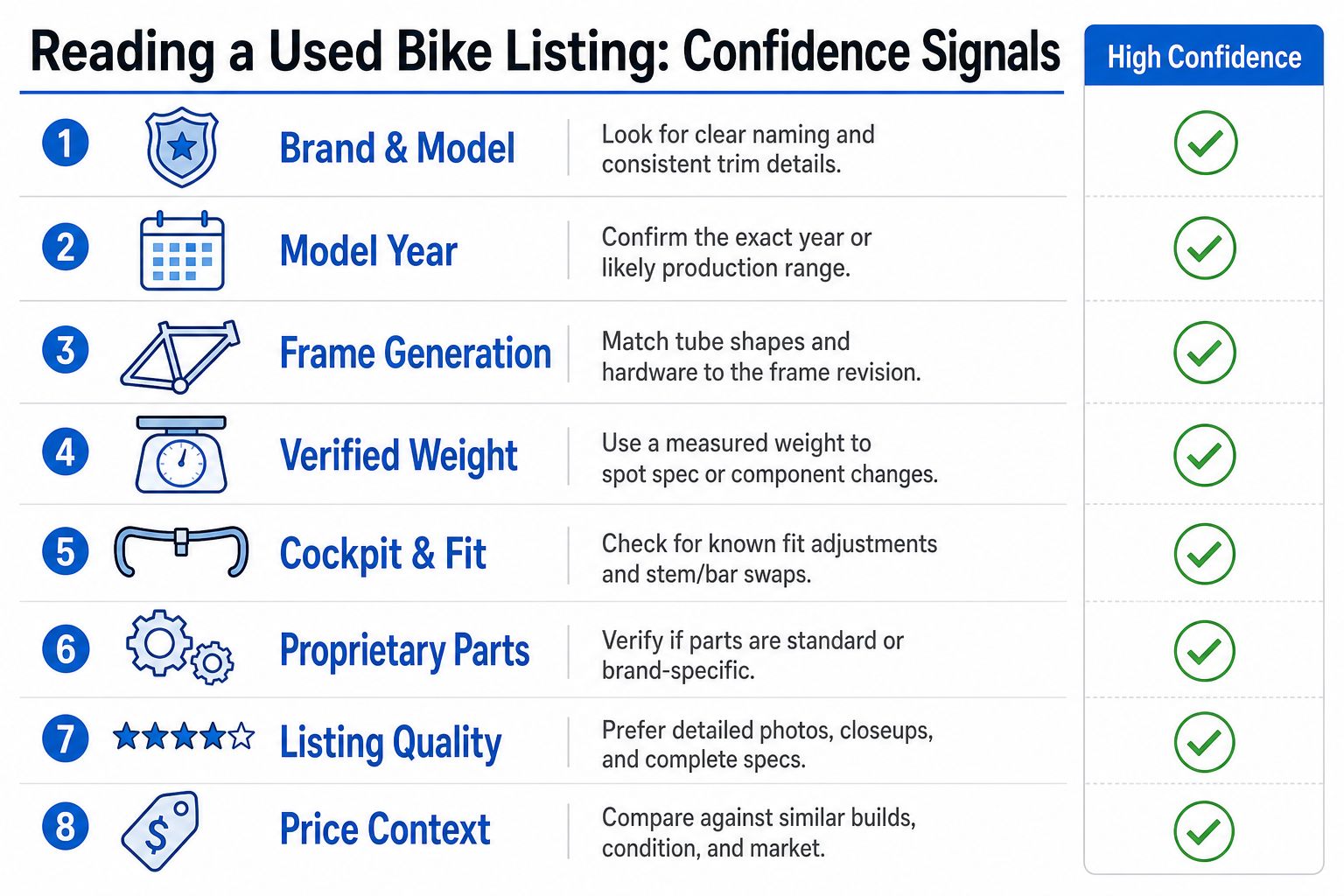
A better listing read starts with brand, model, year, frame generation, size, complete-bike weight, cockpit, proprietary parts, groupset, wheelset, condition, crash history, fit adjustability, and listing completeness. That’s the buyer-side checklist that gives you a real confidence signal instead of a vague gut feel.
Quick confidence checklist
-
Model and year match: Confirm the frame generation so you know what standard you’re buying.
-
Weight is explained: Treat the listed weight carefully if the seller doesn’t say what’s included.
-
Cockpit details are visible: Missing stem, bar, or spacer information is a warning sign.
-
Condition photos are complete: Close-ups of the drivetrain, wheels, and contact points help reduce uncertainty.
-
Price context is coherent: Compare the asking price against the spec, condition, and fit, not just brand name.
Compare used-bike value with more structure before you make an offer. That keeps you focused on comparable value, condition risk, fit uncertainty, and listing uncertainty instead of a headline price alone.
Aero Bike vs Climbing Bike FAQ
Is an aero bike faster than a climbing bike?
An aero bike may be faster during sustained high-speed riding, but it is not universally faster. Rider position, wind, terrain, wheels, tires, weight, and the exact models all affect the result.
Is a climbing bike always lighter?
No. Climbing-oriented bikes often prioritize low weight, but a premium aero bike can weigh less than an older or lower-spec climbing bike. Compare complete-bike weights for the same size and build level.
Can an aero bike climb well?
Yes. Modern aero bikes can climb extremely well. The practical comparison depends on complete-bike weight, gearing, rider position, gradient, and how much of the route is spent at higher speed.
Which bike is better for rolling terrain?
A climbing bike may suit routes with constant rises, corners, and accelerations. An aero bike may suit rolling routes where the rider can maintain high speed for longer sections.
Which geometry measurements matter most?
Start with stack, reach, stem length, handlebar reach, spacer allowance, wheelbase, front-center, trail, and cockpit integration.
Are aero bikes harder to fit?
Not automatically. Some aero bikes have restrictive proprietary cockpits, while others offer useful adjustment. Some climbing bikes are equally integrated. Verify the exact model.
Can SYCLR help compare aero and climbing bikes?
SYCLR helps compare available road-bike listings using fit signals, geometry signals, model-year context, price context, listing quality, and confidence signals.
How SYCLR Helps Compare Aero and Climbing Listings
If you are comparing aero and climbing-oriented road bikes, start with your height, bike type, and budget in the SYCLR app. Compare available fit signals, geometry signals, complete-bike details, model-year context, price context, listing quality, and confidence signals before building your shortlist.
Already know your stack, reach, current-bike geometry, or fit-report details? Use the advanced fit entry to improve your recommendations.