
Used Bicycle Value: What Actually Makes a Used Bike Worth Buying?
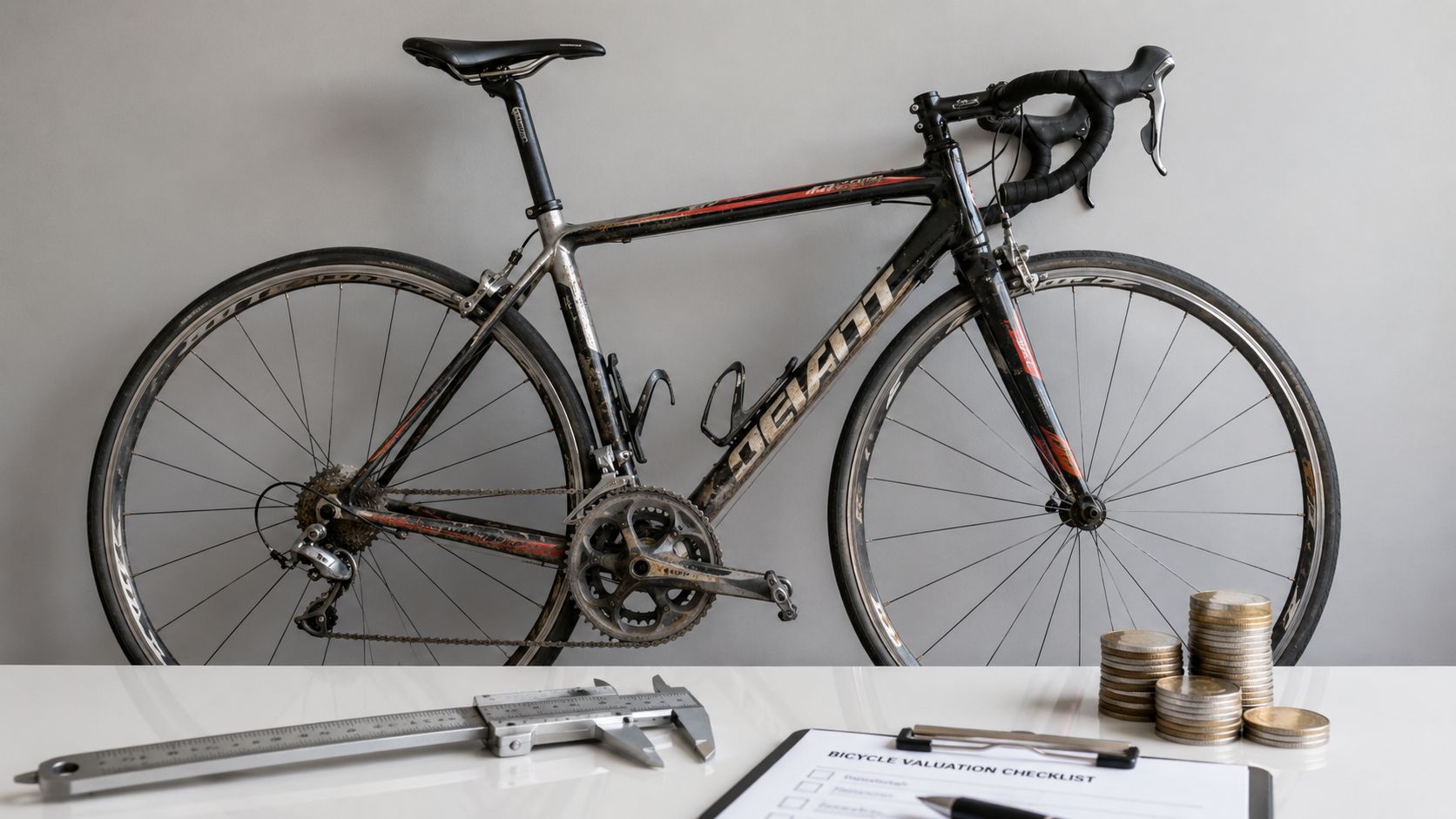
Used bicycle value starts with comparable listings, then changes based on fit confidence, condition, model year, components, and listing quality.
The most popular advice on used bikes is still too simple. Sellers lean on original MSRP. Buyers anchor to the cheapest listing they can find. Both approaches miss the point. A cheap bike that does not fit is low value to you. An expensive bike with a vague listing might still be overpriced because the seller has not removed enough uncertainty to justify the ask.
For road and gravel riders, used bicycle value isn’t one number. It’s a range. The practical way to judge that range is to compare similar bikes, then discount for condition risk, fit uncertainty, and listing uncertainty.
Table of Contents
What Is a Used Bike Really Worth?
A used bike is worth what similar bikes are commanding, adjusted for the risks attached to the specific listing you’re looking at. That’s why generic pricing tools can be helpful as a reference, but they shouldn’t be treated as the answer.
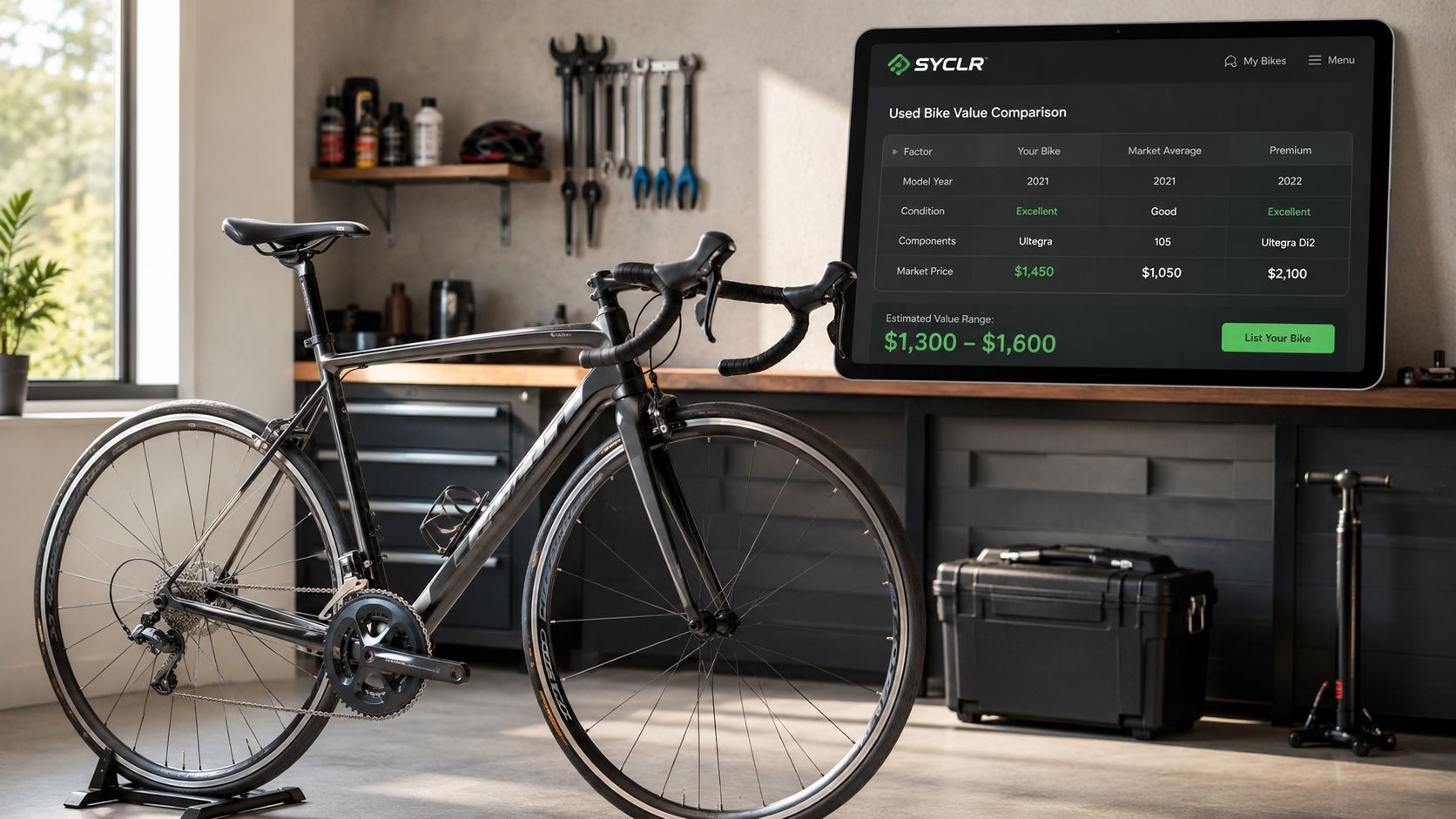
Why simple depreciation isn’t enough
Simple depreciation rules can be useful as a rough starting point, but they break down quickly. A bike’s current value depends on the exact model year, frame generation, condition, components, fit confidence, and how clearly the seller documents the listing.
Original MSRP tells you where the bike started. It does not tell you what the current listing is worth.
It isn’t enough for a buying decision.
A carbon endurance road bike with hydraulic disc brakes, clear service history, and confirmed geometry isn’t worth the same as another bike with the same age and logo but unknown wear, mystery upgrades, and a vague size tag. Road and gravel bikes are especially sensitive to these differences because geometry, drivetrain condition, and spec level all change how usable the bike is on day one.
Practical rule: Original price explains where the bike started. It doesn’t tell you what the current listing is worth.
What fair value actually includes
When I look at a used listing, I care about five things before I care about the seller’s story:
-
Comparable market context
Same brand, model, frame generation, and build level. -
Fit confidence
Whether the size and geometry are clear enough to trust. -
Condition risk
Drivetrain, brakes, wheels, tires, bearings, and frame/fork integrity. -
Component reality
Whether upgrades are relevant, compatible, and documented. -
Listing confidence
Photos, details, service notes, and seller responsiveness.
That matters in a market this large. The global used bicycle market was valued at $38.7 billion in 2021 and is projected to reach $66.2 billion by 2031, growing at a 5.6% CAGR from 2022 to 2031, according to Allied Market Research’s used bike market projection. Buyers have options, so weak listings don’t deserve premium pricing.
If you’re comparing road and gravel listings and want a faster way to organize the basics, you can compare road and gravel bike listings with SYCLR and start narrowing by fit, budget, and confidence signals.
How to Find and Compare Baseline Value
Before adjusting for risk, you need a baseline. That means finding bikes that are closely comparable, not just vaguely similar.
Start with the exact bike, not the brand
Brand alone doesn’t build a useful baseline. A Specialized Tarmac, Trek Domane, Canyon Endurace, or Cervelo Aspero can vary sharply by frame generation, geometry, brake standard, and groupset even when the frame size on the sticker looks close.
The cleanest starting point is this sequence:
-
Confirm the full model name
Not just “Trek road bike” or “Cannondale gravel bike.” -
Confirm the model year or frame generation
That often tells you more than the seller realizes. Geometry, tire clearance, axle standards, cable routing, and drivetrain expectations often track with generation changes. -
Match the original build as closely as possible
Shimano 105 isn’t Ultegra. Mechanical isn’t electronic. Rim brake isn’t hydraulic disc.
Some valuation guides use age-based ranges to estimate depreciation, but those ranges should only be a starting point. A 3–5-year-old bike can vary widely in value depending on frame generation, groupset, brake type, wheelset, condition, and seller documentation.
What to match when comparing listings
For a realistic used bike valuation, compare these attributes as tightly as you can:
-
Brand and model
-
Model year or frame generation
-
Frame material
-
Groupset level
-
Brake type
-
Wheelset level
-
Frame size
-
Road or gravel category match
-
Overall condition
Here’s a practical comparison table.
| Baseline factor | Why it matters | What throws off the comparison |
|---|---|---|
| Brand and model | Establishes the right family of bikes | Comparing endurance bikes to race bikes |
| Model year | Anchors geometry and standards | Mixing generations |
| Frame material | Changes demand and replacement cost | Assuming all carbon or all alloy is equal |
| Groupset | Strong effect on buyer demand | Ignoring partial swaps |
| Brake type | Big difference in current buyer expectations | Comparing rim and hydraulic disc directly |
| Wheelset | Affects both ride feel and value | Treating stock and premium wheels the same |
| Size | Demand and fit both matter | Ignoring whether the size is common |
| Category match | Gravel and road buyers value different traits | Comparing a race road bike to an all-road build |
If you are comparing used listings and need a broader buying framework first, SYCLR’s guide to used road bikes can help you evaluate fit, condition, model year, and listing confidence before you start judging price.
A baseline should be boring. If your comp set includes different frame generations, mixed groupsets, and unclear sizes, your valuation won’t hold up.
Why a Good Deal on the Wrong Size Is Worth Nothing
A used bike can be fairly priced and still be a poor buy. That’s especially true with road and gravel bikes, where small geometry differences change comfort, handling, and how much adjustment room you have.
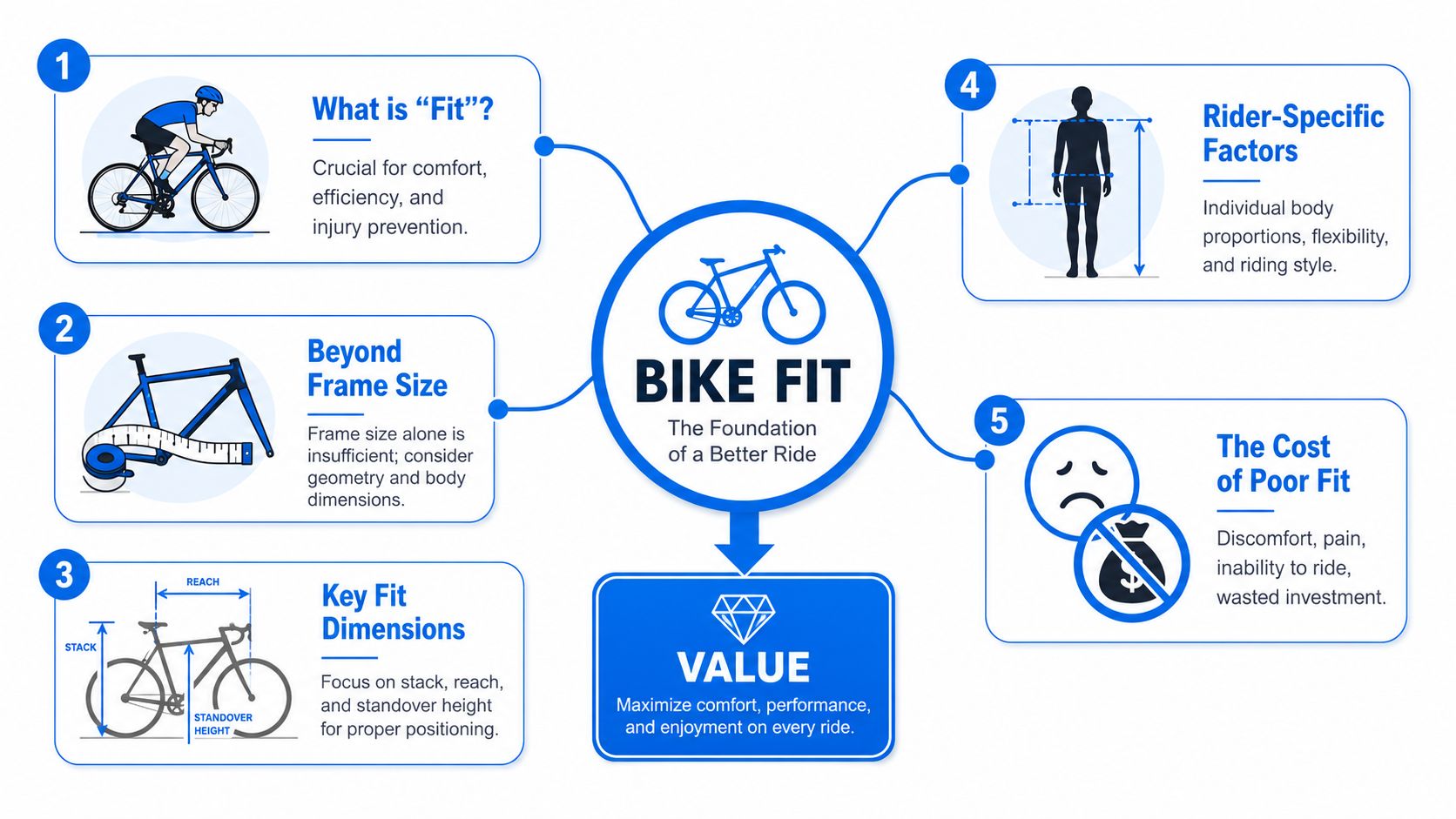
Frame size is only the start
Frame size labels are inconsistent. One brand’s 56cm can feel close to another brand’s 54cm, and “Medium” is even less reliable.
For used bicycle value, what’s important is fit confidence. Can you verify that the bike’s stack, reach, and intended category line up with what you know works for your body and riding style? That’s a much stronger signal than trusting the seat tube sticker.
Traditional valuation guides usually normalize for year and spec, but often ignore fit. That’s a major gap. Pro’s Closet notes that a 10–15 mm stack mismatch can make a road or gravel bike unusable for a rider, yet there is no standard pricing adjustment for a better-fitting frame versus a mismatched one in its discussion of what a bike is worth.
If you’re still cross-shopping general listings, buying a road bicycle online gets a lot safer when you treat geometry as part of value, not a separate sizing issue.
Fit confidence changes value
A road bike listing that includes stack, reach, detailed geometry, and a clear size chart is worth more than a similar listing that says only “fits most riders.” Not because the bike itself is magically better, but because the buyer can evaluate it properly.
That creates a simple decision rule:
-
High fit confidence supports stronger value
-
Low fit confidence justifies a discount
-
Wrong-fit certainty makes the bike low value to you, even if the asking price looks attractive
A bike that doesn’t fit isn’t discounted enough until the price reflects the fact that you may not be able to use it as intended.
For riders who already know their numbers, you can also use your fit details to improve your recommendations when comparing road and gravel options.
Inspecting Condition and Valuing Upgrades
Condition is where asking prices often fall apart. Sellers remember what they spent. Buyers inherit the wear.
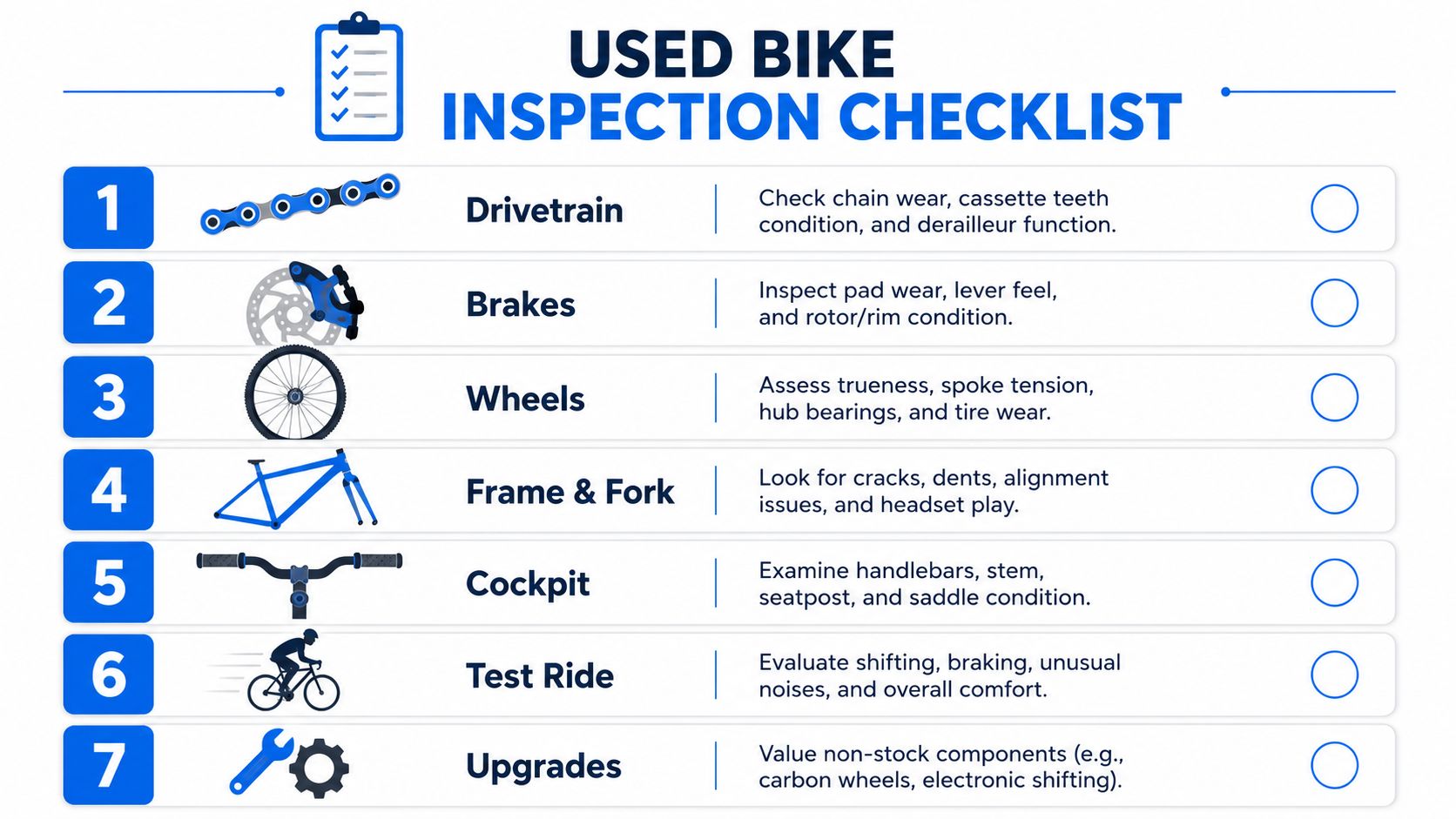
What to inspect before you trust the price
Start with the parts that are expensive, easy to wear out, and annoying to replace right after purchase.
Drivetrain comes first. Look for chain wear, hooked cassette teeth, worn chainrings, and vague answers about mileage or recent replacement. A worn drivetrain can meaningfully reduce value because the buyer may inherit chain, cassette, chainring, and labor costs immediately after purchase. That does not make the bike a bad buy, but it should change the offer.
Then move to the rest:
-
Brakes
Check pad wear, rotor condition, lever feel, and whether the listing clearly confirms rim or hydraulic disc. -
Wheels
Look for dents, cracks, sidewall wear, poor spoke tension, and rough hub bearings. -
Tires
Dry rot, squared tread, and old sealant don’t make a listing worthless, but they do affect what you’ll spend immediately. -
Bearings and frame interfaces
Headset play, rough bottom bracket feel, stuck seatposts, and creaking pivots on gravel-adjacent adventure setups all matter. -
Frame and fork
Cosmetic chips are one thing. Structural uncertainty is another.
A condition downgrade can move price more than many sellers expect. Component spec and condition create a 25–50% variance in value, and a bike rated Fair can drop 15–20% compared with the same model in Good condition, according to this used bike pricing analysis.
A good walkaround video helps if you can’t inspect in person.
Which upgrades actually help value
Upgrades matter less than sellers think and more than buyers think, depending on the part.
Documented upgrades such as carbon wheels, a power meter, or a clearly identified cockpit can support value. But they usually don’t add full retail value back into the bike. Upgrades rarely add their full retail cost back into a used bike’s value. They support a stronger price only when they are identifiable, compatible, relevant, in good condition, and clearly included in the sale. Recent service can also support a stronger ask when it is documented, and BikeTips’ valuation guide notes that excellent condition, recent full service, and relevant upgrades can justify meaningful additions relative to base comp value.
What’s worked best in practice is valuing upgrades only when the seller can prove four things:
-
The exact part is named
-
The part is visible in clear photos
-
The part is compatible and relevant
-
The part is in good condition
“Upgraded” isn’t a value signal by itself. Named parts, clear photos, and clean compatibility are value signals.
Used Bicycle Value Checklist
| Check Point | What to Look For | Impact on Value |
|---|---|---|
| Exact model year confirmed | Seller identifies the year or frame generation clearly | Raises confidence and supports stronger pricing |
| Full model name confirmed | Full trim or build is listed | Prevents false comparisons |
| Frame material confirmed | Carbon, aluminum, steel, or titanium is verified | Keeps comps accurate |
| Groupset and brake type confirmed | Full drivetrain and brake setup is clear | Strong effect on baseline value |
| Wheelset identified | Stock or upgraded wheels are named | Helps judge upgrade relevance |
| Size and geometry verified | Clear size plus geometry data when available | Reduces sizing risk |
| Stack and reach checked when relevant | Especially important for road and gravel fit | Increases fit confidence |
| Drivetrain wear considered | Chain, cassette, and chainrings inspected | Can justify a lower offer |
| Brake, tire, wheel, and bearing condition reviewed | Functional condition is visible or documented | Limits surprise costs |
| Upgrades documented | Specific parts are named and shown | Some upgrades support value |
| Comparable listings checked | Similar bikes are reviewed side by side | Gives you a useful baseline |
| Seller transparency considered | Questions are answered directly | Lowers uncertainty |
| Asking price adjusted for uncertainty | Price reflects unresolved risk | Produces a more realistic offer |
If you’re shopping actively, browsing curated used road bikes can make it easier to compare condition and build differences across listings.
How to Read a Listing for Confidence Signals
Some listings are easy to price because they remove uncertainty. Others force you to guess. That difference should change your offer.
What a strong listing looks like
A strong listing does a few things well. It confirms the exact model year or frame generation, shows clear photos from multiple angles, names the groupset and wheelset, and doesn’t hide wear. It also gives you enough information to compare the bike against similar listings without reverse engineering the whole build.
For road and gravel bikes, strong listings usually include:
-
A clear full-bike photo
-
Drivetrain close-ups
-
Brake and wheel details
-
Visible frame blemishes if they exist
-
Useful size information
-
A seller willing to answer direct questions
Service history also helps. Not because every tune-up transforms value, but because transparent maintenance notes reduce uncertainty.
When uncertainty should lower your offer
Low-confidence listings usually share the same symptoms. The size is vague. The model year is missing. The photos are dim or incomplete. The seller says “lots of upgrades” without listing them. The bike may still be fine, but the price should account for what you can’t verify.
Listing age is one of the easiest signals to miss. A 2025 analysis of bike marketplaces noted that listings active for over 30 days increasingly signal seller optimism rather than fair value, according to this bike marketplace valuation analysis.
| Value Signal | Raises Confidence (Supports Higher Value) | Lowers Confidence (Justifies Lower Value) |
|---|---|---|
| Exact model year | Confirmed year or generation | "Not sure what year" |
| Fit and geometry | Geometry chart, stack/reach, clear size info | Vague size only |
| Drivetrain condition | Close-up photos and service detail | No close-ups, no wear disclosure |
| Wheelset | Named wheelset with visible condition | Wheels not identified |
| Brake type | Clearly stated and shown | Unclear rim vs disc or mechanical vs hydraulic |
| Upgrades | Specific parts documented | "Upgraded" with no proof |
| Seller photos | Multiple clear photos in good light | Stock photos or blurry images |
| Service history | Recent work described honestly | No maintenance information |
| Comparable listings | Asking price aligns with similar bikes | Listing sits high versus better-documented comps |
When a listing gives you less information, don't solve that by trusting the seller more. Solve it by valuing the bike lower.
Calculating a Confidence-Adjusted Offer
Rigid used-bike formulas don't hold up well. A confidence-adjusted offer does.
A practical rule of thumb
Use this framework as a rule of thumb, not a guaranteed valuation formula:
Comparable value minus condition risk minus fit uncertainty minus listing uncertainty equals a more realistic offer range.
That works because it keeps you from overpaying for ambiguity.
Here's how to apply it in practice:
-
Start with comparable value
Use similar brand, model, frame generation, material, groupset, brake type, wheel level, and size. -
Subtract condition risk
Worn drivetrain, tired tires, rough bearings, questionable wheels, and unclear frame history all belong here. -
Subtract fit uncertainty
If stack, reach, or even basic geometry can't be verified, the bike deserves a discount. -
Subtract listing uncertainty
Weak photos, vague spec language, and poor seller communication reduce confidence.
If the seller's story depends on trust instead of details, your offer should reflect that.
A worked example. Say a road bike sold for about $3,500 new and is now four years old: good condition with normal cosmetic wear, still on its original mid-to-high-tier drivetrain, and likely due for a fresh chain and rear tire soon. Comparable bikes are currently listed around $1,700–$2,200. Applying the framework above, an illustrative offer range lands near $1,700–$1,950:
| Factor | This example | Effect on the range |
|---|---|---|
| Original MSRP | ~$3,500, four years ago | Starting context only, not the value |
| Comparable asking range | $1,700–$2,200 | The realistic starting band |
| Condition | Good, normal cosmetic wear | Supports the middle of the band |
| Components | Original mid/high-tier drivetrain | Holds value when verified |
| Wear items due | Chain and rear tire soon | Trims the top of the range |
| Illustrative adjusted range | $1,700–$1,950 | Comparable value minus condition and wear risk |
The range moves down from the top of the comparable band mainly because of the bike’s age, the upcoming wear items, and anything the listing can’t fully verify. It stays a range, not a single number or a guaranteed appraisal: the same bike is worth more with documented service history and clear photos, and less when the model year, condition, or fit can’t be confirmed. Before you trust any asking price, work through a used bike checklist to judge condition and watch for warning signs in the listing.
Frame material and fit move value too. Carbon frames deserve extra scrutiny because hidden damage is harder to spot — it is worth reading about buying a used carbon road bike — and if you can’t inspect a bike in person, how to buy a used bike online covers the evidence to check.
Above all, a fair price is only a good deal if the bike fits. The bike fit guide helps you judge whether the size and geometry match you, whether you are pricing used gravel bikes or road models.
How SYCLR helps
Comparison tools are more useful than generic marketplaces. General marketplaces show listings. They usually don't interpret fit, geometry, price context, or buyer confidence for you.
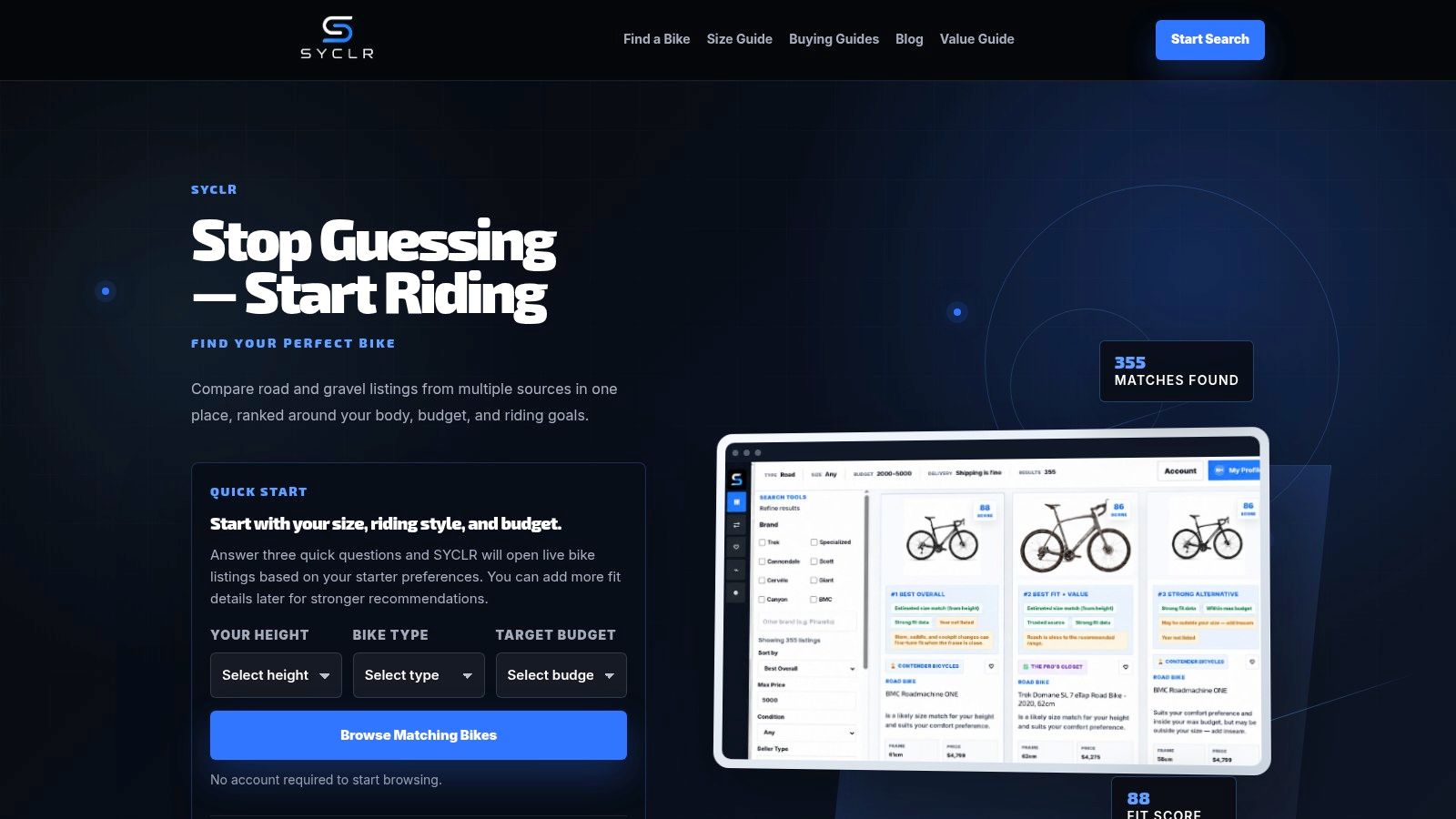
SYCLR is built for that decision layer. It helps road and gravel riders compare listings using fit signals, geometry signals, price context, listing quality, and confidence signals, so you can shortlist smarter before clicking through to a seller. If you're evaluating multiple options, use SYCLR to compare listings by fit, price, and confidence signals. If you already know your current bike geometry or fit numbers, use them to improve your recommendations.
A good used bike deal can still be the wrong bike. The goal is to reduce guesswork, compare better-fit options, and make a more informed buying decision.
Found a promising price?
Check the listing before you shortlist it.
Compare a used bike in SYCLR with fit signals, geometry context, model-year context, listing quality, and price context in one place.
Compare Used Bike ListingsUsed Bicycle Value FAQ
Is original MSRP a good way to price a used bike?
Original MSRP is a starting point, not a valuation. Used bicycle value depends more on comparable listings, condition, fit confidence, model year, components, and listing quality than on what the bike cost when new.
How much do upgrades add to used bike value?
Documented upgrades can help, but usually not at full retail. Upgrades rarely add their full retail cost back into a used bike’s value. They support a stronger price only when they are identifiable, compatible, relevant, in good condition, and clearly included in the sale.
Does bike size affect resale value?
Yes. Common sizes often sell more easily and can support stronger pricing. Fit also affects value to the buyer. A bike that doesn't match your stack, reach, or intended riding position may have low value to you even if the asking price looks fair.
Should I trust the cheapest listing?
No. The lowest asking price may reflect hidden wear, missing details, vague sizing, outdated spec, or poor seller transparency. Cheap and good value aren't the same thing.
How do I price a used bike with no exact model year?
Price it more cautiously. If the seller can't confirm the exact model year or frame generation, your comparison set gets weaker and your uncertainty goes up. That should reduce the offer range.
Are active listings enough for used bike valuation?
They're useful, but not enough on their own. Active listings show asking prices, not what buyers will accept. Listing quality, condition, and how long the listing has been active all matter.
What matters most for used road bike value and used gravel bike value?
The biggest factors are model year or frame generation, fit confidence, condition, groupset, brake type, wheelset, and seller transparency. For road and gravel buyers, geometry clarity matters more than many pricing guides admit.
If you are comparing used road or gravel listings, start with your height, bike type, and budget in the SYCLR app. SYCLR helps you compare listings by fit signals, geometry signals, price context, model year, listing quality, and confidence signals so you can shortlist better-fit bikes before you buy.
Already know your current-bike geometry, stack, reach, or fit-report details? Use your fit details to improve your recommendations.