
Road Bike Geometry Comparison: Race, Endurance & All-Road Fit
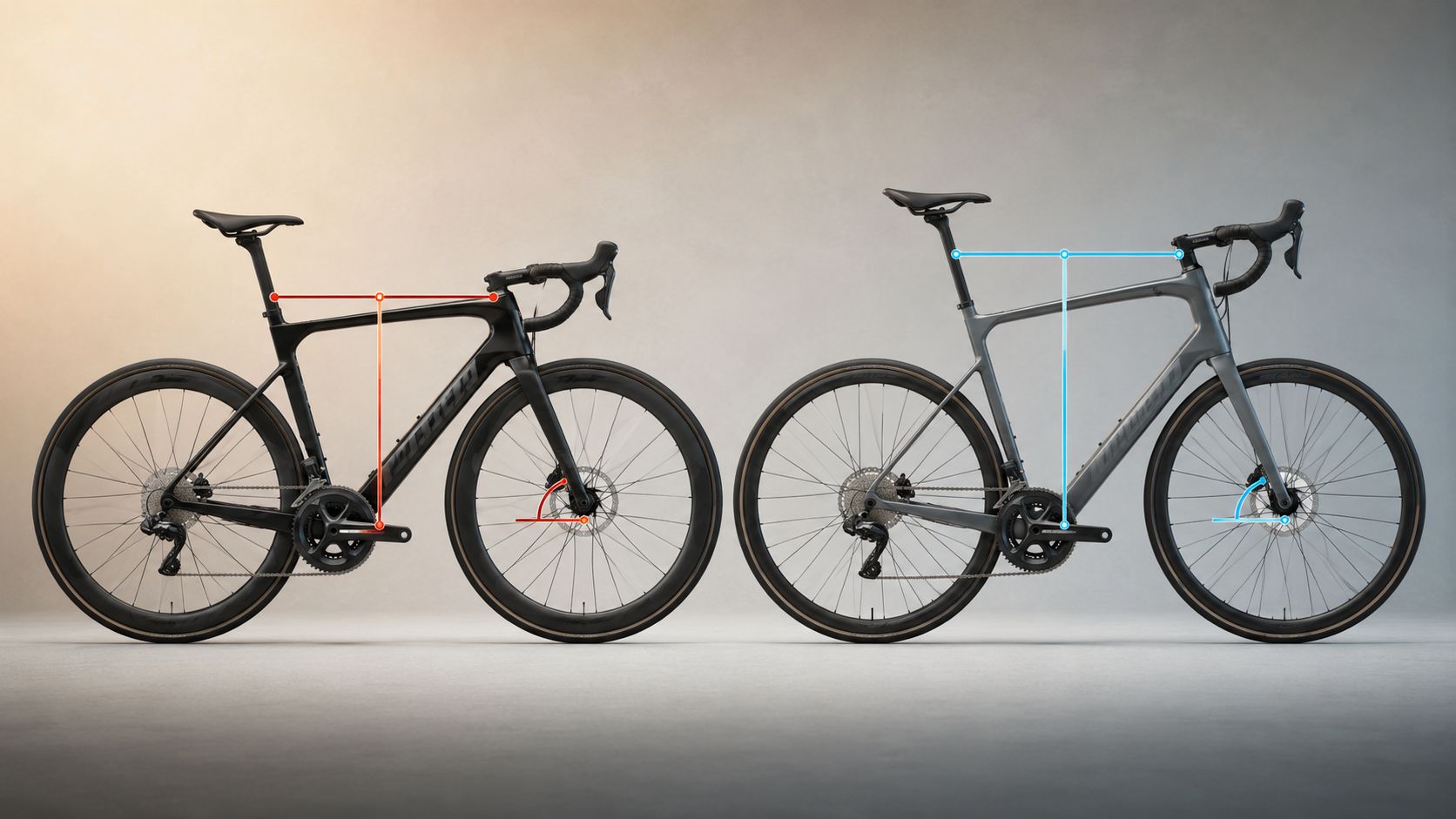
You’re probably looking at two road bikes with the same listed size and wondering why one seems race-ready while the other looks like a long-distance machine. That’s exactly where a proper road bike geometry comparison matters. Start with stack and reach to understand rider position. Then use head tube angle, wheelbase, chainstay length, seat tube angle, and tire clearance to judge handling and use case. That’s how you compare a race bike, endurance bike, aero bike, climbing bike, or all-road frame without getting misled by the size sticker.
Table of Contents
Why Road Bike Frame Size Is Not Enough
You find two used bikes online, both labeled 56cm, both aimed at the same kind of riding, and both look close enough on paper. Then you ride them. One feels stretched and sharp. The other feels higher at the front and calmer through fast corners. The size label did not cause that difference. The geometry did.
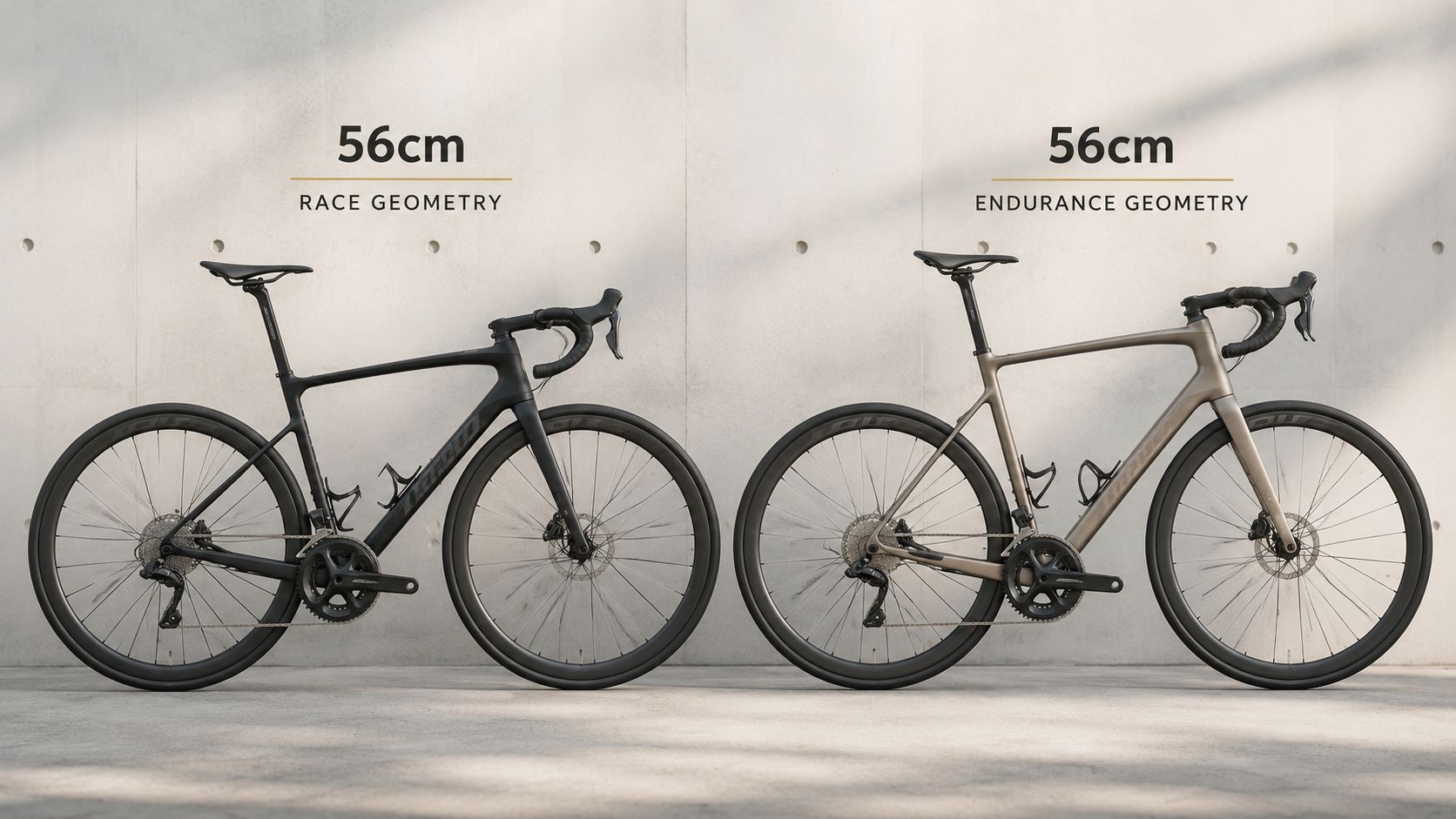
Why two 56cm road bikes can feel unrelated
Brands do not size road frames to a single standard. A 56 in one range can be short and tall. Another 56 can be long, low, and built around a more aggressive position. That is why frame size works as a rough filter, not a buying decision.
The practical question is simple. How close is this bike to the position and ride character you already know works for you?
That shift in approach saves time. Instead of comparing labels, compare the frames that shape contact point range and steering feel. A Specialized Tarmac and a Specialized Roubaix may overlap in nominal size, but they are solving different jobs. One is built around a lower front end and quicker responses. The other usually gives you more front-end height, more stability, and more margin on rough pavement.
Practical rule: Treat the listed size as category information. Use the geometry chart to decide whether the bike actually suits you.
What to compare first
Start with the numbers that affect rider position most directly:
-
Stack: how tall the frame starts at the front
-
Reach: how long the frame starts at the front
-
Seat tube angle: how the frame places your saddle relative to the bottom bracket
Then check the numbers that shape the bike on the road:
-
Head tube angle: a signal for steering speed
-
Wheelbase: a signal for straight-line stability
-
Chainstay length: a signal for rear-end balance and weight distribution
-
Tire clearance: a signal for whether the bike sits closer to race, endurance, or all-road use
For early filtering, a road bike size chart for road riders helps narrow the general size range. After that, the useful workflow is to pull up your current bike, note the geometry that already fits and handles well, and compare each listing against that reference. That method is far more reliable than assuming equal frame labels mean equal bikes.
Decoding Rider Position with Stack and Reach
A common buying mistake looks like this: two used bikes are both listed as 56cm, both seem close enough, and one ends up feeling too low and too long within the first hour. Stack and reach prevent that mistake because they give you a cleaner starting point for comparison.
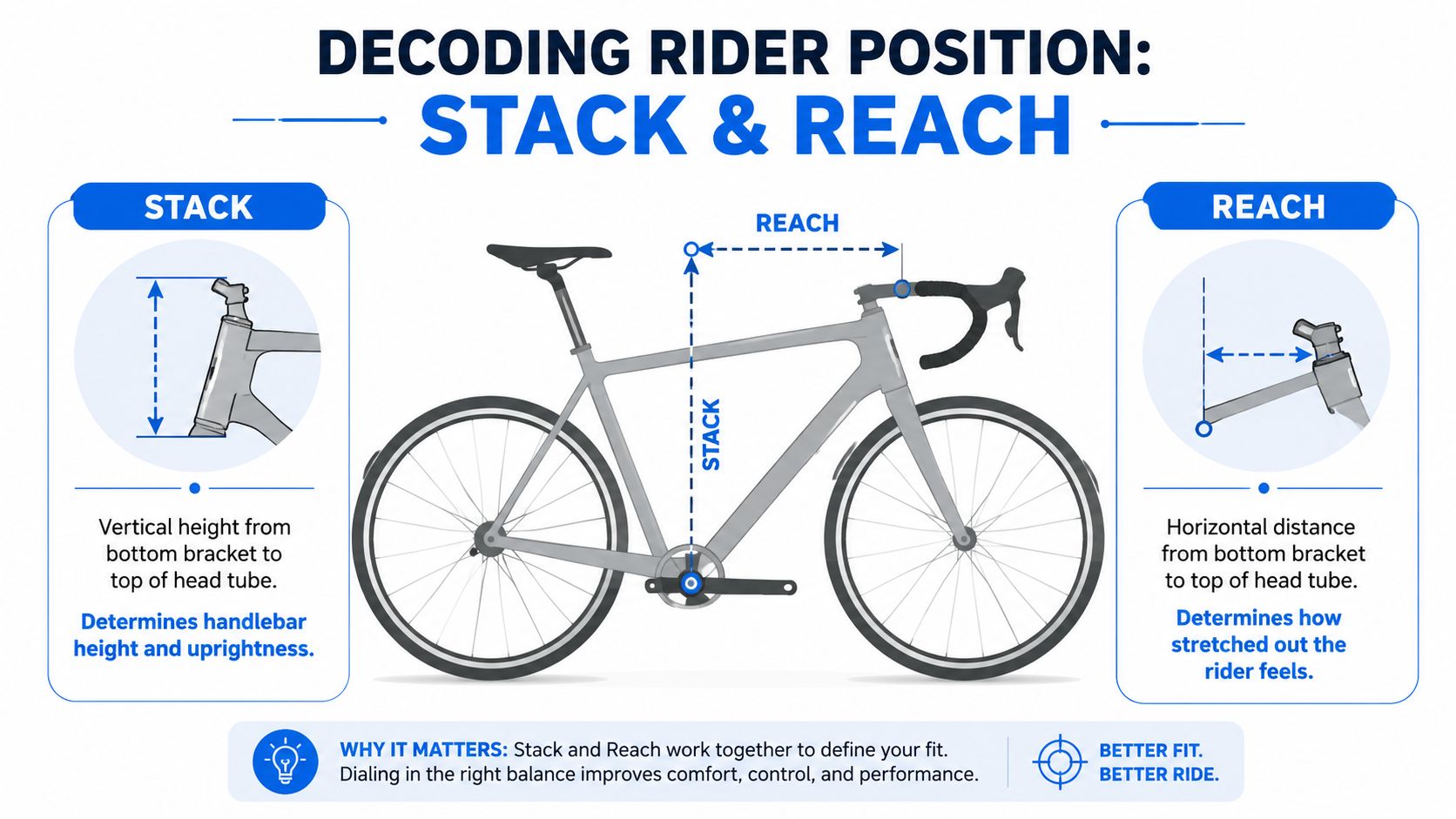
The fit numbers that matter most
Stack is the vertical distance from the bottom bracket to the top of the head tube area used in frame geometry. More stack usually means a taller front end and less drop to the bars. Less stack usually means a lower starting position that asks more from your back, hips, and shoulder mobility.
Reach is the horizontal distance from the bottom bracket to that same front reference point. Typical road bike reach values run from 360mm to 420mm, with 360–380mm feeling short and compact, and 400–420mm feeling longer and more stretched, according to Radmarkt’s road frame geometry overview.
The practical use is simple. Compare those two numbers against a bike you already know fits well. If a new listing is noticeably lower in stack, expect a more aggressive front end. If it is longer in reach, expect more stretch unless you shorten the stem or change bar reach.
That reference-bike method matters because frame labels vary too much between brands. A 54 in one model can put the bars in nearly the same place as a 56 in another.
Use the ratio as a shortcut
The stack-to-reach ratio helps you sort bikes quickly before you get into cockpit parts and spacers. As a rough screen, a higher stack-to-reach ratio often points toward a taller, more upright road position, while a lower ratio often points toward a longer, lower, more aggressive position.
Use the ratio to group listings quickly, not to make the final decision.
For a more detailed explanation, see how stack-to-reach ratio should be interpreted alongside the underlying frame measurements.
I use it to group listings fast. Then I go back to the actual stack and reach numbers, because two bikes can share a similar ratio while still placing the front end quite differently. One may be taller and longer overall. Another may be shorter in both directions but keep the same ratio.
There is also the cockpit to account for. Your hands rest on the bar, not at the frame reference point. Road contact-point fit depends on effective handlebar reach and stack, and common road bars for many riders use 120–130mm of drop and 70–90mm of reach, as outlined by road.cc’s explanation of frame versus cockpit stack and reach. That is why two frames with close geometry numbers can still feel different on the road once stem length, spacer height, and bar shape are factored in.
For buyers comparing listings, the order works well: match your current bike’s stack and reach first, check the ratio second, then account for stem and handlebar differences. A more detailed guide to bike stack and reach measurements covers the terminology if you want to sanity-check the chart before you buy.
Understanding Handling with Key Geometry Signals
Once rider position looks workable, handling becomes the next filter. At this stage, a road bike geometry comparison moves from fit into personality.
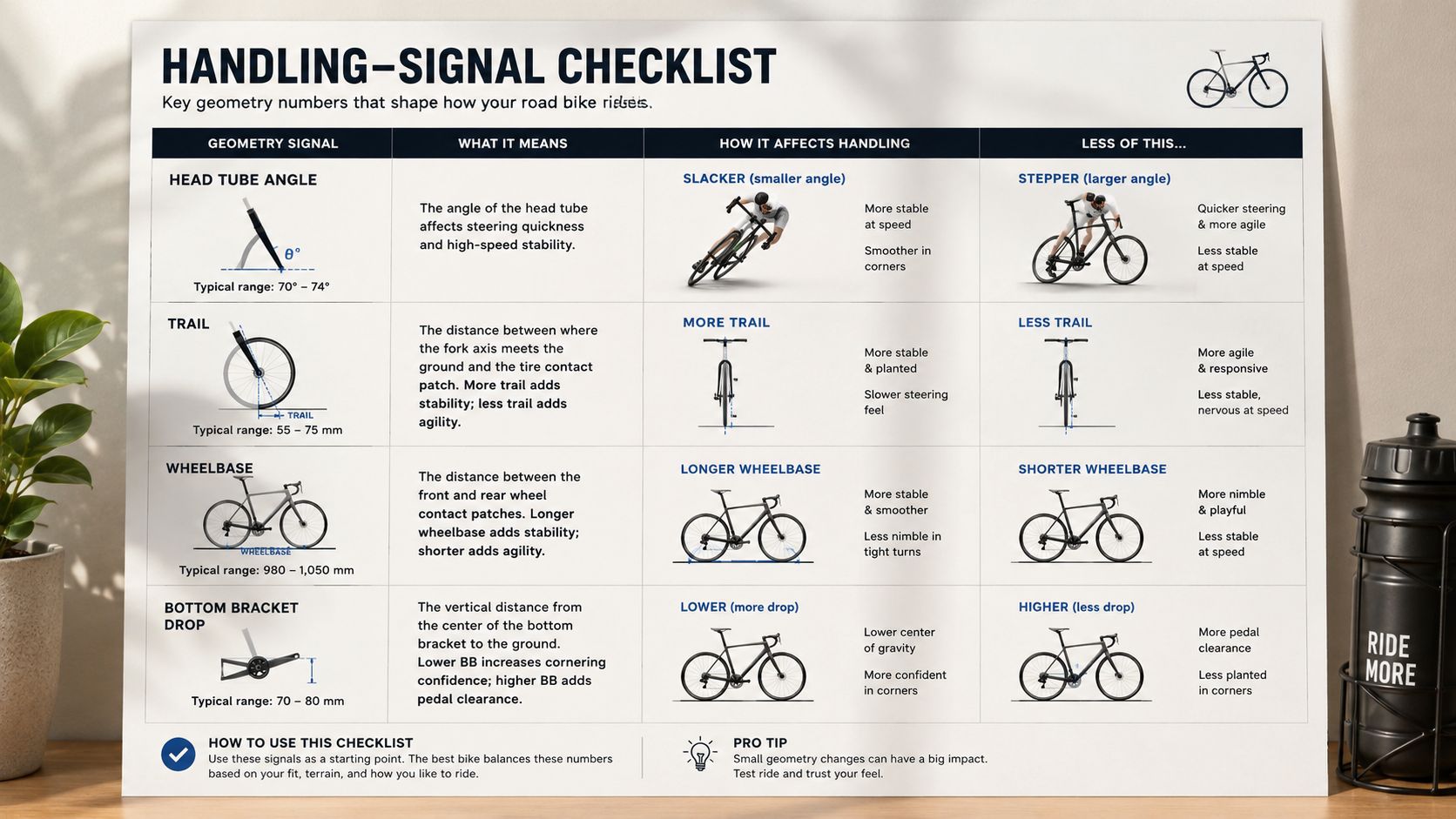
How front-end geometry changes steering feel
A steeper head tube angle usually makes the front end feel quicker and more responsive. That’s the kind of steering many riders like for racing, fast group rides, and bikes that feel eager when you change line.
A calmer front end often comes from a combination of a slightly slacker head tube angle, more trail, and a longer wheelbase. That usually suits long rides, rough pavement, and descents where a rider wants the bike to feel steadier rather than hyper-reactive.
Wheelbase matters because it affects the bike’s overall footprint. Shorter wheelbase often feels tighter and more agile. Longer wheelbase often feels more planted. Chainstay length contributes to that same character from the rear of the bike. Shorter stays usually support a snappier road feel, while longer stays often support stability and tire room.
Buying filter: Don’t judge head tube angle by itself. Compare it alongside wheelbase, trail, and tire clearance.
Road handling signal checklist:
-
Steeper head tube angle usually points toward quicker steering.
-
Slacker head tube angle usually points toward calmer steering.
-
Shorter wheelbase usually feels more responsive.
-
Longer wheelbase usually feels more stable.
-
Shorter chainstays often feel snappier.
-
Longer chainstays often add stability and tire room.
-
Tire clearance helps separate pure road, endurance, and all-road designs.
Why seat tube angle still matters
A lot of road geometry comparisons treat seat tube angle as background noise. That’s a mistake for riders who are sensitive to saddle setback, pedaling posture, or cockpit balance.
Seat tube angle determines where the saddle sits relative to the bottom bracket. A road frame can have acceptable reach on paper but still place the rider too far forward or too far back once the saddle is set correctly. That’s why fit-aware comparisons shouldn’t discard it.
Seat tube angle belongs in the comparison because it affects where the saddle sits relative to the bottom bracket. Two road frames can have similar stack and reach numbers but feel different once saddle position, setback, and cockpit setup are accounted for. Treat seat tube angle as context, not as a replacement for stack and reach.
When I compare road models for real riders, I treat seat tube angle as a context number. It won’t replace stack and reach, but it can explain why one frame accepts a rider’s preferred setup and another needs compromises.
Comparing Race Endurance and All-Road Geometry
Most riders start with a category question before they realize it. They’re not only comparing geometry. They’re comparing what kind of road bike they want.
Road bike geometry comparison table
| Geometry signal | Race road bike | Endurance road bike | All-road bike | Why it matters |
|---|---|---|---|---|
| Stack | Usually lower | Usually higher | Usually moderate to higher | Changes how upright or aggressive the front end feels |
| Reach | Often longer-feeling for a stretched position | Often shorter-feeling for manageability | Often balanced for control and versatility | Shapes cockpit length and weight distribution |
| Wheelbase | Usually shorter | Usually longer | Usually longer or more stable-feeling | Affects agility versus stability |
| Head tube angle | Often steeper-feeling front end | Often calmer front end | Often tuned for steadiness across mixed surfaces | Influences steering response |
| Tire clearance | Typically narrower road focus | More room for wider road tires | More room again for rougher roads and mixed surfaces | Expands usable terrain and changes ride feel |
| Rider position | Lower, sharper, more performance-oriented | Taller, less demanding, easier to sustain | Road-oriented but more forgiving and adaptable | Helps match flexibility, comfort preference, and riding style |
| Best use case | Racing, fast group rides, responsive handling | Long rides, rough pavement, everyday road riding | Paved roads, broken pavement, and light mixed-surface use | Keeps you in the right category before comparing models |
Race bikes usually aim at speed-first road riding. That often means a lower front end, longer-feeling cockpit, quicker steering, and a shorter overall stance. Endurance road bikes tend to raise the front end and calm the handling. The difference becomes easier to understand when you compare a traditional road bike with an endurance bike, especially through stack, reach, wheelbase, and rider-position priorities. All-road bikes push farther toward tire clearance and versatility while staying road-oriented.
Where aero and climbing bikes usually fit
Race bikes and aero bikes can both feel aggressive, but they do not prioritize speed in exactly the same way. Aero bikes often sit close to race geometry in rider position, but the exact handling balance can vary by model. Some feel sharp and committed. Others soften the fit slightly so they remain usable outside a race setting.
Climbing bikes also often live near the race side of the road spectrum, but not always with the same visual cues as aero frames. An aero bike and a climbing bike may both be designed for speed, but their geometry, weight priorities, and ideal terrain can lead to very different buying decisions. A climbing bike’s geometry may still favor a responsive road feel, even if the bike’s design emphasis is low weight rather than aerodynamic shaping.
What many category guides miss is the rise of mixed-surface road bikes. A lot of road content still forces buyers into race or endurance labels, even though all-road and gravel-adapted road geometries have become an important middle ground. The line between all-road and gravel bikes becomes clearer when you compare tire clearance, gearing, stability, and intended terrain. Tire choice also changes handling enough that static frame charts can stop telling the whole story, especially when riders swap between 28mm and 32mm tires, as noted by BikeRadar’s road geometry discussion.
That matters when you compare a pure race bike to an endurance bike with more clearance, or an endurance bike to an all-road frame. Endurance bikes and all-road bikes often overlap, but tire clearance, handling, and surface versatility can separate them. The geometry chart may look only moderately different. The ride experience can still change a lot once real-world tires enter the picture.
A Practical Workflow for Comparing Two Road Bikes
The quickest way to compare two road bikes is to read stack, reach, and the handling signals side by side against a bike you already know. This page stays focused on how race, endurance, and all-road geometry differ; for the full step-by-step comparison method, see how to compare bike geometry
Use your current bike as the reference
If you already own a road bike that feels good, even if it isn’t flawless, use that bike as your anchor. Pull the geometry chart and note the frame’s stack, reach, wheelbase, head tube angle, seat tube angle, and tire clearance.
Then compare each candidate frame against it.

Ask these questions in order:
-
Is the new bike taller or lower?
More stack usually means a more upright starting point. Less stack usually means a lower front end. -
Is it longer or shorter?
More reach usually means a more stretched cockpit. Less reach usually means a more compact fit. -
Does the handling move in the direction you want?
A racier front end may feel great for fast paved riding. A steadier bike may suit rough roads and long days better. -
Will the tire clearance support your actual roads?
This is a practical divider between pure road, endurance, and all-road options.
If both stack and reach move away from what already works for you, the listing usually doesn’t deserve much more time.
A shortlist method for real listings
When you compare real bikes, keep the process simple:
-
Start with category intent: Is the bike race, endurance, aero, climbing, or all-road?
-
Check fit signals next: Compare stack and reach before you compare paint, wheels, or seller claims.
-
Use handling numbers as tiebreakers: Wheelbase, head tube angle, and chainstay length explain why one bike feels calmer or quicker.
-
Look at cockpit context: Stem and bar setup can change feel, but they don’t erase a mismatched frame.
-
Don’t ignore listing reality: A good deal can still be the wrong bike if the geometry doesn’t line up.
For side-by-side checks, a dedicated tool to compare bike geometry is far faster than jumping between brand PDFs and marketplace tabs.
A good used road bike at the right price is still a poor buy if the frame wants to put you in the wrong position.
A same-size example: Imagine two road bikes both listed as 56 cm and both within budget. Their geometry is what separates them:
| Metric | Bike A (56 cm) | Bike B (56 cm) | What it suggests |
|---|---|---|---|
| Frame label | 56 cm | 56 cm | Same nominal size |
| Stack | 570 mm | 590 mm | Bike B sits taller and more upright at the front |
| Reach | 390 mm | 378 mm | Bike A is longer and more stretched in the cockpit |
| Wheelbase | 990 mm | 1015 mm | Bike B is longer and tends to feel more stable |
| Category tendency | Race-oriented | Endurance-oriented | Different intended use, not a better-or-worse bike |
Both bikes are “56 cm,” yet Bike A is lower and longer with a shorter wheelbase — a racier, more responsive platform — while Bike B is taller, shorter, and calmer, leaning endurance. Neither is universally better; the right choice depends on your riding position, intended use, and how each compares with a bike that already fits you. If you have a fit report, our bike fit guide explains how to read those numbers. These figures are illustrative, not a prediction of exact fit — always compare the actual geometry of the specific bikes you are considering.
How SYCLR Simplifies Road Bike Geometry Comparison
You find two promising used road bikes in the same size. One is listed as a 56 race bike, the other as a 56 endurance bike. The photos look good, the prices are close, and the seller descriptions do not tell you much. The question is simpler. Which one is closer to the bike position and handling you already know works?
SYCLR helps turn that question into a usable comparison process.
Instead of treating listings as a pile of frame sizes and marketing labels, SYCLR organizes the details that matter during a buy-or-skip decision. It pulls fit signals, geometry signals, model year, price context, listing quality, and confidence signals into one view so you can judge whether a bike deserves more attention.
That changes the job from hunting for random numbers to comparing bikes against a reference.
A practical way to use it looks like this:
-
Start with the bike you already know. Use your current road bike, or the last one that fit well, as the reference point.
-
Compare stack and reach first. If both move too far from your baseline, skip the listing early.
-
Check the handling cues next. Head tube angle, wheelbase, and chainstay length help explain whether the bike will feel sharper, calmer, or just different in the wrong way.
-
Use model year and listing quality to judge trust. A geometry comparison is only useful if the underlying bike details are clear enough to verify.
-
Bring price into the same decision. A cheaper listing is not a better buy if the frame asks you to accept a position or ride feel that never suited you.
That is the main benefit. It saves time on the wrong bikes before you start rationalizing them.
SYCLR does not replace a professional bike fit. It gives riders a cleaner way to apply the fit information they already have, compare actual listings side by side, and narrow the field with more confidence before they contact a seller.
Comparing two bikes?
Compare listings with geometry and fit context.
Use SYCLR to compare road bike listings with fit signals, geometry context, model-year context, price context, and listing confidence in one place.
Frequently Asked Questions About Road Bike Geometry
Is stack and reach enough for a road bike geometry comparison?
No. Stack and reach should come first because they explain rider position, but they don’t explain the full ride feel. You should also compare head tube angle, wheelbase, chainstay length, seat tube angle, and tire clearance.
Can two road bikes with the same frame size fit very differently?
Yes. Two bikes labeled the same size can still have different stack, reach, and handling geometry. That’s why the size sticker alone isn’t enough for a confident buying decision.
What does endurance road bike geometry usually feel like?
Endurance road bike geometry usually points toward a taller front end, a less demanding position, and steadier handling. It often suits long rides, rough pavement, and riders who don’t want an aggressively low road setup.
What does race bike geometry usually feel like?
Race bike geometry usually feels lower, sharper, and more responsive. It often suits riders who want a more aerodynamic road position and quicker steering for fast riding.
Does seat tube angle matter on a road bike?
Yes. Seat tube angle affects saddle position relative to the bottom bracket. Even when two frames have similar reach, seat tube angle can change how naturally the rider sits and pedals on the bike.
Why does tire clearance matter in road bike comparison?
Tire clearance helps separate pure road bikes from endurance and all-road designs. It also affects real-world use. A bike with more clearance can handle wider tires and rougher roads more comfortably, and tire choice can change handling enough to alter how a geometry chart feels on the road.
What is the best way to compare a used road bike listing?
Use a known reference bike if you have one. Compare the listing’s stack, reach, handling signals, and tire clearance against what already works for you. Then check condition, model year, price context, and listing quality before you decide it belongs on your shortlist.
If you are comparing road bike geometry across real listings, start with your height, bike type, and budget in the SYCLR app. SYCLR helps you compare road and gravel bikes by fit signals, geometry signals, model year, price context, listing quality, and confidence signals so you can shortlist better-fit options before you buy.
Already know your current-bike geometry, stack, reach, or fit-report details? Use your fit details to improve your recommendations.