Aero Gravel Bikes Explained and How to Choose
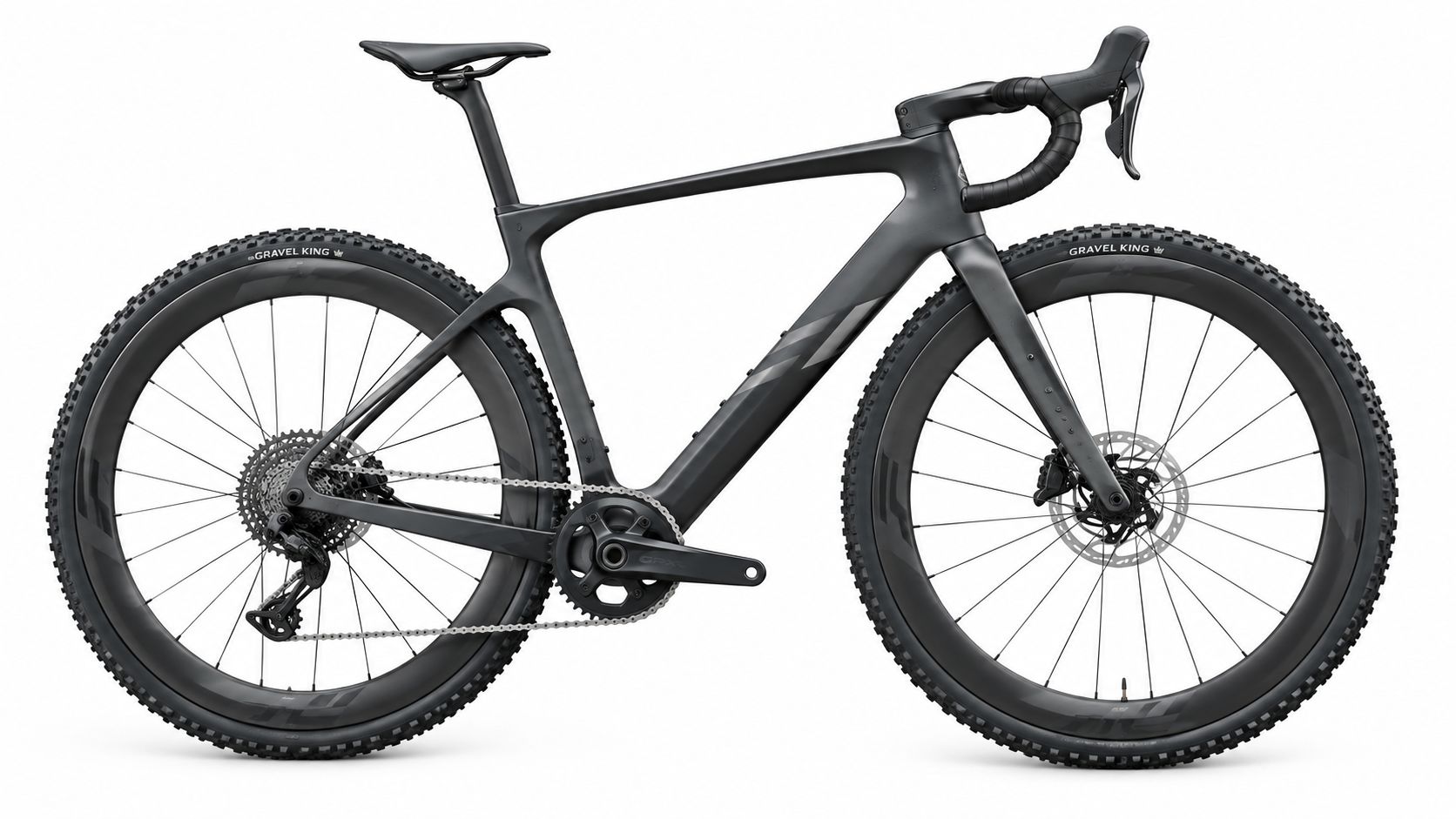
Can an aero gravel bike test faster in a controlled setup but still be the wrong bike for your actual routes? That is the key question most category-level buying advice misses. Aero gravel bikes are best understood as a system-design category: gravel race or performance bikes that combine aerodynamic shaping, integrated or semi-integrated front ends, wheel and tire choices, and rider position around mixed-surface speed. They can make sense for riders who spend meaningful time on fast gravel, hardpack, and paved connectors, but the category label alone does not tell you how a bike will fit, handle, or perform on your terrain.
Table of Contents
- What Aero Gravel Bikes Are and Who They Are For
- How Aero Gravel Design Works From Frame to System
- Aero Gravel vs Traditional Gravel vs Aero Road Bikes
- Fit and Sizing Implications for Aero Gravel Geometry
- When Aerodynamics Matter More on Gravel
- Buying Checklist for New and Used Aero Gravel Listings
- How SYCLR Helps You Shortlist Better Fit Aero Gravel Bikes
- Aero Gravel Bike FAQs
- Are aero gravel bikes always faster than lighter gravel bikes?
- How much tire clearance should an aero gravel bike have?
- Is an integrated cockpit a fit risk?
- What should I check first on a used aero gravel bike listing?
- When should I choose a traditional gravel bike instead?
- Can I use an aero gravel bike for bikepacking?
- Does a lower position automatically make an aero gravel bike faster?
What Aero Gravel Bikes Are and Who They Are For
Aero gravel bikes became a more visible performance category in the early 2020s as brands increasingly treated gravel speed as a whole-bike system rather than only a tire-clearance question.
A frequently cited example comes from Swiss Side's gravel report, which compared specific road and gravel test setups. In that testing, a typical gravel setup showed about 40 watts more combined resistance at 30 km/h than the road setup, under an 80 kg system assumption. Swiss Side split that gap broadly between aerodynamic drag and rolling resistance, with the rolling-resistance comparison based on on-road conditions. At higher speeds in the same analysis, the difference increased further. Those results are useful because they show why aerodynamics can matter in gravel. They should not be treated as a universal prediction for every rider, tire, surface, or course.
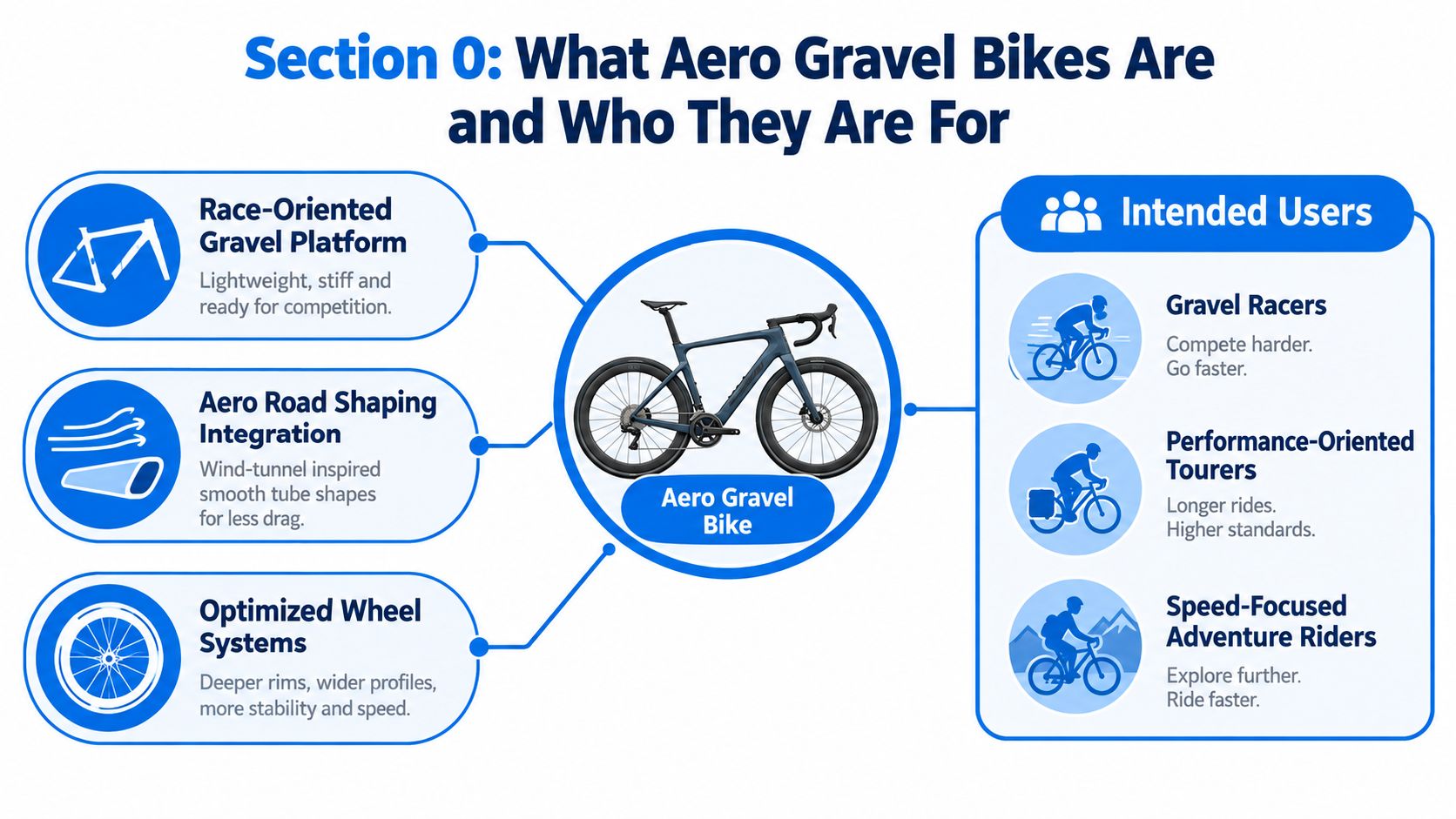
The category sits between an aero road bike and a more general-purpose gravel bike, but those labels describe design priorities, not fixed fit or handling outcomes. An aero gravel frame may use shaped tubing, reduced frontal area, hidden or semi-hidden cables, and wheel and tire pairings selected with drag in mind. At the same time, it still needs gravel-appropriate braking, practical tire clearance, and enough control for mixed surfaces.
That combination can make aero gravel bikes especially relevant to:
Gravel racers riding fast courses with meaningful exposure to wind.
Performance-focused mixed-surface riders who spend substantial time on hardpack and paved connectors.
Speed-oriented endurance riders who care about efficiency but still want gravel tire clearance.
The fit question still comes first. A discounted bike with strong components can still be a poor buy if the frame dimensions, cockpit, or tire setup do not match your riding. Category labels do not automatically determine fit, and they do not replace checking the actual geometry and setup of the specific model and size you are considering.
Buying principle: Treat aero gravel as a complete rider-and-bike system. Aerodynamic features matter most when the position is usable, the tire choice suits the surface, and the overall setup matches the course.
How Aero Gravel Design Works From Frame to System
What makes an aero gravel bike fast is rarely one isolated feature. The gains come from how the frame, fork, cockpit, wheels, tires, bottles, and rider work together. Designers shape tubes to manage airflow, reduce exposed hardware where possible, and pair those choices with wheel and tire setups that preserve speed on mixed surfaces.
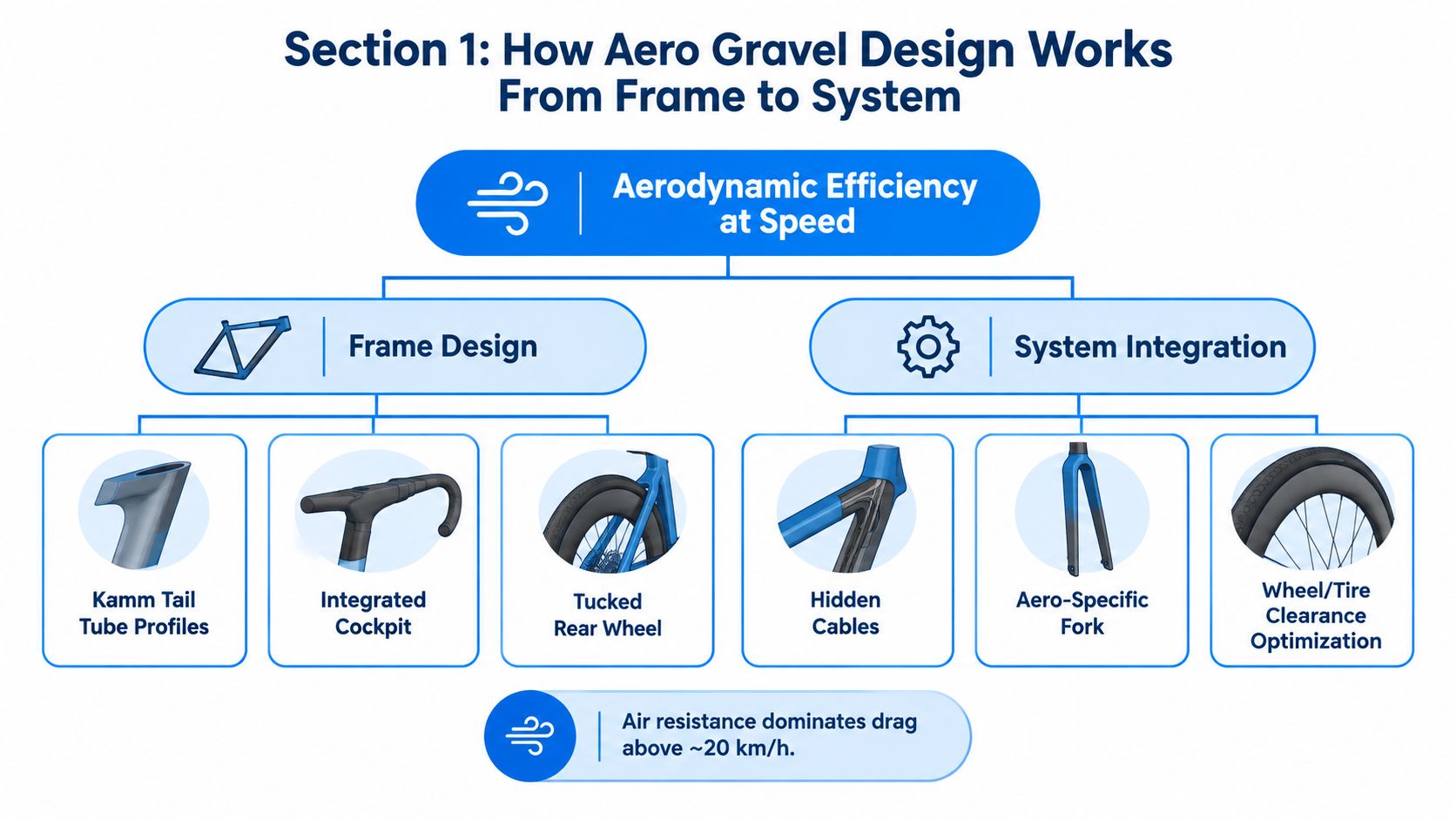
A truncated airfoil, for example, can improve airflow without using a deep full-profile road shape. That matters on gravel, where the bike still needs room for larger tires and enough durability for rougher surfaces. But no single frame feature defines the category on its own. Fork shape, head tube area, cable routing, bottle placement, wheel depth, tire width, tread pattern, and rider posture all influence the final result. This report on Swiss Side's gravel findings helps illustrate why aerodynamic design needs to be understood alongside rolling resistance and surface choice.
Frame shaping has practical limits
Aero gravel frames often balance several competing requirements:
Aerodynamic efficiency: Tube shaping, cable routing, and front-end integration can reduce drag.
Tire clearance: Real clearance is governed by the manufacturer's stated support for that exact frame and configuration.
Control on mixed surfaces: Speed matters only if the bike remains manageable on the surfaces you actually ride.
Practicality: Bags, mounts, mud space, service access, and proprietary parts can all influence ownership.
Tire choice has a large effect on the end result. It influences:
Rolling resistance
Traction
Comfort
Mounted dimensions
Clearance
Aerodynamic performance
That is why the exact wheel and tire setup matters as much as the frame concept. A frame may be marketed as aero, but the practical speed outcome can change significantly with a different casing, tread, actual inflated width, or rim pairing. Always treat the manufacturer's published tire-clearance support as the governing limit, then check that against the wheel and tire combination you plan to run.
As current trend context, several 2026 aero gravel race bikes are moving toward roughly 50 to 55+ mm tire support, according to BikeRadar's Traka technology reporting. That is useful as a market direction signal, not as a universal category rule.
Integration changes maintenance and fit
An integrated or semi-integrated cockpit can reduce exposed hardware and contribute to a cleaner front end. It can also affect adjustability, replacement-part choice, and service complexity. On a used bike, confirm exactly which bar, stem, spacers, headset parts, and routing hardware are installed, and whether replacements remain available.
Aero gravel design is therefore a negotiation between drag reduction, tire support, cockpit integration, wheel and tire choice, and usable rider position. The fastest option on paper is not always the fastest or simplest option for your routes.
Aero Gravel vs Traditional Gravel vs Aero Road Bikes
These categories overlap, but they emphasize different priorities.
An aero gravel bike targets mixed-surface speed, often with more attention paid to airflow and integration than on a general-purpose gravel bike. A traditional gravel bike usually gives more priority to versatility, tire flexibility, mounts, and route breadth. An aero road bike is optimized first for paved-road speed, where narrower tires, road gearing, and road-specific clearances may be more appropriate.
Those category labels are useful as a starting point, but they are not universal fit or handling rules. Two gravel bikes in the same broad category can differ substantially in geometry, tire support, cockpit setup, and intended use.
| Criteria | Aero Gravel | Traditional Gravel | Aero Road |
|---|---|---|---|
| Primary use | Fast mixed-surface riding and gravel racing | Broad gravel and all-road versatility | Fast paved-road riding and racing |
| Design emphasis | Aerodynamic efficiency plus gravel capability | Versatility across a wide range of routes | Aerodynamic efficiency on pavement |
| Tire support | Governed by the exact model and manufacturer limits | Governed by the exact model and manufacturer limits | Usually more limited than gravel bikes, depending on model |
| Cockpit approach | More likely to use integrated or semi-integrated parts | Often easier to change part by part | Frequently integrated |
| Best comparison method | Check geometry, clearance, cockpit, and intended terrain | Check geometry, clearance, mounts, and intended terrain | Check geometry, clearance, gearing, and intended terrain |
The practical consequence is simple: compare the actual bike, not just the category label. An aero road bike may be the better tool if your routes are overwhelmingly paved. A more general gravel bike may be the better tool if your routes demand broader tire options, more mounting space, or easier equipment changes. For a broader look at adjacent categories, see this comparison of all-road and gravel bikes.
Fit and Sizing Implications for Aero Gravel Geometry
Aero gravel geometry can differ meaningfully from one model to another, so fit needs to be evaluated at the frame and setup level, not inferred from the category name. A representative size M aero gravel frame lists a 71° head-tube angle, 85.5 mm bottom-bracket drop, 425 mm reach, and 581 mm stack, according to the BikeInsights geometry comparison.
Those numbers become useful when translated into contact-point possibilities. Stack and reach are useful frame-level signals because they describe the front-end height and length of the frame itself. But final hand position is not determined by frame numbers alone. It also depends on the cockpit, spacer arrangement, bar shape, hood position, saddle position, and the manufacturer's adjustment limits.
Body proportions do not automatically determine the correct stack, reach, cockpit choice, frame category, or size direction. The better approach is to compare the actual frame dimensions and the adjustment range available on the specific bike.
Read the geometry as a position
Use geometry to understand what a frame allows, not to force a universal conclusion from one number. Stack and reach are especially helpful when comparing listings because they provide separate vertical and horizontal frame-level reference points before cockpit components affect the final hand position.
Bottom-bracket drop is best read as part of ride-height and pedal-clearance context, especially once real tire size is considered. Front-center is best read as part of overall geometry and toe-overlap context. Chainstay length, wheelbase, trail, and head angle also matter, but none of them should be treated as deterministic handling labels in isolation.
If you are comparing adjacent sizes, focus on the exact model, year, and size, then compare:
Stack
Reach
Standover
Seat-tube angle
Cockpit dimensions
Available adjustment range
Manufacturer limits
That process is more reliable than using broad rules about who should size up or down. Use this guide to bike stack and reach when comparing listings, and keep standover as a separate check if stop-start confidence matters to you. Integrated cockpits can add adjustment, replacement, and cost constraints because the bar and stem may not be independently changeable.
When Aerodynamics Matter More on Gravel
Aerodynamic gains tend to become more relevant when speeds are higher and the course allows the rider to maintain a consistent position and line.
Wind direction changes the real-world outcome. A headwind can increase the importance of aerodynamic drag, while crosswinds can change how useful a given wheel or front-end setup feels. Yaw angle also changes how bikes and components perform. The Swiss Side's published gravel report is helpful here because it shows why test outcomes need to be read in the context of speed, wind, and surface rather than as a universal promise.
Group riding changes the calculation again. Drafting reduces direct aerodynamic load some of the time, but race situations still include exposed sections, pulls at the front, and repeated accelerations where drag matters.
The course determines whether aerodynamic potential becomes usable speed. Smooth hardpack, open roads, and faster race sectors can make aerodynamic differences more relevant. Rougher or less predictable terrain can shift more importance toward tire choice, control, and consistency.
BikeRadar's 2026 gravel-bike coverage discusses test results showing savings of over 20 watts at 40 km/h for the fastest setups. That figure reflects a specific testing context, not every rider or course, but it helps explain why aero development continues to matter in competitive gravel.
Use this filter:
Fast and open: Aerodynamic features may become more relevant during sustained speed and exposed sections.
Rough and unpredictable: Tire setup, control, and consistency may matter more than drag reduction.
Mixed but noncompetitive: Prioritize fit, comfort, adjustability, and tire flexibility.
Position-limited in practice: The most useful setup is the one you can actually hold and use.
The best comparison is not aerodynamic theory versus no theory. It is theoretical efficiency versus usable speed on your real routes.
Buying Checklist for New and Used Aero Gravel Listings
Aero gravel listings usually need more scrutiny than a simple frame-size label because the complete bike may depend on specific cockpit parts, routing hardware, wheel choices, and tire limits.
Establish the bike's identity
Start with the basics:
Exact model
Model year
Frame size
Manufacturer geometry chart
Manufacturer tire-clearance specification
Those details matter because brands can change geometry, routing, tire support, and cockpit standards without changing the broad model name.
Check fit and compatibility before price
Before focusing on price, confirm the parts and limits that affect whether the bike will actually work for you:
Current wheel and tire setup
Cockpit dimensions
Whether integrated parts are original or changed
Compatibility with replacement parts
Availability of proprietary or model-specific parts
Then compare the listing against the manufacturer's geometry and clearance information. Do not assume a frame advertised around a certain tire size will support every tire labeled that size across every rim width or casing shape.
Assess condition and listing evidence
Keep the condition review practical and listing-focused. Look for clear photos and evidence of the bike's current state, including the frame, fork, cockpit, wheels, and drivetrain. The goal is not a full remote inspection. It is to judge whether the listing provides enough evidence to support the seller's description.
Useful signals include:
Clear listing photos from multiple angles
Visible condition of contact points and major components
Evidence of the current wheel and tire setup
Confirmation of included integrated parts and small hardware
Consistency between the written spec and the photos
If the listing leaves key identity, fit, or compatibility questions unanswered, treat that uncertainty as part of the buying decision. For broader marketplace context, used gravel bike listings vary widely in completeness and clarity.
How SYCLR Helps You Shortlist Better Fit Aero Gravel Bikes
A fit-aware comparison process starts with more than a product name. Start at SYCLR with your height, bike type, and budget to build a practical starting shortlist, then compare:
Fit signals
Geometry signals
Model-year context
Price context
Listing quality
Condition signals where available
Confidence signals
Riders who already know their current-bike numbers or fit details can add them through Advanced Fit.
SYCLR is designed to help riders compare listings before opening a seller page. It does not perform a professional bike fit, physically inspect bikes, authenticate listings, verify ownership or seller claims, or guarantee fit or condition.
The useful outcome is a smaller, more relevant shortlist. For aero gravel bikes, that means checking whether the listing's frame dimensions, cockpit, tire support, and intended terrain match your riding before giving aerodynamic claims too much weight.
Aero Gravel Bike FAQs
Are aero gravel bikes always faster than lighter gravel bikes?
No. Aerodynamics can matter at speed, but the practical result still depends on rider position, tire choice, wheels, terrain, wind, and how consistently you can use the setup.
How much tire clearance should an aero gravel bike have?
There is no single correct number. Use the exact manufacturer-supported clearance for the specific frame and configuration you are considering. As trend context, some newer aero gravel race bikes are moving toward roughly 50 to 55+ mm support, according to BikeRadar's Traka technology reporting, but that is not a universal category rule.
Is an integrated cockpit a fit risk?
It can be. Integrated systems may reduce the range of easy bar and stem changes, so confirm the installed dimensions, adjustment range, routing setup, and replacement-part availability before buying.
What should I check first on a used aero gravel bike listing?
Start with the exact model, year, size, manufacturer geometry, manufacturer tire clearance, current wheel and tire setup, cockpit configuration, integrated-part compatibility, parts availability, and clear condition evidence in the listing.
When should I choose a traditional gravel bike instead?
Choose one when your routes or priorities point more toward versatility, broader equipment choices, extra mounts, or easier setup changes than toward aerodynamic integration.
Can I use an aero gravel bike for bikepacking?
Possibly, but check the frame's mounts, bag space, tire support, wheel setup, and cockpit compatibility first. Some race-oriented frames are less convenient for carrying gear.
Does a lower position automatically make an aero gravel bike faster?
No. Rider position is a major part of total aerodynamic drag, but lower is not automatically faster. The useful position is one that works with the rider, bike, terrain, and complete setup.
Compare road and gravel listings on SYCLR by starting with your height, bike type, and budget, then review fit and geometry signals before judging the aero equipment. For a more informed shortlist, add detailed fit information and compare model-year context, price context, listing quality, and condition signals where available.
SYCLR may earn a commission from qualifying purchases made through some retailer links, at no additional cost to you.
See Current Competitive Cyclist Sales