
All Road Bike vs Gravel Bike: Which Fits Your Riding?
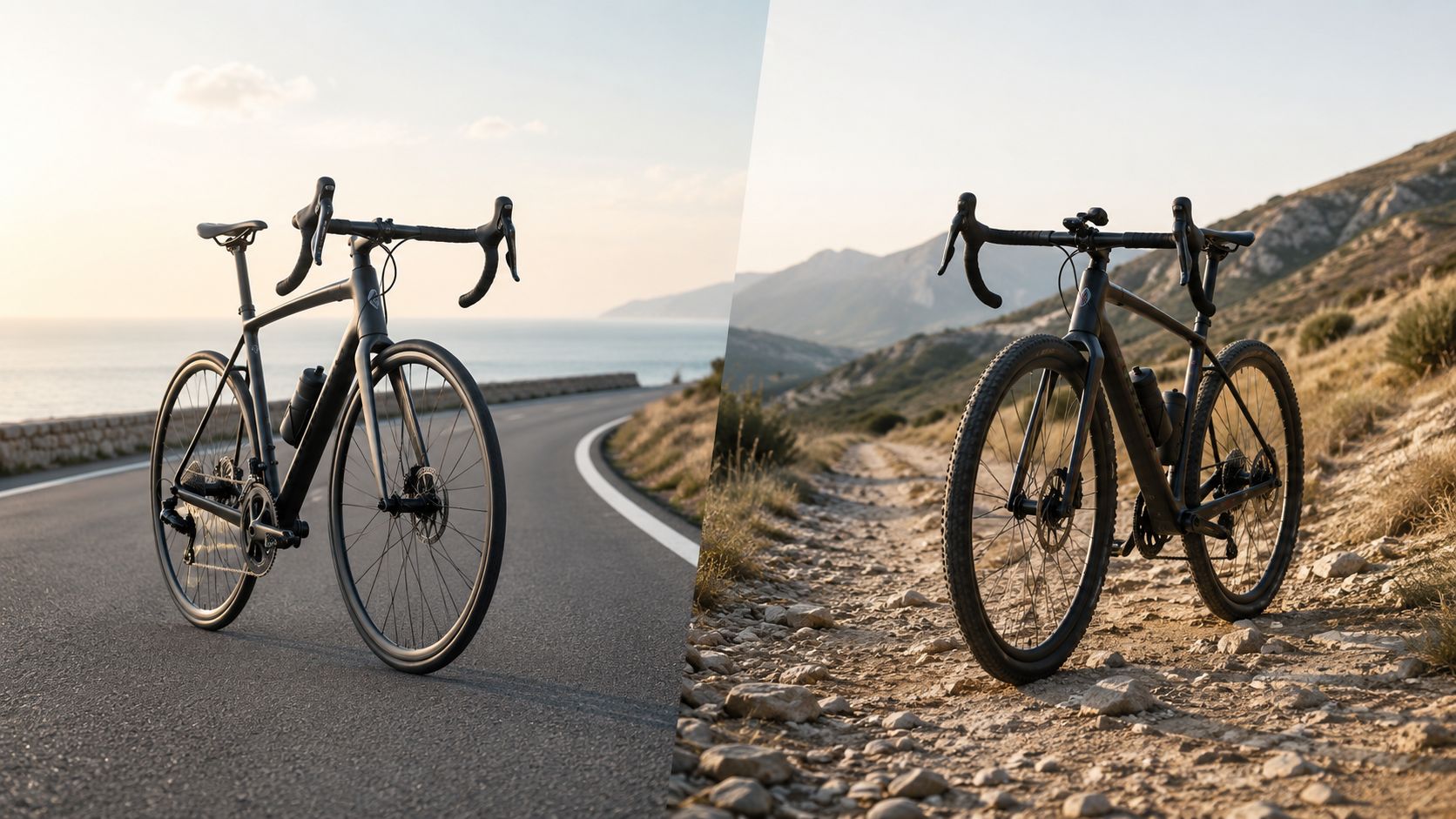
You're standing over two very different bikes that both seem to solve the same problem. One looks fast and tidy, built for pavement first. The other looks a little tougher, a little calmer, and more ready for messy surfaces. If most of your riding is paved, but you want the freedom to leave the road when you need to, the choice usually comes down to this: choose an all-road bike when your routes are mostly pavement with rough connectors, choose a gravel bike when unpaved riding is a real part of the plan.
That's the clean version. The messy version is where most buyers get stuck, because labels hide the details that matter, surface severity, tire clearance, geometry, gearing, mounts, and fit. A bike can be called all-road and still be too road-biased for loose gravel, or called gravel and still feel like overkill if you mostly ride chip seal and hardpack. This is why a good deal isn't just about price or parts, it's about whether the bike fits your routes and your body.
Table of Contents
Choosing Between All-Road and Gravel for Your Actual Routes
A rider usually lands here after the same kind of search. They want one bike that can handle mixed surfaces, but they don't want to buy more capability than they'll use. That's the fork in the road, not whether the bike has knobby tires or a more adventurous name. For riders who spend most of their time on pavement, an all-road bike is usually the better match, because it keeps the road feel while still handling rough pavement, chip seal, hardpack, and short light-gravel connectors.
Practical rule: If most of your miles are paved, make sure the extra gravel capability solves a real need rather than simply adding weight, slower tires, or features you may rarely use.
A gravel bike makes more sense when the unpaved parts are not occasional decoration, but part of the ride's core identity. If you expect loose gravel, rough descents, washboard, mud, or long mixed-surface routes, the extra stability and bigger tire room stop being luxury features and start being the point. That's why the same rider can look at both categories and come to a different answer once the route is honest.
For buyers who are still deciding between road-leaning categories, the broader comparison in SYCLR's endurance road bike vs gravel bike guide is the better next stop. The line here is narrower, though. All-road is usually road-first with mixed-surface flexibility, gravel is usually terrain-first with road tolerance. If you care most about pavement speed and efficient handling, all-road deserves the first look. If you want the bike to stay composed when the surface gets rougher and less predictable, a gravel bike is usually the stronger match.
The mistake is treating this as a lifestyle decision. It's really a route-severity decision. Match the bike to what you ride most, not to the coolest-looking use case in the shop.
What Defines an All-Road Bike and a Gravel Bike
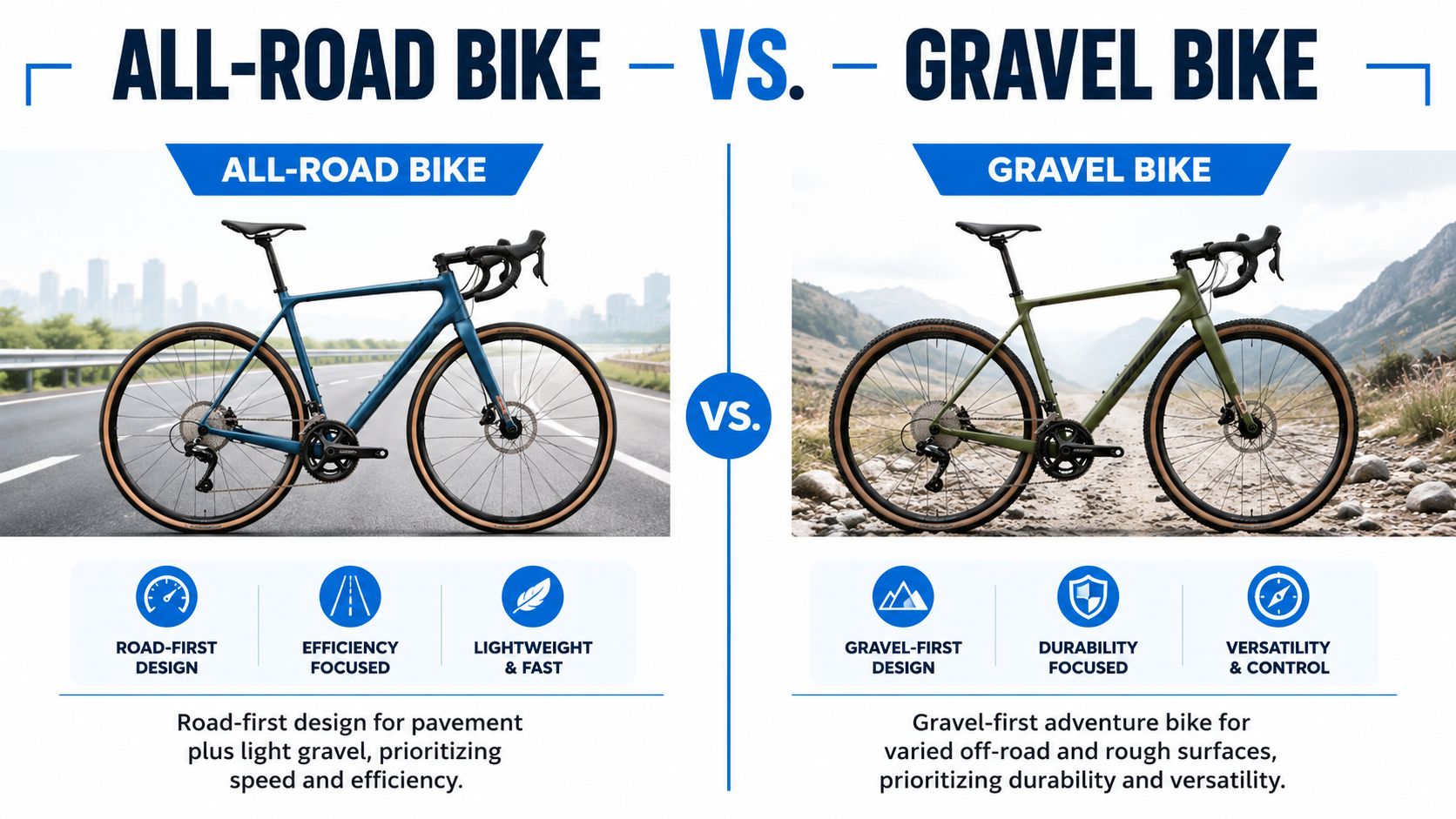
An all-road bike is a road-first machine that has been opened up for more than perfect asphalt. It keeps a fast, efficient road personality, but it adds enough clearance and comfort to handle rough pavement, chip seal, hardpack, and light gravel connectors. That makes it a strong fit for riders who still care about speed, acceleration, and a road-like position, just not at the expense of every rough stretch.
A gravel bike is built for a wider range of unpaved surfaces. It usually gives you more tire room, more stability, lower gearing, and more versatility when the route gets loose, rough, or long. REI describes road bikes as being for efficiency and speed on smooth pavement, while gravel bikes are made for dirt, gravel, and mixed terrain in its road vs. gravel overview, and that distinction still frames the category well. Shimano also treats gravel as a do-it-all discipline that's suited to all-terrain and bikepacking use, which lines up with how most riders use the category. You can see the broader road-versus-gravel boundary in SYCLR's gravel bike vs road bike guide.
Where the categories overlap
The overlap is real, and buyers get tripped up when they assume every label is rigid. Some modern all-road or endurance-leaning bikes can handle light gravel surprisingly well. Some race-gravel bikes feel fast enough on pavement that they won't punish a strong rider on a daily road route. The point isn't to memorize labels, it's to inspect the actual bike.
All-road bikes generally sit between traditional road and dedicated gravel bikes in tire capacity. Gravel bikes usually provide more frame and fork clearance, while all-road bikes typically preserve a more road-oriented setup. Exact limits vary significantly by model and model year. That gap tells you something important, but not everything. Model year, frame generation, and exact spec can shift the whole character of the bike.
Before trusting the category label, verify:
-
Exact model year
-
Maximum frame and fork tire clearance
-
Installed wheel size
-
Stack and reach
-
Wheelbase
-
Head tube angle
-
Chainstay length
-
Bottom bracket drop
-
Drivetrain range
-
Rack, bottle, and bag mounts
The safest habit is simple. Compare the clearance, geometry, and intended use of the exact model in front of you. A category label is just the opening clue.
Tire Clearance as the Category Boundary
Tire clearance is where the all-road vs gravel choice becomes concrete. An all-road bike usually leaves more room than a traditional road bike, but not as much as a true gravel frame. A gravel bike usually gives you room for larger tires and better mud clearance, which matters the moment the surface stops being predictable. Tire width alone is the wrong way to judge a listing.
Check the frame and fork's stated maximum clearance for the exact model year. Don't assume the tire currently mounted tells you what the bike can really take. Used listings are especially bad at hiding this, because sellers often describe the bike by the rubber on it, not by the actual space in the frame. If you are comparing several bikes, SYCLR's bike geometry comparison tool makes those differences easier to compare.
Clearance matters for practical reasons. More room usually means more comfort on rough surfaces, more terrain options, and more flexibility to lower pressure without the tire or frame getting in the way. Less clearance usually keeps the bike closer to a road feel, which is exactly what an all-road buyer often wants. The mistake is paying for off-road capacity you will never use, especially if your riding is mostly pavement and gravel is only an occasional detour.
Buying rule: judge the frame, not the mounted tire. The tire on the listing can change. The frame's maximum clearance is the actual boundary.
Newer all-road frames may offer more clearance than older endurance road frames, and newer gravel frames may be better sorted in geometry and tire capacity. Model year can matter as much as category name. A used buyer who ignores generation is often comparing bikes that look similar but belong to different design eras. If you care about value, the question is not just “can it fit a wider tire?” It is “does this bike offer the clearance I will use without paying for extra bulk I do not need?”
Geometry Differences That Change the Ride Feel
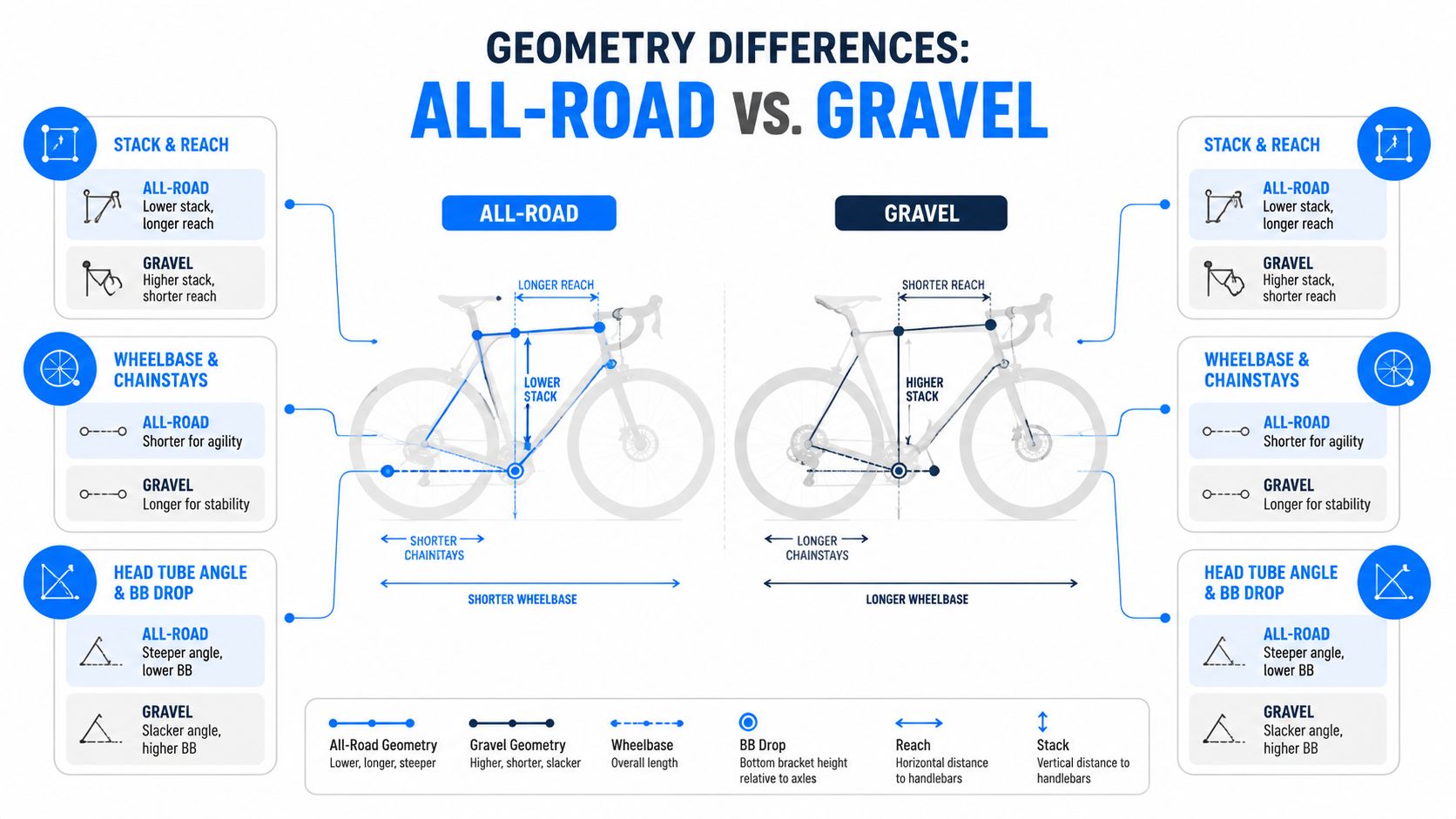
Geometry decides how a bike feels before the tires tell you anything. All-road bikes often preserve a quicker, more road-oriented handling character, while gravel bikes often add stability through wheelbase, front-center, steering geometry, tire volume, and cockpit design. Stack and reach must still be compared on the exact model because category labels do not guarantee a specific fit. The road bike geometry comparison guide provides additional context for understanding where all-road geometry sits between traditional road and gravel categories.
What to compare beyond the label
Focus on stack, reach, standover, wheelbase, head tube angle, chainstay length, and bottom bracket drop. Stack and reach define how high and how long the cockpit feels. Wheelbase and head angle shape whether the bike feels calm or quick. Standover affects how confident the bike feels when you stop, start, or dab a foot on rough ground. Bottom bracket drop influences how low or planted the bike feels in corners and over broken pavement.
An all-road bike usually stays closer to endurance road geometry. That gives you a quicker, more familiar position if you already ride a road bike, and it keeps the handling sharp on pavement. A gravel bike usually pushes the front end farther out and adds stability for loose or uneven surfaces. The difference shows up fast. The all-road bike responds sooner, the gravel bike stays calmer when the surface starts shifting under you.
The same nominal size can still fit very differently. Two bikes in the same nominal size can place the rider very differently. One may have a taller front end, a longer frame reach paired with a shorter stem, or a different wheelbase and front-center. Compare the complete geometry and cockpit setup rather than assuming the same size label creates the same position.
If you want a clearer read on cockpit length and position, SYCLR's Bike Stack and Reach guide is the right reference. A geometry chart also helps you compare two listings side by side without guessing at fit. The category name tells you the intent. The geometry tells you how the bike will sit under you.
Gearing, Mounts, Speed, and Comfort Tradeoffs
Buyers decide whether they want the bike to behave like a road bike that can wander, or an all-terrain bike that can still move well on pavement. Gravel bikes usually come with lower gearing because steep, loose, or loaded riding demands it. All-road bikes often stay closer to road-style gearing, which keeps the bike lively on pavement but can make rough climbs or loaded rides feel less forgiving. That difference matters more than marketing copy ever will.
Mounts are the other quiet divider. Gravel bikes often have more room for bags, bottles, racks, and adventure setups. All-road bikes may have fewer mounts or none at all, because the design priorities still lean toward speed and simplicity. If you know you'll carry gear, or you want the option to build the bike up for longer mixed-surface days, gravel usually gives you more room to grow.
Speed and comfort are a package deal
On pavement, all-road bikes usually keep the edge because they tend to run narrower tires, a more aerodynamic position, and more road-efficient geometry. Gravel bikes trade some of that road speed for broader capability. That doesn't mean they're slow in every situation, it means the design is spending its budget elsewhere. A gravel bike is choosing composure and versatility, an all-road bike is choosing efficiency first.
A gravel bike can be fast enough for many riders on pavement, but it usually isn't the sharpest tool if your routes are mostly smooth roads.
On smooth pavement, an all-road bike will often feel more immediate because it tends to preserve a road-oriented position, faster tires, and quicker handling. A gravel bike may feel slower with wider or more aggressive tires, but the size of that difference depends heavily on tire tread, casing, pressure, rider position, gearing, and the exact bike.
The practical question is not whether every gravel bike is slower. It is whether the additional clearance, stability, gearing, and versatility are worth the pavement tradeoff for the routes you actually ride.
All-Road Bike vs Gravel Bike at a Glance
| Decision factor | All-road bike | Gravel bike |
|---|---|---|
| Primary use | Pavement plus light mixed surfaces | Regular unpaved and mixed-surface riding |
| Road feel | Quicker and more road-oriented | Calmer and more terrain-oriented |
| Tire clearance | Moderate | Usually wider |
| Loose gravel | Limited to moderate capability | Better suited |
| Rough pavement | Strong | Strong |
| Gearing | Often closer to road gearing | Often lower and wider range |
| Mounts | Usually fewer | Often more |
| Loaded riding | Limited depending on frame | Common use case |
| Group rides | More road-friendly | Depends heavily on setup |
| Best fit | Road-first rider | Mixed-surface or terrain-first rider |
Rider Profiles and Real-World Use Cases
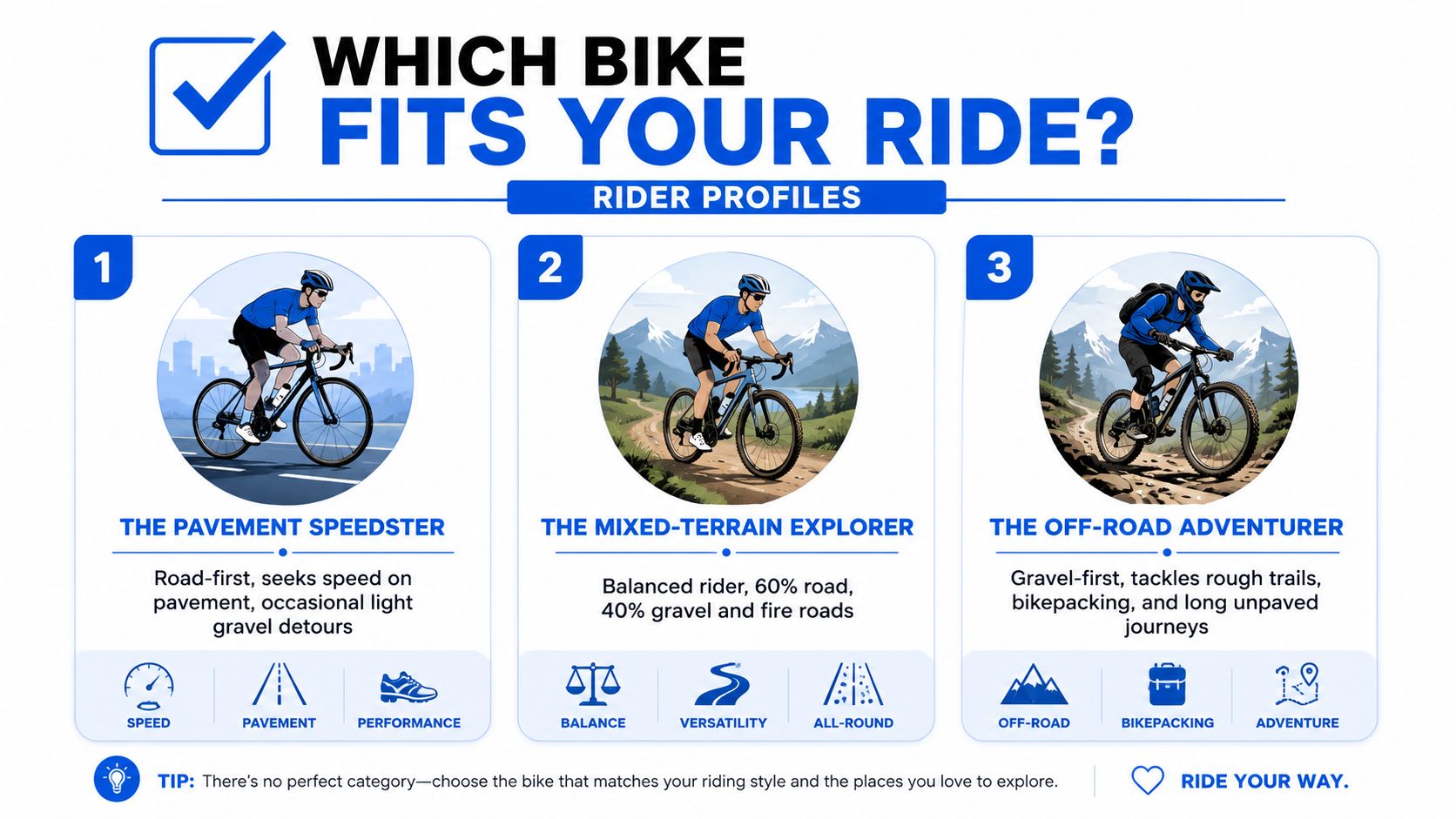
The cleanest way to choose is to describe the rider, not the bike. An all-road bike usually fits the rider who is road-first, wants speed on pavement, and only touches light gravel occasionally. It also fits the rider who wants one fast bike for bad pavement and smooth dirt, but doesn't need a full adventure platform. If that sounds like you, a bike that stays close to road geometry while opening up tire clearance is probably the right lane.
A gravel bike fits the rider who regularly leaves pavement, wants bigger tires, and values control and versatility more than pure road efficiency. It's the better call when the route consistently includes loose or rough surfaces, or when the bike needs to carry gear and stay composed over longer mixed-surface days. The point is not that gravel bikes are “better,” it's that they're built to tolerate more surface abuse without asking the rider to slow down mentally every time the road ends.
Common decision pattern
A lot of buyers start by searching for gravel because they want a one-bike solution. Then they look at their routes and realize most of their mileage is pavement, rough roads, chip seal, and short hardpack connectors. At that point, the all-road bike starts making more sense, because it gives them the road-like feel they want without choosing more off-road capability, tire volume, or utility than their routes require. That's the kind of decision a fit-aware comparison should make easier.
Budget doesn't force the answer by itself. One category is not automatically cheaper, because price depends on frame material, groupset, wheelset, model year, and listing quality. A used all-road bike with modern clearance can be a stronger buy than a tired gravel bike with vague specs, and the reverse can also be true. The core comparison is always the same: what did you pay for, what surfaces will you ride, and how well does the bike match your body?
Here's the fastest self-check.
-
Choose all-road if your rides are mostly paved, you care about road speed, and your off-road use is limited to short connectors.
-
Choose gravel if you leave pavement often, want calmer handling on loose ground, and need more tire room or gear-carrying flexibility.
-
Don't use height alone to decide. Compare stack, reach, standover, model year, and intended use before you commit.
How SYCLR Helps You Compare Better-Fit Listings
SYCLR keeps the comparison focused on the signals that matter, fit, geometry, and listing confidence, instead of category hype. Start with your height, bike type, and budget, or go deeper with fit measurements like stack, reach, and current-bike geometry to sharpen the shortlist. That matters because a bike can look like a bargain and still be the wrong choice if the fit, frame size, or geometry does not match how you ride.
SYCLR helps organize available fit signals, geometry signals, model-year context, price context, listing quality, and confidence signals so riders can compare stronger candidates more efficiently. That matters in the all-road versus gravel decision, because two bikes can look similar in photos and still differ a lot in clearance, posture, and terrain intent. A good deal is only a good deal if the bike fits, whether you are shopping new or used.

All-Road Bike vs Gravel Bike FAQ
What is the main difference between an all-road bike and a gravel bike?
An all-road bike is usually road-first, with enough tire clearance and comfort for rough pavement and light mixed surfaces. A gravel bike usually offers more clearance, lower gearing, stability, and versatility for sustained unpaved riding.
Can an all-road bike handle gravel?
Yes, many all-road bikes can handle hardpack, crushed stone, smooth dirt roads, and short light-gravel connectors. They are less suited to loose, rough, muddy, or deeply rutted terrain.
Is a gravel bike slower than an all-road bike?
A gravel bike may feel slower on smooth pavement, especially with wider or more aggressive tires. The actual difference depends on tires, pressure, rider position, gearing, wheels, and the exact bike.
Which bike is better for mostly paved riding?
An all-road bike will usually make more sense when most riding is paved and unpaved sections are short, smooth, and predictable.
Which bike is better for one-bike versatility?
A gravel bike may offer more surface versatility, but it is not automatically the best one-bike option. Riders who strongly prioritize pavement speed may be happier with an all-road bike.
Which geometry numbers should I compare?
Start with stack, reach, standover, wheelbase, head tube angle, chainstay length, bottom bracket drop, and tire clearance. Always compare the exact model year.
Can SYCLR help compare all-road and gravel bikes?
SYCLR helps riders compare available road and gravel listings using fit signals, geometry signals, model-year context, price context, listing quality, and confidence signals before buying.
If you are comparing road-leaning and gravel bikes now, start with your height, bike type, and budget in the SYCLR app. Use available fit signals, geometry signals, model-year context, price context, listing quality, and confidence signals to shortlist stronger candidates before contacting a seller.