
Clincher vs Tubular Road Tires: Real Buyer Guide 2026
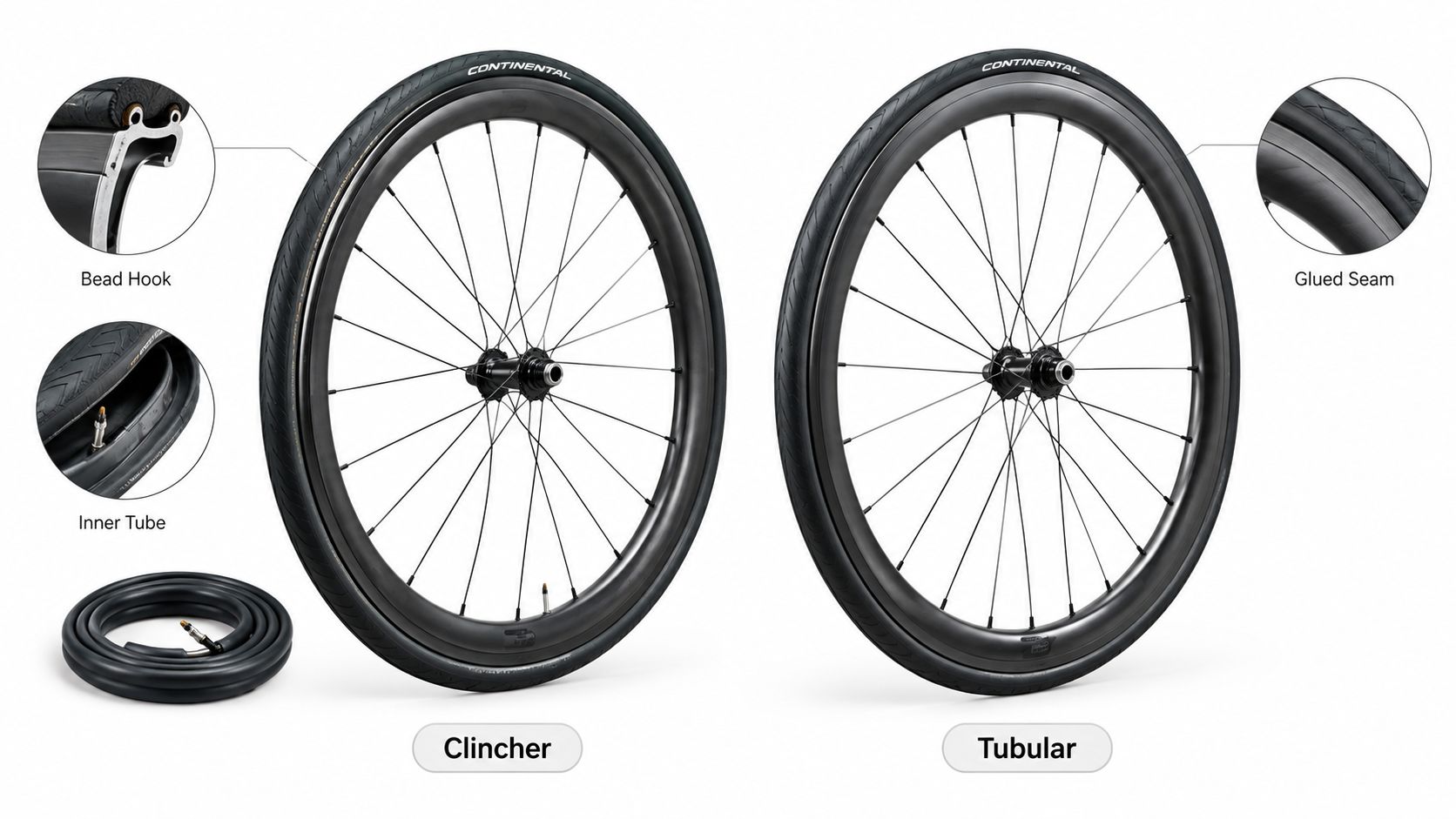
Many cyclists still approach clincher vs tubular as if tubular tires are the default performance option and clinchers are just the convenient fallback. That framing belongs to an older era. In 2026, tubulars are a specialist system. For most road riders, and especially for most gravel riders, the practical comparison is not clincher versus tubular in isolation. It is which tire and rim system gives you the best mix of compatibility, repairability, replacement access, and service support.
It also helps to define the terms clearly at the start:
-
Clincher: a bead-based tire and rim interface.
-
Tube-type clincher: a beaded tire used with an inner tube.
-
Tubeless clincher: a tubeless-compatible beaded tire used with a compatible rim, valve, and sealant.
-
Tubular: an inner tube sewn inside the tire casing, with the tire glued or taped to a dedicated tubular rim.
That distinction matters because not every clincher rim is tubeless-ready. A bike can use a clincher-style bead interface and still require inner tubes. Before comparing performance claims, first confirm which rim and tire format the bike or wheelset actually uses.
A clincher-based setup is still the more practical starting point for most buyers who want simple service, broad tire choice, and straightforward roadside repairs. Tubulars still appear in specialist uses such as cyclocross, some track applications, legacy race wheelsets, and among riders who already own tubular equipment and know how to service it. Modern road racing, by contrast, has largely moved toward tubeless systems rather than tubulars. Before you buy, verify rim compatibility, installation needs, replacement availability, and the real service burden of the system you are considering.
Table of Contents
- Why the Clincher vs Tubular Question Is Different Now
- How Clincher and Tubular Systems Are Built
- Weight, Rolling Resistance, and Punctures
- Installation, Roadside Repair, and Ownership Friction
- When to Choose Clincher and When Tubular Still Makes Sense
- Clincher vs Tubular: What Most Road and Gravel Buyers Should Choose
- How SYCLR Helps You Compare Listings With Confidence
- Clincher vs Tubular FAQs
- What is the difference between clincher and tubular?
- Are all clincher rims tubeless-ready?
- Are tubular tires still worth buying in 2026?
- Are tubular tires faster than clinchers?
- Are tubular tires safer after a puncture?
- Are tubular tires harder to install?
- Should a gravel bike use tubular tires?
- What should I check if a listing includes tubular wheels?
Why the Clincher vs Tubular Question Is Different Now
Older advice often treated professional race equipment as the default benchmark for everyone else. That is one reason tubulars built such a strong reputation. For decades they were associated with lightweight race wheels, premium builds, and elite competition. But that history does not answer the buying question most riders face now.
Today, tubulars are best understood as a specialist system, not a normal default for modern road buying. Their continued relevance is narrow. You may still see them in cyclocross, some track use, older race wheelsets, and among riders who are already invested in tubular service and replacements. For mainstream road riding, and especially for gravel, the more current conversation is usually tube-type clincher versus tubeless-ready clincher.
Modern road racing has also changed. Tubeless systems now occupy much of the performance discussion that once kept tubulars central. Recent technical guides and product support material make the compatibility differences clear, especially the fact that clincher, tubeless, and tubular systems are distinct formats with different rims and service needs, as outlined in Hunt's explanation of clincher, tubeless, and tubular rim compatibility.
The buyer question that matters
A useful comparison starts with ownership, not mythology. Ask these questions first:
-
Rim compatibility: Is the wheel a tube-type clincher rim, a tubeless-compatible clincher rim, or a tubular rim?
-
Installation demands: Can you install and service the system correctly, or will you need specialist help?
-
Roadside repair: What happens if you puncture mid-ride?
-
Replacement access: Can you easily buy the correct tire locally or online when needed?
-
Service availability: Does your local shop regularly work on that system?
-
Listing uncertainty: If you are buying used, do you actually know the tire type, rim identity, and service history?
A listing can make a wheelset look fast or high-end without showing the friction that comes with ownership. For most riders, that friction matters more than a small theoretical performance difference.
Practical rule: Treat tubulars as a specialist ownership choice first, not as an automatic performance upgrade.
How Clincher and Tubular Systems Are Built
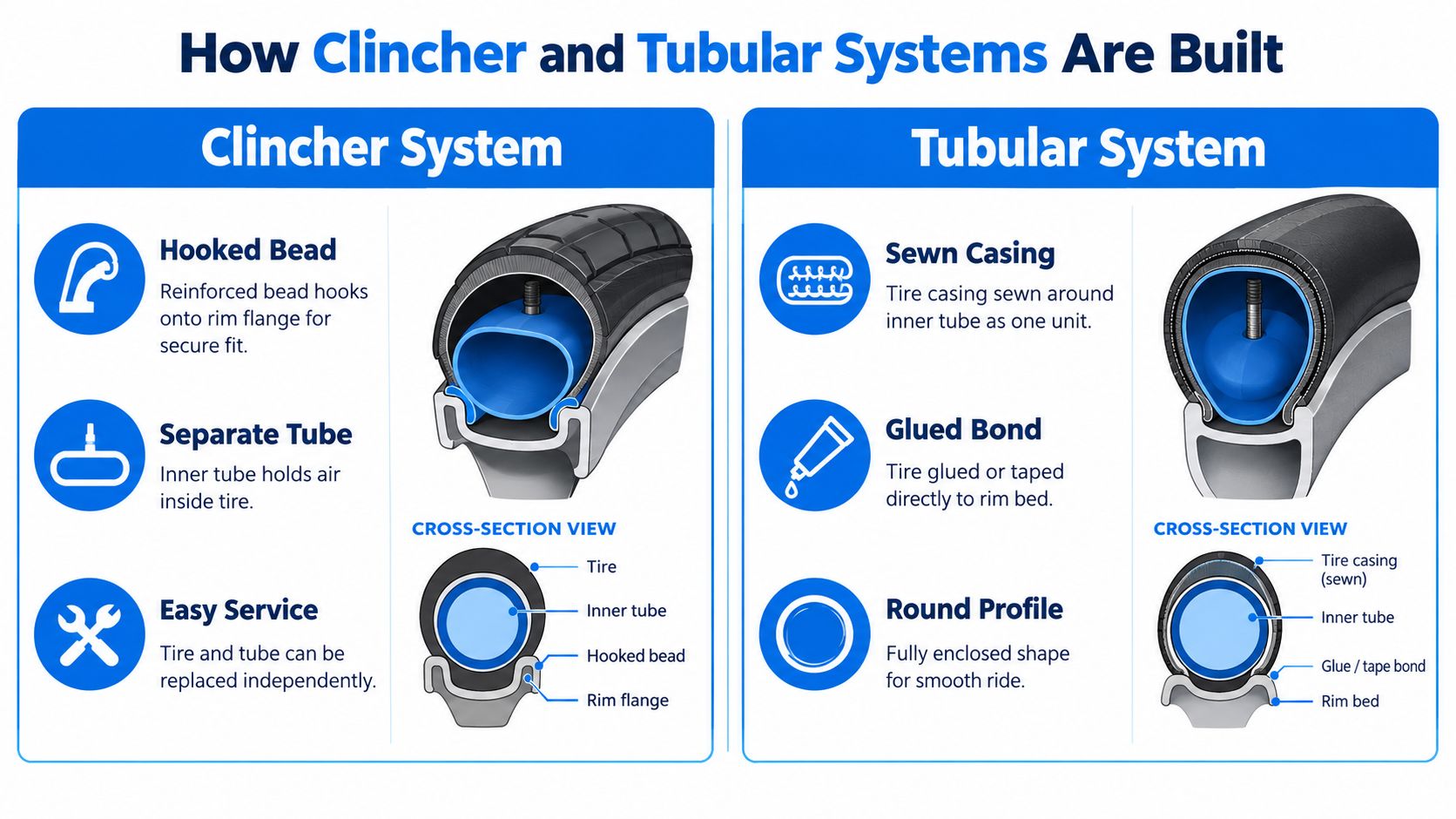
A clincher tire uses a bead that locks into a matching rim interface. That broad definition includes both tube-type clincher and tubeless clincher systems.
A tube-type clincher pairs a beaded tire with a separate inner tube. Air is held by the tube, and the tire itself can usually be reused after a puncture if the casing is still sound.
A tubeless clincher uses a tubeless-compatible beaded tire with a compatible rim, valve, and sealant. The tire still uses a bead-based rim interface, but it is not the same thing as a basic tube-type clincher setup. Not every clincher rim is tubeless-ready.
A tubular tire combines the casing and inner tube into a single sewn assembly. That assembly is then glued or taped onto a dedicated tubular rim. This is a different rim system, not a variation of a standard clincher. Hunt's explanation of clincher, tubeless, and tubular rim compatibility makes the key point clearly: matching wheel standards elsewhere on the bike does not make the tire systems interchangeable.
Why the rim design changes ownership
The bead-based design of a clincher system creates a familiar service routine. With a tube-type clincher, you can remove one side of the tire, repair or replace the tube, inspect the casing, and continue using the same tire if it is still in good condition. With a tubeless clincher, setup and troubleshooting can be more involved, but the service ecosystem is still much broader than with tubulars.
Tubular rims require a different workflow because the tire is bonded directly to the rim. Installation is not just a matter of stretching on a tire and inflating it. The tire has to be mounted straight, bonded correctly, and checked carefully. That changes not only installation, but also repair strategy, replacement planning, and shop support.
Why terminology matters in listings
Listings often blur these distinctions. Sellers may say "clincher," "tubeless," or "race wheels" without fully identifying the rim system. That can create confusion, especially with older wheelsets.
A beaded tire system does not automatically mean tubeless-ready. A high-end wheelset does not automatically mean modern practicality. A tubular wheelset may still be legitimate specialist equipment, but it brings different service needs and replacement constraints. If the listing does not clearly identify the rim type, treat that as added uncertainty.
Historical overviews of bicycle tire systems help explain why tubulars still carry prestige language in listings, even though they are now much less common outside specialist use in this technical overview of bicycle tire systems.
Weight, Rolling Resistance, and Punctures
This is where older assumptions often survive longest. Tubular systems historically enabled lightweight race-wheel designs, and that is part of why they became so strongly associated with performance. But actual system weight depends on the exact wheel, tire, tube or sealant, valve, tape or adhesive, and overall setup. There is no single weight advantage you should assume from the word "tubular" alone.
The same caution applies to speed. Modern clincher and tubeless systems can have very low rolling resistance. Tubular construction alone does not prove lower rolling resistance. The result depends on the specific tire, casing, pressure, rim pairing, and riding surface.
Puncture claims also need care. Tubular tires do contain an inner tube sewn inside the casing. Their construction changes the tire and rim relationship, but tubulars can still puncture or suffer casing damage. Tube-type clinchers can puncture, pinch flat, or cut a tire. Tubeless clinchers can lose sealant, fail to seal a larger cut, or become difficult to reseat after a major problem. None of these systems is automatically superior in every puncture scenario.
For gravel, the most relevant comparison today is often tube-type clincher versus tubeless-ready clincher, not clincher versus tubular. Tubeless-ready gravel setups matter because they combine a bead-based tire format with lower-pressure capability and sealant-based puncture management. If you are comparing gravel tire systems, review this comparison of tubeless and tube-based gravel systems before assuming tubulars belong in the mainstream gravel conversation.
Installation, Roadside Repair, and Ownership Friction
For most buyers, this is the section that matters most.
A tube-type clincher is modular. If the tube fails, you replace or patch the tube. If the tire wears out, you replace the tire. The steps are familiar to most riders and most bike shops.
A tubeless clincher adds setup variables such as sealant, rim tape, valve condition, and bead seating, but it still lives inside a broad modern support ecosystem. Many riders and shops already understand the format well.
Tubular ownership is different. Installation requires correct glue or tape preparation and proper bonding to the rim. The tire must be aligned accurately, mounted carefully, and allowed to bond correctly before hard use. That does not make tubulars unworkable. It does mean the margin for casual installation is smaller, and the consequences of poor setup can be more serious.
What a roadside problem looks like
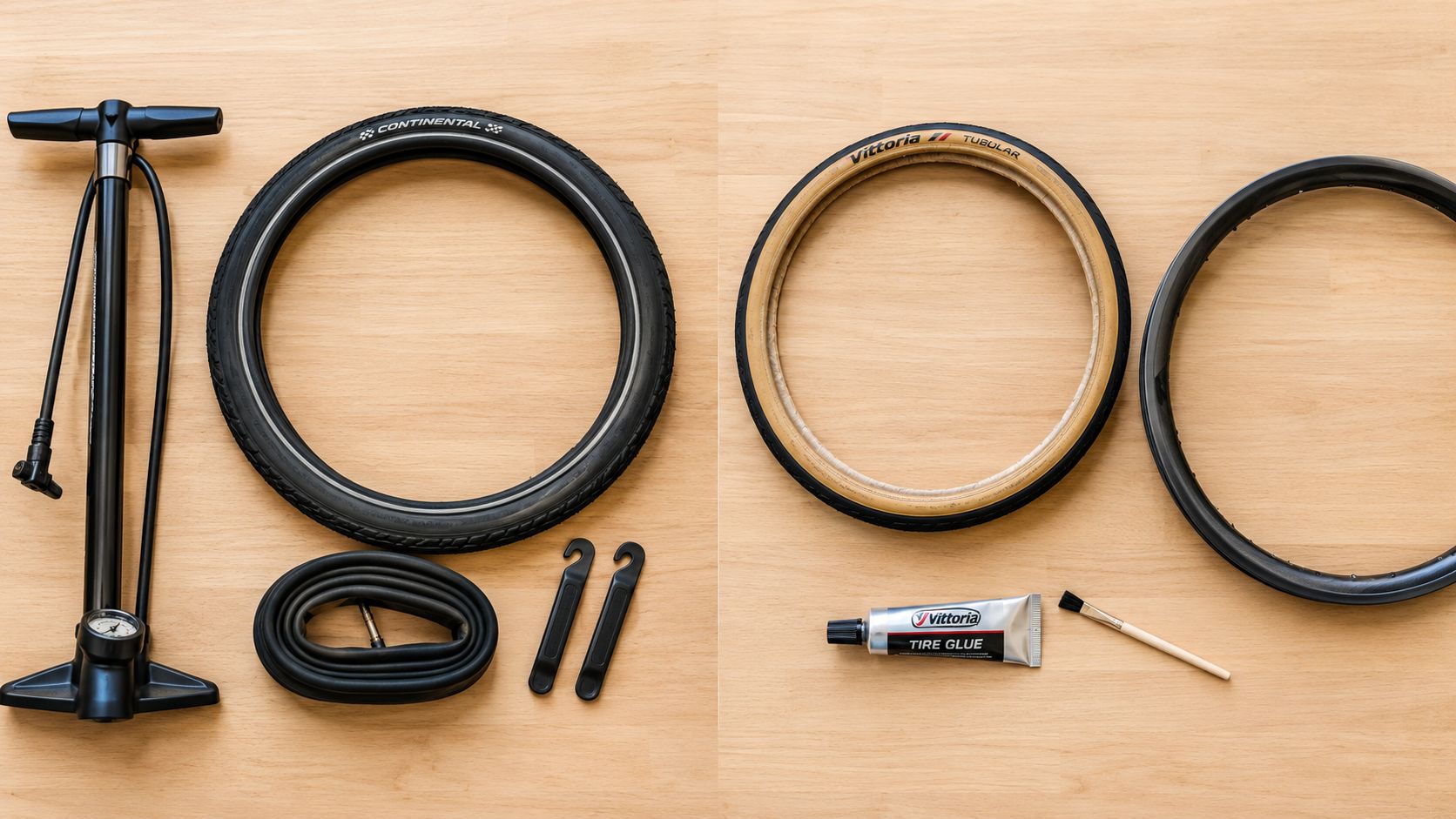
A roadside issue on a tube-type clincher is usually the most familiar case. You remove the wheel, open one side of the tire, replace or patch the tube, inspect the inside of the tire, and reinflate.
A roadside issue on a tubeless clincher can range from quick and minor to messy and inconvenient, depending on whether the sealant closes the puncture or whether the tire needs a plug, a tube, or more involved cleanup.
A roadside issue on a tubular is different again. Because the tire is a sewn unit bonded to the rim, your repair options are narrower in the moment. A rider may need a pre-prepared spare tubular, a temporary solution, or a ride-ending pickup. That can be manageable for someone already committed to the format, but it is a real ownership consideration.
Service reality: The easiest wheel to own is often the one with the broadest repair path, the best local support, and the simplest replacement process.
If you are looking at an older or used tubular wheelset, unknown tire age, bonding history, rim identity, or replacement availability should be treated as additional listing uncertainty.
For pressure decisions, use the tire maker's recommendations and account for rider weight, rim width, tire size, casing, and surface. A practical road bike tire pressure guide can help organize those variables.
Here is a useful service demonstration for riders who want to understand the hands-on difference:
When to Choose Clincher and When Tubular Still Makes Sense
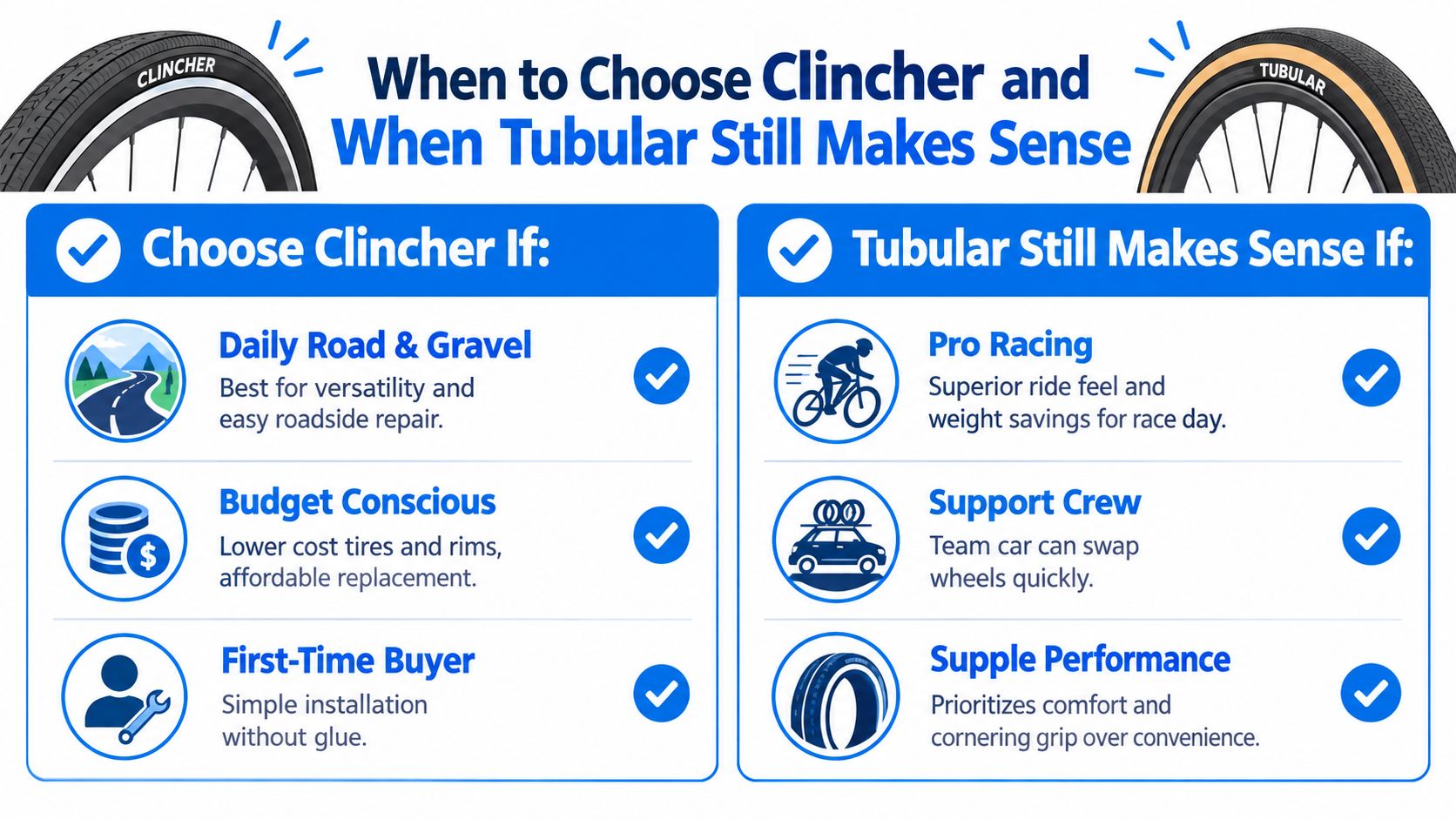
For most riders, the answer is straightforward. Choose a clincher-based system when you want broad compatibility, easier replacement, simpler service, and a more normal modern ownership experience.
That recommendation includes two different paths:
-
Tube-type clincher if you want simplicity, familiar roadside repair, and wide compatibility.
-
Tubeless-ready clincher if you want a modern bead-based system that is especially relevant for gravel and common in contemporary road setups.
Clincher fits most riders
-
Everyday road riding: Tube-type clincher and tubeless-ready clincher setups generally have broader service and replacement support.
-
Gravel riding: Tubeless-ready clincher systems are especially relevant because they support current gravel tire choices and lower-pressure setups.
-
Training and commuting: Bead-based systems are easier to service with common parts.
-
First-time performance buyers: You avoid the added complexity of tubular bonding and specialist replacement planning.
-
General bike-shop support: Service availability is usually much better for clincher-based systems.
Where tubulars still fit
Tubulars still make sense in narrower scenarios. That may include cyclocross, some track applications, legacy race wheelsets that a rider wants to keep using, and riders who are already committed to tubular equipment and service.
Those are real use cases, but they are not the mainstream answer for most modern road or gravel buyers. If you are not already comfortable with the installation method, replacement planning, and repair trade-offs, tubulars usually add more friction than value.
Recent cycling coverage reflects this shift in emphasis, with tubulars treated as a niche choice rather than the standard answer for current riders in this broader comparison of current tire systems.
Clincher vs Tubular: What Most Road and Gravel Buyers Should Choose
For most road and gravel riders in 2026, the practical recommendation is to choose a clincher-based system unless you already have a clear specialist reason to choose tubulars.
That does not mean all clinchers are the same. A tube-type clincher and a tubeless-ready clincher solve different problems. But both are easier to integrate into normal buying, servicing, and replacing than a dedicated tubular setup.
If gravel is part of the plan, tubeless-ready clincher systems deserve especially close attention. They are far more relevant to modern gravel ownership than tubulars.
What to verify before you buy
Before choosing a bike or wheelset, confirm:
-
Rim system: Tube-type clincher, tubeless-compatible clincher, or tubular.
-
Tire compatibility: Do not assume every clincher rim is tubeless-ready.
-
Installation burden: Will you handle the setup yourself, or rely on a shop?
-
Roadside repair plan: What will you actually carry and do if something goes wrong?
-
Replacement access: Can you source the exact tire format without hassle?
-
Service support: Is that system easy to service where you live?
-
Used-listing uncertainty: Unknown tubular tire age, bonding history, rim identity, or replacement availability should lower confidence.
How SYCLR Helps You Compare Listings With Confidence
A tire-system choice is only one part of a bike decision. You also need to compare the listing as a whole.
SYCLR helps you evaluate listings using fit signals, geometry signals, model-year context, price context, listing quality, condition signals where available, and confidence signals. That makes it easier to spot when a wheel specification sounds impressive but adds hidden friction, uncertainty, or replacement difficulty.
Start your comparison at SYCLR. If you already know more about your position and fit preferences, you can add deeper information through Advanced Fit.
A practical listing workflow
-
Filter by riding type: Separate road and gravel options first.
-
Check fit signals: Use size labels as a starting point, not a conclusion.
-
Review geometry signals: Compare the frame's actual shape and position, not just the brand's size name.
-
Confirm the wheel system: Identify whether the bike uses tube-type clincher, tubeless-compatible clincher, or tubular rims.
-
Look at listing quality and condition signals: Clear photos and complete specs matter.
-
Judge confidence signals: Missing details about wheels, tires, or setup should reduce certainty.
SYCLR does not perform a professional bike fit, physically inspect bikes, authenticate listings, verify ownership or seller claims, or guarantee fit or condition. It helps you compare listings with more context so you can shortlist stronger options before you commit.
Clincher vs Tubular FAQs
What is the difference between clincher and tubular?
A clincher uses a bead-based tire and rim interface. That includes both tube-type clincher and tubeless clincher systems. A tubular has an inner tube sewn inside the tire casing, and the complete tire is glued or taped to a dedicated tubular rim.
Are all clincher rims tubeless-ready?
No. A clincher rim uses a bead-based interface, but not every clincher rim is designed for tubeless use. Some require a standard inner-tube setup only.
Are tubular tires still worth buying in 2026?
They can be, but mostly for specialist cases such as cyclocross, some track use, legacy race wheelsets, or riders who are already committed to tubular equipment and service. For most road and gravel riders, clincher-based systems are more practical.
Are tubular tires faster than clinchers?
Not by definition. Modern clincher and tubeless systems can have very low rolling resistance, and tubular construction alone does not prove a faster setup.
Are tubular tires safer after a puncture?
You should not assume that. Tubular construction changes the tire and rim relationship, but tubulars can still puncture or suffer casing damage. The real outcome depends on the specific failure, the setup, and how the rider manages the problem.
Are tubular tires harder to install?
Tubular installation is more specialized because it requires correct glue or tape preparation, careful alignment, and proper bonding to a dedicated tubular rim. Tubular installation requires correct glue or tape preparation, careful alignment, and proper bonding to a dedicated tubular rim.
Should a gravel bike use tubular tires?
Usually no for a typical gravel buyer. Tubeless-ready clincher systems are much more relevant to modern gravel riding because they fit current tire choices, lower-pressure use, and mainstream service patterns.
What should I check if a listing includes tubular wheels?
Check the exact rim type, the tire's apparent condition, whether the bonding history is known, and whether replacement tires are easy to source. If those details are unclear, treat the listing as lower-confidence.
Compare road and gravel listings with fit signals, geometry signals, model-year context, price context, listing quality, condition signals where available, and confidence signals at SYCLR.