Effective Top Tube vs Reach: What Each Geometry Number Means
Most online bike advice blurs two different geometry numbers, then treats them like they answer the same question. They do not. Effective top tube and reach are both frame measurements, but they start from different reference points and describe different parts of the frame. If you treat either one as a shortcut for final cockpit length or exact hand position, you will misread the bike.
Effective top tube, or ETT, is a horizontalized frame reference tied to the seat tube or seatpost axis and the head tube area. Reach is a horizontal bottom bracket-relative frame coordinate to the head tube reference. Both numbers are useful. Neither one equals your finished riding position by itself.
| Metric | What it anchors to | What it describes | What it does not tell you by itself |
|---|---|---|---|
| Effective top tube | Seat tube or seatpost axis and head tube area | A horizontalized frame proportion reference | Final cockpit length, hand position, or comfort |
| Reach | Bottom bracket and head tube reference | Horizontal BB-relative frame coordinate to the head-tube reference | Final cockpit length, hand position, or bar setup |
Table of Contents
- Why Riders Confuse Effective Top Tube and Reach
- How Each Metric Is Measured on the Frame
- Why ETT and Reach Can Tell Different Stories
- Frame Geometry Is Not the Same as Final Cockpit Position
- A Practical Workflow to Compare Bikes Using Reach and ETT
- When Effective Top Tube Adds Useful Context
- How SYCLR Uses Geometry Context
- Common Questions About ETT vs Reach
Why Riders Confuse Effective Top Tube and Reach
The confusion usually starts when riders assume both numbers describe bike length in the same way. They do not. A bike can show a longer effective top tube because of its seat tube geometry, while reach stays relatively similar. Another bike can show a similar reach while presenting a different ETT because the seat tube reference moved.
That matters because these are frame geometry numbers, not complete rider-position numbers. They help you compare frames. They do not directly tell you where your hands will end up once the bike is built with a stem, spacers, handlebar, hood placement, and saddle setup.
Two frame numbers, two reference systems
ETT and reach are often discussed together because both are horizontal measurements. But they are horizontal measurements from different anchors.
ETT is tied to the seat tube or seatpost axis and the head tube area. Reach is tied to the bottom bracket and the head tube reference. That distinction is the whole point. Once the anchor changes, the meaning changes.
Practical rule: Use reach and stack together to compare frame coordinates. Use ETT as supporting context for overall frame proportion, especially when seat tube geometry may be influencing what you see on the chart.
This is also why two bikes that look close on paper can still present different geometry relationships. If you compare frames across categories, model years, or brands without checking the exact measurement reference, you can end up treating unlike numbers as if they were equivalent.
How Each Metric Is Measured on the Frame
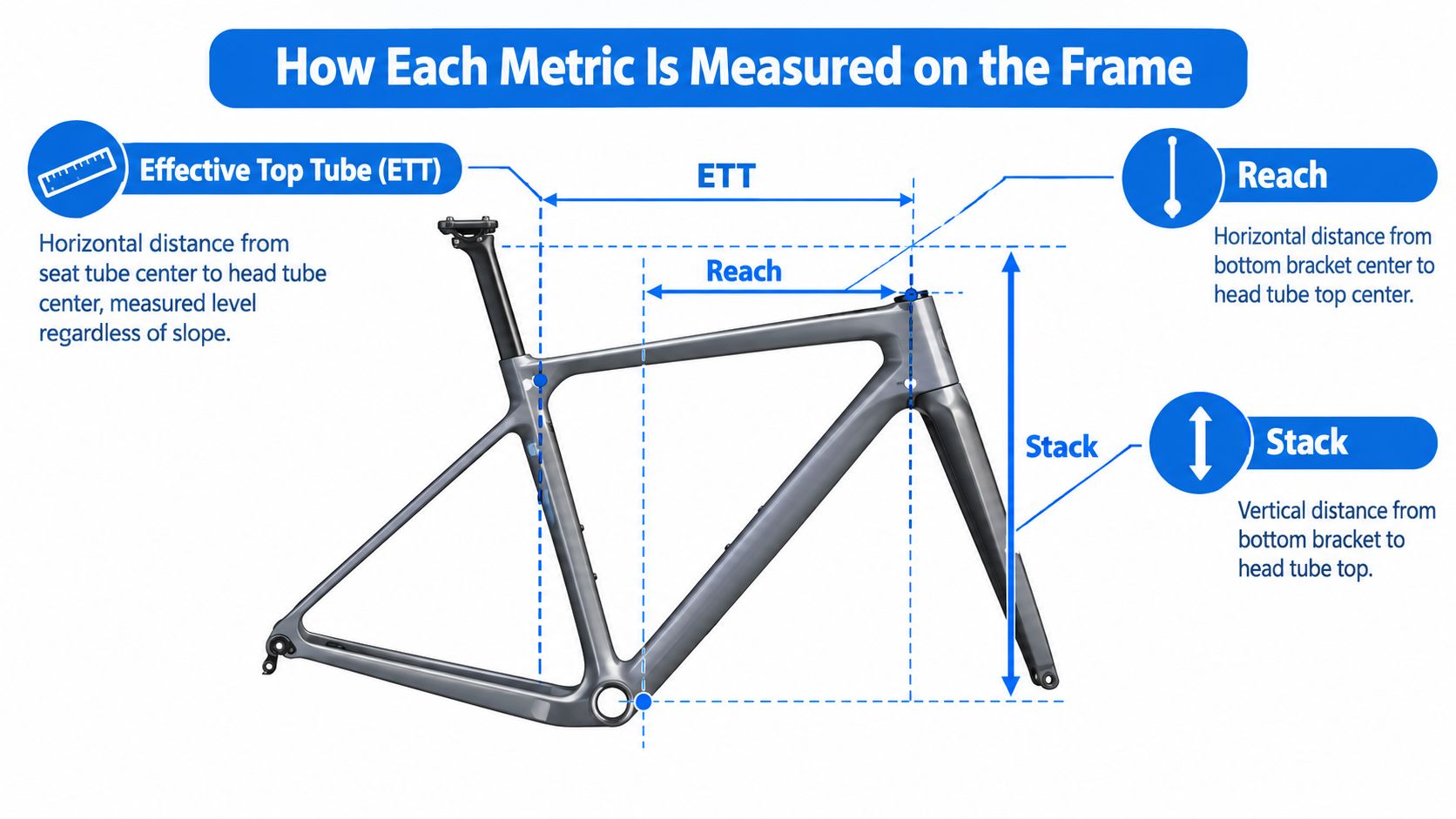
The cleanest way to understand the difference is to picture the reference lines. Effective top tube is a horizontalized measurement tied to the seat tube or seatpost axis and extending toward the head tube area. This is why geometry charts can still present a useful top-tube-based number even when the actual top tube slopes.
Reach is measured horizontally from the bottom bracket to the head tube reference. Because it is BB-relative, it does not move with saddle position, stem choice, or hood placement. It remains a frame coordinate.
ETT follows the seat tube axis, reach does not
ETT changes when the geometry behind its reference changes. If the seat tube angle changes, or if the seat tube or seatpost axis sits differently relative to the bottom bracket, the ETT result can change even if the front of the frame looks quite similar.
Reach behaves differently because it is anchored to the bottom bracket and measured to the head tube reference. That makes it a cleaner way to compare front-end frame length across bikes, but it still does not tell you the final cockpit or exact hand position by itself.
That distinction keeps the article simple:
ETT is a horizontalized frame reference influenced by seat tube geometry.
Reach is a BB-based horizontal frame coordinate.
Neither one equals final cockpit length.
Here's the part that matters most in buying decisions. Moving the saddle does not change frame ETT. Changing the stem does not change frame reach. Those setup choices change rider position on the bike, not the frame's published geometry numbers.
Here's the part online advice usually skips. ETT can still be a useful frame-proportion reference because it preserves a horizontal comparison even on bikes with sloping top tubes bike geometry guide. But it should not be described as a direct seated-fit measurement or a cockpit-length number.
If you want a deeper geometry glossary, use the bike stack and reach guide as the companion page and keep this one focused on the measurement differences.
Why ETT and Reach Can Tell Different Stories
The easiest way to stop guessing is to compare how each metric reacts when the frame's reference geometry changes. ETT and reach often move differently because they are not measuring from the same place.
| Variable Changed | Effective Top Tube | Reach |
|---|---|---|
| Seat tube angle changes | Can change because the seat tube-based reference shifts | Often stays more stable if the BB-to-head-tube relationship is similar |
| Saddle position changes | No change to frame ETT | No change to frame reach |
| Stem length changes | No change to frame ETT | No change to frame reach |
| Top tube is sloped | Still allows a horizontalized frame reference | Unaffected |
| Front-end frame layout changes | May not isolate the BB-to-head-tube relationship clearly | Reflects the BB-based front-end coordinate directly |
Seat Tube Geometry Can Change the ETT Result
Because ETT references the seat-tube or seatpost axis, two frames with similar reach can publish different ETT values when their seat-tube geometry differs. That does not mean one chart is wrong. It means the seat tube-based reference is affecting the top-tube number.
This is the main reason riders get tripped up. They see two bikes with similar reach and assume ETT should match. Or they see two bikes with similar ETT and assume the front of the frame must match. Neither assumption is safe without looking at the full geometry chart.
Buyer consequence: If two bikes have similar reach but different seat tube geometry, ETT can add useful context about frame proportion. If two bikes have similar ETT but different reach, the front-end frame coordinate may still differ in an important way.
Modern geometry charts make the comparison clearer when they publish full stack and reach figures, which is why reach has become such a useful cross-brand coordinate when paired with stack Canyon geometry explainer. But ETT still has value as supporting context, especially when seat tube geometry helps explain why two frames do not line up cleanly on paper.
Frame Geometry Is Not the Same as Final Cockpit Position
A lot of bad bike-fit advice starts by treating frame geometry as if it were the same thing as the final rider setup. It is not. Frame geometry describes the frame. Final cockpit and contact-point position depend on how the bike is built and adjusted.
Neither effective top tube nor reach equals your final cockpit length or exact hand position. A rider's actual position also depends on:
Stack
Stem
Spacers
Handlebar reach
Hood placement
Saddle position
What changes your actual hand position
This is the line buyers need to keep clear in their heads:
ETT and reach are frame numbers.
Stem, spacers, handlebar reach, hood placement, and saddle setup affect the final contact-point relationship.
So if a rider moves the saddle backward, the rider position changes, but the frame's ETT and reach do not. If a rider installs a different stem, hand position and steering leverage change, but the published frame ETT and reach do not.
That is why a clean geometry comparison needs two steps. First, compare the frame itself. Second, compare the likely build and setup needed to reproduce your position. Mixing those two steps together is how riders end up blaming the wrong number.
A Practical Workflow to Compare Bikes Using Reach and ETT
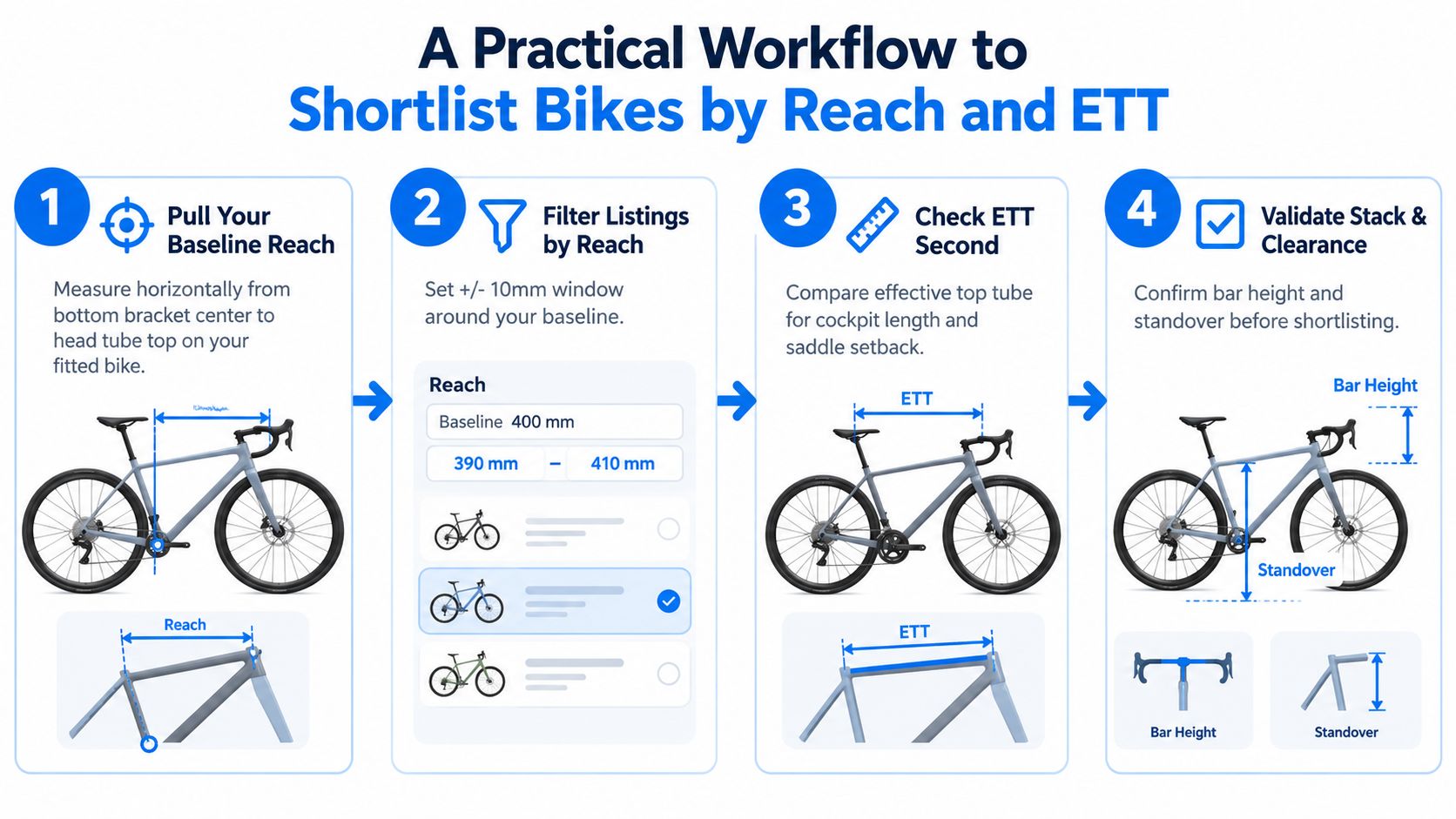
Most buyers get more useful answers from a structured geometry check than from any single shortcut number. The goal is not to make one metric do every job. The goal is to compare the right things in the right order.
Use ETT as supporting context, not a shortcut
Confirm the exact model, year, and size. Geometry can change across generations even when the name and size label stay the same.
Compare stack and reach together. Those two frame coordinates give a clearer starting point than either one alone.
Use a known-good bike or professional-fit reference if available. A trusted baseline is better than guessing from size labels.
Add ETT as supporting context. Use it to understand frame proportion and how seat tube geometry may be shaping the chart.
Evaluate stem, spacers, handlebar reach, hood position, and saddle setup. These determine whether the final contact-point position can match what you need.
Compare the exact manufacturer geometry chart, not the size label. Brand sizing names are not standardized.
That sequence keeps the comparison honest. It separates frame geometry from final rider setup, and it uses ETT where it helps instead of asking it to stand in for every fit variable.
Use the compare bike geometry page when you want to line up multiple listings and stop doing this math in your head.
When Effective Top Tube Adds Useful Context
Reach-first advice can become too absolute if it treats every other geometry number as noise. ETT still helps, just in a narrower role.
Where ETT still helps in real comparisons
ETT is useful when you want more context about frame proportion, especially when seat tube geometry is shaping the published dimensions. It also remains useful when a manufacturer or seller presents incomplete geometry information and you are trying to verify whether you are even looking at the correct frame family or size.
It can also help explain why two bikes with similar reach do not present the same geometry picture overall. In those cases, ETT is not replacing reach. It is adding context around the seat tube-based side of the frame.
Practical rule: Use stack and reach as your main frame coordinates, then use ETT to add context about frame proportion and seat tube-related geometry.
That is a more reliable approach than trying to decide which single number matters most in every situation.
How SYCLR Uses Geometry Context
Decision rule: Compare the frame first, then evaluate whether the likely setup can reproduce your position.
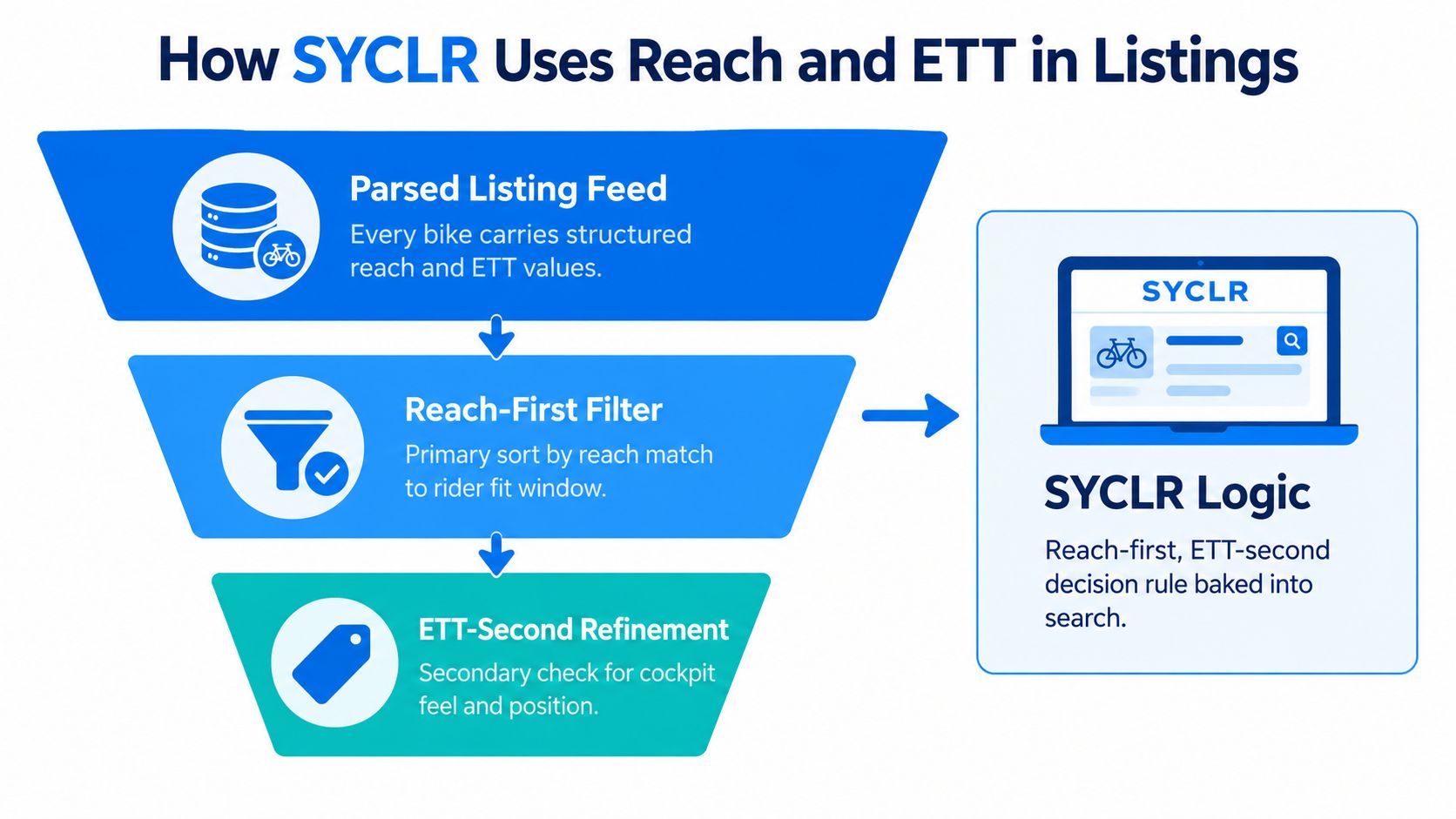
SYCLR compares road and gravel listings using fit signals, geometry signals, model-year context, price context, listing quality, condition signals where available, and confidence signals. That makes it easier to sort listings without treating a single geometry number as the whole answer.
Two bikes can still differ in meaningful ways even when one or two chart values look close. That is why buyers need to see the surrounding context instead of relying on a black-box shortcut.
SYCLR helps narrow the shortlist, but it does not perform a professional bike fit, physically inspect bikes, authenticate listings, verify ownership or seller claims, or guarantee fit or condition. Final contact-point setup still requires rider-specific judgment.
If you are comparing bikes by geometry, model-year context, and price context, that is the shortlist step SYCLR is built for.
Common Questions About ETT vs Reach
Can a longer stem replace a shorter reach
A stem changes hand position and steering leverage, but no universal stem threshold proves a frame is right or wrong. It is one setup variable among several, and it should be considered alongside stack, spacers, handlebar reach, hood placement, and saddle setup.
What if a listing only shows ETT
Do not rely on a universal conversion from ETT to reach. There is no single formula that works across all frames. The better move is to find the exact manufacturer geometry chart for that model, year, and size so you can compare the actual published dimensions.
Does reach matter more for short riders
Not by itself. Reach is still only one frame coordinate, and it becomes more meaningful when evaluated with stack and the rest of the bike's setup. The same basic rule applies to all riders: compare the frame first, then compare the build and contact-point setup.
Is reach or ETT more important on gravel bikes
The better question is not which number is more important in isolation. The better question is which number helps explain the frame clearly when used with the full chart. Reach is a useful BB-based frame coordinate. ETT adds supporting context, especially when seat tube geometry affects how the frame presents on paper.
What should I trust if the two numbers disagree
Start by checking the exact model, year, and size on the manufacturer chart. Then compare stack and reach together and use ETT to understand whether seat tube geometry is part of the difference. If the numbers seem to conflict, the answer is usually in the reference points, not in a single bad number.
How do I shortlist faster without overthinking it
Confirm the exact bike first, then compare stack and reach against a known-good reference if you have one. After that, use ETT as supporting context and review the setup variables that affect final position, including stem, spacers, handlebar reach, hood placement, and saddle setup. That order is faster and more reliable than chasing one shortcut number.
If you're comparing road or gravel listings and you want the geometry to do the talking, use SYCLR to compare fit and geometry signals first, then narrow by bike type, budget, and model-year context. Start with your height if that's all you know, or go deeper with fit details if you already have stack, reach, or a current-bike reference. It's a faster way to shortlist better-fit bikes and spend less time on frames that only look right on paper.