
Meaningful Choice Over Raw Count
More listings matter only when they add genuinely useful alternatives.
Engineering Note
A bike discovery system can look more powerful simply by showing a larger number of listings. But raw inventory count is not the same as useful choice. If many listings are duplicated, poorly identified, weakly supported, or irrelevant to the rider, more inventory can create noise instead of better decisions.
The Metric Trap
Listing count is an easy number to grow, and a big one looks impressive. But it can be misleading. Ten genuinely distinct, well-supported options can be more useful than fifty repetitive or uncertain ones, because recommendation quality depends on whether each new listing actually adds information or choice.
More inventory only helps when it increases useful choice.
Illusion of Depth
Across the broader retail ecosystem, the same underlying bike or the same commercial opportunity can show up in more than one way. Common reasons include:
A larger list is not necessarily a larger set of real choices.
Availability
A bike appearing in a broad catalog does not, by itself, mean it is available near you. A retailer headquarters, a generic brand catalog, a regional catalog, or a shared inventory source does not automatically establish local stock. Proximity should rest on evidence, not assumption — “nearby” should mean demonstrably nearby when it is used as a recommendation signal.
SYCLR distinguishes between inventory that is merely associated with a retailer or catalog and inventory that can be supported as genuinely available in a relevant location.
This same principle becomes especially important when SYCLR determines whether inventory can be treated as genuinely local. See how Local Pick works.
Coverage vs Confidence
Adding listings does nothing for a missing model year, an ambiguous generation, absent geometry, an uncertain size, or incomplete location evidence. A large dataset full of uncertain records is still uncertain — it is just uncertain at scale.
That is the same reasoning behind why SYCLR treats unknown bike geometry as unknown: the honest move is to show what is supported and leave the rest visibly open.
Coverage and confidence are different things.
Signal vs Noise
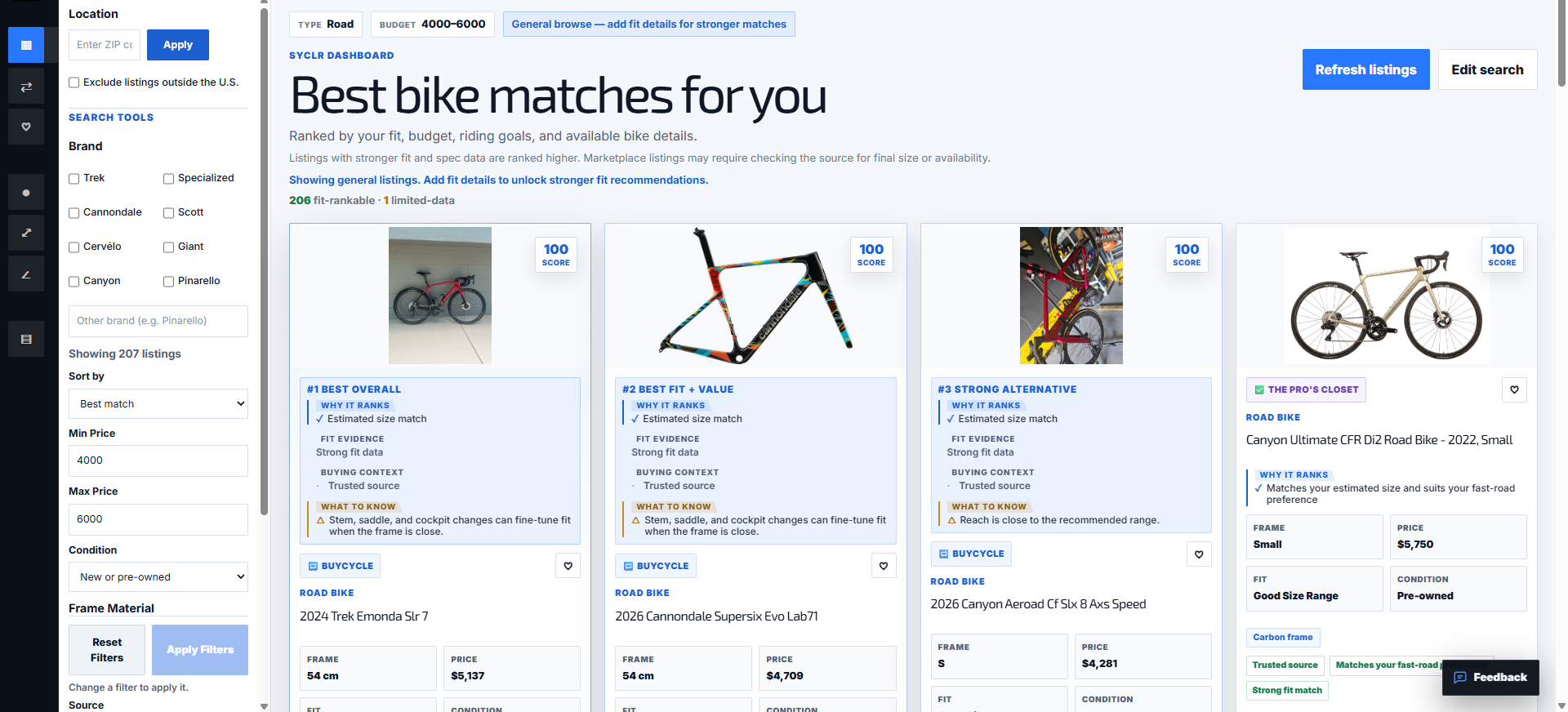
For a rider, a long list is not automatically useful. It works against them when many options are poor fit candidates, several are nearly identical, important evidence is missing, or the results differ mostly by which retailer is selling rather than by anything meaningful about the bike — leaving the rider unsure what deserves attention.
The goal is not to make the result set look large. The goal is to make the differences between useful options easier to understand.
Fit First
Volume never overrides suitability. In SYCLR’s product philosophy:
Those trust commitments are set out in full on Recommendation Integrity.
Added Value
These are examples of how extra inventory can add real decision value — not a fixed checklist. An additional listing tends to be more useful when it contributes one or more of:
The Tradeoff
A system can optimize for maximum apparent inventory coverage, or for more disciplined, interpretable recommendation evidence. The ideal wants both breadth and quality — but when they conflict, cosmetic scale should not be allowed to force unsupported claims.
Useful breadth is better than artificial depth.
The Principle
Five commitments sit underneath the way SYCLR treats inventory volume.
More listings matter only when they add genuinely useful alternatives.
Repeated representations do not automatically create new choice.
A catalog relationship is not the same thing as demonstrable local stock.
A larger dataset does not remove uncertainty from weak records.
Inventory breadth, price, proximity, and commercial status do not replace rider fit.
For Riders
The aim is a result set with fewer meaningless distinctions and clearer differences between the options that matter — with uncertainty shown plainly when the evidence is weak, local context used only when it can be supported, and fit kept separate from retailer relationships and raw inventory volume.
This is decision support, not a promise. SYCLR does not claim that every listing is perfectly unique, perfectly current, or perfectly local — it aims to keep those distinctions honest rather than hidden behind a big number.
Connections
How SYCLR Works shows how evidence is weighed into a comparison, and Recommendation Integrity sets out the trust commitments that keep volume, price, and commercial status from overriding fit.
This note also builds directly on why SYCLR treats unknown bike geometry as unknown — and, where identity or geometry is in question, how SYCLR verifies manufacturer geometry.
Keep Reading