
Local Means Demonstrably Local
A retailer’s presence alone does not prove a specific bike is local.
Methodology
Finding a bike nearby sounds simple, but a retailer appearing near a rider does not automatically mean a specific bike is genuinely local, available for pickup, or shippable. SYCLR treats local availability as an evidence problem first — then keeps fit separate from proximity.
“Local means demonstrably local.”
What Local Isn't
A bike shop can have a real, physical location and still list bikes online that are not held at that address. Broader catalogs can pull in manufacturer, distributor, warehouse, or shared inventory, so a product being visible on a store’s site is not proof that the store owns that specific bike locally.
A real store does not automatically make every online listing local.
Evidence First
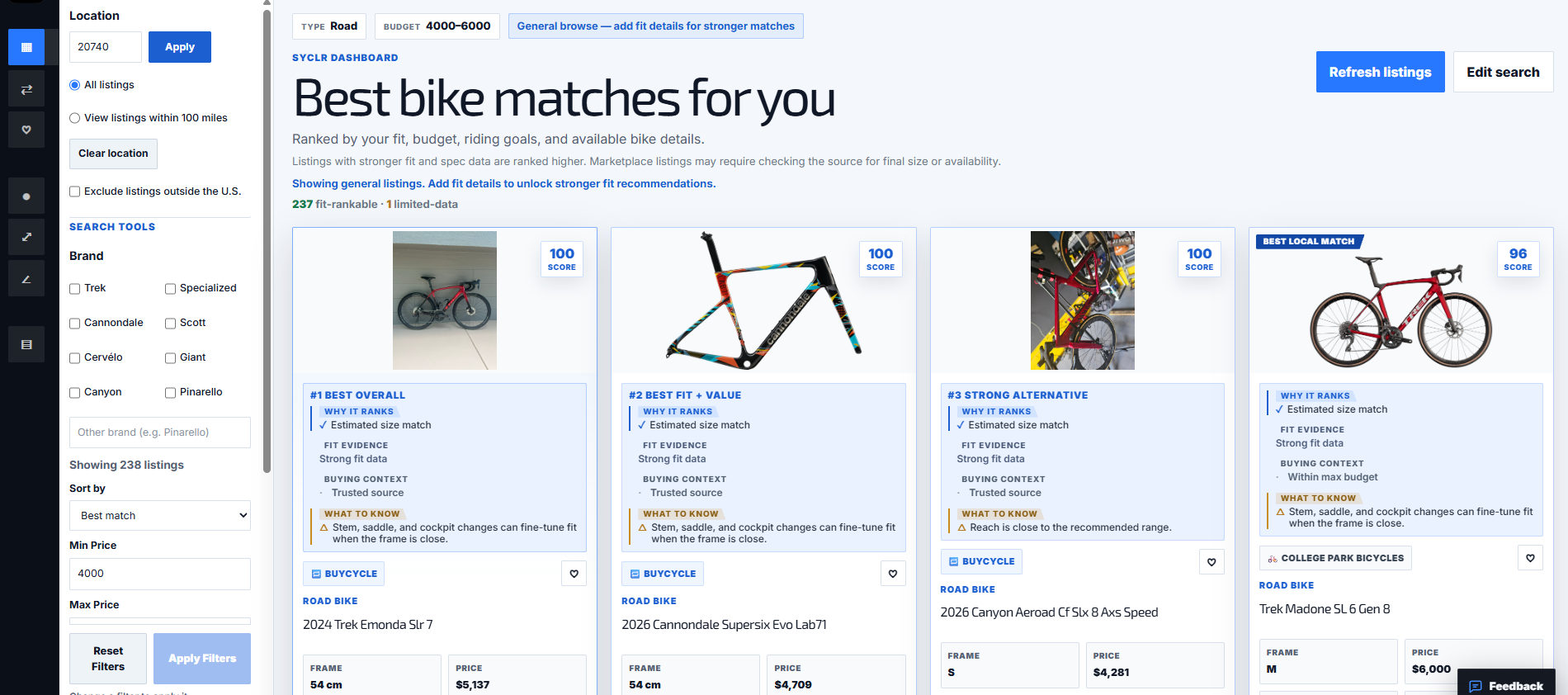
SYCLR distinguishes genuine local retailer inventory from broader online and distributor catalogs, then considers whether a bike can actually be picked up or shipped before showing it as an available option.
In practice that means looking for enough public evidence to support a geographic attribution. When that evidence is insufficient, SYCLR does not present the bike as confidently local — the uncertainty is preserved rather than converted into a location claim.
Fulfillment
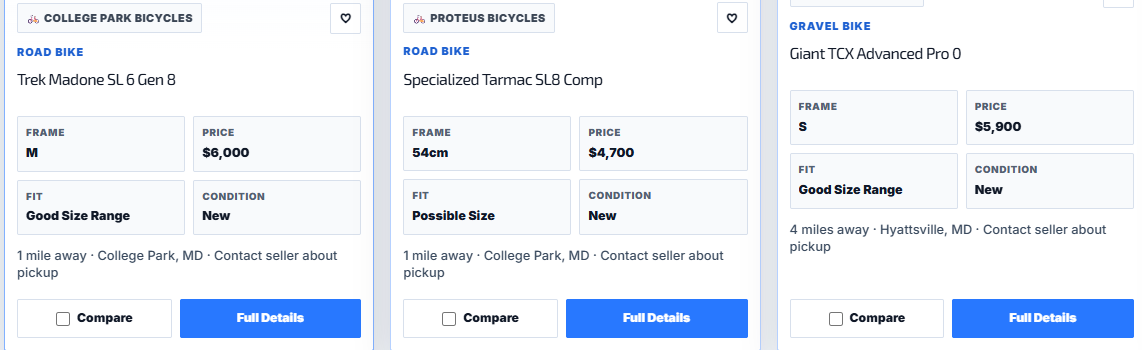
Some bikes may be available for local pickup while others can also be shipped. SYCLR considers available fulfillment information when deciding which listings to show — a bike may be pickup-only, shippable, both, or carry incomplete fulfillment information.
A bike being nearby does not mean it ships nationally, and a bike shipping widely does not make it a local pickup.
Uncertainty
No shipping information is not the same as confirmed shipping. The absence of a stated restriction is not proof of availability, so SYCLR does not convert missing fulfillment evidence into a nationwide claim.
Unknown is not the same thing as yes.
This is the same evidence philosophy described in why SYCLR treats unknown bike geometry as unknown, applied to a different problem: availability.
Fit First
Proximity can make a bike convenient, but convenience is not fit. A nearby bike should not outrank a better-supported match simply because it is geographically closer — location is one input to a buying decision, not a replacement for whether the bike suits the rider.
A local bike is only useful if it is still a plausible bike for the rider.
Fit stays primary throughout, as described in how SYCLR works. To go deeper on fit itself, see the bike fit guide.
Independence
Affiliate status does not make a listing local, and a retailer commercial relationship does not prove geographic availability. Inventory qualifies as local because of evidence, not because it is monetized.
Commercial relationships do not create local inventory evidence.
That separation is part of a broader commitment set out on Recommendation Integrity.
Scope
SYCLR is not trying to list every bike shop in a city. Instead it surfaces qualifying road and gravel inventory from sources that can be supported geographically, while keeping fit and evidence visible.
The goal is not to count nearby stores. The goal is to surface useful nearby bikes.
Geography & Language
When SYCLR describes local discovery, the wording should match the real geography. “In” is used when qualifying inventory is actually anchored in the named place — for example, “in Denver” or “in College Park.” “Near” is used when the supported inventory sits outside the named city but is still relevant to riders there — for example, “near Washington DC.”
These are methodology illustrations, not a menu of places. Whether any given market can honestly say “in” or only “near” depends on the evidence available for that market.
Retailer Independence
The retailers represented in SYCLR are independent third parties. They are not SYCLR locations, and appearing in local discovery does not mean SYCLR owns, operates, or is partnered with the shop.
SYCLR may include qualifying listings from independent retailers without implying ownership, affiliation, or control.
For Riders
The aim is local discovery that a rider can trust:
This is decision support, not a guarantee — SYCLR does not promise that every listing is perfectly fresh, perfectly unique, or that every bike in a region is covered.
The Principle
Five commitments sit underneath how SYCLR treats local availability.
A retailer’s presence alone does not prove a specific bike is local.
Pickup and shipping are separate availability questions.
Missing location or shipping evidence is not converted into certainty.
Proximity cannot turn the wrong bike into the right bike.
Affiliate or retailer relationships do not create local eligibility.
Connections
How SYCLR Works covers how evidence is weighed into a comparison, and Recommendation Integrity sets out why proximity and commercial status never override fit.
It also builds on how SYCLR verifies manufacturer geometry and the engineering note on why more bike listings do not automatically mean better recommendations.
As SYCLR expands local discovery, this methodology determines which markets can support location-specific inventory pages and which should remain broader regional coverage.
Ready to see where local discovery is currently supported? Explore Local Bikes.