
How Much Can Bike Fit Be Adjusted on a Frame
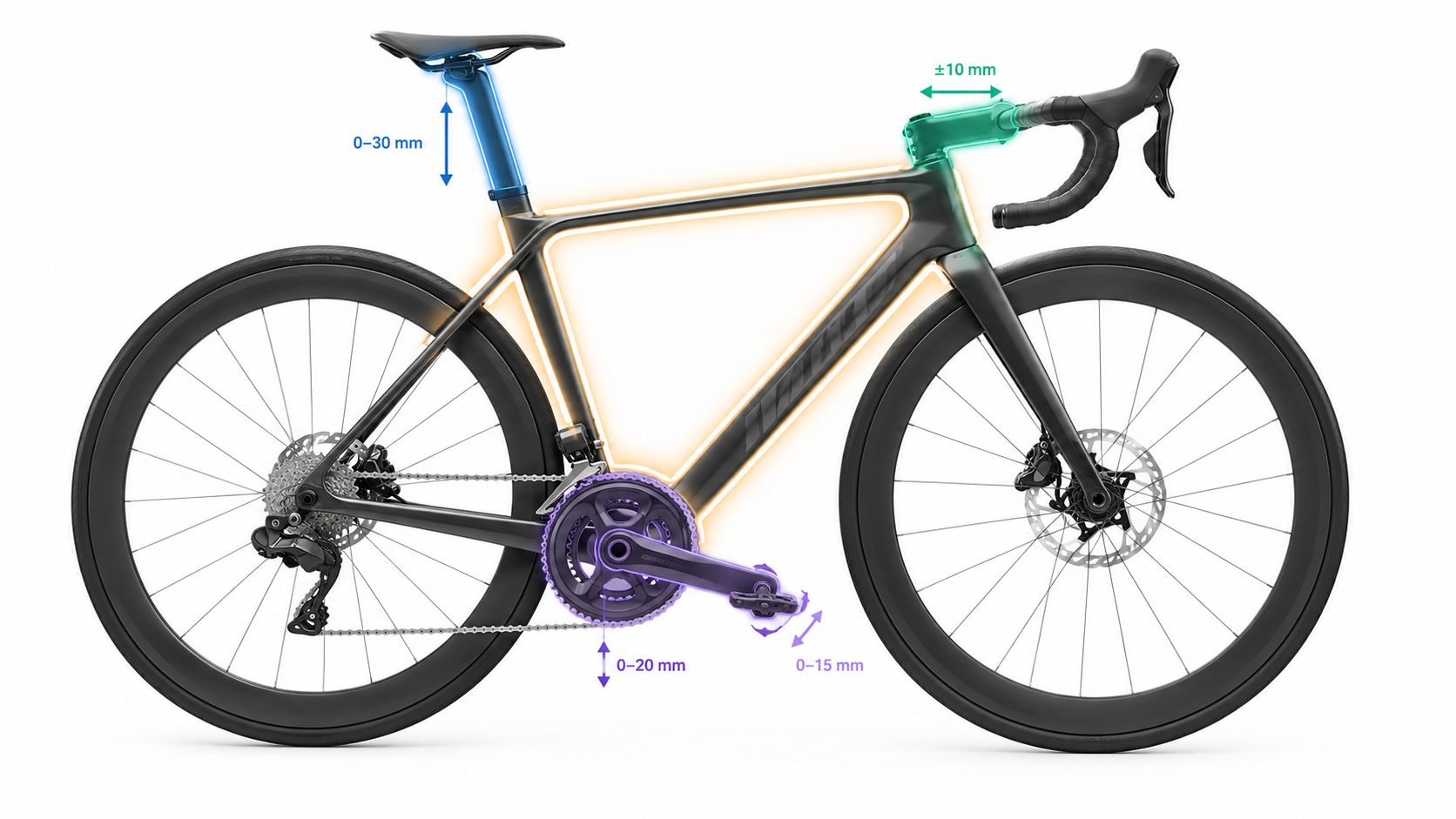
Contact points such as the saddle, handlebar, hoods, and cleats can be adjusted, but a bicycle frame still sets the basic coordinates the rest of the setup must work from. Components can refine a plausible frame. They cannot reliably turn the wrong frame into the right one.
That is the problem with the common advice given to used-bike buyers: “You can always make it fit.” In practice, fit adjustment is conditional. A stem swap, spacer change, saddle adjustment, or different handlebar may help reproduce an intended position, but those parts do not change the frame's underlying geometry, axle locations, or the structural limits that govern the final setup.
For road and gravel riders, the better buying question is not how much bike fit can be adjusted in the abstract. It is whether the exact frame, in its exact model year and size, can reproduce the rider's intended contact points within realistic component choices and manufacturer limits.
That distinction matters most in used listings, where the asking price may be attractive but the geometry chart is missing, the cockpit may already be heavily altered, or the size label may mean something different from one brand or model year to the next.
Table of Contents
- Understanding the Limits of Bike Fit Adjustment
- What Bike-Fit Variables Are Adjustable
- Stack and Reach as Primary Frame Coordinates
- When Adjustments Are Not Enough
- Evaluating Used Bike Listings for Fit Viability
- How SYCLR Helps You Shortlist Better-Fit Bikes
Understanding the Limits of Bike Fit Adjustment
A bicycle has several rider contact variables that can be adjusted: saddle height, saddle fore-aft, bar position, hood position, cleat position, and sometimes handlebar shape or stem configuration. Those changes affect posture, weight distribution, reach, leg extension, and the relationship between the rider and the controls.
They do not give the frame unlimited flexibility.
The frame fixes the relationship among the bottom bracket, head tube, seat tube, and wheels. It sets the starting point for the cockpit and the rider's position relative to the bike. Fork design, steerer length, headset configuration, seatpost design, and manufacturer limits then determine how far the setup can be refined safely and sensibly.
Practical rule: Use components to refine a plausible frame, not to justify a fundamentally unsuitable one.
This becomes clear in used-bike shopping. A listing may show a familiar size label, yet the exact model year and geometry may place the bars lower, farther forward, or in a different relationship to the saddle than the rider needs. A different stem, spacer arrangement, or bar may help, but the real question is whether the intended position can be reproduced without forcing the setup into an impractical configuration.
Fine-tuning versus rescue work
A close frame match gives you room to work. You can establish the saddle position for pedaling first, then refine the cockpit around it with appropriate stem, spacer, handlebar, and hood choices.
A poor match creates a chain of compromises. If the saddle must be moved primarily to compensate for cockpit reach, the pedaling position is no longer the main priority. If the bar height depends on an awkward front-end arrangement, or the stem choice exists only to compensate for the frame rather than support the intended setup, the bike may still be technically adjustable while remaining impractical in use.
That is why the useful question is not whether a part can move. It is whether the complete setup can reproduce the intended riding position with sensible hardware choices, enough remaining adjustment for final setup, and compliance with component and manufacturer limits.
Height alone will not answer that. Two riders of the same height can require different saddle positions, handlebar heights, reaches, hood angles, bar widths, or crank lengths. For a buyer, the safer process is to compare the actual frame coordinates and cockpit configuration against a known-good reference rather than trusting a small, medium, or large label.
What Bike-Fit Variables Are Adjustable
A used bike can appear close on paper and still fail once the contact points are set. The practical way to assess it is to separate the adjustable variables, understand what each one changes, and identify what constrains it.
The saddle establishes the pedaling position. The stem, spacers, handlebar, and hoods refine the upper-body position. Cleat position affects the rider's relationship to the pedals. Each variable can help. None of them removes the need for an appropriate frame.
| Component | What it changes | What constrains it |
|---|---|---|
| Saddle height | Leg extension and rider height over the bottom bracket | Seatpost length, minimum insertion, frame proportions, rider biomechanics |
| Saddle fore-aft | Rider position relative to the bottom bracket, primarily for pedaling support | Saddle rail limits, seatpost offset, saddle design, rider pedaling needs |
| Stem length and angle | Bar-clamp position and steering leverage | Frame starting coordinates, steerer length, cockpit compatibility, intended setup |
| Spacers and steerer | Handlebar height and stem position on the steerer | Fork, frame, headset, cockpit design, steerer length, manufacturer limits |
| Handlebar reach and shape | Hand position, wrist angle, and effective cockpit shape | Bar design, rider preference, control needs, compatibility |
| Hood position | Practical hand position and control angle on drop bars | Bar shape, control design, brake hose or cable routing, setup limits |
| Cleat position | Foot placement over the pedal and lower-limb relationship | Shoe design, cleat hardware, pedal system, rider biomechanics |
These are working variables, not independent solutions. A bike may offer movement at several contact points while still failing to reproduce the intended position once the whole system is considered.
Saddle height often has meaningful vertical adjustability because the seatpost slides within the frame, but that does not make every frame suitable. Saddle fore-aft should primarily support pedaling position. It is not a reliable way to solve cockpit reach. After the saddle is established, evaluate the cockpit separately.
Stem changes alter bar-clamp position and steering leverage. Evaluate the complete setup. A stem can be part of a good solution, but stem choice alone does not prove a frame is right or wrong.
Why the variables interact
Adjustments affect one another. Raising the saddle can change how the bars feel. Hood position can alter the practical hand location on a drop bar. Handlebar shape may change the usable cockpit even when the frame and stem remain the same.
That interaction is exactly why isolated numbers can mislead buyers. A listing may seem adjustable because one part can still move, while the setup as a whole is already close to its limits. The better approach is to ask whether the intended contact points can be reproduced together, not whether each part has some movement left on its own.
For used listings, preserve adjustment headroom for final setup. A bike that already relies on unusual cockpit choices, limited seatpost range, or little remaining steerer adjustment deserves more scrutiny than one that starts close to the intended position with ordinary parts.
Stack and Reach as Primary Frame Coordinates
Seat-tube size remains a rough label, not a reliable fit measurement. Brands use different seat-tube angles, top-tube lengths, head-tube dimensions, and size naming systems. Geometry can also change between model years while the familiar size label remains the same.
Stack and reach are useful frame-level coordinates because they describe where the front of the frame begins relative to the bottom bracket. They make it easier to compare exact frames across brands, model years, and sizes.
They are not the entire fit envelope.
Use stack and reach to compare the exact candidate frame against a known-good bike or fit reference. Then evaluate whether the intended contact points can be reproduced with the available stem, spacers, bar shape, hood position, saddle setup, and other component choices, all within component and manufacturer limits.
Stack-and-reach charts made comparisons across brands and model years more useful than older size labels. The background to that change is explained in CycleSite's history of reach and stack. For a used listing, these measurements help identify whether the frame starts near the rider's intended position or requires a setup that may be difficult to reproduce.
A practical geometry check
Begin with a known reference if possible. That may be a current bike that fits well, a professional fit report, or a position you have already validated through riding. Record the frame coordinates and the setup that creates the position, including stem, spacers, handlebar, hoods, saddle position, and seatpost details.
Then compare that reference with the exact candidate bike, using the correct model year and size rather than the advertised size label alone.
Check three things:
Frame starting point: Does the candidate frame begin near the known reference, or does it require the cockpit and saddle to do most of the work?
Ability to reproduce contact points: Can the intended saddle position and bar position be recreated with compatible components and within manufacturer limits?
Remaining adjustment headroom: After reproducing the intended setup, is there still enough room for normal refinement, or would the bike end up at the edge of its usable adjustment?
The practical conclusion is not a universal pass or fail number. It is whether the exact frame and component arrangement can reproduce the intended riding position in a realistic way.
Check the manufacturer's geometry chart for the exact model year, then compare it with the hardware shown in the listing. The SYCLR bike stack and reach resource helps interpret those measurements alongside the rider's preferred position, flexibility, and riding style.
When Adjustments Are Not Enough
A large parts catalogue does not solve every fit problem. Components can move contact points, but the complete setup still has to remain practical, compatible, and within the limits specified by the frame and component manufacturers.
The warning sign is not one particular stem length, spacer arrangement, or saddle position in isolation. The warning sign is a listing that can only reproduce the intended position through impractical changes, unsupported combinations, or a setup that leaves no useful room for refinement.
Available spacer and steerer adjustment depends on the fork, frame, headset, cockpit, and manufacturer limits. Saddle position depends on the rider's pedaling needs, not simply on where the bars need to end up. Stem changes alter bar-clamp position and steering leverage. Evaluate the complete setup.
If reproducing the intended position requires impractical changes, exceeds component or manufacturer limits, or leaves no useful adjustment headroom, reconsider the frame.
Plausible, uncertain, or impractical
Use a neutral framework when a listing looks close.
| Listing state | What it means |
|---|---|
| Plausible within available adjustment | The exact frame starts near the intended position, the current or planned components appear capable of reproducing it, and useful setup headroom remains |
| Uncertain, more information or setup evaluation needed | Key geometry, cockpit, model-year, or manufacturer-limit details are missing, so the fit outcome cannot yet be judged confidently |
| Impractical within intended component or manufacturer limits | Reproducing the intended position would require unsupported, excessive, or highly compromised changes, or would consume nearly all usable adjustment |
A low asking price does not remove fit risk. Add the cost of any cockpit parts, seatpost changes, or setup work, then weigh the possibility that the bike still will not reproduce the intended position in a practical way.
A professional fitter can help establish reproducible contact-point targets when the rider is uncertain about the intended position. A fitting does not make an unsuitable frame suitable, but it can provide a stronger reference for evaluating candidate bikes and avoiding speculative parts purchases.
The following video offers general fit education. Use it alongside a frame-specific inspection or professional assessment, not as a substitute for either.
Evaluating Used Bike Listings for Fit Viability
A used-bike listing can look adjustable and still be the wrong frame. Sellers often provide the frame size, a side photo, and the component list while omitting the exact model year, geometry chart, stem details, spacer situation, or evidence that the cockpit has already been altered.
Treat the listing as evidence, not as a completed fit assessment.
Checks before messaging the seller
Confirm the exact frame. Record the brand, model, discipline, size, and model year. Geometry may change between versions, so the model name alone cannot establish fit.
Check stack and reach. Compare the exact frame coordinates against a known-good bike or fit reference. Use the correct model year and size, not only the seller's size label.
Read the current cockpit in the photos. Look at the current stem, visible spacers, steerer arrangement, handlebar shape, hood setup, and whether the existing configuration leaves useful adjustment headroom.
Check saddle and seatpost position. Note saddle fore-aft on the rails, seatpost extension, and any obvious signs that the current setup is already close to its limits. Keep in mind that saddle fore-aft should primarily support pedaling position, not solve cockpit reach.
Ask about manufacturer and component limits. Available spacer or steerer adjustment, seatpost insertion, compatible stem configurations, and cockpit options depend on the frame, fork, headset, and parts used.
Identify missing information. If the seller cannot confirm the model year, geometry, current stem, spacer arrangement, or other key setup details, treat the fit outcome as uncertain rather than assuming it will work.
Do not infer the required fit from a category label alone. Road and gravel labels provide context, but they do not determine the rider's position or prove that a listing will reproduce it.
Message the seller with precise requests: a photo showing the steerer and spacers, the current stem length and angle if known, saddle and seatpost details, the exact model-year designation, and any geometry chart or original specification link available. If those details are unavailable, classify the bike as uncertain rather than assuming the missing information will work in your favour.
For a process covering identity, photos, condition, and seller communication, use this guide to comparing used bike listings. The goal is to sort listings into bikes that appear plausible, bikes that remain uncertain, and bikes that already look impractical.
How SYCLR Helps You Shortlist Better-Fit Bikes
Fit-aware buying starts before you compare component groups or paint colours. Enter your height, preferred bike type, and budget first, then use available geometry and listing signals to separate frames that appear plausibly close from those that need more scrutiny.
Riders with a known current-bike position can go further. Add stack, reach, and other fit details through the advanced fit-details entry, then compare those details against the geometry information available for each listing. The point is not to calculate a universal fit envelope. It is to make the relevant evidence easier to inspect before you contact a seller.
SYCLR compares road and gravel listings using fit signals, geometry signals, model-year context, price context, listing quality, condition signals where available, and confidence signals.
SYCLR does not perform a professional bike fit, physically inspect bikes, authenticate listings, verify ownership or seller claims, or guarantee fit or condition.
A practical shortlist workflow
Start with the riding brief. Decide what type of riding the bike needs to support, define the budget, and identify any known position requirements before a compelling listing changes the criteria.
Next, compare the fit signals:
Exact frame identity: Confirm the precise model, model year, and size.
Frame coordinates: Review stack, reach, and any other relevant geometry data rather than relying on height alone.
Current cockpit setup: Check the stem, spacers, steerer room, handlebar shape, hood setup, and saddle position shown in the listing.
Ability to reproduce the intended position: Compare the listing against a known-good bike or fit reference, then judge whether the contact points appear reproducible within component and manufacturer limits.
Adjustment headroom: Check whether the listing still leaves room for normal refinement after the intended setup is recreated.
Price and listing context: Compare the asking price with the bike's specification, age, condition, and fit uncertainty.
Confidence signals: Treat complete geometry, clear photos, and specific seller answers as stronger evidence than vague descriptions.
A general marketplace may show inventory, but it usually does not interpret whether a listing matches your position requirements, model-year context, fit constraints, and tolerance for uncertainty. A fit-aware comparison platform can organize those signals so you spend less time opening unsuitable listings and more time evaluating the candidates that remain.
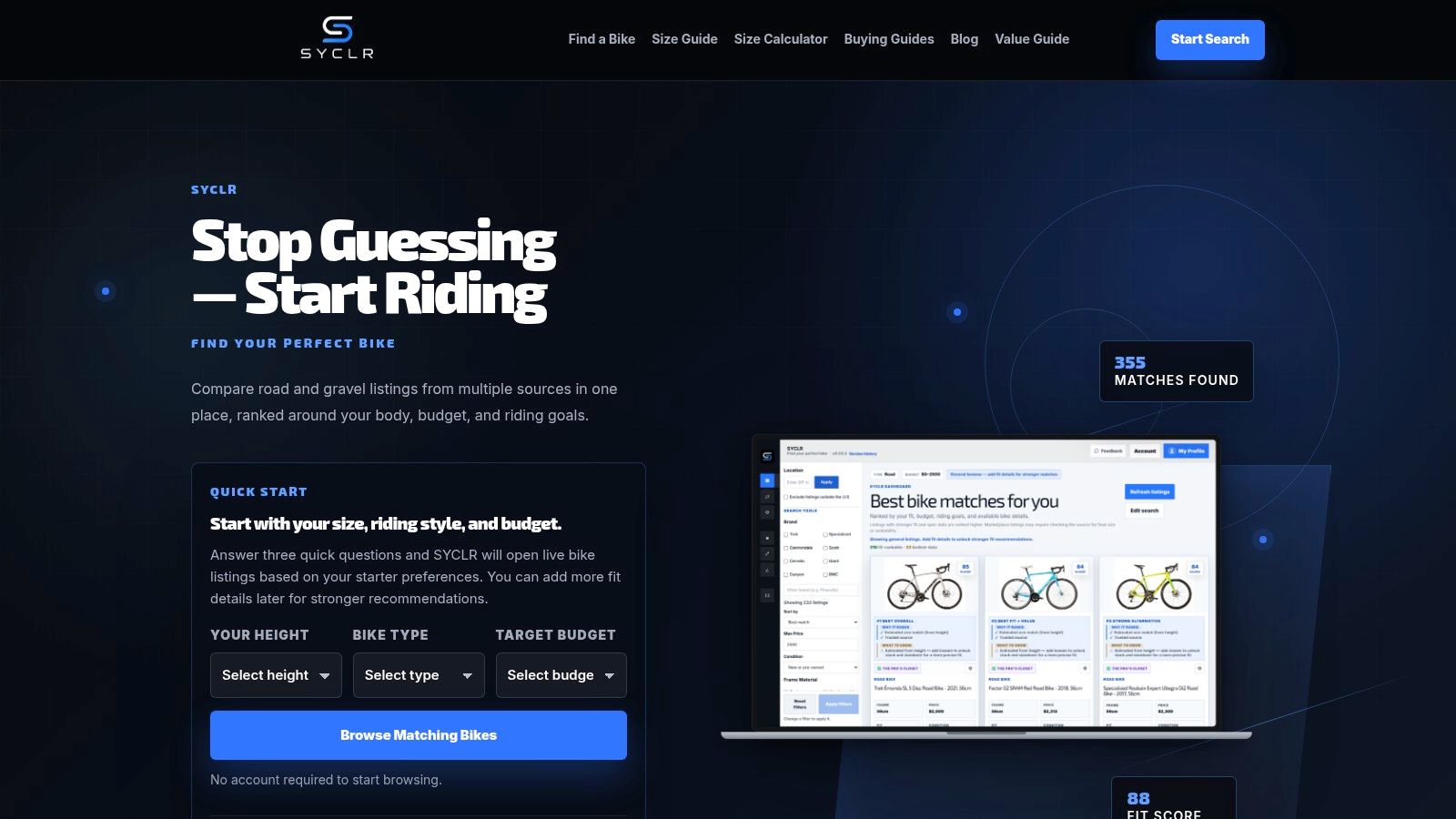
Use the SYCLR app to compare road and gravel listings using fit signals, geometry signals, model-year context, price context, listing quality, condition signals where available, and confidence signals. SYCLR does not guarantee fit or condition and does not replace a professional bike fit or mechanical inspection. It helps reduce guesswork and surface more plausible candidates before you invest time or money in a seller conversation.
The buying decision remains yours. A good shortlist is one where the frame starts near your intended position, the contact points appear reproducible with practical component choices, and the listing evidence is strong enough to justify the next step.
Start with SYCLR by entering your height, bike type, and budget, then compare fit and geometry signals across road and gravel listings. If you already know your stack, reach, current-bike geometry, or fit-report details, use the advanced fit options to shortlist bikes that appear easier to reproduce in practice rather than trying to force the wrong frame into place.