
Shimano GRX Groupset Hierarchy Explained
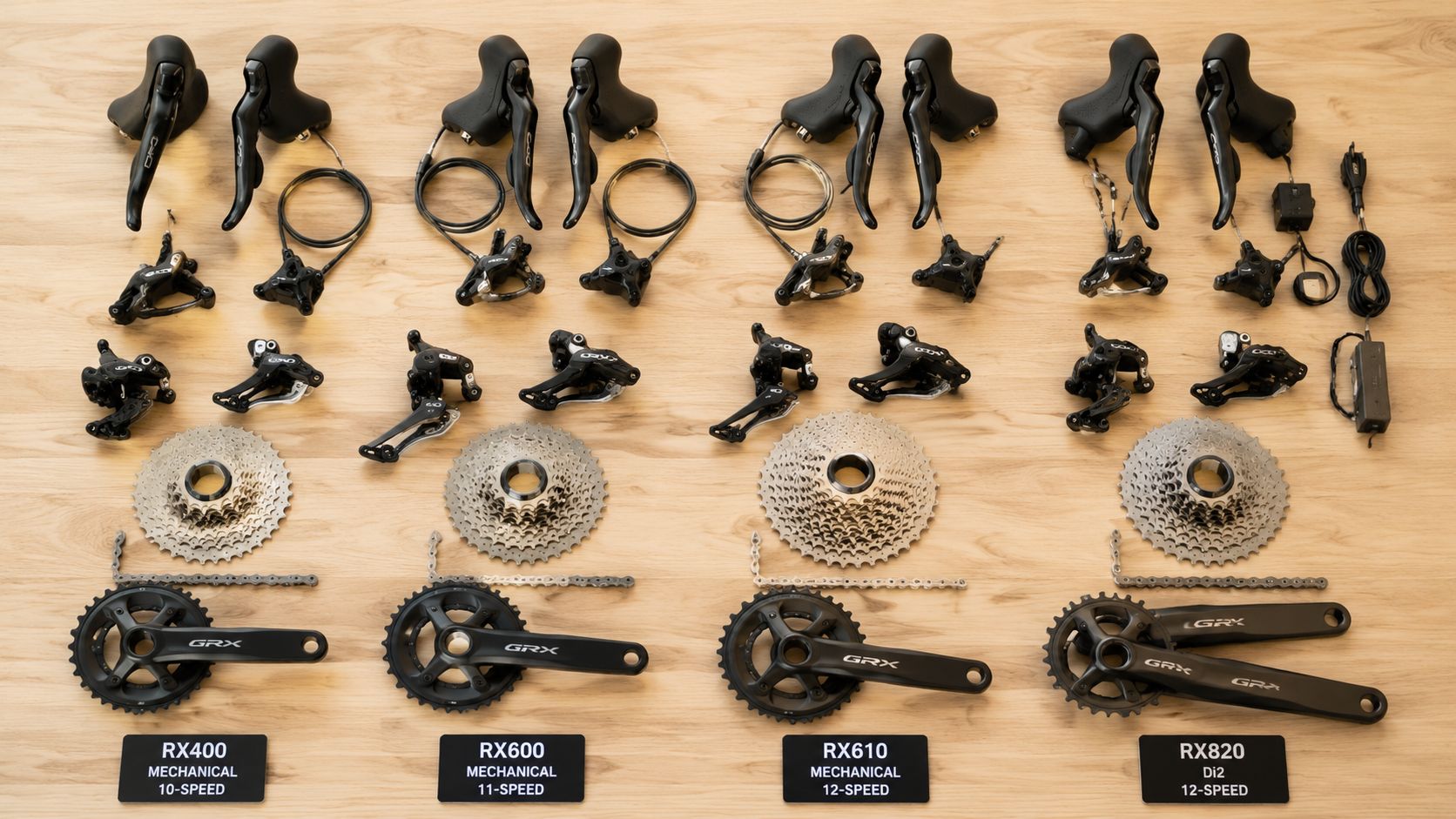
The most useful way to understand the Shimano GRX groupset hierarchy is not as a simple 400-to-600-to-800 ladder. GRX is better understood as a set of families, generations, speed counts, drivetrain layouts, and shifting systems. For buyers comparing complete bikes or decoding a used-bike listing, the details that matter are the exact component family, the number of cassette speeds, whether the drivetrain is 1x or 2x, whether it is mechanical or Di2, and whether the installed parts form one Shimano-supported system.
Shimano launched GRX in 2019 as its dedicated gravel component platform, then expanded it into distinct 10-speed, 11-speed, and 12-speed branches. That means a bike advertised simply as "Shimano GRX" could be built around RX400 10-speed mechanical, RX810 11-speed mechanical, RX815 11-speed Di2, RX610 12-speed mechanical, RX820 12-speed mechanical, RX825 2×12 Di2, RX717 1×12 Di2, or RX827 fully wireless 1×12 Di2. Those are not interchangeable labels. They imply different shifters, derailleurs, cassettes, cranksets, chains, freehub requirements, and upgrade paths.
This page stays focused on GRX itself: RX400, RX600, RX610, RX810, RX820, RX815, RX825, and RX827, with attention to speed count, 1x or 2x architecture, mechanical versus Di2, gearing, compatibility, and used-bike verification. If you want Shimano's broader road groupset ladder, use the separate Shimano groupset hierarchy guide.
Table of Contents
- Why the Shimano GRX Groupset Hierarchy Is Not a Simple Ladder
- GRX Families at a Glance
- How Current 12-Speed GRX Differs From Older 10-Speed and 11-Speed GRX
- 1x and 2x GRX Gearing, Using Shimano-Supported Setups
- GRX Compatibility Rules for Safe Comparisons
- GRX Value Across Complete Gravel Bikes
- Used Bike Checks for Shimano GRX
- Buyer Recommendations and SYCLR Comparison Tools
- Frequently Asked Questions
Why the Shimano GRX Groupset Hierarchy Is Not a Simple Ladder
A GRX label identifies a component family, not one universal drivetrain. The hierarchy only makes sense when you place that family inside the correct generation, speed count, shifting type, and drivetrain layout. A listing that says "GRX 800" without model codes still leaves several important questions unanswered.
For example, RX810 refers to the older 11-speed mechanical GRX family, while RX820 is the current 12-speed mechanical family. RX815 is older 11-speed Di2. RX825 is the current 2×12 Di2 family. RX827 is Shimano's fully wireless 1×12 Di2 GRX family. Those systems do not share the same assumptions about cassettes, chains, derailleurs, controls, or electronic hardware. Shimano's GRX product documentation and dealer manuals make that generation split explicit.
A complete-bike buyer should therefore decode the actual build before deciding whether one bike is better value than another. The useful question is not whether one listing has a higher number printed after RX. The useful question is whether the installed GRX parts create the gearing, compatibility, and service path you want.
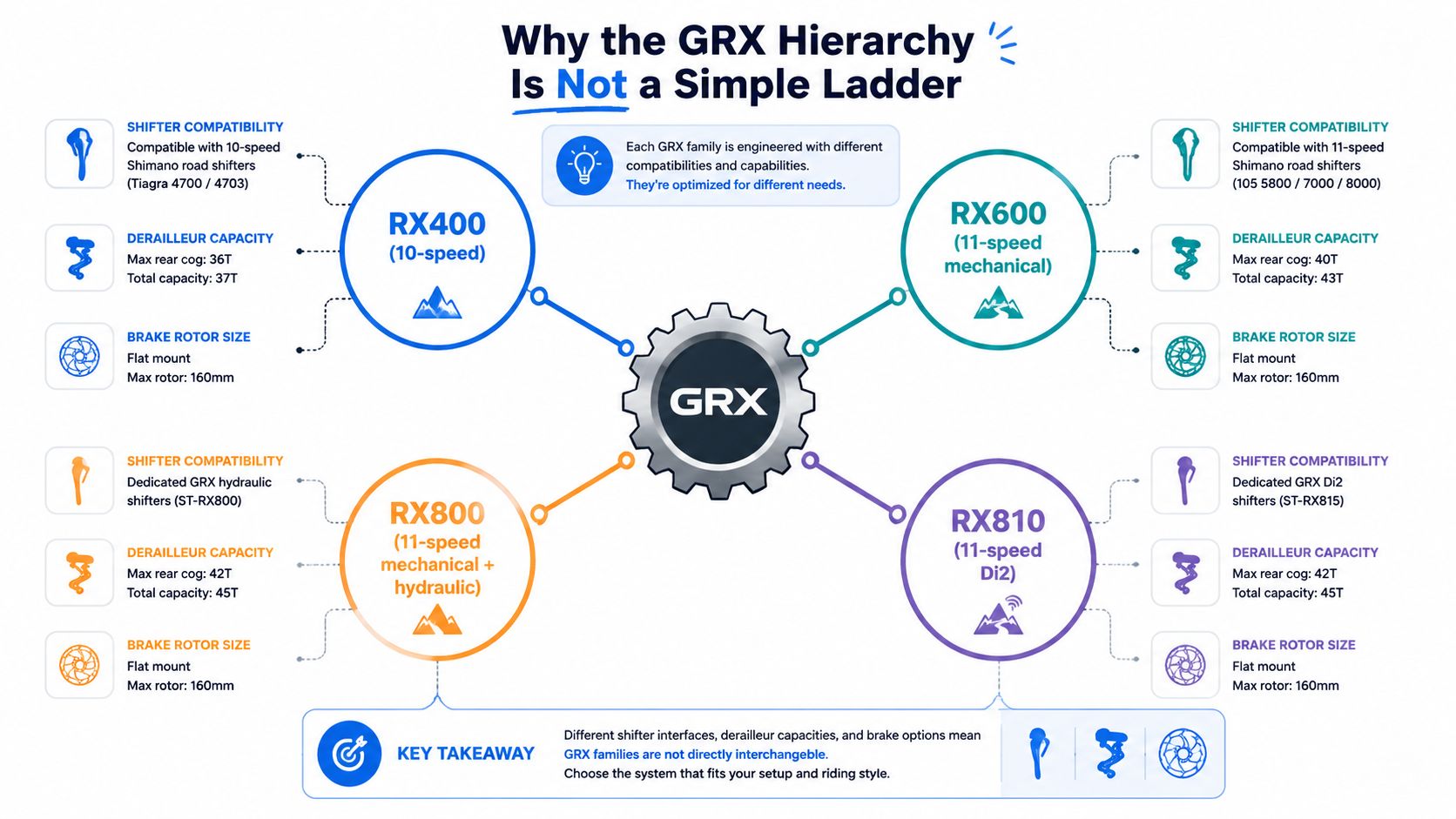
The key variables that define a GRX system
Before comparing any GRX bike or parts listing, identify these variables:
Family and exact model code: RX400, RX600, RX610, RX810, RX815, RX820, RX825, RX827, plus the specific code on the part.
Speed count: 10-speed, 11-speed, or 12-speed.
Shifting system: mechanical cable actuation or Di2 electronic shifting.
Drivetrain layout: 1x or 2x.
Gearing context: exact chainrings, cassette size, rear-derailleur capacity, and freehub type.
The model code is often more useful than the family name alone. ST-RX400 points to 10-speed mechanical controls. RD-RX810 is the 11-speed 2x mechanical rear derailleur. RD-RX812 is the 11-speed 1x mechanical rear derailleur. FD-RX825 identifies the current 2×12 Di2 front derailleur family. Once you have the codes, you can check whether the bike is built around one Shimano-supported GRX configuration or a legitimate mixed OEM setup.
Practical rule: Never compare "GRX 600 versus GRX 800" until you have written down the cassette speed, the chainring layout, the shifting system, and the exact component codes.
GRX Families at a Glance
This is a configuration table, not a prestige ladder. It is meant to help you decode listings and compare complete bikes accurately. Shimano's GRX range spans older 10-speed and 11-speed systems as well as current 12-speed mechanical and Di2 systems
| Family | Generation context | Speed | Mechanical or Di2 | 1x or 2x context | Compatible gearing context |
|---|---|---|---|---|---|
| RX400 | Original GRX generation | 10-speed | Mechanical | 2x | Commonly 46/30T with 11-34T or 11-36T |
| RX600 | Original GRX generation | 11-speed | Mechanical | Component family used within 11-speed GRX builds | Exact role and gearing depend on the specific RX600 component and surrounding drivetrain |
| RX810 / RX812 | Original GRX generation | 11-speed | Mechanical | RX810 for 2x; RX812 for 1x | RD-RX810 supports 11-30T through 11-34T cassettes; RD-RX812 supports 11-40T through 11-42T cassettes |
| RX815 | Original GRX generation | 11-speed | Di2 | 1x or 2x depending on exact build | 11-speed electronic GRX; gearing and compatibility depend on the exact derailleur, crank, cassette, and component configuration |
| RX610 | Current GRX 12-speed generation | 12-speed | Mechanical | 1x or 2x | Includes 46/30T 2x crank option and 1x crank options within Shimano-supported 12-speed GRX builds |
| RX820 | Current GRX 12-speed generation | 12-speed | Mechanical | 1x or 2x | 1x supports 10-45T or 10-51T cassette configurations; 2x uses 48/31T with 11-34T or 11-36T |
| RX717 | Current GRX 12-speed Di2 generation | 12-speed | Di2 | 1x | Fully wireless 1×12 GRX configuration; verify the exact Shimano-supported cassette, chainring, and component combination |
| RX825 | Current GRX 12-speed Di2 generation | 12-speed | Di2 | 2x | Electronic 2×12 GRX; verify the exact crank, cassette, battery, controls, and derailleur configuration |
| RX827 | Current GRX 12-speed Di2 generation | 12-speed | Di2 | 1x | Fully wireless 1×12 GRX; Shimano's launch configuration includes 10-51T cassette context |
GRX families can also appear in mixed Shimano-supported builds. A complete bike may combine one GRX family in the controls, another in the crank, and another in the brakes or derailleurs. That is not automatically a problem. A mixed OEM GRX build can be fully legitimate if the speed count, chainline, cassette, derailleur capacity, and shifting system all match Shimano's intended compatibility.
The point of the table is not to rank one row above another. It is to identify what the bike actually is before you compare fit, geometry, wheels, brakes, wear, and price.
How Current 12-Speed GRX Differs From Older 10-Speed and 11-Speed GRX
The practical difference between current 12-speed GRX and older 10-speed or 11-speed GRX is not just the number of cogs. It is the combination of generation, cassette standard, derailleur design, gearing choices, and replacement path.
Current mechanical 12-speed GRX is split between RX610 and RX820. RX610 brings 12-speed GRX into a lower-cost mechanical configuration, including a 46/30T 2x crankset option. RX820 is Shimano's 12-speed mechanical GRX family offering additional current gearing and component options alongside RX610, with both 1×12 and 2×12 configurations. Shimano supports RX820 1x with 10-45T and 10-51T cassettes, and RX820 2x with a 48/31T crankset and 11-34T or 11-36T cassettes.
Older GRX still matters because it remains common on complete bikes and on the used market. RX400 is 10-speed mechanical. RX810 is 11-speed mechanical. RX815 is 11-speed Di2. Those builds can still be excellent if the bike fits well and the parts are complete, but they should be assessed on their own standards rather than treated as partial versions of 12-speed GRX.
| Build context | Speed | Typical Shimano-supported chainring context | Typical Shimano-supported cassette context | Shifting |
|---|---|---|---|---|
| RX400 2x | 10 | 46/30T | 11-34T or 11-36T | Mechanical |
| RX810 2x | 11 | 48/31T | Up to 34T | Mechanical |
| RX812 1x system | 11 | 40T or 42T | 11-speed 1x GRX cassette context, check exact build | Mechanical |
| RX815 11-speed Di2 | 11 | Depends on exact 1x or 2x build | Depends on exact build | Electronic |
| RX610 2x | 12 | 46/30T | 12-speed 2x GRX cassette context, check exact build | Mechanical |
| RX820 1x | 12 | 40T or 42T | 10-45T or 10-51T | Mechanical |
| RX820 2x | 12 | 48/31T | 11-34T or 11-36T | Mechanical |
| RX825 2×12 Di2 | 12 | 2×12 GRX crank context | 12-speed 2x GRX cassette context | Electronic |
| RX827 1×12 Di2 | 12 | 1×12 GRX chainring context | 10-51T cassette context in Shimano's wireless GRX launch | Electronic |
The important buyer takeaway is simple: current GRX hierarchy is a matrix. RX610, RX820, RX825, and RX827 are not just newer labels. They refer to specific 12-speed mechanical and electronic systems. Older RX400, RX810, and RX815 remain relevant, but the right comparison is always exact build versus exact build.
1x and 2x GRX Gearing, Using Shimano-Supported Setups
GRX gearing makes the most sense when you evaluate it through exact Shimano-supported combinations, not general rules about where 1x or 2x belongs. The real differences show up in range, gear spacing, front-shifting hardware, cassette size, and derailleur compatibility.
For 10-speed RX400 2x, the common reference setup is 46/30T with 11-34T or 11-36T. That gives a low climbing gear and a relatively broad overall range for a 2x gravel drivetrain.
For 11-speed GRX mechanical, Shimano split the rear derailleurs by drivetrain type. RD-RX810, the 2x rear derailleur, supports cassettes up to 34T. RD-RX812, the 1x rear derailleur, is intended for 40T to 42T front chainrings. That distinction matters because an 11-speed GRX listing described vaguely as "RX810" may not tell you whether the bike is using the 2x or 1x rear-derailleur path.
For 12-speed RX610 2x, Shimano offers a 46/30T crankset, which gives a lower front gearing profile than the 12-speed RX820 2x setup. For 12-speed RX820 2x, Shimano uses 48/31T with 11-34T or 11-36T. Compared with 46/30T, a 48/31T crank produces higher corresponding front-chainring ratios. The actual low- and high-end gearing still depends on the cassette paired with it.
For 12-speed RX820 1x, Shimano supports 40T or 42T chainrings with 10-45T or 10-51T cassettes. Moving from 10-45T to 10-51T increases total range but also changes spacing across the cassette. That may be useful or unnecessary depending on the terrain, cadence preferences, and speed profile of the rider.
| Setup | Chainring context | Cassette context | What changes in practice |
|---|---|---|---|
| RX400 2×10 | 46/30T | 11-34T or 11-36T | Broad range, 2x shift structure, older 10-speed spacing |
| RX810 2×11 | 48/31T | Up to 34T | 11-speed 2x spacing, tighter top-end structure than 46/30T |
| RX812 1×11 | 40T or 42T | Exact 11-speed cassette depends on build | Simpler front end, single-ring structure, spacing depends on cassette choice |
| RX610 2×12 | 46/30T | Exact Shimano-supported 12-speed cassette depends on build | Lower-geared 12-speed 2x GRX option |
| RX820 2×12 | 48/31T | 11-34T or 11-36T | Current 12-speed 2x GRX with broader high-speed range than 46/30T |
| RX820 1×12 | 40T or 42T | 10-45T or 10-51T | Current 12-speed 1x GRX with wider cassette options |
| RX825 2×12 Di2 | Depends on exact crank | 12-speed 2x cassette context | Electronic 2x shifting, exact gearing depends on build |
| RX827 1×12 Di2 | Depends on exact chainring | 10-51T context | Fully wireless 1x Di2 GRX configuration |
The correct comparison is therefore not "1x for rough terrain, 2x for pavement." It is whether a specific chainring and cassette combination delivers the cadence steps, top-end gearing, and low-end support you want. Use this gravel bike gearing guide to compare range and cadence logic, then verify the exact component codes on the bike itself.
GRX Compatibility Rules for Safe Comparisons
GRX branding alone does not prove compatibility. Compatibility is component-specific, and Shimano-supported GRX builds still need to be checked at the level of speed count, drivetrain layout, derailleur capacity, cassette fit, chainline, and shifting system.
A bike can legitimately mix GRX families within one build, but you should not infer compatibility from the logo or from a family number alone. The same applies when comparing GRX to non-GRX Shimano parts. The only safe method is to verify the exact model codes and assess the system as a whole.
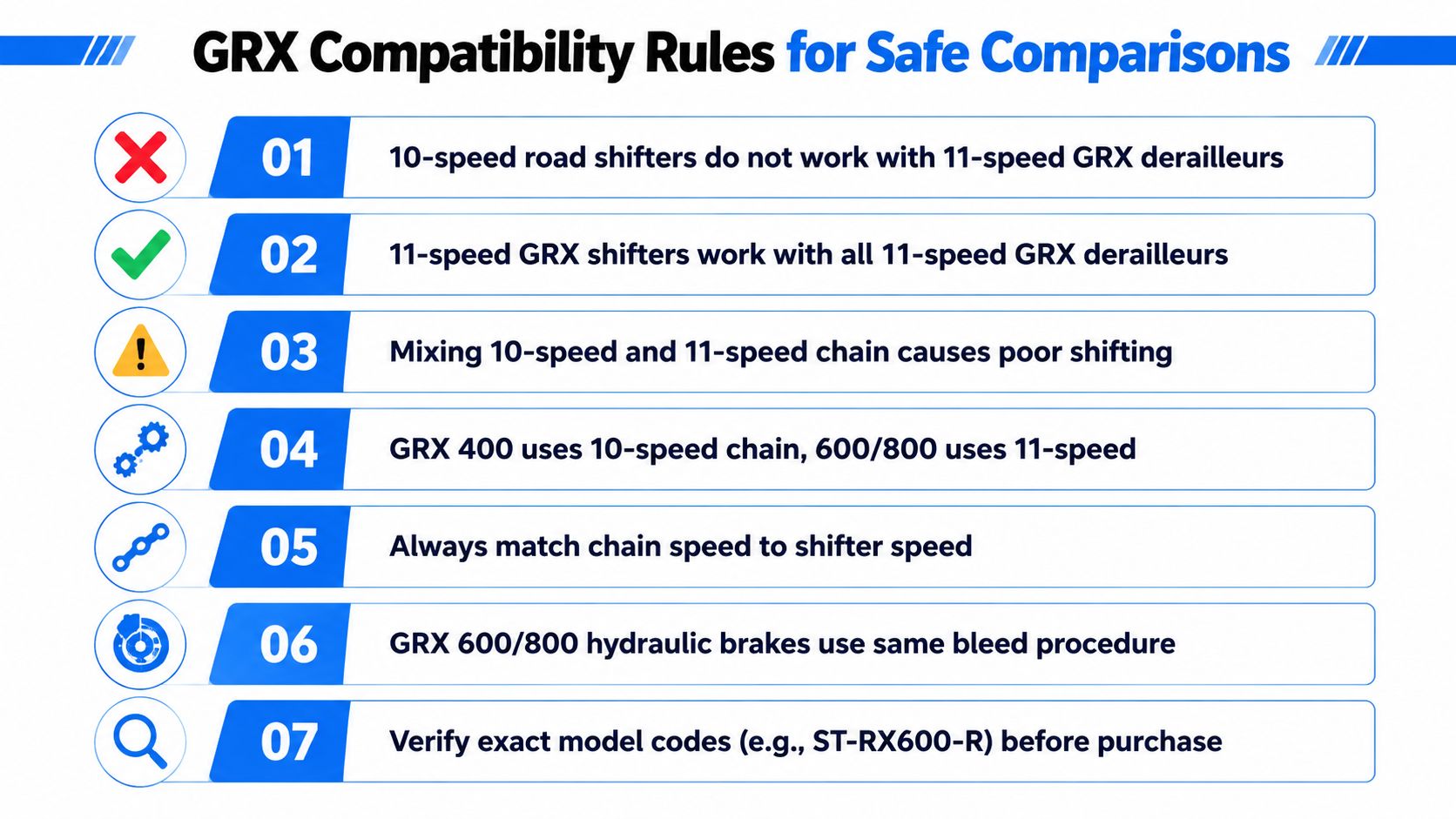
What to verify before buying parts
Speed count: Confirm whether the system is 10-speed, 11-speed, or 12-speed.
1x or 2x layout: Check whether the bike is built around a front derailleur or a single-ring crank.
Derailleur capacity: Verify the largest sprocket and total capacity against the installed chainrings and rear derailleur.
Cassette and freehub standard: Confirm that the cassette fits the wheel's freehub body.
Crank and chainline: Check that the crankset and front-derailleur context match the intended GRX layout.
Mechanical versus Di2: Mechanical shifters and derailleurs do not substitute directly for Di2 parts.
Generation: Older 11-speed and newer 12-speed GRX systems should not be treated as interchangeable by default.
Exact component codes: Photograph codes such as ST-RX610, RD-RX810, RD-RX812, FD-RX825, or RD-RX827 before ordering replacements.
Di2 adds an electronic layer to the compatibility check. With RX815, RX825, or RX827, you must confirm that the shifters, derailleurs, battery or batteries, charging method, and any required wiring or ports match the actual Di2 generation on the bike.
The safest approach is simple: record each code, count the cassette cogs, identify the chainring layout, and verify the build against Shimano documentation or a qualified mechanic. Do not infer compatibility from a GRX family number alone.
GRX Value Across Complete Gravel Bikes
A complete gravel bike's value is never determined by the GRX family name alone. Two bikes with similar GRX branding can differ substantially in generation, cassette range, wheel quality, fit, frame design, service needs, and replacement cost.
A current RX610 12-speed mechanical bike may be the more rational buy than an older RX815 Di2 bike if the newer bike fits better and the older one has incomplete charging hardware or worn drivetrain parts. In the same way, a well-kept RX400 or RX810 bike can still be a strong purchase if the exact gearing suits the rider and the frame, wheels, and brakes are in good condition.
This is also why the GRX page should stay separate from broad Shimano road hierarchy discussions. GRX has its own gravel-specific logic around chainline, clutch derailleurs, crank options, and 1x or 2x architectures. If you want the broader road-group overview, use the separate Shimano groupset hierarchy guide. Here, the right question is narrower: which GRX build is actually on the bike, and does that complete build fit the intended use?
Used Bike Checks for Shimano GRX
A used GRX bike should be verified by exact component code and actual build, not by the GRX logo on the frame-side photo.
Start with the basics: identify the shifters, rear derailleur, crankset, cassette, and brakes. Confirm the speed count, the 1x or 2x layout, the cassette size, and whether the build appears to be original or mixed. A mixed OEM GRX build can be completely legitimate, but you should understand exactly what has been changed.
Inspect drivetrain wear and crash evidence at the same time. Chain wear, poor drivetrain performance, damaged cassette or chainring teeth, bent derailleur hangers, scuffed or damaged rear derailleurs, damaged controls, and contaminated braking surfaces can all affect value more directly than the GRX family label itself.
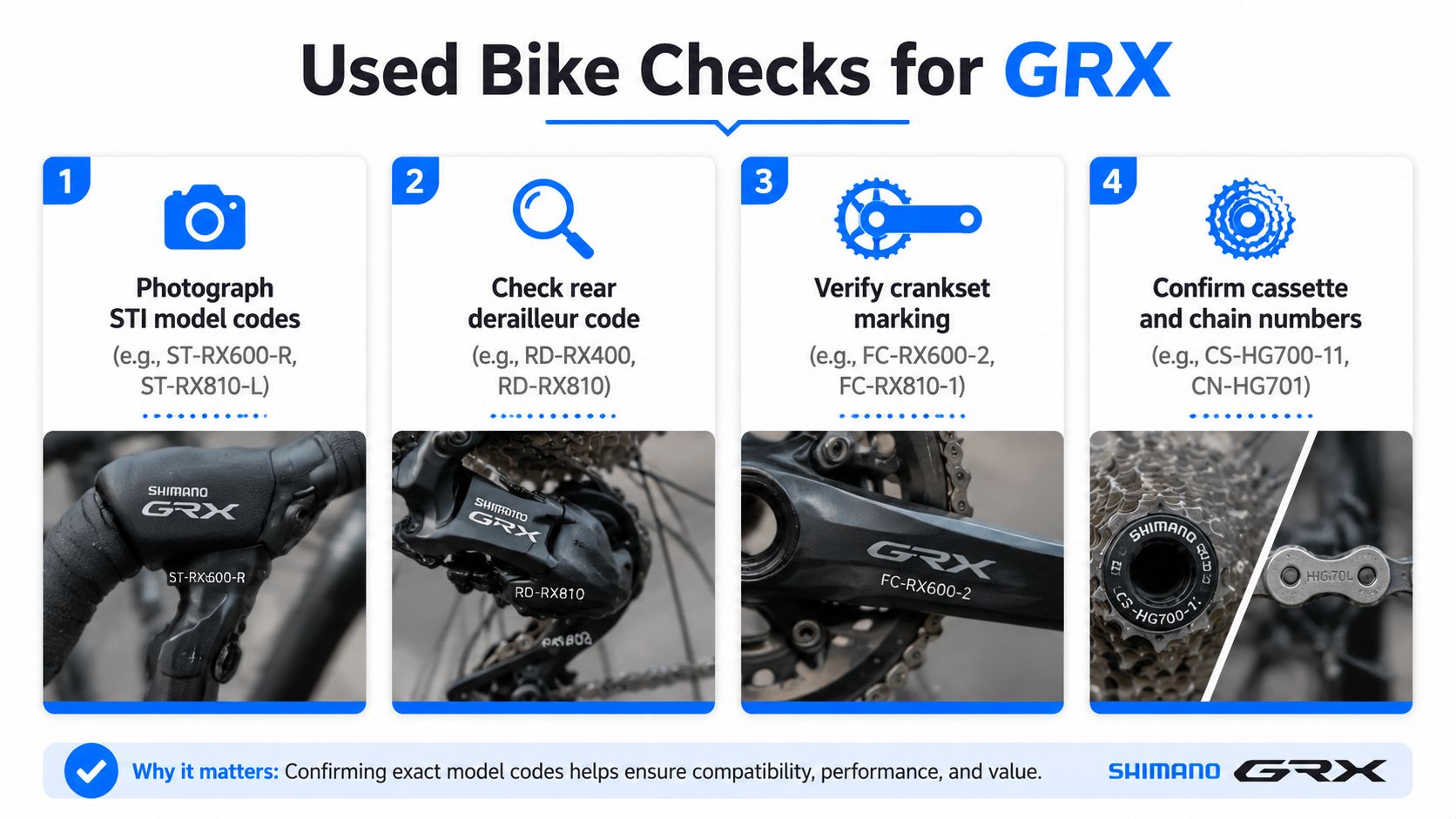
A concise used-bike verification sequence
Photograph the controls and derailleurs. Record the exact model codes.
Count the cassette cogs and note the largest sprocket. Confirm the speed and cassette context.
Read the crank markings and chainring sizes. Confirm whether the bike is 1x or 2x.
Check for mixed OEM parts. Mixed GRX builds can be legitimate, but they should make mechanical sense.
Inspect wear and crash damage. Focus on chain, cassette, chainrings, hanger alignment, brake condition, and derailleur damage.
For Di2, verify the complete electronic system. Confirm the correct battery hardware, charging equipment, wiring where applicable, controls, derailleurs, and other generation-specific electronic components are present and functioning.
Use this used-bike checklist alongside a mechanic's inspection when a listing is unclear or the bike shows signs of heavy use.
Buyer Recommendations and SYCLR Comparison Tools
The best GRX bike is the one whose fit, geometry, and complete build match the rider, not the one with the highest GRX family number in the listing title.
That is especially important in GRX because the family label does not tell you enough on its own. It does not confirm whether the bike is 10-speed, 11-speed, or 12-speed, whether it is 1x or 2x, whether it is mechanical or Di2, whether the cassette range is correct for your needs, or whether the build is complete and Shimano-supported.
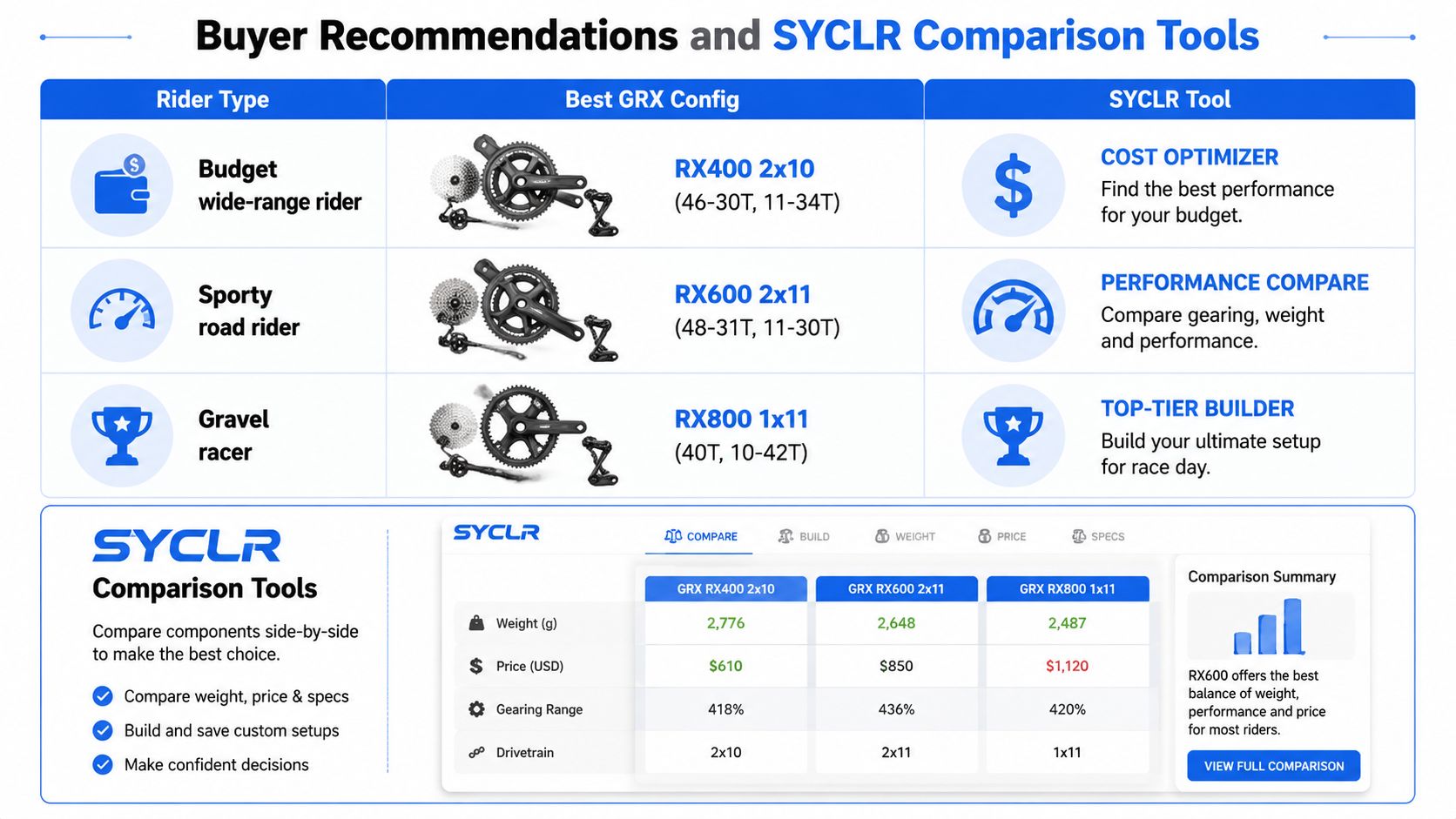
SYCLR helps riders compare gravel listings using fit signals, geometry signals, model-year context, price context, listing quality, condition signals where available, and confidence signals. It does not verify GRX authenticity, originality, compatibility, or condition for you, so the final component audit still belongs to the buyer and, where appropriate, a mechanic.
Match the listing to the bike fit and build
Start with fit and geometry. Compare stack, reach, tire clearance, cockpit setup, crank length, and riding position before ranking one GRX build over another.
Decode the exact GRX configuration. Confirm the family, speed count, 1x or 2x layout, cassette range, and shifting type.
Treat mixed builds carefully, not automatically negatively. Mixed OEM GRX setups can be valid.
Use listing quality as a signal. Incomplete component photos or vague GRX descriptions increase uncertainty.
Start with rider height, bike type, and budget in the SYCLR app, then compare the resulting listings by fit and geometry signals before narrowing the shortlist by exact GRX build.
Frequently Asked Questions
What is the Shimano GRX groupset hierarchy?
The Shimano GRX groupset hierarchy is best understood as a matrix of families and generations rather than a simple prestige ladder. RX400 is 10-speed mechanical. RX810 is 11-speed mechanical. RX815 is older 11-speed Di2. RX610 and RX820 are 12-speed mechanical families. RX717 and RX827 are current 1×12 Di2 options, while RX825 is 2×12 Di2. Exact architecture and compatibility still depend on the specific component family and generation. The correct comparison always depends on speed count, drivetrain layout, shifting system, and exact component codes.
How do RX600 and RX800-series GRX actually differ?
RX600 and RX800-series GRX do not describe one universal like-for-like comparison. In the original GRX generation, RX600 commonly appeared in crank and brake-level roles within 11-speed mechanical builds, while RX810 and RX815 covered higher-spec 11-speed mechanical and Di2 configurations. The useful distinction is not a road-style prestige map. It is the exact part, speed count, drivetrain layout, and whether the build is mechanical or electronic.
What is the difference between RX717, RX820, RX825, and RX827?
These are current 12-speed GRX families, but they do not represent the same drivetrain architecture. RX820 is mechanical 12-speed GRX. RX825 is 2×12 Di2. RX717 and RX827 are 1×12 Di2 options with different component positioning and specifications. Always compare the exact shifters, derailleurs, cassette, chainring, battery system, and compatibility rather than treating “12-speed GRX” as one drivetrain.
How should I compare 1x and 2x GRX gearing?
Compare the exact Shimano-supported chainring and cassette combinations, not broad assumptions. A 46/30T setup differs meaningfully from 48/31T. A 10-45T cassette differs from a 10-51T cassette. The most useful comparison is range, gear spacing, low-end ratio, high-end ratio, and whether the derailleur and freehub standards match the bike.
Can GRX component families be mixed?
Yes, mixed OEM GRX builds can be legitimate if they follow Shimano-supported compatibility. The checks still need to be component-specific: speed count, 1x or 2x layout, derailleur capacity, cassette and freehub standard, crank and chainline, mechanical versus Di2, generation, and exact component codes.
What should I check before buying a used GRX bike?
Verify the exact model codes on the controls, derailleurs, crankset, and cassette. Confirm the speed count, cassette size, crank setup, and whether the bike is 1x or 2x. Check for mixed OEM parts, drivetrain wear, and crash damage. If it is Di2, confirm the correct battery and charging hardware are included and working.
Use SYCLR to compare available gravel listings using fit signals, geometry signals, model-year context, price context, listing quality, condition signals where available, and confidence signals. Narrow the bikes that best match your fit and riding needs first, then decode the exact GRX configuration before making a purchase decision.