Shimano Groupset Hierarchy: Road and Gravel Guide
The most common advice about Shimano is too simple. A higher badge doesn't automatically make a bike the better buy, and on used listings it can be the least important part of the decision. Generation, speed count, brake type, condition, wheels, frame, and fit all affect what the bike really is, not just what's printed on the derailleur. That's why a Shimano groupset hierarchy is useful as a map, but not as a final verdict, especially when a listing only says “105” or “Ultegra” without naming the exact series.
Table of Contents
- Why the Shimano Badge Does Not Tell the Whole Story
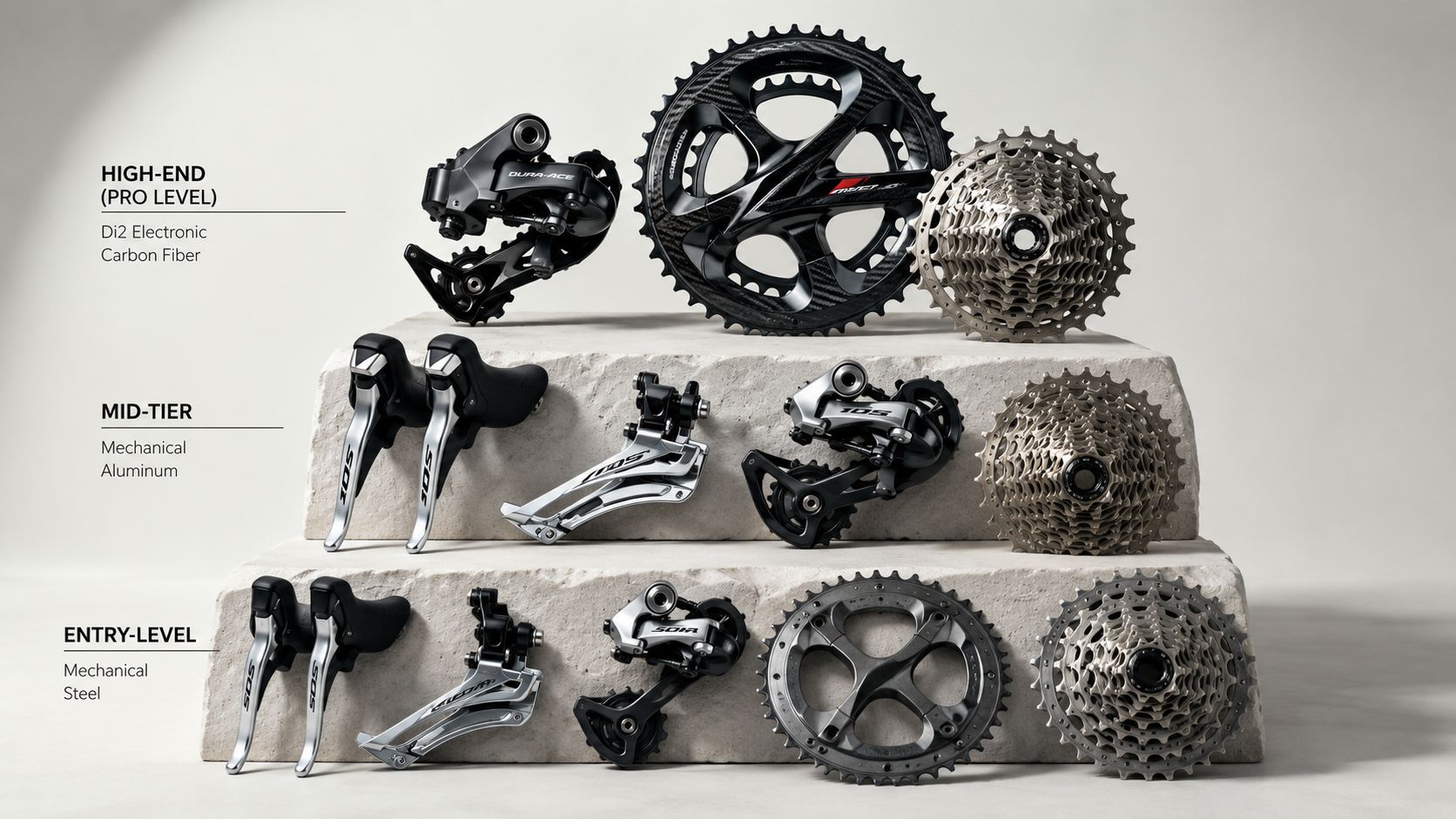
- The Shimano Road Groupset Hierarchy at a Glance
- What Changes Between Shimano Tiers
- Shimano 105 as the Value Reference Point
- Tiagra, Sora, Claris and the CUES Platform
- Where Shimano GRX Fits in the Gravel Lineup
- How Groupset Badges Distort Used-Bike Value
- Choosing Between Two Shimano-Equipped Bikes
- Shimano Groupset Hierarchy FAQs
Why the Shimano Badge Does Not Tell the Whole Story
A Shimano badge tells you where a groupset sits in the lineup. It doesn't tell you whether the bike fits, whether the parts are worn, or whether the drivetrain is the current version or an older one. That matters because Shimano's road hierarchy has clear tiers, but the same family name can hide very different hardware generations, and the label alone doesn't expose the trade-offs.
Practical rule: treat the groupset as a starting clue, not the answer.
A bike with a higher-tier badge can still be the wrong purchase if the frame is off, the wheels are poor, or the seller's photos are thin. A lower-tier bike can be the smarter buy if it fits better, is newer, and has cleaner components. On used bikes especially, a badge can create confidence that the rest of the listing hasn't earned.
That's where fit-aware shopping changes the process. Instead of asking only whether the bike has a premium name, compare fit signals, geometry signals, model-year context, price context, listing quality, and confidence signals. That approach reduces guesswork and helps you shortlist better-fit options rather than chase component branding alone.
The Shimano Road Groupset Hierarchy at a Glance
Shimano currently organizes its road groupsets under Dura-Ace, Ultegra, Shimano 105, Tiagra, Sora, Claris, and CUES. For used-bike shoppers, however, the family name is only the first step. Generations within the same family can differ in speed count, shifting system, braking options, compatibility, and available replacement parts.
| Groupset | Road lineup position | Used-bike checks |
|---|---|---|
| Dura-Ace | Top-tier road performance | Series, speed count, Di2/mechanical generation, brakes |
| Ultegra | High-performance road | Generation, Di2/mechanical, component mix |
| Shimano 105 | Performance-oriented road | Series, 11- vs 12-speed, mechanical vs Di2 |
| Tiagra | Mid-range road | Series, speed count, brake setup |
| Sora | Recreational/value road | Generation, gearing, component condition |
| Claris | Entry road | Generation, gearing, condition |
| CUES | Cross-category platform | Series, speed count, intended application |
A listing that simply says “105” or “Ultegra” is therefore incomplete. Identify the component series and generation before comparing specifications or value.
What Changes Between Shimano Tiers
Moving through Shimano's hierarchy can change component weight, materials, electronic-shifting availability, gearing configuration, braking components, and other features. The exact differences depend heavily on generation, which is why comparing family names alone can be misleading.
A higher tier does not guarantee a better complete-bike purchase. Frame fit and geometry, wheels, condition, model year, component generation, and asking price can outweigh the importance of the groupset badge.
The differences riders feel
The differences between tiers are best evaluated through specific features rather than assumed ride-quality improvements. Compare the number of speeds, mechanical or electronic shifting, gearing options, brake configuration, component weight, ergonomics, and compatibility for the exact generations being considered.
The practical takeaway is direct. Higher tier does not automatically mean better bike. A premium groupset can sharpen the ride and trim weight, but frame quality, wheel choice, and fit often matter more in day-to-day use than the drivetrain badge.
What matters more than the badge
Speed count: More speeds can give smaller gaps between gears, but the benefit depends on the complete build.
Brake type: Rim and disc, mechanical and hydraulic, all change maintenance and ride feel.
Generation: A newer 105 can ride very differently from an older 105, even if both are labeled the same.
Whole-bike spec: Wheelset, frame, and cockpit can matter more than a tier jump in real use.
Used-bike listings make this distinction clear fast. The sticker on the derailleur does not tell you whether the bike has older mechanical parts, newer electronic shifting, or a mixed build that has already been pieced together from replacements. A complete-bike view gives you the answer. The hierarchy tells you where Shimano placed the groupset, but it does not tell you whether the bike fits your body, your routes, or your budget.
Shimano 105 as the Value Reference Point
105 is the tier buyers should understand first because it marks the point where Shimano road groupsets start to feel performance-focused without jumping into the pricing and refinement territory of Ultegra or Dura-Ace. That is why so many riders use it as the value reference point. It gives you a realistic middle ground, where the trade-off between ride quality and cost usually makes sense on a complete bike.
Why 105 gets compared so often
105” is not one specification. A used listing may refer to an older 11-speed generation or a newer R7100-series 12-speed system. Current R7100 includes both mechanical and Di2 options, so buyers should identify the exact series, speed count, shifting system, and brake configuration rather than valuing the bike from the 105 name alone.
What to check in a 105 listing
Start with the series code, the number of speeds, and whether the bike is mechanical or Di2. Then check the brakes, because a 105 bike can sit in a very different category depending on generation and brake system. If the listing does not show the shifters, derailleurs, crank, cassette, and brakes clearly, treat the spec as incomplete until you confirm it.
A clean older 105 bike can still be better value than a newer one with poor fit or weak condition. The badge does not ride the bike. The rider does.
Tiagra, Sora, Claris and the CUES Platform
The lower half of Shimano's road hierarchy is where used-bike listings often mislead buyers. A Tiagra bike can be a very sensible 10-speed road machine, Sora is a practical 9-speed entry point, and Claris remains the 8-speed baseline. The badge alone does not tell you whether the complete bike is worth buying.
Why lower tiers can still be smart buys
A Tiagra, Sora, Claris, or CUES-equipped bike can still be the stronger purchase when its fit, condition, generation, wheels, frame, and price outperform a higher-tier alternative. Evaluate what the complete bike provides rather than assuming the groupset position determines value or suitability.
CUES makes the old ladder even less tidy. It now appears across road, gravel, hybrid, and commuter bikes as a cross-category platform, so a listing that says “CUES” does not slot neatly into the classic road hierarchy. Buyers need to check the exact CUES series and speed count, because the badge says more about platform than about a single road-only rung (Sigma Sports).
A lower-tier badge can hide a better bike if the frame fits you and the listing is honest.
For road buyers, that means not dismissing a Claris, Sora, Tiagra, or CUES bike too quickly. If the geometry works and the price reflects the bike's actual condition, those bikes can be the more sensible fit-aware choice. CUES also shows up in gravel and mixed-use builds, where gearing choices matter as much as the badge on the derailleur. For a closer look at those gearing choices, Gravel Bike Gearing is a more useful reference than judging the platform by label alone.
Where Shimano GRX Fits in the Gravel Lineup
GRX sits outside the road hierarchy because it is built for gravel first. That matters for used-bike value, because a GRX bike can look “lower” or “higher” on paper without telling you whether it is suited to rough surfaces, steep climbs, or mixed-surface riding.
How to Compare GRX Groupsets
GRX should not be forced into a direct Tiagra-to-105-to-Ultegra hierarchy. Shimano treats GRX as its dedicated gravel component family, with multiple generations and configurations spanning 10-, 11-, and 12-speed systems as well as mechanical and electronic options.
Current and recent GRX families include RX400, RX600/RX610, RX800/RX820, and Di2 configurations such as RX717 and RX815. The useful comparison is not “Which road groupset is this equal to?” but:
exact GRX series
speed count
mechanical or Di2
1x or 2x configuration
cassette and chainring range
component compatibility
condition and generation
For used gravel bikes, those details provide more buying context than an approximate road-groupset equivalent.
Why gravel buyers care about different things
On gravel, gearing shape and chain retention often matter more than chasing the lightest drivetrain. Riders also care about clutch-style rear derailleur behavior and how well the drivetrain holds up on rough ground, not just the name printed on the lever. A bike that looks modest on a hierarchy chart can still be the better choice if it gives you the gear range and control you need on climbs and broken surfaces.
Fit, tire clearance, and the terrain category should lead the decision. For buyers comparing setup choices, SYCLR's gravel bike gearing guide gives a more useful framework than forcing GRX into a road-only ranking.
How Groupset Badges Distort Used-Bike Value
Used-bike listings often turn the groupset name into a shortcut for value. That shortcut is risky. A bike advertised as “Ultegra” may have a mixed build, with parts that don't all match the badge on the frame listing, so buyers should verify the shifters, derailleurs, crankset, cassette, and brakes individually.
What to verify before you trust the badge
Check the exact series numbers on the parts, not just the seller's headline. A bike advertised as Ultegra may use a complete Ultegra groupset, a factory mixed specification, or components changed later in its life. Verify the individual parts rather than assuming every component should carry the same tier name.
Compatibility should be verified at the exact component level rather than inferred from hierarchy position. Speed count, shifting architecture, derailleur capacity, chainring configuration, brake system, and component generation can all affect whether Shimano parts work together. Before treating a mixed build as an upgrade or downgrade, verify the actual component numbers against Shimano's compatibility documentation.
A quick used-bike check
Shifters: Confirm the model number and series.
Derailleurs: Match front and rear parts to the advertised tier.
Crankset: Check the arm marking and finish.
Cassette: Verify the speed count and condition.
Brakes: Identify rim, mechanical disc, or hydraulic disc.
An older Ultegra bike is not automatically better value than a newer 105 bike. Compare generation, condition, wheels, frame, and fit before you compare the badge. If you want a structured value lens for that process, used bicycle value guidance is a better starting point than the group name alone.
Choosing Between Two Shimano-Equipped Bikes
A Tiagra bike and a 105 bike can both be good buys, and neither badge decides the result on its own. If they fit similarly, compare the model year, drivetrain generation, wheel quality, brake configuration, component condition, frame material, geometry, and total asking price. That order matters more than the label on the derailleur.
A practical way to compare them
Start with fit, because a better drivetrain on the wrong frame is still the wrong bike. Then check whether the 105 bike is newer, whether it has the exact generation you want, and whether the wheels or frame are better than the Tiagra bike's. If the Tiagra bike is newer, cleaner, and better matched to your riding position, it can easily be the smarter deal.
Buyer rule: don't pay for a higher-tier badge when the rest of the bike is weaker.
If you're comparing two used listings, ask the seller for photos of the shifters, derailleurs, crankset, cassette, and brakes, plus the model year and any part swaps. A listing with more complete photos usually gives you more confidence, but confidence still isn't proof. For a full pre-buy process, a used bike checklist is the right companion to the groupset label.
That's the proper way to use Shimano hierarchy. Not as a shortcut to “best,” but as one part of a broader decision that includes fit and complete-bike value.
Shimano Groupset Hierarchy FAQs
What is the order of Shimano road groupsets?
Shimano's road lineup includes Dura-Ace, Ultegra, Shimano 105, Tiagra, Sora, Claris, and CUES. Used-bike buyers should also identify the exact generation because speed count, shifting system, braking options, and compatibility can vary within the same family.
Is Shimano 105 better than Tiagra?
105 sits above Tiagra in Shimano's road hierarchy, but that does not automatically make a 105-equipped bike the better purchase. Compare generation, condition, fit, wheels, frame, brakes, and complete-bike price.
Is Ultegra worth more than Shimano 105?
Ultegra occupies a higher position in Shimano's road lineup, but whether the premium is worthwhile depends on the exact generations and complete bikes being compared. Groupset level should be one input rather than the deciding factor.
Where does Shimano GRX fit in the hierarchy?
GRX is Shimano's gravel-specific component family rather than a single rung in the road hierarchy. Compare the exact GRX series, speed count, shifting system, gearing configuration, compatibility, and condition.
Is older Ultegra better than newer 105?
Not automatically. A newer 105 system may differ substantially from an older Ultegra generation in speed count, shifting architecture, compatibility, and available features. Compare the exact components and complete bikes.
Does groupset level matter when buying a used bike?
Yes, but it should not outweigh fit, geometry, model year, condition, component generation, wheels, compatibility, and asking price. A higher-tier groupset cannot compensate for the wrong bike or a poor listing.
If you're comparing road or gravel bikes, use the full listing, not just the groupset badge. Start in the SYCLR app with your height, bike type, and budget, then compare fit and geometry signals, model-year context, and price context side by side. If you already know your stack, reach, or fit-report details, refine the shortlist with advanced fit details and cut the guesswork before you contact the seller.