Used Carbon Road Bike: How to Check Fit, Frame Condition & Value

You're scrolling a listing for a used carbon road bike and the price looks right. The photos are clean, the frame looks fast, and the seller says it's “barely ridden.” That's exactly when buyers get sloppy.
A carbon bike can be a great purchase, but only if fit, frame generation, carbon condition, component spec, seller transparency, and price context all line up. If one of those is off, the deal gets shaky fast. The material itself isn't the problem, it's the hidden damage, the vague history, and the mismatch between the bike and the rider.
Table of Contents
Why used carbon road bikes need extra caution
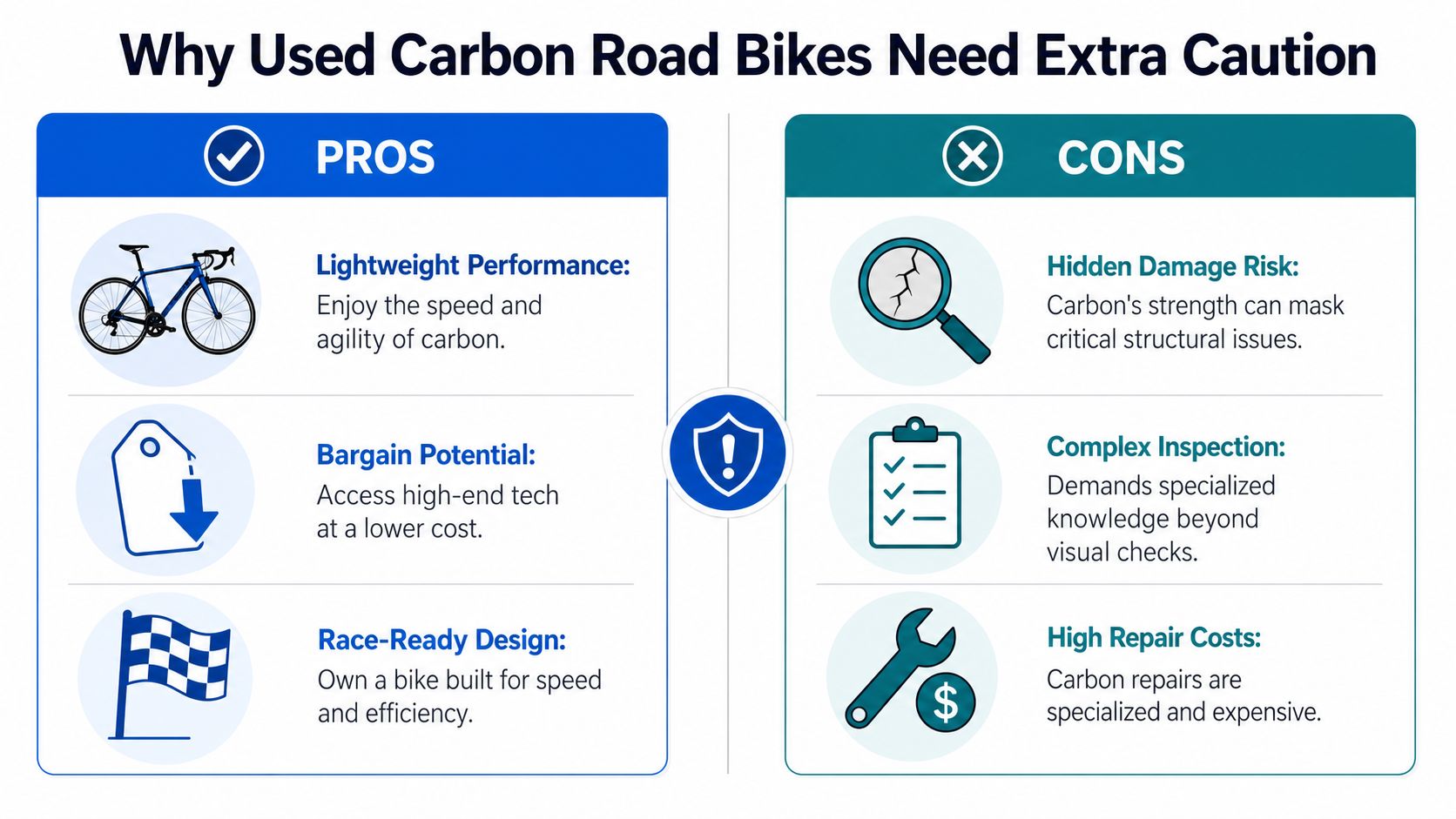
A glossy used carbon road bike can look like an easy win. The paint shines, the weight looks appealing, and the asking price feels low enough to justify a quick decision. That is the trap. Carbon bikes can hide impact damage, clamp damage, and repair history that never shows up in the hero photo.
The used carbon road bike market has plenty of attractive listings, but the material raises the stakes. A clean-looking carbon frame still needs a clear model year, verified geometry, honest damage history, and enough close-up photos to support the asking price.
Practical rule: if the listing does not give you confidence on fit, model year, and frame condition, the low price is not a good price.
Carbon’s appeal is performance, weight, and ride feel, but those benefits only matter if the bike fits and the frame condition is trustworthy. A used carbon road bike with unclear history, poor photo coverage, or questionable geometry should not stay on the shortlist just because it is light.
That is why the right way to shop is simple. Start with confidence signals. If the seller cannot support the bike's age, geometry, and condition story, walk away or push the bike lower on your shortlist.
Walk away or get a professional inspection when:
The seller avoids crash, repair, or repaint questions.
The frame has sharp impact marks, deep cracks, ripples, soft spots, or suspicious bubbling.
The seller refuses close-up photos of high-risk carbon areas.
The model year or frame generation cannot be verified.
The bike has a repaired carbon area with no documentation.
The price only makes sense if you ignore carbon uncertainty.
Verify model year and frame generation
Model year matters more on a used carbon bike than casual buyers expect. Two bikes with the same name can ride differently, fit differently, and support different parts. Brake standard changes, axle standards, cable routing, integrated cockpits, tire clearance, and electronic shifting compatibility all tend to shift across generations.
Don't trust the name on the listing
A seller can call something a “2021” bike because that's when they bought it. That doesn't mean the frame is from that generation. Ask for the exact model name, the frame size, and the year on the original invoice or purchase proof. If the seller can't provide that, treat the listing as weaker than it looks.
Use the geometry chart and official product archive when you can. A frame revision can change the front end, cockpit layout, or serviceability enough that the bike no longer matches the rider's intended use. That's not a small detail, especially when you're comparing a second hand carbon road bike against newer listings with more current standards.
Check the generation before you compare price
The value conversation only works when you're comparing like with like. A newer frame with disc brakes and modern routing is not the same purchase as an older rim-brake frame with outdated compatibility. Even if the brand name is strong, the generation drives the actual buying decision.
If the seller is vague about model year, generation, or trim level, that's a confidence problem. It doesn't mean the bike is bad. It means you don't know what you're buying yet.
Assess fit and geometry overview
Start with fit before you get distracted by carbon, groupsets, or paint condition. A used carbon road bike can look perfect and still be the wrong bike if the frame is too long, too low, or built around a riding position that does not suit you.
Use stack and reach, not just the size label
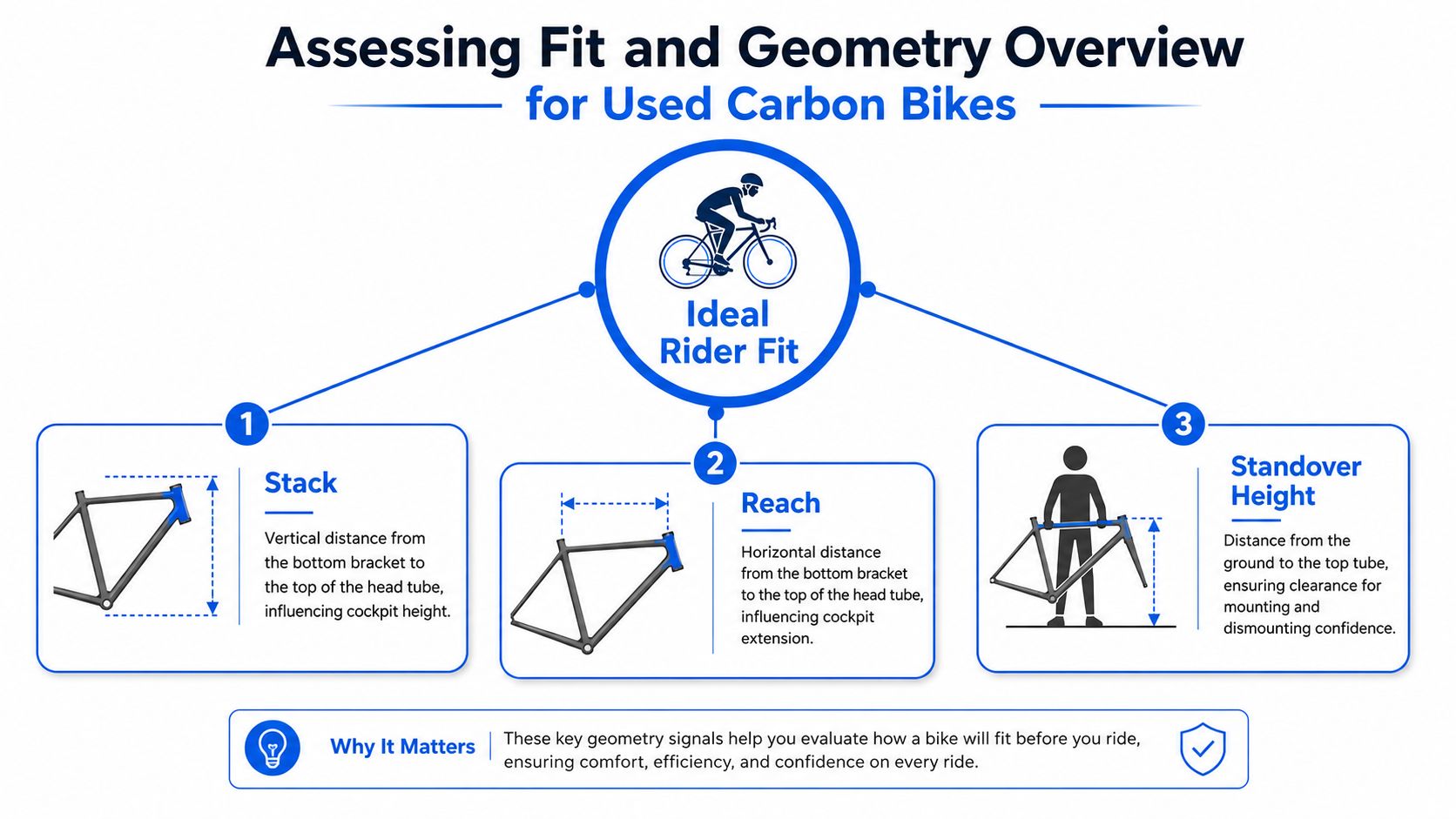
Seat-tube labels are a weak way to compare used listings. An independent used-bike guide says stack and reach give a more accurate representation of bike fit than traditional seat-tube measurements, which makes them the right starting point for comparing used road bike listings (Bike Room fit guidance). Stack tells you how tall the front end starts. Reach tells you how long the frame feels through the cockpit. Those two numbers tell you far more than a “54” or “56” label ever will.
If you already know your fit measurements, use SYCLR's fit details entry point to compare listings cleanly, then cross-check the geometry against the bike itself.
Check the handling cluster too
Stack and reach do not tell the whole story. Standover, wheelbase, head tube angle, bottom bracket drop, and seat tube angle all shape how the bike fits and how it rides. Those geometry signals show whether a bike will feel sharp, stable, race-oriented, or more all-road in character.
A bike that fits on paper can still feel wrong in motion if the frame shape does not match your body and riding goals.
A short stem or different saddle can hide a poor fit for a while, but it does not fix the frame. If the geometry is off, move on. For a more structured fit comparison, use the Bike Fit Guide. The infographic below also helps you measure stack, reach, and standover height the right way.
Inspect carbon frame condition and damage clues
Start with the parts that fail hardest. Strong light, slow movement, and a skeptical eye matter more than glossy photos. A clean listing can still hide damage that makes a used carbon road bike a bad buy.
Look at the critical areas first
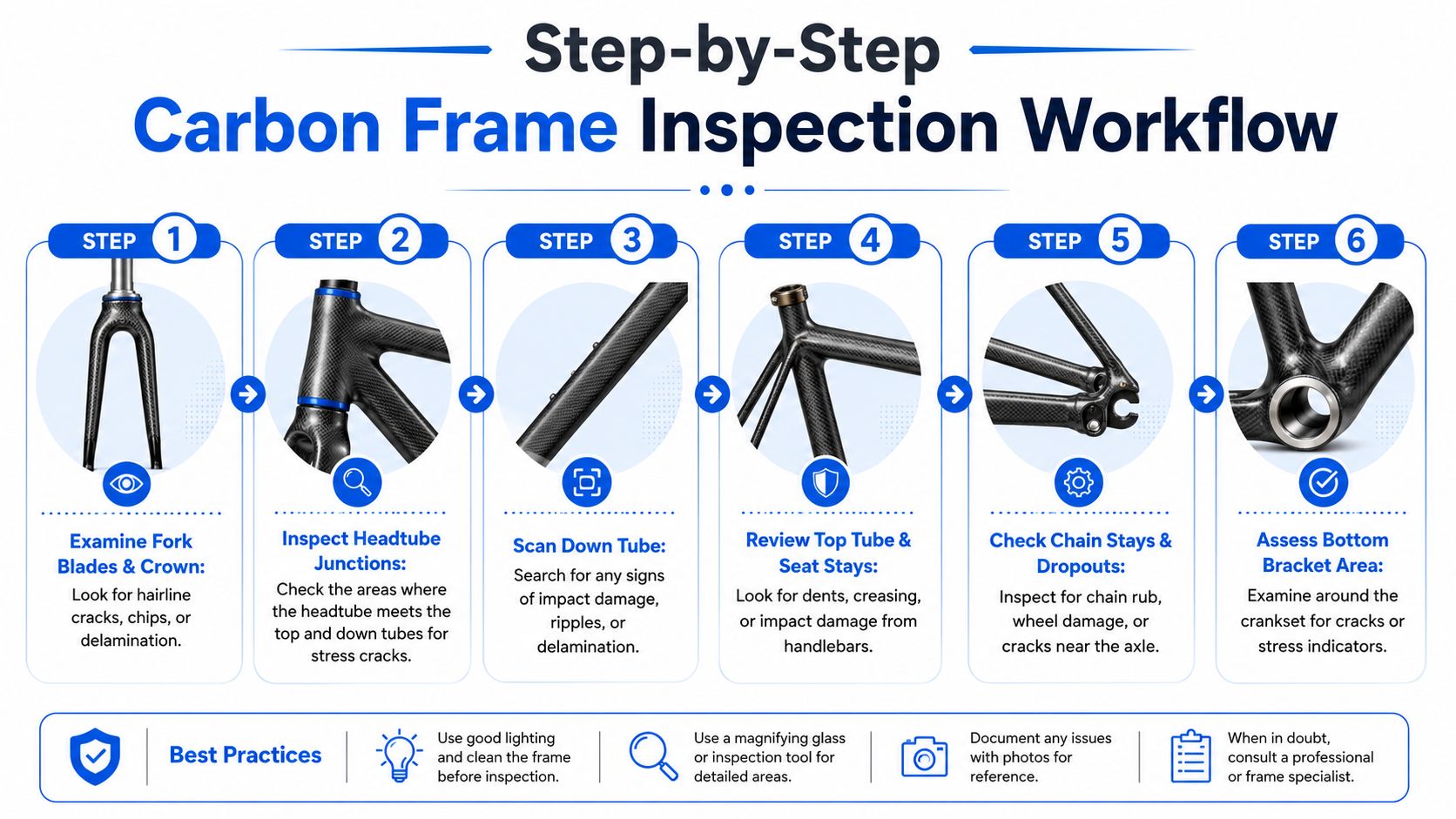
Carbon frames deserve extra caution around crush points and impact areas. Pay close attention to the fork, head tube, underside of the down tube, bottom bracket area, dropouts, stays, and seat cluster. Visible ripples, sharp impact marks, deep cracks, suspicious repairs, or damage the seller will not photograph clearly should lower confidence immediately.
Do not use a universal depreciation rule for used carbon road bikes. Compare the listing against similar bikes with the same brand, model, generation, frame size, brake type, groupset, wheelset, condition, and seller transparency. Age matters, but condition and uncertainty matter just as much.
What to look for in person
Use a simple workflow when the bike is in front of you. Compare the frame's fit-related shape with its damage-prone areas at the same time, because a bike that measures right still needs to pass the carbon check.
Fork and crown: look for chips, sharp impact marks, or asymmetry.
Head tube junctions: check for cracks, ripples, or bubbling paint.
Down tube underside: scan for scrape marks, flat spots, or hidden scuffs.
Bottom bracket area: inspect around the crankset for stress lines or disturbed paint.
Chainstays and seatstays: watch for rub marks, creasing, or suspicious repairs.
Dropouts and seat cluster: look closely at clamp zones and axle interfaces.
Photos help, but they do not prove structural integrity. If the seller will not provide close-ups of these areas, lower your confidence in the listing. If you want a broader red-flag pass before you commit, use the SYCLR used bike red flags checklist and compare it against the frame in front of you.
Carbon inspection photo checklist:
Fork blades and fork crown
Head tube and headset junctions
Underside of the down tube
Bottom bracket shell
Chainstays
Seatstays
Dropouts
Seat cluster and seatpost clamp area
Bottle bosses and cable ports
Any paint chips, scratches, touch-up marks, or repaired areas
Evaluate repair history and component specs
A frame with a known repair history can still be a decent buy, but only if the seller is honest and specific. What kills confidence is not the repair itself, it's the evasiveness. If the seller dodges questions about crashes, repainting, or warranty work, assume the story is incomplete.
Ask direct questions and expect direct answers
Get the facts on the frame before you get distracted by the build kit. Ask whether the bike has ever been crashed, repaired, repainted, or warrantied. Ask for close-ups of any marks, touch-up areas, or suspicious discoloration. If the seller says “nothing major” but can't explain visible damage, that's a bad sign.
Good documentation beats a polished description. Original purchase proof, service records, and repair paperwork matter more than a few flattering photos.
If the frame was repaired professionally, that's better than a vague “don't worry about it.” You still need the details, but documented history gives you something to evaluate.
Check the components as part of the whole bike
Brake type matters, especially when comparing generations. Electronic shifting versus mechanical shifting changes service expectations. Wheelset condition matters because a carbon frame paired with tired wheels can still become an expensive repair project. Tire clearance, cockpit setup, and seatpost design also affect how usable the bike really is.
Drivetrain wear still matters because it changes the real cost of the bike. Ask for clear photos of the chain, cassette, chainrings, derailleurs, and crank area. If the chain, cassette, or chainrings look worn, factor likely replacement costs into the offer. A premium carbon frame does not make a tired drivetrain cheaper to fix.
Determine price context and value
Price only matters relative to what you're getting. A low asking price on a used carbon road frame can still be expensive if the size is wrong, the generation is old, the parts are worn, or the seller won't document anything. That's why price context has to include condition and uncertainty, not just the sticker.
Compare listings against the same bike, not the same category
Don't compare a carbon race bike to a carbon endurance bike and call it a market check. Compare by brand, model, generation, size, brake type, groupset, wheelset, tire clearance, service history, and crash history. If you skip those filters, you're comparing unrelated bikes.
Use this framework instead:
Comparable value minus condition risk minus fit uncertainty minus listing uncertainty equals a more realistic offer range.
That's the cleanest way to judge a used carbon bike without pretending there's a universal appraisal. A stronger listing with complete photos, clear model-year details, and a fit match deserves more money. A vague listing with missing angles and questionable specs deserves a lower offer or a pass.
Keep depreciation in context
A resale discussion focused on high-end carbon bicycles gave one example of $8,000 to $10,000 in depreciation over five years, and noted that modern carbon bikes often sell at a 30% to 40% discount versus retail price at three years (used-carbon depreciation discussion). That doesn't give you a universal formula, and you shouldn't treat it like one. It does tell you that carbon bikes lose value fast enough that age and generation matter a lot.
For a broader value comparison workflow, the Used Bicycle Value page is the right place to anchor your shortlist. That's where you should compare similar listings, then adjust for the risk you uncovered during inspection.
Checklist and next steps with SYCLR
A used carbon bike should only stay on your shortlist when the fit, frame identity, carbon condition, and listing confidence all hold up together. If one of those pieces is weak, the bike stops being a strong buy and starts becoming a gamble.
| What to check | Why it matters | Confidence signal | Walk-away signal |
|---|---|---|---|
| Exact model year | Affects generation and compatibility | Original invoice or clear manufacturer match | Seller can't verify year |
| Full model and trim | Confirms what you're actually buying | Name matches photos and spec | Vague or inconsistent naming |
| Frame size | Helps narrow the fit | Size matches geometry and rider needs | Only seat-tube label given |
| Stack and reach | Better fit comparison than size labels | Geometry chart is available | No geometry data at all |
| Standover | Helps with mounting confidence | Clear clearance for the rider | Borderline or uncertain clearance |
| Road category | Explains riding position and handling | Race, endurance, aero, climbing, or all-road is clear | Category is unclear |
| Fork and head tube condition | High-stress carbon zones | Clean close-ups with no cracks | Seller avoids close-ups |
| Down tube underside | Often hides impact marks | No ripples or deep scuffs | Hidden or missing photos |
| Bottom bracket area | Common stress point | Clean surface, no bubbling | Damage or repair marks |
| Chainstays and seatstays | Can show impact or rub damage | Even surface, no unusual marks | Cracks, chips, or distortion |
| Dropouts | Important for axle and alignment | No damage around interfaces | Visible impact or wear |
| Seatpost and seat cluster | Clamp damage can be overlooked | Clean clamping zones | Crushed or scarred areas |
| Visible paint damage | Helps spot possible deeper issues | Minor cosmetic wear only | Sharp marks or suspicious bubbling |
| Repair or crash history | Changes confidence fast | Clear documentation | Evasive seller answers |
| Brake type | Affects service and compatibility | Matches your needs | Unclear or mismatched parts |
| Drivetrain wear | Impacts total cost | Wear is disclosed | Chain and cassette condition unknown |
| Wheelset condition | Can add major replacement cost | Trueness and condition are clear | Cracks, flat spots, or no photos |
| Tire clearance | Affects real-world use | Clear clearance is listed | No clearance info |
| Seller photos | Better photos mean better confidence | Close-ups of key areas | Only one or two polished shots |
| Service records | Shows maintenance history | Records are available | No records, no proof |
| Comparable pricing | Prevents overpaying | Matches similar listings | Price is based on hope, not context |
Used Carbon Road Bike FAQ
Is buying a used carbon road bike a good idea?
Buying a used carbon road bike can be a good idea when the fit, model year, frame condition, component spec, seller transparency, and price context all make sense. It becomes risky when damage history, repair history, or frame identity is unclear.
What should I check first on a used carbon road bike?
Check the exact model year, full model name, frame size, and frame generation first. Then verify stack, reach, standover, carbon condition, component spec, and seller documentation.
How can I spot carbon damage on a used road bike?
Look for sharp impact marks, deep cracks, ripples, soft spots, suspicious paint bubbling, touch-up areas, unexplained repairs, or damage around the fork, head tube, down tube, bottom bracket, stays, dropouts, and seat cluster.
Can photos prove a carbon frame is safe?
No. Photos can reduce uncertainty, but they cannot prove structural integrity. If the bike is expensive, the damage is unclear, or the seller’s story does not match the photos, consider a professional carbon inspection.
Which geometry numbers matter most on a used carbon road bike?
Stack and reach are the first fit numbers to check. Standover, wheelbase, head tube angle, bottom bracket drop, seat tube angle, and tire clearance also help explain fit, handling, and category.
How should I judge the value of a used carbon road bike?
Compare similar bikes by brand, model, generation, size, brake type, groupset, wheelset, condition, and seller transparency. Then adjust for condition risk, fit uncertainty, and listing uncertainty.
Can SYCLR help compare used carbon road bike listings?
Yes. SYCLR helps riders compare used carbon road bike listings by fit signals, geometry signals, model year context, price context, condition signals, listing quality, and confidence signals before contacting sellers.
SYCLR helps you compare fit signals, geometry signals, model year context, price context, condition signals, listing quality, and confidence signals in one place. It's useful when you want to shortlist smarter instead of bouncing between listings and guessing. If you already have fit details, use the fit details entry point; if you're starting from scratch, compare used carbon road bike listings in SYCLR and narrow the field before you message a seller.
If you are comparing used carbon road bikes now, start with your height, bike type, and budget in the SYCLR app. SYCLR helps you compare listings by fit signals, geometry signals, model year context, price context, condition signals, listing quality, and confidence signals so you can shortlist better-fit used road bikes before contacting sellers.
Already know your stack, reach, current-bike geometry, or fit-report details? Use the fit-details entry to improve your recommendations.