Used Bike Red Flags: How to Spot Risky Listings Before You Buy
You’re probably looking at a listing right now that seems promising. The price is attractive, the headline sounds decent, and the seller says it’s in “great condition.” But the photos are weak, the model year is missing, the size description is vague, and the parts list feels incomplete.
That’s where most bad used-bike decisions start.
The biggest problem usually isn’t the obvious one. It’s not always a visible crack, a rusty chain, or a scratched derailleur. The primary risk is uncertainty. If you can’t verify the exact bike, its fit, its ownership story, its condition, or why it’s priced the way it is, you’re not evaluating a deal. You’re guessing.
Table of Contents
The Real Risk in Buying a Used Bike
A used road or gravel bike can be a smart buy. It can also be a slow, expensive mistake that starts with an incomplete listing and ends with a bike that doesn’t fit, needs more work than expected, or has a story the seller can’t support.
That’s why used bike red flags should be treated as confidence problems first. A clean-looking bike with poor information is still risky. A cheap bike with no model year, weak photos, and vague seller answers can become more expensive in practice than a better-documented listing at a higher asking price.
Uncertainty is what changes the risk
A strong listing lets you answer basic questions before you message the seller:
-
Identification: What exact bike is this?
-
Fit: Is the size and geometry even worth considering?
-
Condition: Can I see the wear points that matter?
-
Ownership: Does the seller sound like the owner of this bike?
-
Price context: Does the asking price match the bike and the unknowns?
If those answers aren’t available, your risk rises fast. That’s true whether you’re shopping for your first endurance road bike, a gravel upgrade, or a used carbon race bike.
Practical rule: If the listing leaves you with more questions than confidence, treat that as a red flag, not as an invitation to “see what happens.”
A lot of buyers focus too narrowly on bargain hunting. That’s understandable, especially when a listing looks like it might be the cheapest route into a better bike. But price only matters after the basics are verified. If the fit is wrong, the frame generation is unclear, or the components don’t match the seller’s story, the discount doesn’t help much.
That’s the mindset shift that matters most. Don’t start with “Is this a deal?” Start with “Can this listing support a confident buying decision?”
Listing and Seller Red Flags
The first filter happens before you travel, before you inspect the bike, and often before you even message the seller. Most risky listings tell on themselves early.
The fastest test
Ask one question immediately: Can I identify the exact bike from the listing alone?
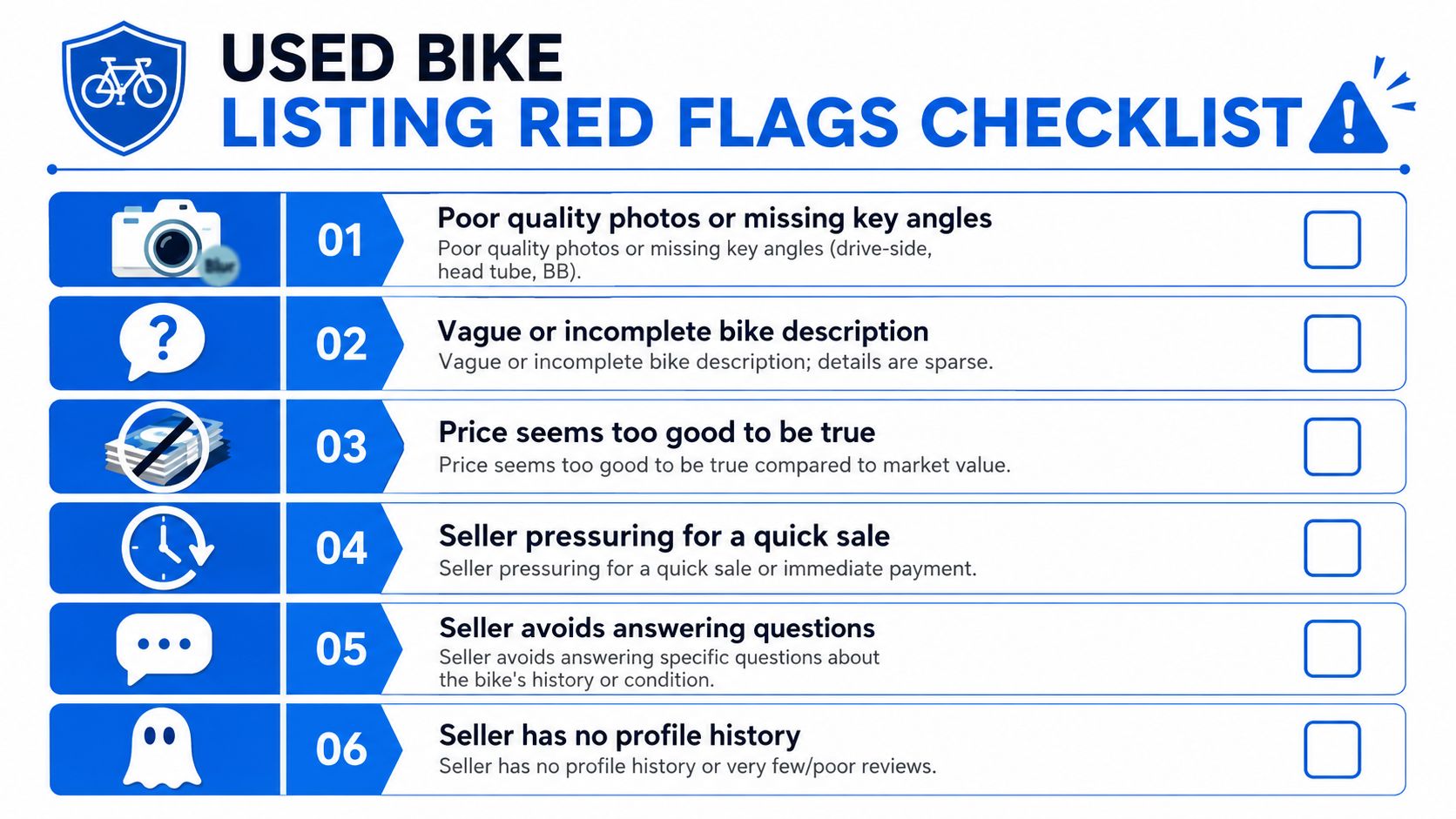
You should be able to tell the brand, model, year or frame generation, size, brake type, drivetrain, and enough visual details to compare it against similar bikes. If the listing just says “56cm carbon road bike” or “medium gravel bike, upgraded,” listing confidence is low.
A vague model name is one of the most common used bicycle red flags because it blocks every other decision. You can’t judge fit well, you can’t compare price well, and you can’t verify whether the parts shown even belong on that build.
For a broader buying workflow focused on road listings, SYCLR’s guide to used road bikes is a useful companion.
Photo quality tells you a lot
Bad photos aren’t always dishonest, but they do create unnecessary risk. The strongest listings include a clear drive-side shot, full-bike photos from both sides, and close-ups of the areas buyers need to inspect.
Weak listings often show:
-
Dim or blurry images: You can’t inspect frame surfaces, wear, or component consistency.
-
No drive-side photo: You can’t properly assess drivetrain condition or the complete build.
-
No detail shots: Missing views of the fork, head tube, bottom bracket area, stays, and dropouts leave too much hidden.
-
Stock or marketing-style photos: If the pictures look like manufacturer images instead of phone photos, ask for a current photo with today’s newspaper or a handwritten note with the date. That’s recommended in Better Bike’s used-bike inspection advice.
If a seller won’t provide basic photo verification before you travel, the listing doesn’t deserve more of your time.
Seller behavior matters
The description can be incomplete because the seller is casual. The conversation is where you find out whether they’re also evasive.
Watch for these used bike seller red flags:
-
Avoids direct questions about the model year, frame number, receipt, or service history.
-
Gets defensive about reasonable verification requests.
-
Cannot support maintenance claims with receipts, shop records, or specific service details.
-
Refuses basic inspection conditions, such as meeting in daylight or allowing a careful look at the bike.
Price red flags are context red flags
A very low price isn’t automatically a great find. Often, it’s a signal that something important is missing.
A very low price is not proof that something is wrong, but it should slow you down. If a bike is priced far below similar listings, ask why. The answer should make sense: cosmetic wear, an urgent move, older components, missing accessories, or known service needs. If the price is unusually low and the seller also avoids model-year details, ownership history, frame-number checks, or close-up photos, the risk rises quickly.
That doesn’t mean every discounted bike is bad. It means a low price only helps if the listing also supports the bike’s fit, condition, model year, and ownership story.
Ask for a clear one-sentence explanation of the price and the bike’s origin. If the seller can’t give one, treat that as a deal breaker.
Fit and Geometry Red Flags
A used bike can look clean, be mechanically sound, and still be the wrong bike for you. That’s why fit red flags matter just as much as seller red flags.

Fit red flags are still red flags
Be skeptical when a seller writes “fits most riders,” “good for 5’7 to 6’1,” or “medium should work.” Those phrases are convenient for the seller and useless for the buyer.
Frame size labels vary between brands and even between generations of the same model. A 54 in one road bike doesn’t necessarily line up cleanly with a 54 in another. A medium gravel frame may ride very differently depending on stack, reach, wheelbase, front end height, and intended use.
A good deal on the wrong geometry is still a poor buy.
That matters even more if you’re moving between categories. A road rider buying a gravel bike, or a gravel rider trying an endurance road bike, can get caught by familiar size labels and unfamiliar fit.
For a deeper side-by-side approach, use compare bike geometry when the listing gives you enough detail to identify the exact bike.
What a strong listing should give you
You don’t need a full professional fit report to screen a used listing well. You do need enough information to compare it intelligently.
Look for these fit signals:
-
Exact frame size
-
Model year or frame generation
-
Category clarity, such as race road, endurance road, all-road, or gravel
-
Geometry data or enough identification to find it
-
Visible cockpit setup, including spacers, stem length, and saddle position
If the seller only gives a size label and a rough height range, that’s not enough. Height alone isn’t precise enough for a confident used-bike purchase.
When fit uncertainty stacks up with other weak signals, the listing becomes hard to justify. That’s especially true when you can’t test ride or when the bike is far enough away that you’d be committing time and travel before confirming basics.
A good used listing doesn’t need to be polished. It just needs to make verification possible.
Physical Condition and Component Red Flags
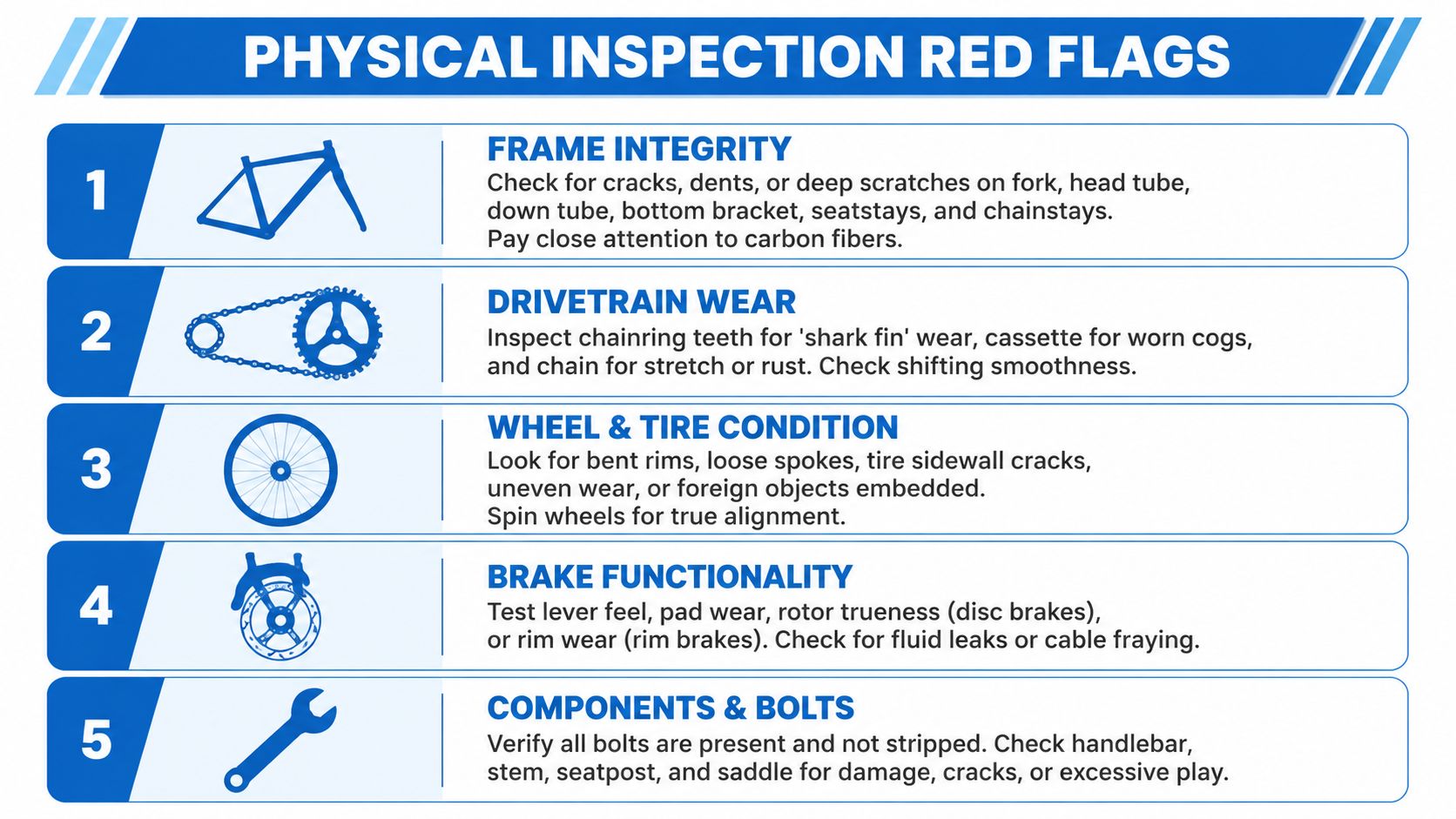
Once a listing passes the basic confidence test, the next job is physical inspection. During the physical inspection, used bike inspection red flags become concrete.
Frame and ownership checks
Start with the frame itself, then confirm that the bike’s identity hasn’t been tampered with.
The frame number is the most vital aspect. According to CycleSite’s guidance on buying safely, tampered or missing frame numbers are the single most definitive red flag indicating a stolen bike. Experts cited there state that consider reporting the listing through the marketplace if it appears suspicious and buyers should “walk away immediately” without confrontation. The same guidance points buyers to BikeIndex.org as the largest free bike registration database, with BikeRegister in the UK and 529 Garage in North America serving similar verification roles. It also states that running the frame number through a stolen-bike database takes thirty seconds.
If you see grinding marks, fresh paint over the number, scratched-over digits, or a conveniently placed sticker over the area, stop communication, screenshot the listing, consider reporting the listing through the marketplace if it appears suspicious, and leave it alone.
Used carbon bike red flags
Carbon bikes deserve extra caution because serious damage isn’t always obvious in normal marketplace photos.
Ask for close-up photos of:
-
The fork and head tube area
-
The underside of the down tube
-
The bottom bracket shell
-
Dropouts
-
Chainstays and seatstays
-
Any paint damage or touched-up area
What lowers confidence on a used carbon bike?
Sharp impact marks. Ripples. Deep cracks. Soft spots. Repairs that aren’t clearly explained. Paint damage that the seller minimizes but won’t photograph closely.
For higher-value or uncertain carbon purchases, a professional inspection is worth considering. Photos can reduce guesswork, but they can’t prove structural integrity.
A fair asking price still has to be adjusted for uncertainty. If the carbon frame history is unclear, use that uncertainty when you assess whether the bike is worth pursuing at all. For pricing context, see used bicycle value.
Before inspecting a used bike in person, make a short photo and inspection checklist so you do not rely on memory once you are standing in front of the bike.
In-person inspection checklist:
-
Frame number visible and untampered
-
Clear drive-side view
-
Fork, head tube, down tube, bottom bracket, stays, and dropouts checked
-
Chain, cassette, chainrings, and derailleur inspected
-
Brake pads, rotors, calipers, and lever feel checked
-
Wheels checked for dents, cracks, spoke tension, and hub smoothness
-
Tires checked for dry rot, cuts, and uneven wear
-
Headset and bottom bracket checked for play
-
Seller story matches the bike’s condition and components
Wear signs that matter on any bike
Not every worn part is a deal breaker. Some are normal service items. The issue is whether the wear matches the seller’s story and the asking price.
Specific mechanical red flags include the following:
-
Rim brake wear: Heavy wear on the rim braking surface means the rim needs replacement, according to Rouvy’s secondhand bike guide.
-
Disc rotor wear: Rust or scoring on rotors indicates significant wear or contamination, also noted by Rouvy.
-
Tire condition: Tire wear that doesn’t match the advertised mileage suggests the seller is misrepresenting usage. Rouvy also notes that rotting and cracking tires suggest poor maintenance.
-
Chain condition: A chain with tight spots, rust, stiff links, or uneven wear points to hard riding and neglect, based on Rouvy’s guidance.
-
Handling on a test ride: If the bike pulls to one side, the frame or fork is likely bent, which Rouvy describes as a structural failure that can’t be safely corrected.
Another practical clue is mismatched parts. Replaced components that don’t match the rest of the bike can indicate incompatible assembly or hidden crash history, as highlighted in this used-bike inspection video.
Non-negotiable: If the bike tracks badly on a test ride or the frame number has been tampered with, stop there. Don’t try to rationalize it.
The Red Flag Checklist for Used Bikes
Use this as a fast screening table when you’re comparing listings or standing next to a bike in person.
Used Bike Red Flags Checklist
| Red Flag | Why It Matters | What to Ask or Check |
|---|---|---|
| Missing model year | Makes value, geometry, and component verification harder | Ask for the exact year or frame generation |
| Vague model name | Prevents accurate comparison against similar bikes | Ask for the full model name and trim |
| Size only, no geometry | Size label alone doesn't tell you enough about fit | Ask for size, model year, and geometry details |
| Poor photos | Hides wear, damage, and component mismatches | Ask for clear full-bike and detail photos |
| No drive-side photo | Blocks drivetrain and build verification | Request a straight, well-lit drive-side image |
| No drivetrain close-ups | Makes wear harder to judge | Ask for chain, cassette, crank, and derailleur photos |
| No brake or wheel details | Leaves major service items unclear | Ask what brake type, wheelset, rotor, and tire condition the bike has |
| “Upgraded” without specifics | Can hide cheap swaps or incompatible parts | Ask for exact part names, age, and receipts if available |
| “Fits most riders” | Suggests guesswork instead of fit information | Ask for frame size, geometry, and intended rider fit context |
| Seller avoids questions | Lowers trust and listing confidence | Ask direct questions once. If answers stay vague, move on |
| Price too low without reason | May point to hidden issues or stolen property | Ask why it's priced low and compare with similar listings |
| Carbon damage not shown clearly | Photos may hide impact or repair clues | Request close-ups of fork, head tube, down tube, BB, stays, and dropouts |
| Shipping pressure | Pushes you toward payment before verification | Slow the process and verify details first |
| Payment pressure | Increases fraud risk and weakens your leverage | Don't send money until identity, bike details, and terms are clear |
How to Act on Red Flags
Spotting red flags is only half the job. The next step is deciding whether the issue is fixable, negotiable, or a reason to walk.
Ask better questions
A good message is short and direct. You're not trying to sound clever. You're trying to reduce uncertainty.
Ask things like:
-
Identification: What is the exact model year and full model name?
-
Ownership: Do you have proof of purchase or service receipts?
-
Condition: Can you send close-ups of the drivetrain, fork, bottom bracket area, and any paint damage?
-
Fit: What is the exact frame size, and do you know the geometry or model year so I can look it up?
-
Parts: Which components were upgraded, exactly?
One useful test is whether the seller can answer in plain language. Honest sellers may not know every technical detail, but they usually answer straightforwardly and try to help.
Know when to walk away
Some red flags should end the process immediately.
Walk away when you see:
-
A tampered or missing frame number
-
A seller who won't support basic verification
-
A bike that pulls to one side on a test ride
-
Hidden or minimized carbon damage with no clear explanation
-
Pressure to pay before details are verified
There's no prize for forcing a questionable deal to work. The strongest buying move is often a calm no.
Rejecting uncertainty is part of buying well. You're not being difficult. You're protecting your time, money, and future repair budget.
Use minor issues as negotiation points
Not every red flag means “don't buy.” Some mean “adjust the offer.”
Worn tires, a neglected chain, unclear service timing, or cosmetic damage can justify a lower number if the bike's identity, fit, and ownership story still hold up. That's a confidence-adjusted offer. You're paying for the bike that's in front of you, not the cleaner story in the listing.
What doesn't work is using negotiation to fix major uncertainty. If the year is still unclear, the fit is still questionable, or the seller still avoids direct answers, the right move usually isn't a lower offer. It's walking away.
Shortlist Smarter and Reduce Guesswork
Most bad used-bike purchases don't happen because buyers ignore obvious danger. They happen because the listing looks close enough, the price feels tempting, and the missing details get waved away.
That's why the best used bike red flags framework starts with completeness. Can you identify the exact bike? Can you check whether it fits your body and riding goals? Can you understand the model year context, condition signals, and price context well enough to compare it against better-documented alternatives?
If the answer is no, keep moving.
This matters even more for road and gravel buyers because fit and geometry aren't side issues. A bike can be authentic, reasonably priced, and mechanically decent, yet still be a weak buy if the stack, reach, frame size, or category don't suit the rider. A low price on the wrong bike is still a poor outcome.
SYCLR is built for that earlier decision point. Instead of treating bike shopping like a simple marketplace scroll, it helps riders compare listings using fit signals, geometry signals, model year context, price context, listing quality, and confidence signals. That doesn't replace an in-person inspection or a professional opinion when needed. It does help buyers reduce guesswork and shortlist better-fit bikes before they buy.
Used Bike Red Flags FAQ
What is the biggest red flag when buying a used bike?
The biggest red flag is uncertainty. If you cannot verify the exact bike, model year, fit details, condition, ownership story, or price context, you are guessing instead of evaluating a deal.
What should I check first in a used bike listing?
First, check whether you can identify the exact bike from the listing alone. Look for the brand, model, year or frame generation, frame size, drivetrain, brake type, and clear photos.
Is a very cheap used bike always a red flag?
Not always. A low price can be legitimate, but it should make you ask more questions. If the low price comes with missing details, weak photos, unclear ownership, or seller pressure, confidence should drop quickly.
What are red flags on a used carbon bike?
Used carbon bike red flags include sharp impact marks, deep cracks, ripples, soft spots, suspicious repairs, hidden damage, or a seller who avoids close-up photos of the fork, head tube, down tube, bottom bracket area, stays, and dropouts.
Is “fits most riders” a red flag?
Yes. “Fits most riders” is too vague to support a confident purchase. A stronger listing should provide the exact frame size, model year, geometry context, and enough detail to check stack, reach, standover, and category fit.
When should I walk away from a used bike?
Walk away if the frame number appears tampered with, the seller avoids basic verification, the bike tracks poorly, carbon damage is unclear, or payment pressure starts before the bike’s identity and condition are verified.
Can SYCLR help spot used bike red flags?
SYCLR helps riders compare listings by fit signals, geometry signals, model year context, price context, listing quality, and confidence signals. It does not replace an inspection, but it can help buyers reduce guesswork before they contact sellers.
If you already know your current bike's geometry, stack, reach, or fit-report details, starting with that information usually leads to a stronger shortlist. If you don't, starting with your height, bike type, and budget is still a practical way to narrow the field before you spend time on weak listings.
Compare used bike listings with SYCLR to shortlist better-fit road and gravel bikes before you buy. If you already know your fit details, current-bike geometry, stack, or reach, start with the more advanced fit-aware entry point.