Gravel Bike vs Mountain Bike: Which Suits Your Riding?
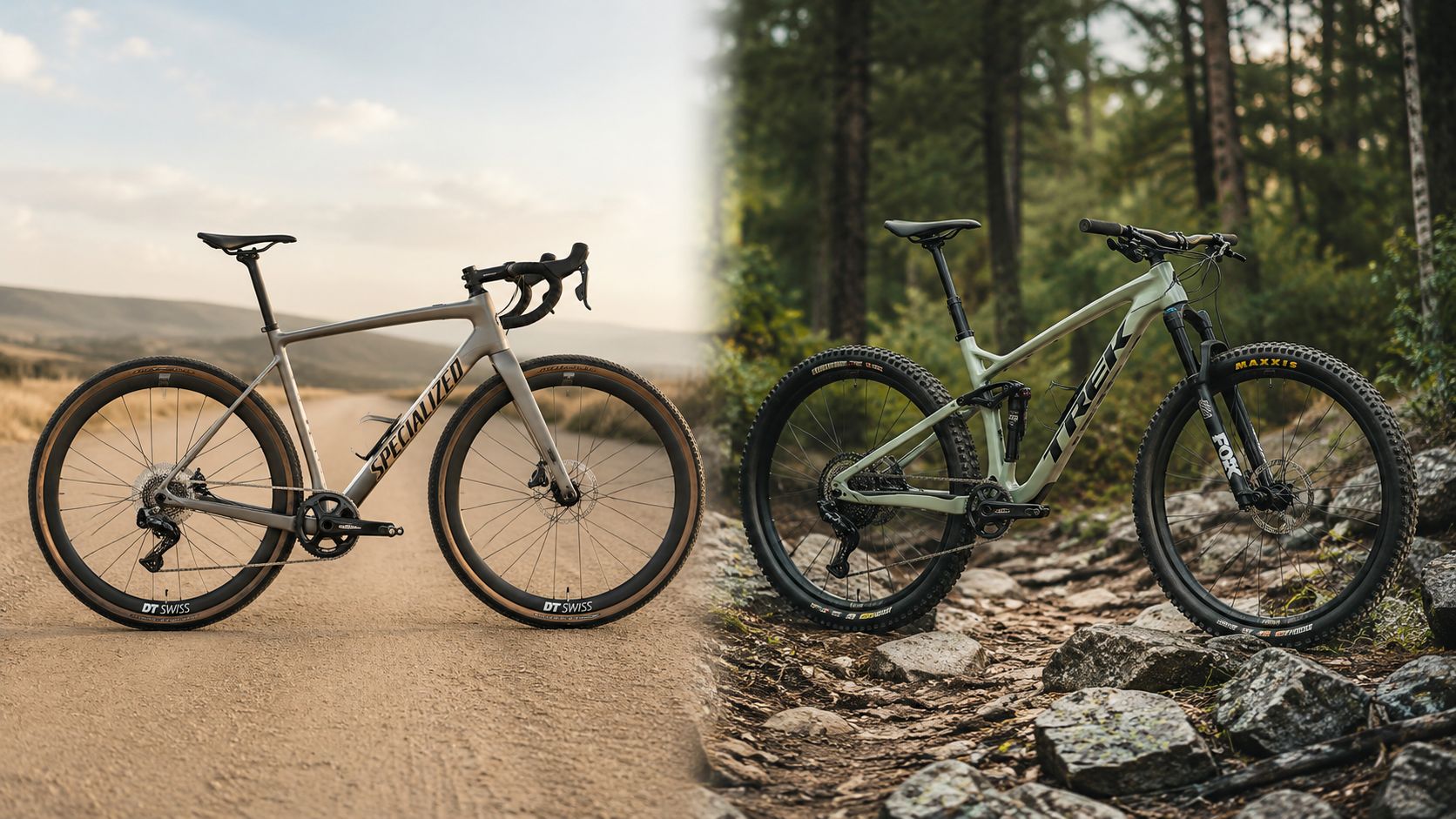
Neither bike category is universally better. A gravel bike is usually the better fit for pavement, dirt roads, smoother gravel, and longer mixed-surface rides. A mountain bike becomes more appropriate when technical singletrack, rough descents, roots, rocks, repeated impacts, and trail control are regular priorities. The right choice comes from the details of the bike in front of you, not just the label on the frame.
If your riding sits between those poles, compare the exact frame geometry, riding position, tire clearance, wheel and brake setup, suspension, gearing range, and the condition of the individual bike. Some modern gravel bikes are surprisingly capable, and some mountain bikes pedal efficiently across mixed terrain. That overlap is real, but it does not erase the differences in intent.
Table of Contents
- The Real Question Behind Gravel Bike vs Mountain Bike
- Geometry and Fit Differences That Change the Ride
- Tires, Suspension, Drivetrain, and Cockpit
- Which Bike Fits Which Rider and Terrain
- The Overlap Zone Where the Lines Blur
- How to Shortlist the Right Gravel Bike With SYCLR
- Decision Recap and Frequently Asked Questions
The Real Question Behind Gravel Bike vs Mountain Bike
The broad distinction is simple. Gravel bikes are designed for speed, range, and versatility across pavement and unpaved roads. Mountain bikes are designed to maintain traction, composure, and control when trails become rougher, steeper, and more technical. But broad distinctions are only a starting point.
A gravel bike is usually built around a drop-bar cockpit, a rigid frame and fork or, in some cases, a limited-travel front end, and clearance for tires that suit unpaved roads and mixed surfaces. Many also include mounts for bottles, bags, racks, or fenders. A mountain bike is usually built around a flat bar, tires selected for off-road terrain, and either front suspension alone or front and rear suspension together. Within that category, an efficient XC hardtail, a short-travel trail bike, and a full-suspension trail bike can feel very different from each other.
| Buying question | Gravel bike | Mountain bike |
|---|---|---|
| Best terrain | Pavement, dirt roads, smoother gravel, mixed-surface distance | Technical singletrack, rough descents, roots, rocks, repeated impacts |
| Usual cockpit | Drop bar, with some flat-bar exceptions | Flat bar |
| Suspension approach | Often rigid, sometimes limited-travel front suspension | Hardtail fork or full suspension |
| Design priority | Mixed-surface versatility, sustained riding, and varied hand positions | Technical-terrain control and managing repeated impacts |
| Extra used-bike concern | Fit, clearance, wheel standards, drivetrain wear | Fit, suspension condition and service history, wheel and drivetrain wear |
The real buying question is not which label sounds more capable. It is which terrain you ride most often, and which terrain would expose the wrong bike most quickly. A rider who spends most days on pavement and dirt roads needs a different machine from a rider who drops into rocky singletrack every weekend, even if both describe their rides as mixed.
Terrain-first rule: Buy for the surfaces that matter most to your riding, and for the consequences when the bike is wrong.
Budget matters too. A used gravel bike may still need tires, chain, cassette, brake work, bar tape, or wheels. A used mountain bike adds suspension condition and service history to the checklist. A low asking price is not a bargain if the frame puts you in the wrong position or the suspension needs immediate work.
Geometry and Fit Differences That Change the Ride
Geometry shapes how a bike fits, how it steers, and how confidently it handles your terrain. That is true whether the frame is labeled gravel or mountain. Category gives you a general idea of intended use. The individual numbers, cockpit setup, and wheel-tire package tell you how the bike will actually ride.
Head angle, seat angle, reach, stack, wheelbase, front-center, chainstay length, and bottom-bracket height all matter, but they matter together. One number in isolation rarely tells the full story. Neither does the frame size printed on the sticker.
Stack and reach come before the size label
Stack is the vertical distance from the center of the bottom bracket to the top-center of the head tube. Reach is the horizontal distance from the center of the bottom bracket to that same point at the head tube. These are frame measurements, not full cockpit measurements, and they help compare bikes more accurately than assuming the same size label means the same fit across brands or categories.
They still do not tell the whole fit story on their own. A rider's position also depends on stem length and angle, handlebar width and shape, hood placement on a drop bar, spacer height, saddle position, crank length, and the rider's flexibility, proportions, and preferred posture. A gravel bike with a short stem and shallow-reach bar can feel quite different from another gravel bike with a longer stem and longer-reach bar, even if the frame reach is similar. The same is true on mountain bikes, where bar width, rise, backsweep, stem length, and control placement strongly influence body position and steering feel.
Compare stack, reach, and other bike geometry measurements side by side with SYCLR. Use those numbers as a shortlist tool, then review the complete cockpit and your current-bike reference before assuming a bike will fit.
Wheelbase, front-center, and bottom-bracket height affect balance
Wheelbase influences how the bike distributes weight and responds as speeds and surfaces change. Front-center, the distance from the bottom bracket to the front axle, affects toe clearance, weight distribution, and how much room the rider has when moving around the bike. Bottom-bracket height influences pedal clearance and the bike's center of mass relative to the ground.
Those measurements help explain why two bikes with similar tire clearance can feel very different. One may feel composed when the surface turns loose and uneven. Another may feel quicker and more direct on roads and smooth gravel. Neither response is automatically better. The better bike is the one whose geometry matches your riding position, your handling preferences, and the terrain you actually ride.
If you already own a bike that fits well, use it as a reference point, not as proof that another bike with similar stack or reach will fit the same way. The complete riding position still depends on the rest of the cockpit and setup.
Tires, Suspension, Drivetrain, and Cockpit
Category labels only go so far. In practice, tire setup, suspension layout, gearing range, and cockpit design often decide whether a bike feels right for your routes.
Tires create the first practical split
Tires are the first practical divider because they affect grip, speed, vibration, braking feel, and steering response across every surface you ride. But width alone is not enough. The useful comparison includes tread pattern, casing construction, pressure range, rim width, wheel diameter, terrain, and frame-fork clearance.
When assessing a gravel bike, check the manufacturer's stated maximum tire clearance for the specific frame and fork, then account for the actual rim width and the tire you plan to run. Some modern gravel bikes now support very wide tires, in some cases around 50 mm or roughly 2.1 to 2.2-inch rubber, but that does not turn them into mountain bikes. Wide tires can add comfort, traction, and margin on rough surfaces, yet the bike's geometry, cockpit, wheel strength, braking setup, and intended use still define where it works best.
Mountain bikes are typically paired with wider and more aggressive tires because their intended terrain asks more from braking, side grip, casing support, and impact resistance. But not every mountain bike needs the same tread, and not every gravel route rewards the widest tire a frame can clear.
For a used bike, do not rely on a seller's tire description alone. Confirm the exact frame and fork specs, current wheel setup, and remaining clearance. Use this gravel bike tire size guide to assess width and rim compatibility before buying replacement tires.
Suspension changes the bike's job
Suspension is not just a comfort feature. It changes how a bike deals with repeated impacts, how the tires stay in contact with rough ground, and how much control the rider can maintain as speed and trail difficulty increase.
Many gravel bikes remain rigid because that keeps weight, complexity, and maintenance lower while preserving the direct feel many riders want on pavement and unpaved roads. Some gravel bikes now use limited-travel forks or front-end compliance systems, which can make sense for rougher gravel and light trail use. That does not make them substitutes for true trail-focused mountain bikes.
Mountain bikes commonly use front suspension for technical terrain, while full-suspension bikes add rear suspension to help manage repeated impacts and maintain control across rough surfaces. A hardtail can be the right answer for riders who want trail capability with less complexity, while a full-suspension bike becomes more compelling when rough descents, repeated compressions, and traction under load are routine parts of the ride.
On a used mountain bike, suspension condition deserves special attention. Ask about service history, stanchion wear, seal condition, shock function, pivot play, and whether any parts need immediate replacement. Photos and descriptions can help you ask better questions, but they do not verify safety or mechanical health.
Gearing and cockpit should match the route
Drivetrain choice should follow terrain, cadence preference, load, and maintenance priorities. Some gravel bikes use 1x systems for simplicity and chain retention. Others use 2x systems to provide tighter cadence steps and broader gearing for riders who spend significant time on paved roads. Mountain bikes often emphasize gear range and control under steep or technical load, but the exact cassette, chainring, and wheel size matter more than the category name.
Cockpit design deserves the same level of scrutiny. Drop bars give multiple hand positions and can work very well for longer mixed-surface rides. Flare, reach, drop, hood shape, and hood placement affect leverage and comfort. Flat bars offer a different control layout, with brake levers, shifters, and wider hand placement that can be advantageous when steering precision and body movement become more important.
Neither cockpit is universally better. The better setup is the one that supports your riding position, your control needs, and the surfaces you ride most.
Which Bike Fits Which Rider and Terrain
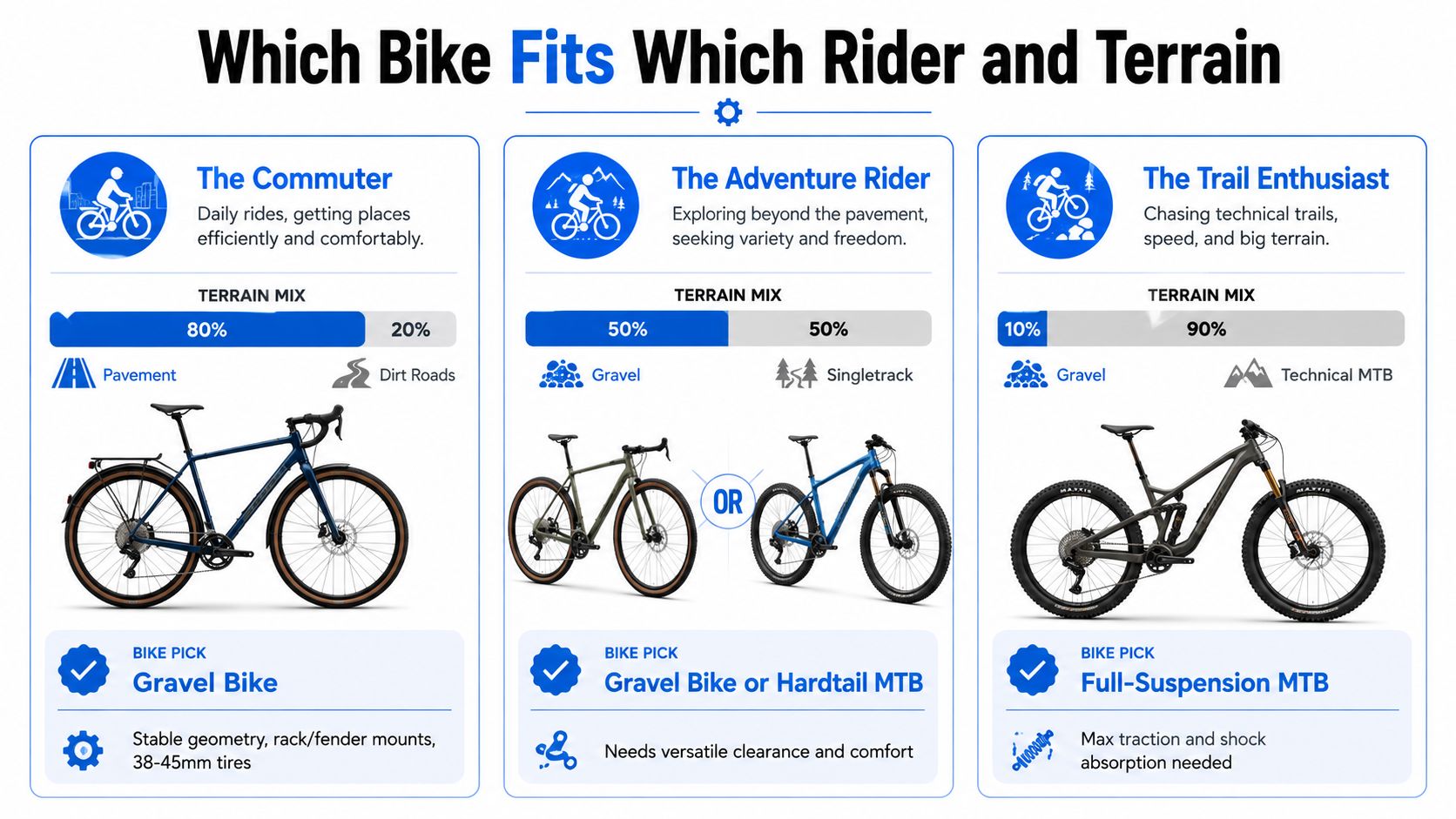
A commuter, a road rider exploring dirt, and a dedicated trail rider may all say they need one bike for mixed riding. Their best answers are not the same.
The pavement-heavy commuter
If most rides are paved, but your route includes rough streets, hard-packed paths, or regular dirt roads, a gravel bike is usually the stronger starting point. It keeps the focus on mixed-surface efficiency and day-to-day practicality while allowing a more durable tire setup than a typical road bike.
This rider should look carefully at riding position and utility details. Mounts for fenders, racks, bottles, and bags may matter more than an extra tier of drivetrain. If a drop-bar position feels too committed for the rider's body or daily use, a flat-bar gravel bike may be a better solution than jumping straight to mountain-bike geometry.
The common mistake is buying for occasional rough sections while making the everyday ride slower, heavier, or harder to live with than it needs to be.
The road rider who keeps turning onto dirt
A road-oriented rider who increasingly rides dirt roads, doubletrack, and smoother forest routes will usually be better served by a gravel bike. The drop-bar format preserves hand-position variety for longer rides, and the extra tire clearance opens meaningful room to tune grip, speed, and comfort for mixed surfaces.
The important step is not simply choosing the most aggressive or most relaxed-looking gravel frame. It is comparing the actual geometry and cockpit with the rider's current bike and intended terrain. A frame can appear versatile on paper yet still create too much reach, the wrong bar position, or a tire and wheel setup that does not match the surfaces being ridden.
The wrong purchase here is often a mountain bike bought for occasional trail ambitions when the bulk of riding still happens on pavement and smoother dirt.
The dedicated singletrack rider
If your priority is technical singletrack, a mountain bike is the more appropriate choice. In many cases that means starting with a hardtail if budget, simplicity, and moderate trail demands line up, then considering full suspension when the terrain regularly includes rough descents, repeated impacts, embedded rocks, roots, and traction-intensive climbing.
A gravel bike can reach the trailhead and handle smooth paths well, but it is not the right tool once technical trail control becomes the main job. At that point, suspension setup, brake power, wheel strength, tire casing, cockpit control, and the bike's intended use matter more than low weight or road efficiency.
For used buyers, a simpler but healthy mountain bike is often a better purchase than a more exotic bike with unclear suspension history or expensive compatibility issues. Focus on fit, frame condition, suspension health, wheel integrity, brake condition, and whether the bike's design matches the trails you actually ride.
For a more route-specific decision, use this guide to choosing the best gravel bike type for your terrain. The key question is still simple: which surfaces dominate your riding, and which wrong-bike compromise would you notice most?
The Overlap Zone Where the Lines Blur
This is where the decision gets interesting. Some modern gravel bikes now clear much larger tires than earlier generations and borrow ideas from XC bikes, especially for rough gravel events and backcountry riding. At the same time, some efficient hardtails and short-travel mountain bikes can cover gravel roads and long mixed-surface routes better than many riders expect.
Current manufacturer examples show how broad the overlap has become. The Trek Checkpoint SL Gen 3 is built around larger tire clearance and rougher-terrain capability within a gravel format (Trek Checkpoint product page). The Lauf Seigla is another example of a gravel bike designed around wide tire clearance and rough-surface intent (Lauf Seigla product page). On the mountain-bike side, efficient XC hardtails such as the Specialized Chisel remain purpose-built MTBs even when set up for fast rolling terrain (Specialized Chisel product page).
The lesson is not that the categories have merged. It is that spec sheets matter more than stereotypes.
A wide-clearance gravel bike can make excellent sense for riders who spend most of their time on gravel and dirt roads, occasionally venture onto smoother singletrack, and still want drop-bar hand positions and all-day mixed-surface range. A hardtail makes more sense when trail control is becoming a regular priority, even if some rides still include pavement and gravel connectors. A full-suspension bike makes more sense when the terrain regularly asks the rear wheel to absorb repeated hits and maintain traction under load.
Wide tire clearance alone does not make a gravel bike a mountain bike. The differences remain in geometry, suspension design, cockpit control, brake setup, wheel intent, and the way the bike is meant to be ridden.
Read the specification sheet instead of the label
In the overlap zone, compare the details that actually shape the ride:
Geometry: Look at the complete geometry chart, not one number. Consider how the frame is intended to position the rider and behave on your terrain.
Suspension: Compare rigid, limited-travel, hardtail, and full-suspension setups according to the impacts and control demands you face.
Cockpit: Drop bars and flat bars support different hand positions, steering inputs, and body movement. Stem length, bar shape, and control layout matter.
Tire system: Check manufacturer clearance, actual wheel and rim specs, tread choice, casing support, and pressure range together.
Wheels and brakes: Rougher terrain usually places greater demands on wheel strength, rotor size, caliper power, and heat management.
Intended use: Ask what the bike was built to do most of the time, not what it can survive occasionally.
Practical filter: If your riding is mostly roads and smoother unpaved surfaces with occasional trail detours, a gravel bike may still be the cleaner answer. If trail handling and repeated impacts are becoming central to the ride, move toward a hardtail or full-suspension MTB.
How to Shortlist the Right Gravel Bike With SYCLR
If gravel fits your terrain, SYCLR can help you compare gravel listings with more structure and less guesswork. Start with the ride you actually do, not the category you want to want.
Set the dominant terrain. Clarify whether most rides are paved, mixed-surface, rough gravel, or light trail. That determines how much tire clearance, carrying capacity, and rough-surface capability you actually need.
Record your fit context. Height is only a starting point. Add inseam and, where useful, your current-bike reference or fit-report details. Then compare frame geometry and cockpit context rather than trusting the size label alone.
Check model-year details. Tire clearance, axle standards, brake mounts, drivetrain compatibility, internal routing, and tubeless support can change between model years.
Review listing quality carefully. Use photos and descriptions to identify what is shown, what is missing, and what needs clarification. Do not assume listing materials verify safety or condition.
Compare total cost, not just price. Account for likely service, worn consumables, tire changes, fit adjustments, and any parts needed to make the bike suit your riding.
SYCLR focuses on road and gravel listings, not mountain-bike discovery. If gravel is the right category for your terrain, start comparing listings in the app using fit signals, geometry signals, model-year context, price context, listing quality, condition signals where available, and confidence signals. If you already know your current-bike geometry or fit-report details, the advanced fit entry is a better starting point than height alone.
If a mountain bike fits your riding better, use the same terrain, fit, geometry, condition, and compatibility framework when evaluating MTB options elsewhere.
Quick check: If you cannot explain why the frame suits your position, why the tire and wheel setup suit your terrain, and what condition risks remain, you are not ready to buy that listing.
Decision Recap and Frequently Asked Questions
Choose a gravel bike when your riding is centered on pavement, dirt roads, smoother gravel, and longer mixed-surface distance. Choose a hardtail mountain bike when technical singletrack and rougher trail control become regular priorities. Move toward full suspension when the terrain repeatedly demands rear-wheel impact management and traction.
Neither category is automatically better. The best choice is the bike whose geometry, cockpit, tire system, suspension setup, and overall condition match your body and your riding.
What tire clearance do I actually need for my riding?
Start with your real surfaces, not a universal number. Consider the terrain, expected mud or debris, tread pattern, casing support, pressure range, rim width, and the exact maximum clearance published by the frame and fork manufacturer. If you plan to change wheels or tires later, confirm compatibility before buying the bike.
Should geometry matter more than the gravel or mountain-bike label?
Once the broad use case is established, exact geometry becomes more useful than the category label alone. The category tells you the bike's general intent, while the geometry helps explain how that individual bike fits and handles. Two bikes in the same category can place the rider very differently and respond very differently on the trail or road.
Does a short-travel fork turn a gravel bike into a mountain bike?
No. It can expand the bike's comfort and capability on rougher surfaces, but it does not change the rest of the system. Geometry, cockpit, wheel strength, brake setup, tire support, and intended use still determine whether the bike is better understood as a gravel bike or a mountain bike.
Should I prioritize components or the frame?
Prioritize a sound frame and a riding position that suits you, then evaluate the parts around it. Components can be upgraded, but the wrong frame, poor compatibility, or neglected suspension can turn a seemingly good deal into an expensive mistake.
How can I compare noisy cross-category listings?
Start with terrain and fit, then compare geometry, tire and wheel compatibility, braking setup, suspension if relevant, model-year details, condition evidence, and total cost. If gravel is the better fit, use SYCLR to compare listings. If mountain bikes are the better answer, apply the same evaluation framework when shopping MTB options elsewhere.
If your riding points toward gravel, open SYCLR to compare available gravel listings using fit signals, geometry signals, model-year context, price context, listing quality, condition signals where available, and confidence signals. If mountain biking better matches your terrain, apply the same fit, geometry, condition, and compatibility framework when shopping MTB options elsewhere.