
How to Tell What Year a Bike Is: A Real Guide
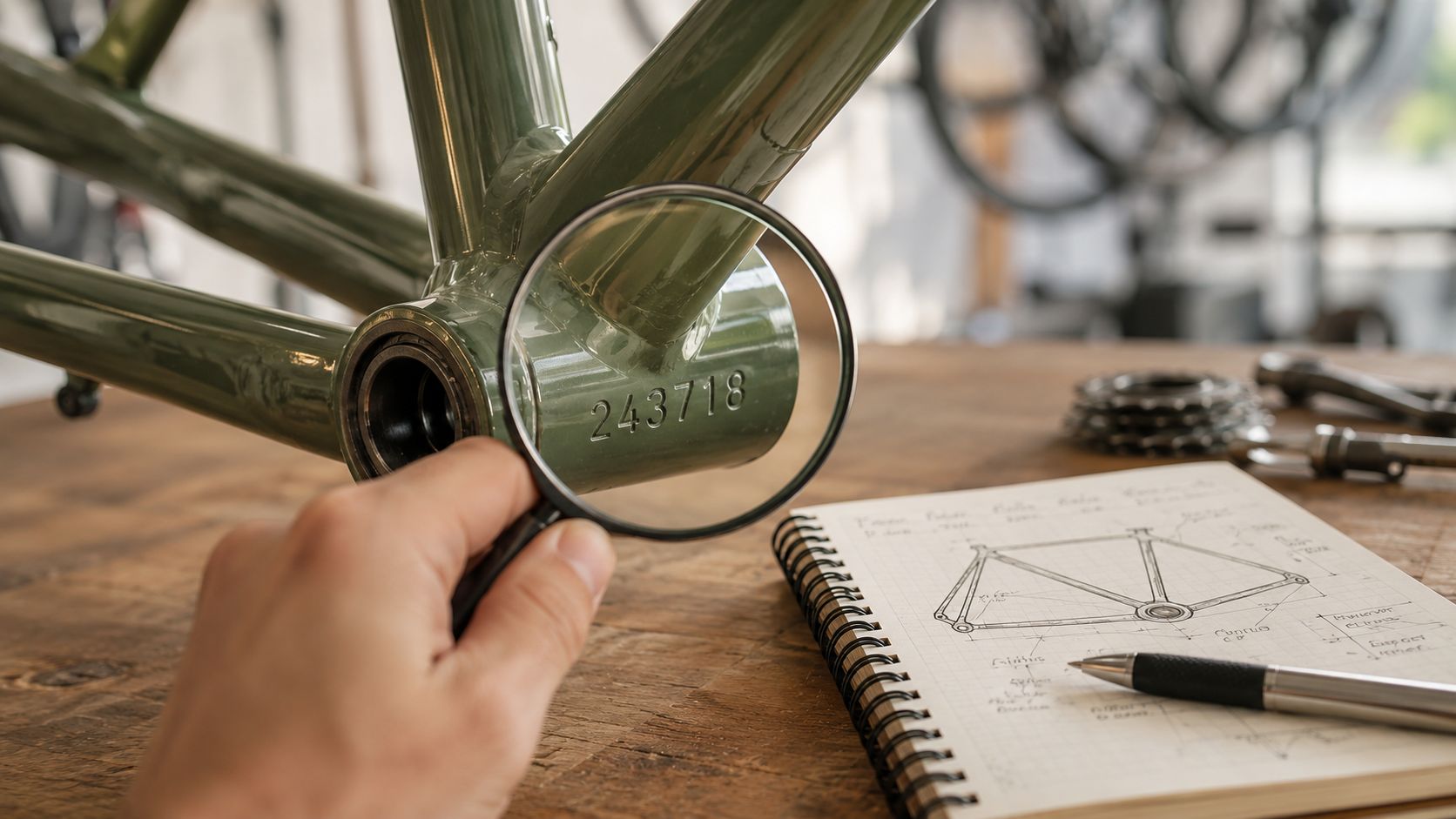
You're looking at a used road bike with a clean frame, a plausible price, and a seller who says it's a "2022 model." The drivetrain looks newer than the paint, the serial number does not resemble anything you can decode online, and the receipt only shows when the current owner bought it. How do you tell what year a bike is without treating weak evidence like proof?
The reliable answer is to build a case. Start with the complete frame serial, identify the manufacturer and likely era, compare the frame against manufacturer archives and catalogs, then use frame features, component dates, registries, and photos as supporting evidence. A serial number may narrow the production period, but it often will not establish the marketed model year by itself. That distinction matters when you are comparing price context, listing quality, and confidence on the used market.
Table of Contents
- Why a Serial Number Alone Will Not Tell You the Year
- Recording the Serial and Reading It Brand-First
- Reading the Frame Itself for Model-Year Clues
- Cross-Checking Manufacturer Archives, Catalogs, and Geometry Sheets
- Using Component Date Codes Without Overclaiming
- Registries, Community Archives, and Model-Year Context
- How to Tell What Year a Bike Is FAQs
- Can a bike serial number tell me the exact year?
- What is the difference between production date and model year?
- Does the purchase receipt prove the bike's year?
- Can frame details narrow the year if the serial is unclear?
- Do Shimano component date codes tell me the bike's year?
- Can a bike registry verify the model year?
- Your Identification Checklist and Next Step
Why a Serial Number Alone Will Not Tell You the Year
A bicycle serial number is not a vehicle VIN. Bicycle serial formats are not standardized, and there is no universal bicycle serial-number decoder. A stamped sequence may refer to a production batch, factory, date, or internal frame record, but it may also offer little useful model-year information without the correct manufacturer context. Bike Index's serial-number guidance makes the same practical point: most bicycles have a serial number, commonly beneath the bottom bracket, but placement and format vary.
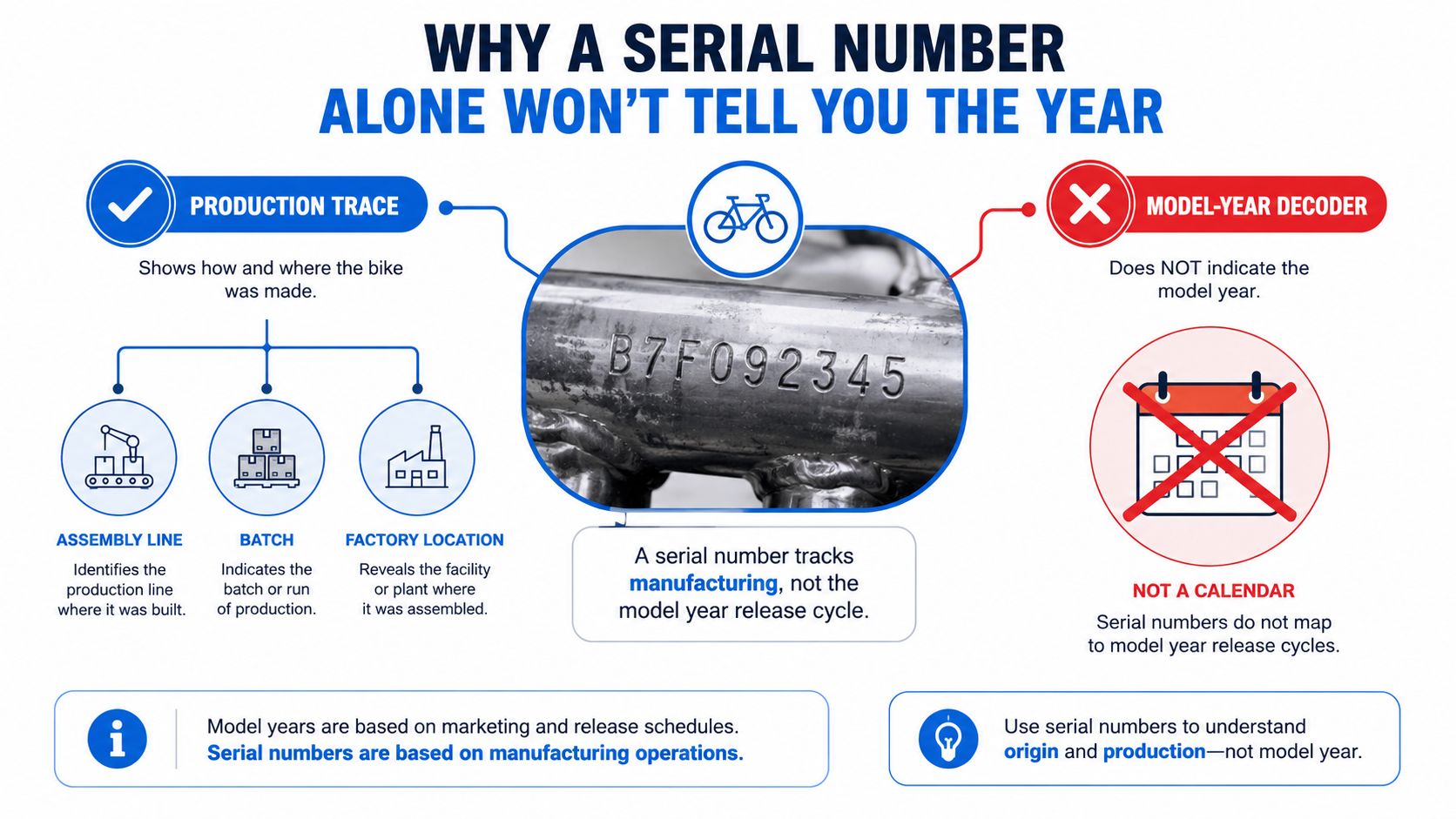
That creates four separate dates that buyers often collapse into one:
Manufacturing date, when the frame was produced.
Model year, the model designation used in the manufacturer's catalog.
Purchase year, when a shop or rider bought it.
Component production date, when a derailleur, crank, hub, brake, or wheel was made.
Those dates can disagree without anyone being dishonest. A frame produced late in one calendar year may be marketed as the next model year. A bike may be sold later from leftover stock. It may also have replacement parts, an updated groupset, or a mixed build assembled after the frame was made. Purchase year tells you something about ownership history. It does not automatically identify the frame generation or catalog year.
Why manufacturer and era come first
Before applying any serial format, identify the manufacturer and likely era. The same-looking string can mean different things across brands, factories, and production periods. Without that context, a generic serial search is usually just pattern-matching.
That is why the right question is not, "What year does this number decode to?" It is, "What brand made this frame, what era does it appear to belong to, and is there any manufacturer documentation that explains how this serial format worked at that time?"
Practical rule: A serial number is evidence. It is not a verdict.
If a seller points to one number and says it proves the year, ask what manufacturer documentation supports that reading. A careful identification usually gives a likely year or range, explains the evidence, and flags conflicts instead of pretending to know more than the facts support.
Recording the Serial and Reading It Brand-First
Treat the serial as evidence, not the answer. First make the marking readable. Dirt, worn stamping, bad lighting, and missing characters can send the whole search in the wrong direction, especially when letters resemble digits.
Clean the area gently, use indirect light, and photograph the marking from several angles. Take one close image and another that shows where it sits on the frame. Record the string exactly as stamped, including leading zeroes, spaces, hyphens, and any ambiguous characters such as 1, I, 5, or S. Do not "correct" unclear characters from memory.
Common serial locations include the bottom bracket shell, head tube, dropout, chainstay, and other manufacturer-specific locations. Bike Index's serial database guidance is useful here because it shows how much serial placement can vary, and why location alone does not identify a year.
Identify the manufacturer before interpreting the characters. Check the down-tube logo, head badge, fork crown, decal style, tubing marks, and any model-family graphics. Then look for manufacturer serial guidance, archived support pages, official catalogs, or period documentation that matches that brand and era.
Keep one case note with:
The exact serial.
The manufacturer and suspected model family.
The serial's location on the frame.
Photos of the full bike and key frame details.
Any suspected production era, clearly marked as unverified.
At this stage, a registry lookup can add supporting context. A complete serial may return an existing registration, similar serials, or theft-status information. Bike Index explicitly does not identify a bike or model year from the serial number alone, so any registered make, model, or year should still be checked against manufacturer documentation.
Reading the Frame Itself for Model-Year Clues
When the serial does not resolve cleanly, the frame becomes your primary physical record. Frame-level features can help narrow a generation, but they do not prove an exact year. Manufacturer documentation remains primary.
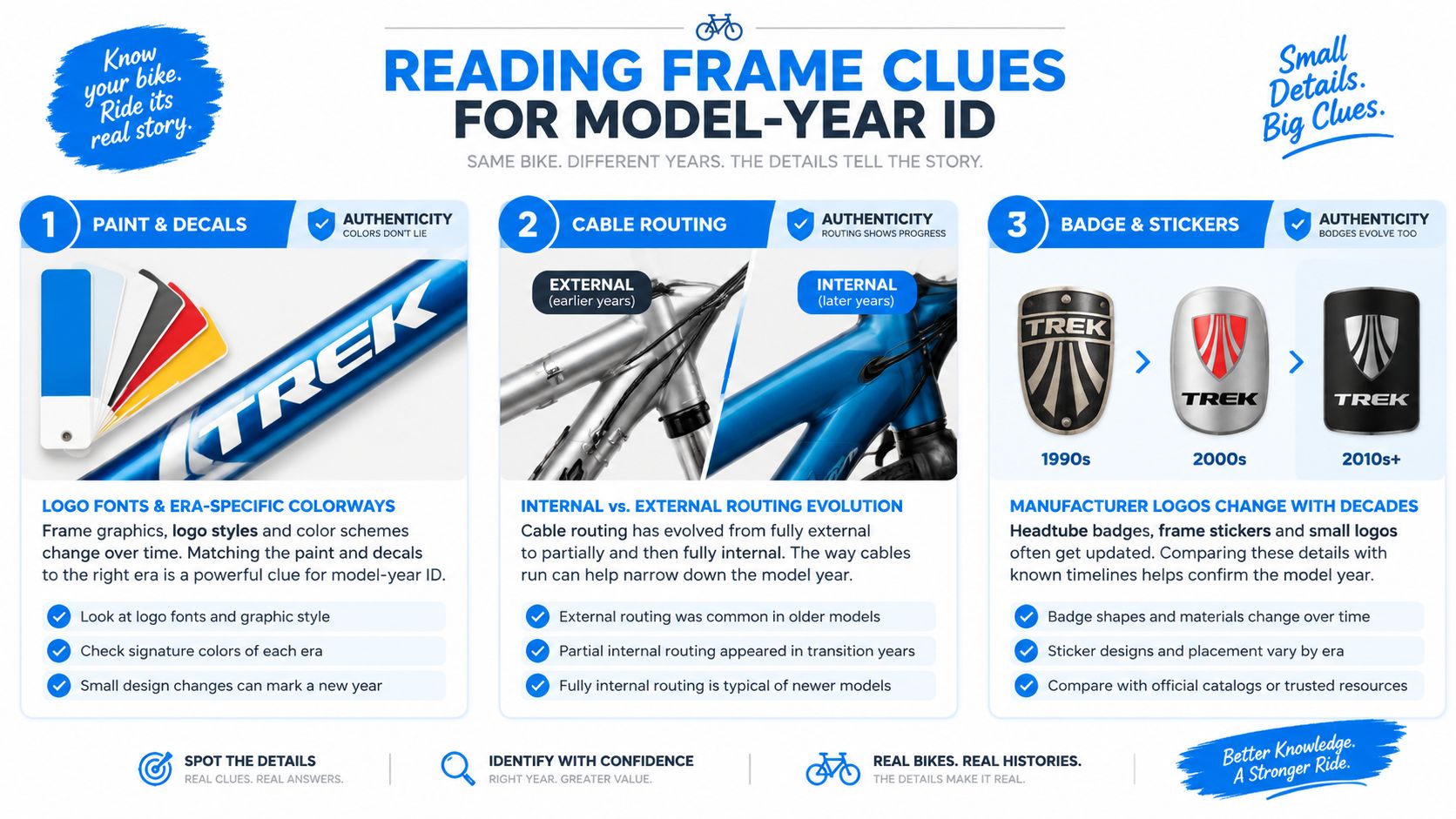
Start with frame and fork features that usually require more substantial changes than swapping drivetrain components. Brake and axle standards, cable routing, fork and dropout design, bottom-bracket and head-tube design, and paint or decals can all help you separate one generation from another. None of those clues should be treated as definitive on its own.
Rank clues by how stable they are
Brake and axle standards are often useful because they reflect frame and fork design choices. Their value comes from matching them to the model's documented history, not from assigning a year to the standard itself. They still do not prove an exact year by themselves.
Cable routing can help when you compare it against catalog photography and archived product pages. External routing, port shapes, and internal entry points may line up with a frame revision. But routing alone should stay in the supporting column, especially on bikes that have been rebuilt.
Fork and dropout design deserve close photographs. Fork blade shape, crown details, dropout profile, axle interface, and small mounting features can all help distinguish one frame family from another.
Bottom-bracket and head-tube design add more context. Threaded versus press-fit bottom brackets, straight versus tapered head tubes, and similar structural details can help narrow the field when you compare them with official documentation.
Paint and decals are useful, but fragile. Logo font, model lettering, badge placement, color blocks, and graphic transitions can support a match, but repainting, decal replacement, regional variants, and poor seller photos all reduce confidence.
Take dedicated photos of the head tube, bottom bracket shell, both dropouts, fork crown, cable stops or ports, brake mounts, and any tubing stamps. Those details make catalog matching much easier and keep the frame, not the current parts kit, at the center of the identification.
Frame-level features are often more stable clues than replaceable components, but repainting, repairs, replacement forks, and other changes can still complicate identification.
Cross-Checking Manufacturer Archives, Catalogs, and Geometry Sheets
Once you have the serial and frame details recorded, move to manufacturer documentation. Prioritize manufacturer archives, official catalogs, archived product pages, geometry or specification sheets, and manufacturer serial guidance. Community archives are supporting evidence only.
Compare the frame carefully. Paint color, decal placement, tubing marks, fork shape, cable routing, brake mounts, axle interfaces, and factory build descriptions can eliminate a surprising number of near matches. Do not stop when one image looks close. Adjacent model years and regional builds can look very similar.
Build a shortlist, not a single answer
Create a comparison record with candidate years or year ranges. For each candidate, mark whether the evidence matches, conflicts, or remains unknown.
| Evidence | Candidate A | Candidate B | Confidence effect |
|---|---|---|---|
| Paint and decals | Matches | Partial match | Useful, but vulnerable to repainting |
| Fork design | Matches | Conflicts | Helpful frame-level clue |
| Cable routing | Matches | Unknown | Useful if official photos are clear |
| Brake and axle standards | Matches | Conflicts | Can narrow a generation |
| Geometry or spec sheet | Partial match | Matches | Important supporting documentation |
| Original component specification | Matches | Partial match | Supporting evidence only |
Geometry sheets can help distinguish otherwise similar model generations once you have already narrowed the model family. Compare the correct frame size and use the manufacturer's own chart as the reference. For deeper explanations of geometry terminology, use SYCLR's bike geometry chart rather than turning this identification guide into a geometry tutorial.
A typical hard case is a frame whose paint appears in two adjacent catalogs while the bike now carries newer parts. If one archived product page and one geometry sheet match the frame details better than the other candidates, you may have enough to report a likely year. If the documentation stays split, report a range. That is stronger than claiming a precise year the evidence does not support.
Using Component Date Codes Without Overclaiming
Components can support a bike's timeline, but they cannot replace frame research. Parts wear out, get upgraded, sit in shop inventory, or move from one bike to another. A component date identifies the component, not the frame or the marketed model year.
Shimano is a useful example because it has used two-letter production date codes on many components beginning in 1976, with the alphabet cycling after 2001. Not every Shimano component or production era uses the same visible marking scheme, so confirm that the code system applies to the specific component before decoding it.
Read the result narrowly: if the marking is correctly identified and decoded, it supports a production period for that component. Then compare that date with the frame, the catalog specification, and any other dated components.
What component dates can and cannot tell you
Inspect components that carry identifiable model numbers, production markings, or documented date codes. Common candidates may include derailleurs, shifters, cranks, hubs, brakes, and other marked components, depending on the manufacturer and era.
Mixed or newer components are common on used bikes. A newer derailleur may reflect normal replacement, an upgrade, a warranty repair, or a later rebuild. Older parts on a newer frame can reflect leftover stock, a regional build, or a parts-bin assembly. Do not infer deception from component mismatch alone.
| Component evidence | What it can suggest | What it cannot prove |
|---|---|---|
| Several codes from a similar period | A plausible assembly window | Exact frame year |
| One newer derailleur | Replacement, upgrade, or later rebuild | That the seller is being deceptive |
| Older crank and newer shifters | Mixed or revised build | Original factory specification |
| Components matching a catalog | Support for a candidate year | Ownership, authenticity, or a guaranteed model year |
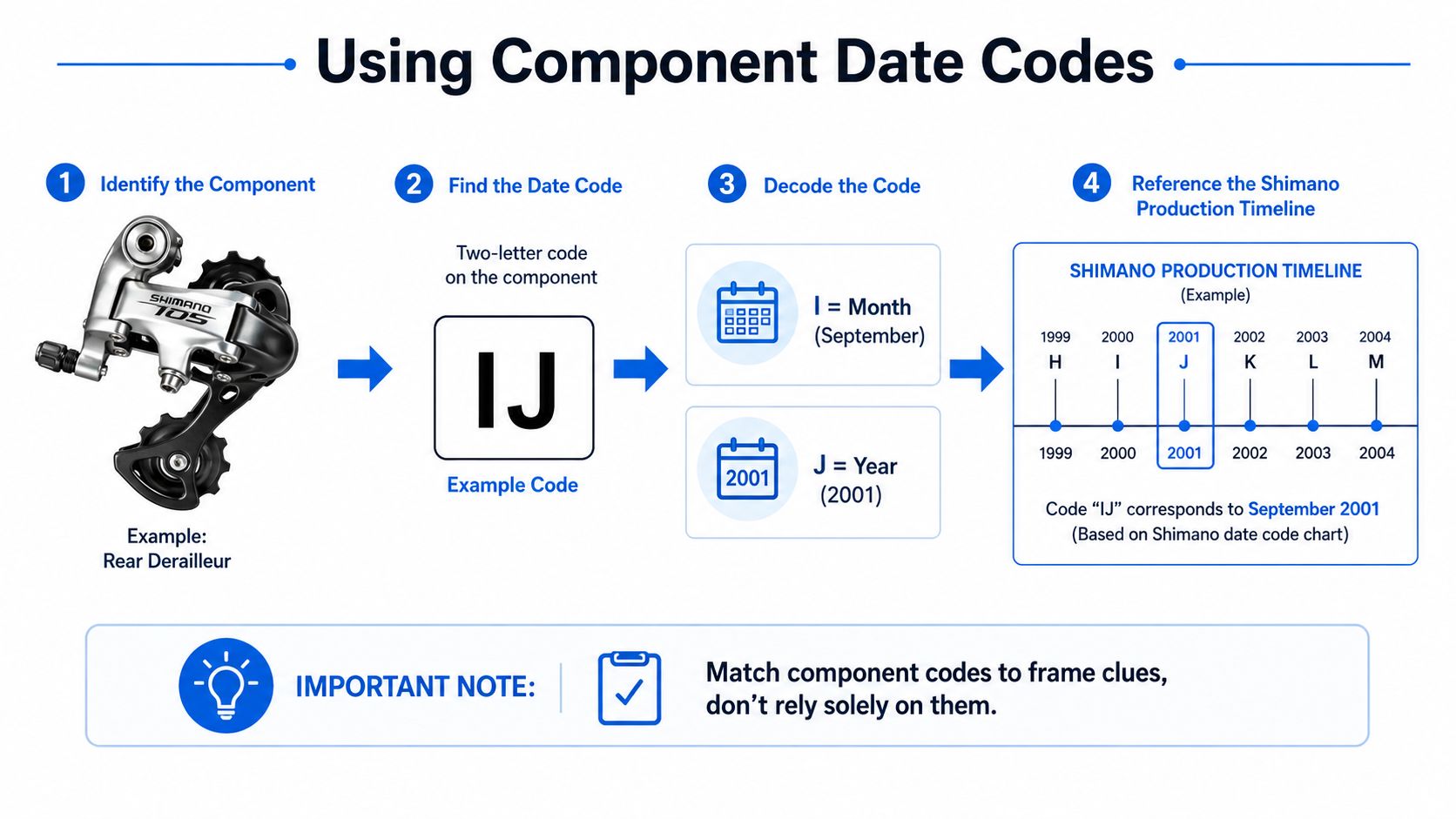
If several component dates cluster around the same period and the frame details align with the same catalog window, confidence increases. If they do not, record the conflict and keep the conclusion modest. Component dates are supporting evidence, not a substitute for manufacturer documentation.
Registries, Community Archives, and Model-Year Context
Registries, archives, and historical listings do different jobs. Bike registries do not authenticate model year. They are useful for registration context, serial matches, and theft-status context. User-entered model or year information must be verified independently.
Community archives can still help, especially when official documentation is incomplete. Owner photos, historical listings, and enthusiast galleries are useful for comparing decal placement, regional colors, trim variations, and details that may not be obvious in one catalog image. But they remain supporting evidence, not primary proof.
What each source is actually good for
| Source | Confirms year | Useful for |
|---|---|---|
| Manufacturer archive or catalog | Sometimes, when frame details and specification match | Model identity, colors, geometry, original build |
| Manufacturer serial guidance | Sometimes, for supported brands and eras | Interpreting a serial in the right context |
| Archived product page or spec sheet | Sometimes | Model-family comparison and generation clues |
| Bicycle registry | No automatic model-year verification | Registration context, serial matches, theft-status context |
| Community archive | Rarely by itself | Comparing photos, decals, colors, and regional variations |
| Seller receipt | No | Purchase history, not necessarily model year |
The real value comes from synthesis. A likely year or range becomes more credible when the serial context, frame features, official documentation, and component period all point the same way. When the evidence conflicts, that conflict matters. Possible explanations include a repaint, replacement fork, mixed build, regional variation, or simply incomplete evidence.
SYCLR uses fit signals, geometry signals, model-year context, price context, listing quality, condition signals where available, and confidence signals when comparing road and gravel listings. It does not authenticate bikes, verify ownership, or guarantee a seller-stated model year.
How to Tell What Year a Bike Is FAQs
Can a bike serial number tell me the exact year?
Sometimes a manufacturer-specific serial format can help narrow production timing, but a serial number often cannot establish the marketed model year by itself. There is no universal bicycle serial-number decoder.
What is the difference between production date and model year?
Production date refers to when the frame or component was made. Model year refers to the model designation used by the manufacturer. Purchase year is when the bike was actually sold to a shop or rider. Those dates can legitimately differ.
Does the purchase receipt prove the bike's year?
No. A receipt usually confirms when someone bought the bike, not when the frame was produced or what model year the manufacturer assigned to it. It is useful ownership-history context, but not a final identification source.
Can frame details narrow the year if the serial is unclear?
They can. Frame and fork details may help narrow the likely generation or model-year range when they are compared with manufacturer documentation. Brake and axle standards, cable routing, fork and dropout design, bottom-bracket and head-tube design, and paint or decals can all help. But none of those clues should be treated as conclusive without manufacturer documentation.
Do Shimano component date codes tell me the bike's year?
A documented Shimano production code may help estimate when that specific component was made. It does not establish the frame's production date or the bicycle's marketed model year.
Can a bike registry verify the model year?
Not by itself. A registry can be useful for registration context, serial matches, and theft-status context, but user-entered year or model information must be checked against the frame and manufacturer documentation.
Your Identification Checklist and Next Step
Use this checklist before you trust a listing year or repeat one in your own listing. It turns a guess into a documented case.
Photograph and transcribe the serial: Record every character exactly, along with its location on the frame.
Identify the manufacturer and likely era first: Do not apply any serial pattern until the brand and period make sense.
Capture frame-level evidence: Photograph brake mounts, axle interfaces, cable routing, fork and dropout details, bottom-bracket and head-tube design, paint, decals, and any tubing marks.
Check manufacturer documentation first: Prioritize archives, official catalogs, archived product pages, geometry or spec sheets, and manufacturer serial guidance.
Use component dates carefully: Read them as component evidence, not proof of frame year or marketed model year.
Use registries for context: Check serial matches, registration context, and theft-status context, but verify any stated model or year independently.
Write the honest conclusion: State whether the evidence supports a likely model year, a likely production period, a year range, or only a broader era.
Separate what you know from what you suspect. If the serial context, frame details, official documents, and component dates all align, you may have a strong case for a likely model year. If they conflict, report a range and explain why. That is better than false precision.
For condition review, use the used-bike inspection checklist separately. This page owns a narrower question: using serial context, frame evidence, manufacturer documentation, component dates, and registry information to estimate a likely model year or range.
Model year is one piece of a used-bike decision, not proof of authenticity, ownership, condition, or value.
Use SYCLR to compare road and gravel listings using fit signals, geometry signals, model-year context, price context, listing quality, condition signals where available, and confidence signals. When a listing's stated year matters to your decision, independently verify the serial, frame details, manufacturer documentation, and specification before purchasing.