
How to Check a Used Bike Serial Number Before You Buy
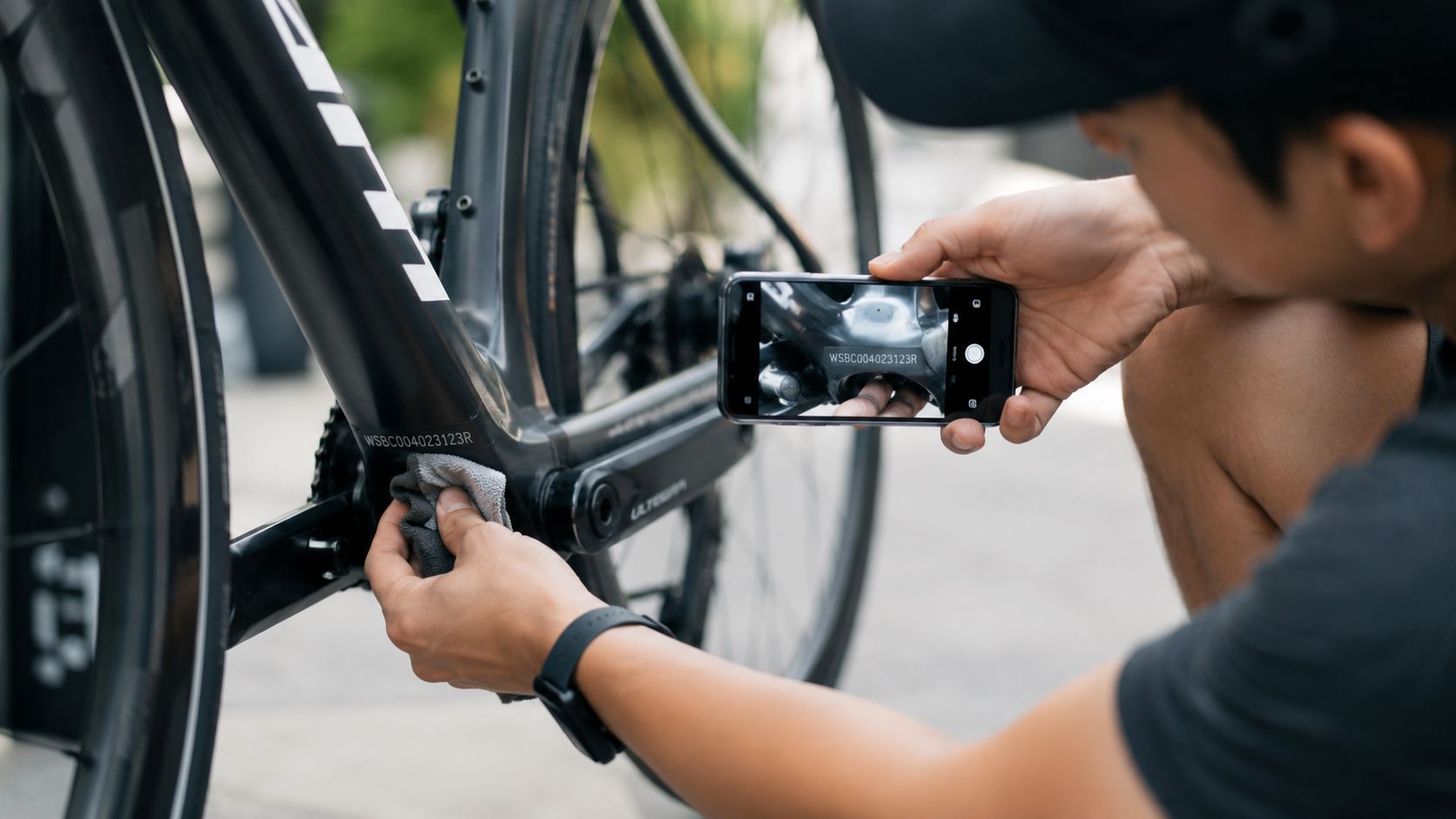
A bike serial number can help you screen a used bike, but it is not a universal decoder and it is not an authentication result. The sound approach is an evidence chain: locate the marking, record it exactly, check manufacturer context, search relevant registries, compare any returned information with the actual bike, and inspect the serial area for inconsistencies. Keep material conflicts unresolved until they can be explained or independently verified. A clean result can reduce some uncertainty. It cannot prove ownership, authenticity, or that the bike has never been stolen.
For many road, gravel, and mountain bikes, the serial is often found under the bottom bracket, but that location is common, not universal. Serial locations vary by manufacturer and production era, and some older, handmade, or unusual bikes may lack a conventional serial. Absence alone does not prove theft or tampering. What matters is reading the frame carefully, using brand-specific context where available, and documenting what you actually find.
Here is how to check a used bike serial number before you buy.
Table of Contents
- Why a Serial Number Is Not a Magic Decoder
- Where to Find and How to Record the Serial
- Cross-Checking Serials Across Manufacturer and Registry Sources
- Reading Returned Make, Model, and Year Claims Carefully
- Red Flags Around the Serial Area
- What to Do When Evidence Conflicts
- How SYCLR Helps and Your Next Move
- Used Bike Serial Number FAQs
- Where is the serial number on a used bike?
- What if the bike has no visible serial number?
- Should I record the serial exactly as shown?
- What photos should I take of the serial?
- If Bike Index returns no match, is the bike clean?
- Can Bike Index tell me the exact make, model, and year from the serial?
- Are multiple number groups on a bike a bad sign?
- Do receipts or warranty cards prove the bike is legitimate?
- What should I do if a registry shows a possible stolen match?
- What if the serial and the bike details do not line up?
Why a Serial Number Is Not a Magic Decoder
There is no universal bicycle serial-number decoder. Formats vary by manufacturer and production era, and a number that looks informative on one brand may mean very little without that brand’s documentation. Some manufacturers offer serial tools, warranty records, frame databases, or archived catalogs. Others provide limited support, especially for older, discontinued, private-label, or small-batch frames.
A serial number answers a narrower question than many buyers assume. It can help connect a frame with manufacturer records, registry entries, or seller documents where matching information exists. It does not automatically decode the exact model, establish the precise model year, verify ownership, or authenticate the frame.
Practical rule: Treat every serial lookup as evidence, not a verdict.
Bike Index is useful for registration context, matching or similar serial context, and theft-status context. It does not identify the exact bike or model from the serial alone, guarantee model year, verify ownership, authenticate the frame, or prove that a no-match bike is clean. A blank result means only that the searched system did not return a relevant record.
The number itself can also be misread, entered incorrectly, obscured by dirt or finish wear, or recorded in more than one way. That is why the process starts with careful location, exact recording, and comparison against the bike in front of you.
Where to Find and How to Record the Serial
Start with the underside of the bottom bracket, the frame area where the crank arms meet. This is a common location on many road, gravel, and mountain bikes, according to Bike Index’s serial-number guidance and Bike Sonoma’s frame-number resource. It is not universal. Serial locations vary by manufacturer and era, so if you do not find it there, continue with a structured search.
Check these areas next:
-
Head tube: Common on some frames and often easier to inspect than the bottom-bracket area.
-
Rear dropout and stays: Check both sides, including inner faces and undersides.
-
Seat tube: Look around the lower section and near the bottom-bracket junction.
-
Top tube or down tube: Some manufacturers place markings on the underside or near a frame junction.
-
Other manufacturer-specific frame locations: Check brand guidance or period references before assuming a marking is missing.
Some older, handmade, or unusual bikes may not have a conventional serial in the places you expect. If a bike appears to lack one, compare the frame and marking locations against manufacturer documentation or period references before drawing conclusions.
Use the manufacturer’s terminology where possible. A frame number may appear as a continuous string, or it may include a prefix such as SN, a production code, or another manufacturer-specific sequence.
Record the raw serial exactly as shown. Preserve letters, numbers, dashes, spaces, and visible punctuation. Then, if a registry or police database requires a different input format, create a second search version that follows that system’s rules. For example, the Canadian Police Information Centre bicycle search instructs users to enter letters and numbers without spaces or special characters. Follow each database’s formatting requirements rather than improvising.
Take a straight-on close-up of the complete serial, then a wider contextual photo showing where it sits on the frame. If the marking is faint, add an angled photo under neutral light. These images help you compare characters later and document what was present at inspection time. They do not authenticate the bike.
Do not scrape, grind, polish, chemically clean, or invent unreadable characters. If part of the sequence cannot be read confidently, record it as unresolved.
Keep the original serial photos and listing information available while you compare search results and seller details.
Cross-Checking Serials Across Manufacturer and Registry Sources
Use different sources for different questions. Manufacturer records can help with frame identity and production context. Registries can help with registration and theft-status context. Police or government databases can show reports that do not appear in public cycling registries.
Start with the manufacturer. Search the brand’s official serial guidance, support pages, archived catalogs, warranty lookup, or frame-record system where available. The exact result depends on the brand and production era. Sometimes you will get useful frame-family or period context. Sometimes you will get very little.
For registry context, Bike Index’s registration search allows serial searches and can surface matching or similar registration records. Jurisdiction-specific systems can also matter because registry coverage varies by country, police reporting process, and platform. BikeRegister’s bike checker is one example of an established registry in its market, and official police or government tools such as the Canadian Police Information Centre bicycle search may provide additional context.
| Source | What it cannot establish alone |
|---|---|
| Manufacturer support/tool | Current ownership, authenticity, or complete history |
| Bicycle registry | Current ownership, authenticity, or absence from other systems |
| Police/property register | Complete ownership history, authenticity, or mechanical condition |
| Manufacturer archives | That the specific bike is definitely the claimed model/year |
Do not confuse a model lookup with a theft lookup. One asks what the frame may be. The other asks whether a registry or authority associates that serial with a report or registration. Both are useful, but neither replaces direct comparison with the actual frame.
If the bike's identity is still unclear after serial work, use how to identify bike model from photos as a separate process. Keep photo-based identification separate from the serial check.
If a registry or police database returns a possible stolen match, pause the transaction and verify through the registry, platform, or appropriate authority. Seller paperwork may add context, but it does not automatically resolve a theft record.
Keep the relevant search results and notes available while you compare the evidence.
Reading Returned Make, Model, and Year Claims Carefully
A returned make, model, or year should be treated as information to verify against the physical bike and manufacturer documentation. Compare the result with the bike in front of you, including tubing shape, welds, dropout style, bottom-bracket shell, cable routing, brake mounts, axle standards, fork details, decals, and paint placement.
Component evidence can help, but it can also mislead. Drivetrain and brake parts are often replaced, so their model codes may identify the component without proving that it originally shipped on that frame. If a claimed year conflicts with the visible frame details, the mismatch needs explanation.
Compare the frame before the parts
Manufacturer catalogs, geometry charts, and specification sheets are useful only when they match the exact model and production period you are testing. A similarly named successor or prior version can look close enough to create identification errors. Small differences in cable routing, brake standards, dropout design, fork shape, or bottom-bracket type can matter.
A common real-world outcome is uncertainty. A seller may claim a precise model year, while the serial suggests only a broad production window and the visible frame details overlap more than one catalog listing. In that situation, the responsible conclusion may be a narrower range or an unresolved identity.
For deeper year research, use how to tell what year a bike is. Keep the tasks separate:
-
Serial interpretation asks whether you read the marking correctly.
-
Model identification asks which frame design you are looking at.
-
Model-year identification asks when that version was sold or produced.
-
Theft-status lookup asks whether a registry or authority associates the serial with a report.
-
Ownership context asks whether available records and seller documentation are consistent with the seller's account.
-
Authenticity concerns ask whether frame construction, markings, or documentation conflict with the claimed manufacturer or model.
A serial check alone does not verify ownership or authenticate a bike.
One piece of evidence may help several of these questions without settling all of them.
Red Flags Around the Serial Area
Keep serial-area concerns narrow and specific. Focus on issues such as:
-
Marking format, method, or location conflicts with manufacturer documentation for that frame and era
-
Unusual abrasion or localized surface work around the serial area
-
Interrupted or unreadable characters that prevent reliable recording
-
Seller claims about the bike's identity that conflict with registry or manufacturer information
None of these points alone proves theft, fraud, tampering, or a counterfeit frame.
Multiple number groups can be legitimate. Manufacturers may use separate frame numbers, production codes, mold codes, labels, stickers, engraving, etching, or other identifiers. Do not treat multiple number groups, labels or stickers, engraving, etching, or non-bottom-bracket serials as suspicious by themselves. Compare marking format, method, and location with manufacturer documentation for the specific frame and era.
Likewise, do not assume a marking is suspicious simply because it appears in a different method or location than you expected. The right question is whether it matches known manufacturer practice for that bike, not whether it matches a generic rule.
If broader transaction concerns exist, use used-bike red flags for the wider listing and seller assessment. Keep this serial section focused on the frame marking and the evidence directly attached to it.
What to Do When Evidence Conflicts
When the evidence does not line up, stop trying to force a clean answer. Write down each discrepancy, save the relevant screenshots and photos, and note when the information was supplied.
Ask for supporting documents such as receipts, invoices, warranty cards, service records, and other seller paperwork. These can support transaction and history context. They do not automatically prove current ownership, model year, or authenticity.
Compare every document against the frame itself. Does the serial match exactly? Does the claimed model align with the visible frame details? Does the manufacturer information fit the marking format and location? If a seller explains a repaint, replacement frame, or listing mistake, compare that explanation with the available documentation and frame evidence.
If a registry or police database indicates a possible stolen match, pause the transaction and verify the result through the relevant registry, platform, or authority before proceeding.
If the serial cannot be read confidently, if the manufacturer context does not fit, or if the returned information conflicts with the bike in front of you, the correct result may be unresolved. That is a valid conclusion.
How SYCLR Helps and Your Next Move
For a used bike with an identifiable serial, serial and registry checks can be useful parts of the pre-purchase verification process.
SYCLR helps riders compare road and gravel listings using fit signals, geometry signals, model-year context, price context, listing quality, condition signals where available, and confidence signals. It does not authenticate bikes, verify ownership, confirm theft status, inspect serials, physically inspect bikes, or guarantee seller claims.
Use it as a comparison layer after completing the serial and identity checks relevant to the listing.
The practical sequence looks like this:
-
Before inspection: Save the listing, request enough identifying information to check the serial and bike identity, and ask for any relevant documentation.
-
During inspection: Read the serial yourself, compare it with the seller's information, photograph the marking clearly, and compare the frame details with the claimed identity.
-
After serial checks: If the bike still looks promising, move to the broader condition review in the used-bike checklist.
Open SYCLR to compare road and gravel listings starting with height, bike type, and budget. If you already know stack, reach, current-bike geometry, or fit-report details, use the advanced fit details entry to narrow your shortlist before deciding which bike deserves inspection time.
Used Bike Serial Number FAQs
Where is the serial number on a used bike?
On many bikes, the serial is under the bottom bracket. That is a common location, not a rule. Depending on the manufacturer and era, it may also appear on the head tube, rear dropout, stays, seat tube, top tube, down tube, or other manufacturer-specific frame locations.
What if the bike has no visible serial number?
Do not jump straight to theft or tampering. Some older, handmade, or unusual bikes may lack a conventional serial, or the marking may be hidden, faint, painted over, or located somewhere brand-specific. Compare the frame against manufacturer documentation or period references before drawing conclusions.
Should I record the serial exactly as shown?
Yes. Keep a raw version with every visible letter, number, dash, space, and punctuation mark. If a registry or police database requires a simplified format, create a second search version that follows that system's rules.
What photos should I take of the serial?
Take a straight-on photo showing the full serial, a wider photo showing its location on the frame, and an angled photo under neutral light if the marking is hard to read. These photos document what you saw. They do not authenticate the bike.
If Bike Index returns no match, is the bike clean?
No. A no-match result means that Bike Index did not return a relevant record in that search. It does not prove ownership, authenticity, model year, or that the bike has never been stolen.
Can Bike Index tell me the exact make, model, and year from the serial?
Not from the serial alone. Bike Index is most useful for registration context, matching or similar serial context, and theft-status context. Use manufacturer documentation, frame details, and other supporting evidence for identity work.
Are multiple number groups on a bike a bad sign?
Not necessarily. Multiple number groups can be legitimate. Some frames carry a serial plus separate production or factory codes. Compare marking format, method, and location with manufacturer documentation for the specific frame and era.
Do receipts or warranty cards prove the bike is legitimate?
They can support transaction and history context, but they do not automatically prove current ownership, model year, or authenticity. Always compare the documents with the frame and serial itself.
What should I do if a registry shows a possible stolen match?
Pause the transaction and verify the result through the registry, platform, or appropriate authority. Do not assume seller paperwork settles the issue on its own.
What if the serial and the bike details do not line up?
Treat the bike as unresolved while you compare the frame, serial format and location, registry results, and available documentation. If material conflicts cannot be explained or independently verified, consider not proceeding.