
How to Tell if Bike Components Are Original
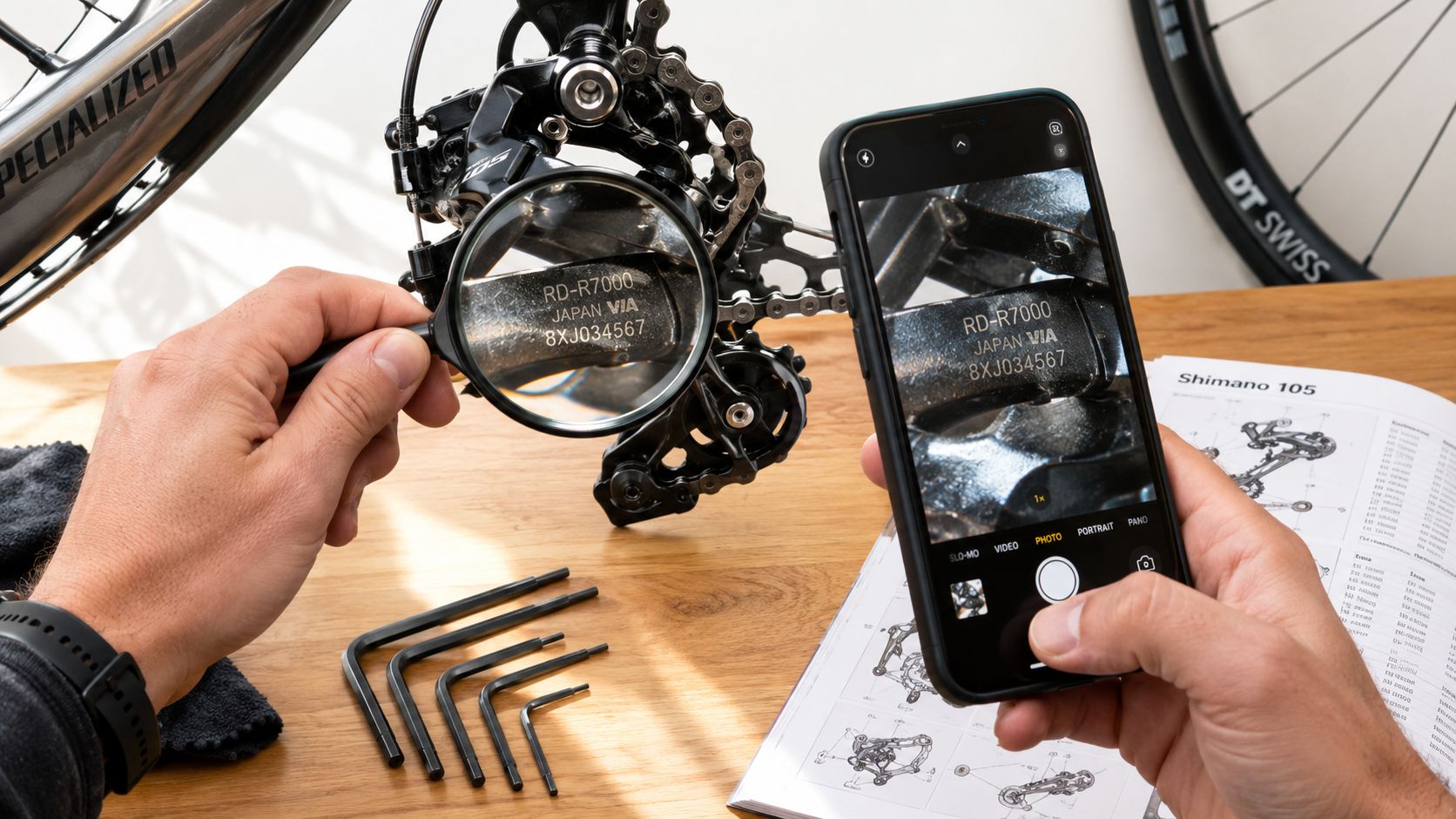
You've found a clean used road or gravel bike at an attractive price, but the listing's “original groupset” claim rests on a few carefully chosen photos. Before you judge the deal, identify the fitted parts and compare them with the manufacturer’s original specification. Check exact model codes, official specifications, date or serial markings where relevant, condition, and compatibility. Then weigh those findings against frame fit, model-year context, price context, and seller transparency. Original components can strengthen listing confidence, but they do not make the bike a good purchase if the frame does not suit your needs.
A practical distinction matters throughout this process: Original does not mean authentic, and authentic does not mean original. A component may be:
Genuine and factory-spec consistent
Genuine replacement
Genuine upgrade or downgrade
Counterfeit
Unverified
A useful rule to apply is this: A model code or authentication check can help establish what a component is. Comparing it with the manufacturer’s original specification can show whether it is factory-spec consistent. Neither alone proves that the exact component was installed on that frame when the bike left the factory.
Table of Contents
- Why Component Originality Matters for Used Bikes
- Identifying Fitted Components and Provenance Signals
- Comparing Model Codes With Factory Specification
- Visual Verification Concerns and Counterfeit Warning Signs
- Connecting Ownership Questions to Fit and Listing Confidence
- How SYCLR Helps
- Requesting Proof and Making the Final Call
Why Component Originality Matters for Used Bikes
A polished frame can hide a complicated history. You might inspect a used endurance road bike, see a clean carbon frame, and assume the complete build matches the manufacturer's original specification. The seller may describe it as a recent model with a premium groupset, while the bike combines an older drivetrain, replacement brakes, a different wheelset, and an aftermarket cockpit.
That does not automatically make the bike bad. Riders replace parts for sensible reasons. A worn cassette, damaged derailleur, crash-replaced handlebar, warranty swap, or preferred crank length can all explain a deviation from the factory build. The problem starts when a modified bike is presented as original, or when fitted parts are counterfeit, incompatible, heavily worn, or poorly documented.
The industry has dealt with counterfeit components for years. An enforcement report about FSA counterfeit sales documented fake chainsets, seatposts, handlebars, stems, and wheels being sold in Taiwan, with the issue first emerging in 2009. That does not mean every mixed-specification used bike is suspicious. It does mean that visual confidence alone is a weak test when a seller makes originality claims.
The buyer consequences
A substituted component can change more than the bike's appearance:
Value: A bike advertised with a higher-tier or newer groupset may be worth less if key parts belong to an older generation or lower specification.
Serviceability: Compatibility problems can appear when shifters, derailleurs, cassettes, brakes, wheels, and freehub standards come from different systems.
Replacement cost: A suspicious part may work today but create uncertainty when you need replacement hardware, firmware support, seals, pads, or a matching component.
Listing confidence: A seller who provides clear component history gives you more useful evidence than one who relies on brand names and flattering photos.
Practical rule: Treat originality as a condition and transparency signal, not as a trophy. An honestly modified bike can be a better purchase than a supposedly original bike with vague history.
A realistic price assessment should separate the frame identity from the parts currently attached to it. SYCLR's guide to used bicycle value is useful for that broader judgment, because a comparable bike's value becomes less certain when condition, fit, component history, and listing completeness are unclear.
Identifying Fitted Components and Provenance Signals
A used bike can look exactly like the listing description until the fitted parts reveal a different history. Your first task is not to prove originality in the abstract. It is to identify what is actually installed on the bike, document those components carefully, and compare them with the exact factory specification for the frame model, model year, and trim being advertised.
This matters because component-history questions are layered. You want to know:
Which components are fitted now.
Whether those components match the manufacturer's original build for that exact bike.
Whether any replacements or upgrades have been documented.
Whether the seller's evidence supports authenticity, provenance, and timeline consistency.
Whether any uncertainty should lower your confidence in the listing.
Date, serial, and model-code formats vary by manufacturer, generation, and component. Use the manufacturer's documentation for the exact part rather than assuming one decoding convention applies across the brand.
A practical inspection sequence
Clean only the inspection area. Use a soft cloth and mild cleaner. Avoid aggressive polishing, scraping, or removing finish around an engraved mark.
Record the marking exactly. Include letters, numbers, separators, and the marking's position on the part. Take one close photograph of the characters and another wider photograph showing their location.
Identify the component precisely. Record the brand, model family, generation if known, part type, and exact model code. “Ultegra rear derailleur” is not enough when the exact code provides the real evidence.
Inspect several major parts. Check shifters, derailleurs, brakes, crankset, wheels, and fit-relevant cockpit parts. One replaced item may be routine. A pattern across multiple parts tells you much more.
Compare the fitted parts with the claimed bike. Match the installed component set against the exact frame model, model year, and trim level being advertised.
Document replacements when disclosed. If the seller says a crank, wheelset, brake, or cockpit part was changed, record what changed and when.
Treat gaps as signals. Missing codes, unclear photos, and vague answers do not prove a problem, but they do reduce listing confidence.
Use a guide to checking a used bike serial number alongside the component inspection. Photographing a serial from both a close angle and a wider context view helps confirm the characters and their position on the frame. That record is also useful when a seller's photos are cropped or too low-resolution to verify.
Read codes cautiously
Date, serial, and model-code markings can help you assess whether a component belongs to a plausible production window for the claimed bike. That supports timeline consistency only. It does not prove factory installation.
A part may have been replaced under warranty, installed as an upgrade, transferred from another bike, or fitted from shop stock after the frame's original production run. For that reason, a plausible production date should be treated as one piece of evidence, not as proof that the bike left the factory with that exact component.
When markings and seller claims do not line up, ask direct questions and document the answers. A mismatch is not automatic proof of a fake. It may simply mean the bike is modified and should be described and valued accordingly.
Comparing Model Codes With Factory Specification
A used bike can carry genuine components and still be misrepresented. A derailleur from the right brand may belong to another generation, a wheelset may have been added later, or a crank may give the bike a different setup from the manufacturer's original trim. Confirming the exact part helps you judge both value and listing accuracy.
Find the complete part number or model code on the component, not only the marketing name. Depending on the item, the marking may be on a derailleur body, the inside of a crank arm, the underside of a brake lever, the hub shell, the wheel rim, or another less visible area. If the code is hidden, request a clear photograph of it. A cropped logo tells you very little.
Match each part to manufacturer documentation
Use the exact model code to check:
The manufacturer's official catalog or support page.
The technical document for the relevant generation.
The stated number of speeds.
Cable pull, electronic system, or hydraulic compatibility.
Cassette, freehub, axle, rotor, and mounting standards.
The claimed finish, logo treatment, and hardware.
The model-year specification for the complete bike.
Check fit and compatibility standards as carefully as identity. A genuine crank can still be the wrong one for the original build. A real wheel can use a different axle standard. An authentic derailleur can still be unsuitable for the cassette or shifting system fitted to the bike.
For Shimano products supplied with an applicable anti-counterfeit package label, Shimano provides a 2D-code verification process. That does not create a universal authentication method for loose used components. Use manufacturer documentation, exact model codes, compatibility checks, purchase records, and seller evidence as appropriate.
For hierarchy context, consult the Shimano groupset hierarchy page from SYCLR, then confirm the exact model codes in official technical documents.
Use an evidence hierarchy
Different evidence answers different questions. Manufacturer archives are strongest for establishing the published factory specification, while bike-specific invoices, build sheets, and service records can provide stronger evidence about the history of an individual bike.
When deciding whether a bike appears original, modified, or simply under-documented, rank the evidence in this order:
Manufacturer archive or official model-year specification
Original build sheet or dated dealer invoice, when available
Exact component model codes and generation
Manufacturer serial or service lookup, where available
Seller replacement or service records
Clear contextual and close-up photographs
Seller description alone
This hierarchy helps you avoid overweighting a clean photo or a confident claim. The seller's description may be useful, but it is weaker than official documentation, model codes, and dated records.
Use the evidence to sort the bike into one of four practical outcome categories:
Factory-spec consistent: The fitted components align with the official specification for the exact bike, model year, and trim.
Clearly replaced or modified: The installed parts differ from the original specification, and the change is identifiable.
Identity verified but installation history unknown: You can identify the fitted parts, but you cannot prove whether they were original to the frame.
Unverified: The evidence is too incomplete or inconsistent to support the seller's component claims.
Separate factory-spec consistency from authenticity and provenance
This distinction is where many used-bike listings become confusing.
Factory-spec consistency asks whether the fitted component matches what the manufacturer originally specified for that exact bike.
Authenticity asks whether the component itself appears genuine.
Provenance asks whether there is credible evidence explaining how that exact component came to be on that frame.
Those are related but different questions.
A bike can be factory-spec consistent and still lack proof that every component is original to that exact frame. A bike can also carry authentic parts that are clearly later replacements. And a bike can have identifiable components whose installation history remains unknown.
The most accurate listing descriptions usually document replacements rather than hiding them. If a crank, brake, cockpit part, or wheelset has been changed, that change should be recorded and reflected in the asking price. When the evidence is incomplete, treat the uncertainty itself as a listing-confidence signal.
“Original groupset” should never be accepted as a conclusion from branding alone. Identify the fitted parts, compare exact model codes with the official specification, document known replacements, and separate what is verified from what is only claimed.
Visual Verification Concerns and Counterfeit Warning Signs
Visual clues are screening signals, not proof. Good machining, attractive packaging, and convincing logos can still appear on a problematic component. Conversely, a genuine part may show normal manufacturing variation, replacement finish, or wear from use and service.
Inspect the component under consistent light. Compare the typography, logo placement, bolt heads, pivot hardware, finish, and serial or model-code position with a known genuine example from the manufacturer or a reputable retailer. Pay attention to patterns across several parts rather than relying on one detail.
| Verification Concern | What to Look For | Buyer Action |
|---|---|---|
| Mismatched fonts or logos | Letter shapes, spacing, logo size, or printed model names differ from official examples | Request the exact model code and compare with manufacturer documentation |
| Inconsistent code placement | The mark sits in an unusual location or appears unevenly applied | Ask for close and contextual photographs, then compare with known genuine examples |
| Missing manufacturer marks | Expected logos, codes, labels, or technical markings are absent | Treat the part as unverified until stronger evidence is available |
| Suspicious packaging | Vague labels, poor print quality, mismatched box details, or no traceable product code | Ask for purchase records and packaging photographs |
| Deliberately removed or obscured marks | Serials or identifying marks appear scratched off, covered, or intentionally damaged | Treat deliberately removed or obscured identifying marks as a serious verification concern and do not rely on the seller’s component claims without stronger evidence |
| Price dramatically below credible market context | The complete bike or claimed high-end parts are priced far below comparable, credible listings | Require stronger documentation and verify identity carefully |
| Inconsistent wear | Fresh-looking drivetrain parts sit beside heavily worn controls, or finish wear does not match use | Ask whether parts were replaced and adjust your confidence accordingly |
Also inspect fitment details and compatibility details. A questionable stem, handlebar, crank, or wheel standard may indicate a replacement, a poor-quality part, or a setup that no longer matches the listing description.
Do not negotiate around a red flag as if it were only cosmetic. If the seller cannot establish identity, specification, or replacement history with reasonable evidence, that uncertainty belongs in the buying decision, not just in the price discussion.
Connecting Ownership Questions to Fit and Listing Confidence
Component originality does not establish fit. Evaluate the exact frame and installed contact-point components separately against a known-good bike, fit report, or documented position.
Keep fit in proportion here. The point of checking originality is to understand what is fitted, whether it matches the claimed bike, and whether changes affect how the listing should be described and valued.
Identify Fit-Relevant Component Changes
Focus on the installed parts that most directly change rider setup:
Stem: A different stem changes bar-clamp position, final hand position depends on complete cockpit setup.
Handlebar: A different handlebar can change effective hand position and control placement.
Saddle: A different saddle changes the installed contact point and should be documented.
Seatpost: Different offset changes available saddle-clamp position, actual saddle position also depends on rails, saddle, saddle height and frame geometry.
Crank length: Crank length changes pedal-circle radius and should be documented when comparing the installed setup.
A changed contact-point component does not automatically make the bike a poor choice. It does mean the installed setup may differ materially from the original retail build.
Evaluate confidence as a group of signals
A strong listing usually gives you enough information to compare:
Identity: Exact frame model, size, trim, and likely model year.
Installed components: Clear model codes, generation details, and documented replacements.
Condition: Wear, service records, crash history, and visible damage.
Fit-relevant setup: Stem, handlebar, saddle, seatpost, and crank length where relevant.
Transaction quality: Clear photographs, consistent description, and direct answers.
A general marketplace may show inventory without interpreting fit, model-year context, condition, price context, or source confidence. That is why a crisp component photo should not outweigh a missing frame serial, vague trim description, or seller who will not answer basic questions.
For a deeper overview of the fit variables that matter before purchase, use SYCLR's bike fit guide. The practical conclusion is simple: A verified component build does not make an unsuitable frame suitable.
How SYCLR Helps
SYCLR compares road and gravel listings using fit signals, geometry signals, model-year context, price context, listing quality, condition signals where available, and confidence signals.
Use those signals to keep component verification in proportion. A listing with clear part photographs and a coherent specification may deserve closer inspection, but you still need to confirm the seller's claims. A listing with incomplete photos, uncertain identity, and no useful geometry data should remain a low-confidence option even if the headline price looks attractive.
Start with height, preferred bike type, and budget, then compare available fit and geometry signals. Riders who already know stack, reach, current-bike geometry, or fit-report details can use the advanced fit details entry to make the comparison more relevant. SYCLR does not perform a professional bike fit, physically inspect bikes, authenticate listings, verify ownership or seller claims, or guarantee fit or condition. It helps you shortlist bikes with more context before you contact the seller.
Requesting Proof and Making the Final Call
Ask for evidence in a way that gives the seller a fair opportunity to respond. A useful message is specific:
“Please photograph the frame serial number with the surrounding frame visible.”
“Please send close-ups of the rear derailleur, shifters, brakes, crank, and wheels.”
“Please include every visible model code, date mark, or serial marking.”
“If the parts were replaced, which parts were changed and when?”
“Do you have the original invoice, build sheet, service record, or packaging?”
A transparent seller may not know every code, but they should usually be able to provide clear photographs and describe what they know. Blurry images, cropped serials, contradictory answers, or pressure to pay before inspection increase listing uncertainty.
Build your final decision from the evidence rather than from one attractive feature. Confirm the frame identity, compare fitted component codes with official specifications, check wear and compatibility, review any documented replacements, and account for service or replacement risk. A modified bike can be acceptable when the seller describes it accurately. A supposedly original bike with unexplained mismatches should be priced and judged with caution.
Frequently asked questions
Can a bike have original components if the date or serial markings do not match perfectly?
Yes. Components can be replaced, upgraded, or installed from existing stock at different times. A mismatch does not prove fraud, but several major components from a conflicting production window require an explanation.
Does an authentic component prove it came with the frame?
No. Authentication can help establish what a component is. It does not prove that the manufacturer installed it on that particular frame when the bike left the factory.
If a part matches the original specification, does that prove it is original to the bike?
No. It may show that the part is factory-spec consistent. It still does not prove installation history or provenance unless supported by stronger records.
Should I avoid every bike with replacement parts?
No. Replacement parts are normal in used-bike ownership. Focus on whether the seller identifies them, whether they are compatible, whether their condition is clear, and whether the bike is described accurately.
What should I check first on a remote listing?
Start with the frame serial, exact model and trim, clear photographs of the major components, and the seller's description of replacements. Those checks can prevent you from spending time on a listing that lacks basic evidence.
Can component originality tell me whether a bike fits?
No. Component originality does not establish fit. Evaluate the exact frame and installed contact-point components separately against a known-good bike, fit report, or documented position.
How should I classify a bike when the evidence is incomplete?
Use practical outcome categories. It may be factory-spec consistent, clearly replaced or modified, identity verified but installation history unknown, or unverified. That classification is often more useful than forcing a yes-or-no conclusion about “originality.”
Is a low price enough to justify buying an unverified bike?
Not by itself. A low price may account for an honestly disclosed modification, but it does not resolve authenticity, compatibility, condition, fit, or service uncertainty. If the seller cannot establish what is fitted, you cannot reliably estimate the bike's true value.
Compare road and gravel listings on SYCLR, starting with your height, bike type, and budget. Use the available fit and geometry signals, model-year context, price context, and listing confidence details to shortlist better-fit bikes before you request component proof from the seller.