Best Gravel Bike Tires for Fit-Aware Riders in 2026
If you are searching for the best gravel bike tires in 2026, start with a simple truth: there is no universal winner. The right tire depends on where you ride, how your bike measures in the real world, how the tire mounts on your rims, and whether the casing, tread, and tubeless setup match the job.
That matters because gravel tires that look similar on a brand page can behave very differently once mounted. Printed size is not the same as actual mounted width. Rim internal width can change both the measured width and tire profile. Hookless approval can vary by exact size, not just by tire family. And a tire that excels in rolling efficiency on hardpack may be the wrong tool for wet, loose, or rock-strewn routes.
This guide is built around current named tire recommendations, verified from manufacturer pages and current independent testing where available, with a fit-first buying framework for riders who care about clearance, rim match, and real use.
| Riding need | What to prioritize | What to avoid |
|---|---|---|
| Fast hardpack | Low-drag tread, measured width match, secure tubeless fit | Open mud tread you do not need |
| Balanced mixed gravel | Predictable shoulder grip, moderate protection, versatile casing | Tread with insufficient shoulder or loose-surface support for your routes |
| Rough or rocky terrain | Cut resistance, stable casing, measured clearance under load | Lightweight race casings with minimal protection |
| Wet or loose terrain | More open tread where conditions require it, braking grip, dependable cornering support | Tight file tread for sloppy routes |
| Durability priority | Proven puncture protection, realistic size choice, easy field service | Chasing the lightest option for loaded riding |
| Race and rolling-efficiency priority | Low rolling resistance, fast center tread, fit with real frame tolerance | Overspec tread and casing for smooth race courses |
Table of Contents
- How to Choose the Best Gravel Bike Tire in 2026
- Best Gravel Bike Tires for 2026
- 1. Schwalbe G-One RS, race and rolling-efficiency priority
- 2. Continental Terra Speed ProTection, fast hardpack
- 3. Specialized Pathfinder Pro, balanced mixed gravel
- 4. Pirelli Cinturato Gravel H SmartEvo GR, fast hardpack and mixed gravel
- 5. Vittoria Terreno Dry, fast mixed gravel
- 6. WTB Raddler, wet and loose terrain
- 7. Panaracer GravelKing X1, rough mixed terrain
- 8. Schwalbe G-One R, rough or rocky terrain
- Comparison Table, Current Gravel Tire Picks
- Fit, Clearance, and Rim Width Before You Buy
- Hookless and Tubeless, What to Verify
- Pressure, Keep It Specific to Your System
- A Better Way to Narrow Tire Choices
- How SYCLR Helps You Shortlist Bikes That Suit Your Tire Plan
- Common Gravel Tire Questions Answered
- Which gravel tire is the best overall in 2026?
- How should I compare 40 mm, 45 mm, and 50 mm gravel tires?
- How do I check if a tire will really fit my bike?
- Can I assume a tire is hookless compatible if the brand says tubeless-ready?
- Does TPI tell me everything about comfort or durability?
- Should I choose by tread or casing first?
How to Choose the Best Gravel Bike Tire in 2026
The fastest way to buy the wrong gravel tire is to shop by marketing category alone. “Race,” “all-road,” and “adventure” can be useful shorthand, but they do not tell you whether the tire will mount to your measured width, clear your frame and fork in real use, or match your terrain.
A stronger approach is to evaluate gravel tires in this order:
-
Verified bike clearance and wheel compatibility
-
Actual mounted tire dimensions on your rim width
-
Terrain and surface priority
-
Casing and protection level
-
Tubeless and hookless approval for the exact size
-
Independent rolling and puncture testing, where available
That order keeps you from buying a tire that looks ideal in a test chart but fails your bike in the workshop.
Start with measured fit, not printed size
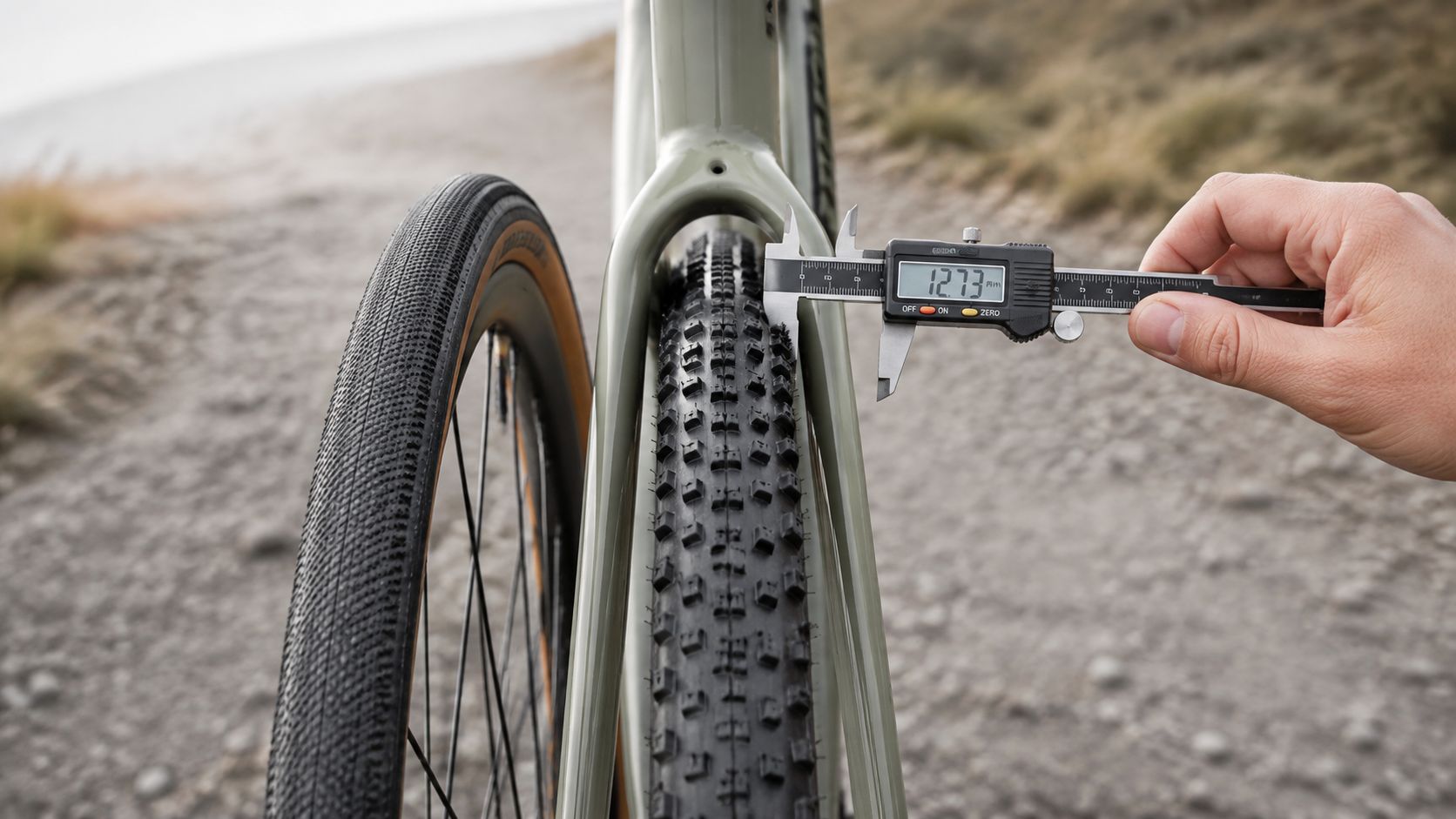
A 45 mm tire is not always a 45 mm tire once installed. Rim internal width affects the mounted tire’s real width and shape, sometimes enough to change whether it clears the frame, how it corners, and whether it leaves adequate room at the tightest points. That is why fit-aware riders should compare actual mounted dimensions, not just sidewall numbers.
If you need a deeper width primer, use SYCLR’s gravel bike tire size guide.
Keep width education simple
Broadly speaking, narrower gravel tires tend to suit smoother and faster routes, while larger-volume options can make more sense on rougher surfaces. But there is no universal width rule that works across all bikes, rims, rider weights, and terrain. Treat width as a fit and use-case decision, not a trend decision.
Best Gravel Bike Tires for 2026
These picks are organized by use case, not by a fake one-size-fits-all ranking. Where possible, the recommendation is supported by current manufacturer specifications plus current independent testing or widely cited comparative testing.
1. Schwalbe G-One RS, race and rolling-efficiency priority
Why it stands out: The G-One RS is one of the clearest examples of a modern gravel race tire aimed at fast surfaces and efficient speed. Schwalbe currently offers the G-One RS in 35-622, 40-622, 45-622, 50-622, 55-622, and 60-622 sizes. Current variants use TLR construction with Race or Race Pro casing/protection configurations depending on the exact size and version. Schwalbe positions the RS as its lowest-rolling-resistance G-One option and describes it as a semi-slick intended for fast gravel surfaces.
Best use: Fast gravel events, hardpack-heavy routes, and riders who want low drag without moving all the way to a slick.
What to watch: This kind of tire makes the most sense when your terrain really is speed-oriented. If your regular routes include sharp rock, sustained mud, or loaded bikepacking, a more protective or more open pattern may be smarter.
2. Continental Terra Speed ProTection, fast hardpack
Why it stands out: Continental positions the Terra Speed ProTection as a fast off-road tire, and its current product page shows tubeless availability with an added ProTection puncture layer. The current line is shown in 650 x 35B, 650 x 40B, 700 x 35C, and 700 x 40C sizes on the manufacturer page (Continental Terra Speed ProTection). BikeRadar’s review highlights its 3-ply 180 TPI ProTection casing and BlackChili compound, reinforcing its reputation as a fast option for dry and firm conditions (BikeRadar Terra Speed review).
Best use: Fast hardpack, dry race courses, and riders who want a quick-rolling tire with more off-pavement bite than a smooth all-road tire.
What to watch: Continental specifically notes that maximum inflation pressure for hooked and hookless applications, plus maximum inner rim width, is shown on the tire packaging and may differ between applications (Continental Terra Speed ProTection). Do not assume every size shares the same hookless approval or pressure limit.
3. Specialized Pathfinder Pro, balanced mixed gravel
Why it stands out: The Pathfinder Pro remains a current mixed-surface option in Specialized’s gravel range, pairing a relatively smooth center section with more defined shoulder tread. Specialized currently lists the Pathfinder Pro 2Bliss Ready alongside newer gravel options such as the Pathfinder TLR, so treat the Pro as a versatile mixed-gravel choice rather than automatically as Specialized’s latest race tire.
Best use: Riders who split time between hardpack, broken gravel, and pavement connectors, and want a tire that does not feel overbuilt on faster rides.
What to watch: The Pathfinder Pro is often chosen by riders who want one tire for many conditions, but that versatility only works if the tread style matches your actual surface mix. It is not the automatic answer for mud or for sharp, rocky backcountry riding.
4. Pirelli Cinturato Gravel H SmartEvo GR, fast hardpack and mixed gravel
Why it stands out: Pirelli’s Gravel H has built a strong reputation as a hardpack-oriented tire with a casing and protection package that appeals to riders who value resilience as much as pace. It regularly appears in independent group comparisons that evaluate rolling, puncture resistance, and all-round performance rather than speed in isolation, including large comparative testing from Gran Fondo (Gran Fondo gravel tire group test).
Best use: Dry to mixed terrain where durability matters, especially for riders who want a hard-surface tire that feels less delicate than the lightest race-first options.
What to watch: “H” means hard terrain intent. If your routes stay wet, soft, or consistently loose, Pirelli’s more open gravel patterns may make more sense than this one.
5. Vittoria Terreno Dry, fast mixed gravel
Why it stands out: The Terreno Dry has a long-established place in gravel because its center tread is designed to roll quickly while its shoulder pattern offers more bite once leaned over. In mixed terrain, that can make it a strong bridge between race speed and usable traction. It is also a frequent reference point in independent comparison testing, including the broad gravel category testing collected by Bicycle Rolling Resistance and other review outlets (Bicycle Rolling Resistance gravel reviews).
Best use: Dry to mixed gravel where you want a quick center tread but a more substantial off-center tread shape than a minimal file pattern.
What to watch: It is more versatile than a pure hardpack race tire, but it is still not a dedicated wet-condition tread.
6. WTB Raddler, wet and loose terrain
Why it stands out: The Raddler fills an important role in this list because not every rider needs a hardpack-biased tire. Its tread intent is better suited to riders who regularly see loose-over-hard surfaces, wetter sections, and terrain where braking and climbing traction matter more than absolute rolling speed.
Best use: Wet or loose terrain, rougher mixed rides, and riders who want a more assertive tread without moving all the way to a cyclocross-style mud tire.
What to watch: Its more pronounced tread is aimed at different conditions than a hardpack-oriented semi-slick, so riders who spend most of their time on smooth gravel or pavement should compare the added tread against their actual traction needs.
7. Panaracer GravelKing X1, rough mixed terrain
Why it stands out: Panaracer’s current GravelKing range includes the GravelKing X1 in 700x35C, 700x40C, 700x45C, 700x50C, and 27.5×1.90 configurations. The current family also includes more-protected X1+ and race-oriented X1 R variants, allowing riders to choose different casing priorities around the same general tread concept. (Panaracer GravelKing X1 35-622, Panaracer GravelKing X1 40-622).
Best use: Riders who want more bite and rough-terrain range than Panaracer’s faster GravelKing patterns, without abandoning all-day versatility.
What to watch: As with Continental, do not assume hookless approval or pressure limits across the whole family without checking the exact size and current packaging.
8. Schwalbe G-One R, rough or rocky terrain
Why it stands out: If the G-One RS sits at the race-fast end, the G-One R is the more terrain-capable stablemate for riders who still want speed but need more off-road grip and support. It belongs on a 2026 best-of list because many gravel riders need this middle ground: quicker than a fully aggressive tread, more planted than a race-first file pattern.
Best use: Rough or rocky terrain, mixed endurance rides, and riders who want more confidence on broken surfaces than a race tire usually delivers.
What to watch: It is a better fit than an RS-style tire when your regular route quality is inconsistent, but it still needs to be measured against your actual frame and rim setup before buying wider sizes.
Comparison Table, Current Gravel Tire Picks
| Tire | Available relevant widths | Tread type | Casing / protection option | Tubeless status | Best-use context |
|---|---|---|---|---|---|
| Schwalbe G-One RS | 35, 40, 45, 50, 55, 60 mm listed (source) | Low-drag race gravel tread | Super Race / V-Guard on listed variants | TLR | Race and rolling-efficiency priority |
| Continental Terra Speed ProTection | 35 and 40 mm in 650b and 700c on manufacturer page (source) | Fast hardpack tread | ProTection layer, 3-ply 180 TPI per review (source) | Tubeless | Fast hardpack |
| Specialized Pathfinder Pro | Commonly available in gravel-relevant widths, verify current region stock | Fast center with shoulder grip | Brand-specific casing varies by version | Tubeless-ready versions available, verify exact model | Balanced mixed gravel |
| Pirelli Cinturato Gravel H | Gravel-relevant widths vary by market, verify exact listing | Hardpack-oriented mixed tread | Protection-focused gravel casing options | Tubeless-ready versions available, verify exact model | Balanced mixed gravel, durability priority |
| Vittoria Terreno Dry | Gravel-relevant widths vary by market, verify exact listing | Fast center, more pronounced shoulder pattern | Casing options vary by version | Tubeless-ready versions available, verify exact model | Fast mixed gravel |
| WTB Raddler | Gravel-relevant widths vary by market, verify exact listing | More open mixed tread | Casing options vary by version | Tubeless-ready versions available, verify exact model | Wet and loose terrain |
| Panaracer GravelKing X1 | 35, 40, 45 mm listed (35 mm source, 40 mm source) | Rougher mixed-terrain tread | TLR gravel casing, exact build varies by size | TLR | Rough mixed terrain |
| Schwalbe G-One R | Gravel-relevant widths vary by market, verify exact listing | Faster all-round gravel tread | Schwalbe gravel casing varies by version | Tubeless-ready versions available, verify exact model | Rough or rocky terrain |
The point of this table is not to force a single ranking. It is to make the tradeoffs visible. Some tires are faster. Some are tougher. Some are better once surfaces turn loose or wet. The best gravel tire is the one that matches your riding context and fits your bike properly.
Fit, Clearance, and Rim Width Before You Buy
Already know which tire characteristics suit your bike and terrain? You can also browse current retailer sale inventory after checking the exact tire size, casing, and compatibility you need.
SYCLR may earn a commission from qualifying purchases made through some retailer links, at no additional cost to you.
See Current Competitive Cyclist Sales
Actual mounted size matters more than the sidewall label
Frame and fork clearance should be checked against the actual mounted tire width and height on your rims, not just the nominal number on the sidewall. Wider internal rims can increase mounted width and reshape the profile enough to change real-world clearance. Tire construction matters too. Two tires with the same printed size can mount differently because of casing design.
If clearance is one of your constraints, compare your setup against SYCLR’s gravel bike tire clearance guide.
Do not generalize frame or fork clearance
Do not rely on forum folklore, generic “fits up to” claims, or universal clearance formulas. Check the manufacturer’s frame or fork documentation where possible, then verify the bike itself at the chainstays, seatstays, fork crown, and any other tight points. Mud accumulation, wheel flex, and tolerance differences can all matter in use, especially once a tire measures larger than expected.
This is also why it is risky to repeat blanket advice like “choose the widest tire that fits.” A larger tire is not automatically the better tire if it compromises clearance, leaves less room for contamination, or pushes the bike outside the intended wheel and tire envelope.
Hookless and Tubeless, What to Verify
Tubeless gravel setups can work extremely well, but keep the setup logic brief and exact.
-
Verify that the exact tire size is approved for your rim type.
-
Verify any hookless-specific width and pressure limits from the tire and rim manufacturer.
-
Do not assume that a tubeless-ready tire is automatically approved for all hookless rims.
-
Do not assume one pressure limit applies across a whole tire family.
Continental states this clearly for the Terra Speed ProTection line: the maximum inflation pressure for hooked and hookless applications and the maximum inner rim width are shown on the tire packaging and may differ between applications (Continental Terra Speed ProTection). That is the right way to think about hookless in general. Approval is model- and size-specific.
For a concise setup comparison, use SYCLR’s tubeless vs tubes guide for gravel bikes.
Pressure, Keep It Specific to Your System
Pressure should be treated as a system variable, not a universal rule. Tire volume, measured width, casing design, rim internal width, rider weight, riding style, terrain, and whether you use tubes or tubeless all affect the usable range. Fixed front and rear splits, fixed minimums, and one-size-fits-all PSI charts are a poor substitute for actual setup work.
What is worth saying confidently is this:
-
Pressure needs to be checked against the tire and rim manufacturer’s limits.
-
The same labeled tire can want a different pressure range on a different rim.
-
A pressure that feels efficient on smooth hardpack may be a poor choice on broken rock.
-
Tubeless can expand setup options, but it does not erase compatibility rules.
For detailed setup guidance, use SYCLR’s gravel bike tire pressure guide.
A Better Way to Narrow Tire Choices
If you want a short decision framework, use this one:
-
Measure your current tire and available bike clearance.
-
Confirm rim internal width and rim type.
-
Choose the tread category that matches your most common terrain, not your fantasy route.
-
Choose casing and protection based on puncture risk, route roughness, and ride length.
-
Verify tubeless and hookless compatibility for the exact size you plan to buy.
-
Use independent testing to compare tires within the same category, not across unrelated use cases.
Bicycle Rolling Resistance remains useful because it gives riders a consistent framework for comparing gravel tires within that site’s own methodology, while broader comparative testing such as Gran Fondo’s helps show the tradeoff between speed, puncture resistance, and weight across many models (Bicycle Rolling Resistance gravel reviews, Gran Fondo gravel tire group test).
How SYCLR Helps You Shortlist Bikes That Suit Your Tire Plan
If you are comparing bikes as well as tires, the most useful question is not just “what tire do I want?” It is “which bikes genuinely support that tire plan with the fit and geometry I need?”
SYCLR helps you shortlist road and gravel listings using fit signals, geometry signals, model-year context, price context, listing quality, condition signals where available, and confidence signals. Once a bike makes your shortlist, confirm the manufacturer’s stated tire clearance and the exact wheel-and-tire configuration before assuming your planned tire will fit.
Use SYCLR when you want to compare listings with more context than generic marketplace filters can provide.
Common Gravel Tire Questions Answered
Which gravel tire is the best overall in 2026?
There is no honest universal winner. A tire that is excellent for hardpack racing can be the wrong choice for wet, loose, rocky, or loaded riding. The better question is which tire is best for your terrain, bike clearance, wheel setup, and durability needs.
How should I compare 40 mm, 45 mm, and 50 mm gravel tires?
Compare them by actual mounted dimensions on your rims, not only by printed size. Then compare what each width means for your available clearance, terrain needs, and tread category. A nominal 45 mm from one brand can sit differently from a nominal 45 mm from another.
How do I check if a tire will really fit my bike?
Start with the frame and fork manufacturer’s guidance, then measure the tightest points on the actual bike and compare them against the tire’s mounted size on your rim width. Recheck if you change rims, because internal width can change tire dimensions enough to affect fit.
Can I assume a tire is hookless compatible if the brand says tubeless-ready?
No. Tubeless-ready does not automatically mean approved for every hookless rim. Hookless compatibility, maximum pressure, and in some cases rim width limits can vary by exact tire size and construction. Always verify the current manufacturer guidance for the exact tire and rim combination.
Does TPI tell me everything about comfort or durability?
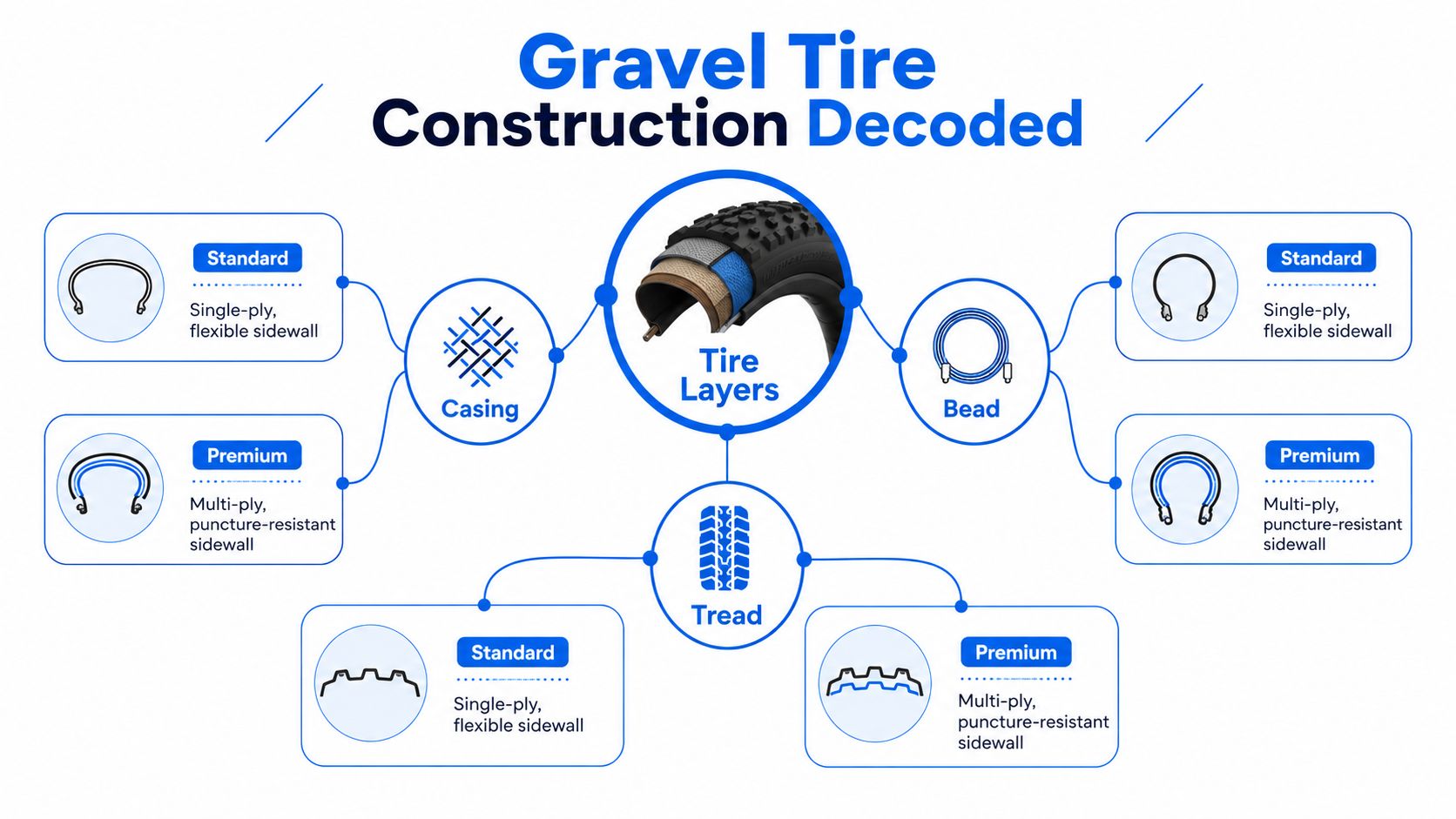
No. TPI is only one part of casing construction. It should not be treated as a universal shortcut for ride feel, speed, or toughness on its own. Protection layers, rubber compound, ply structure, tread thickness, bead design, and intended use all shape how a tire rides and lasts.
Should I choose by tread or casing first?
Start with bike clearance, wheel compatibility, and intended surface, then evaluate tread and casing together. Tread helps determine where the tire performs best, while casing and protection affect durability, support, mass, and puncture behavior.
Use SYCLR to compare road and gravel listings using fit signals, geometry signals, model-year context, price context, listing quality, condition signals where available, and confidence signals. Narrow the bikes that plausibly match your fit and riding needs first, then verify whether their frame clearance, wheel specification, and tire compatibility support the gravel tires you want to run.