
Bike Wheelbase Explained: What It Means and Why It Matters

You're comparing two used bikes that both carry a size 56 label, yet the geometry charts do not match. One listing shows a shorter wheelbase than the other, but that number alone does not tell you which bike fits better, handles better for you, or represents a better buy. It is one geometry signal inside a larger system.
Bike wheelbase explained starts with a simple definition. Wheelbase is the horizontal distance between the front and rear axle centers. That measurement can help you compare how different frames are laid out, but it should not be treated as a standalone verdict on handling, fit, or quality.
Table of Contents
- What Wheelbase Actually Is on a Bike
- How Front-Center and Rear-Center Relate to Wheelbase
- How Wheelbase Fits Into the Rest of Bike Geometry
- Reading Wheelbase on a Spec Sheet or Listing
- Comparing Wheelbase and Fit Signals Across SYCLR Listings
- Used-Bike Checks for Wheelbase and Geometry Plausibility
- Bike Wheelbase FAQs
What Wheelbase Actually Is on a Bike
Wheelbase is the horizontal distance between the front and rear axle centers. It is not the bike's overall length, not the distance between tire edges, and not the top-tube length. Bikexchange's bicycle geometry guide also separates wheelbase from stack and reach, which describe rider-position dimensions rather than the axle-to-axle layout.
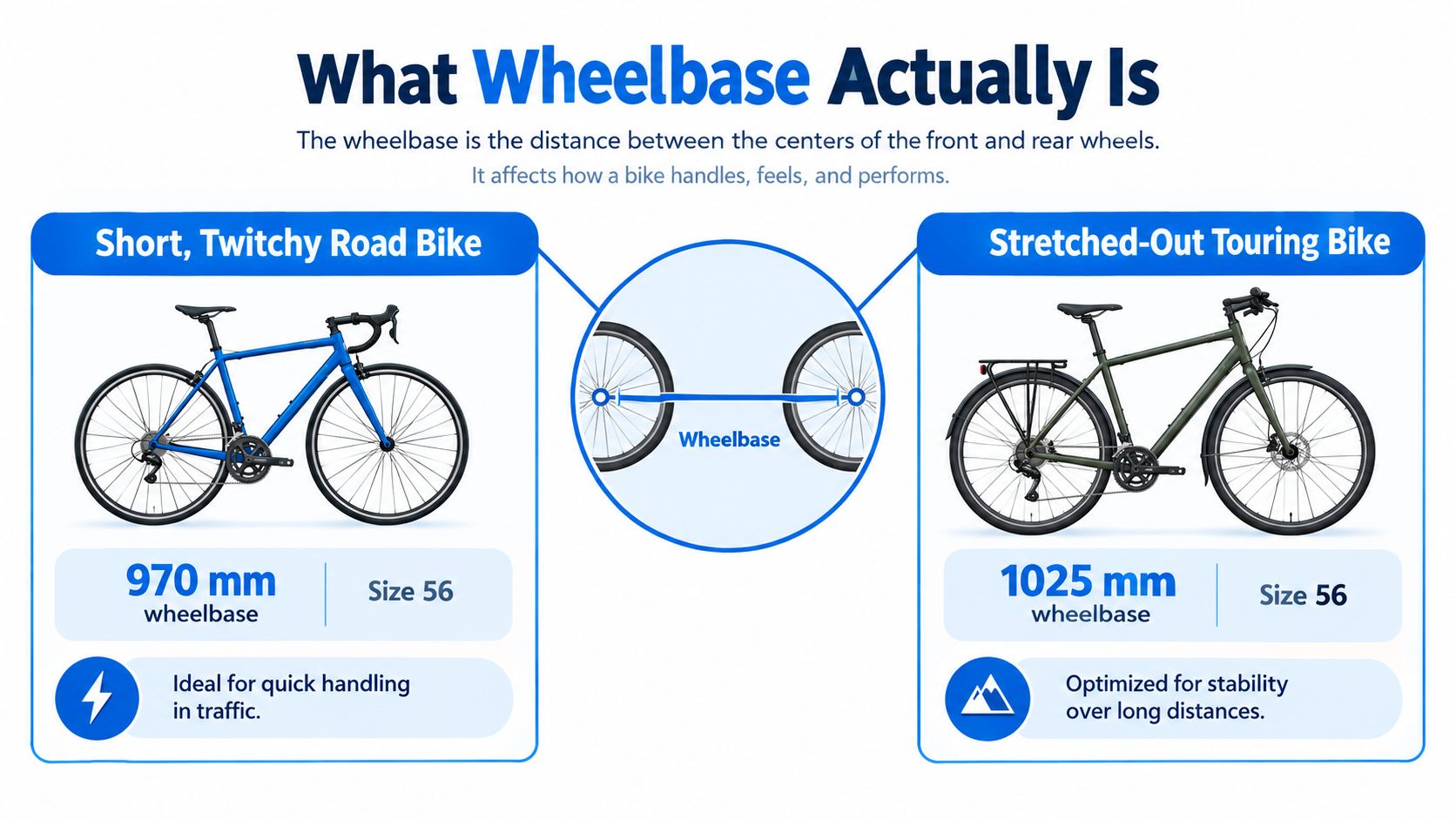
Wheelbase matters because it reflects part of how a frame is packaged. It tells you something about the relationship between the front and rear axles, but it does not summarize the whole riding experience. Interpreting wheelbase responsibly means reading it alongside trail, head angle, fork offset, front-center, rear-center, tire setup, rider position, load, and speed. Light Cycling's geometry guide places wheelbase among several geometry variables that work together rather than independently.
Wheelbase is not a fit measurement
Your stack and reach describe rider position more directly than wheelbase does. Two bikes can share a similar wheelbase while differing meaningfully in stack, reach, seat-tube angle, top-tube length, or cockpit setup. That is why wheelbase should not be used as a substitute for bike fit. SYCLR's bike fit guide is the better starting point for the broader fit question.
Wheelbase is still useful. It helps buyers compare frame layout across listings before seeing a bike in person. The key is to treat it as one geometry signal, not as a standalone answer.
How Front-Center and Rear-Center Relate to Wheelbase
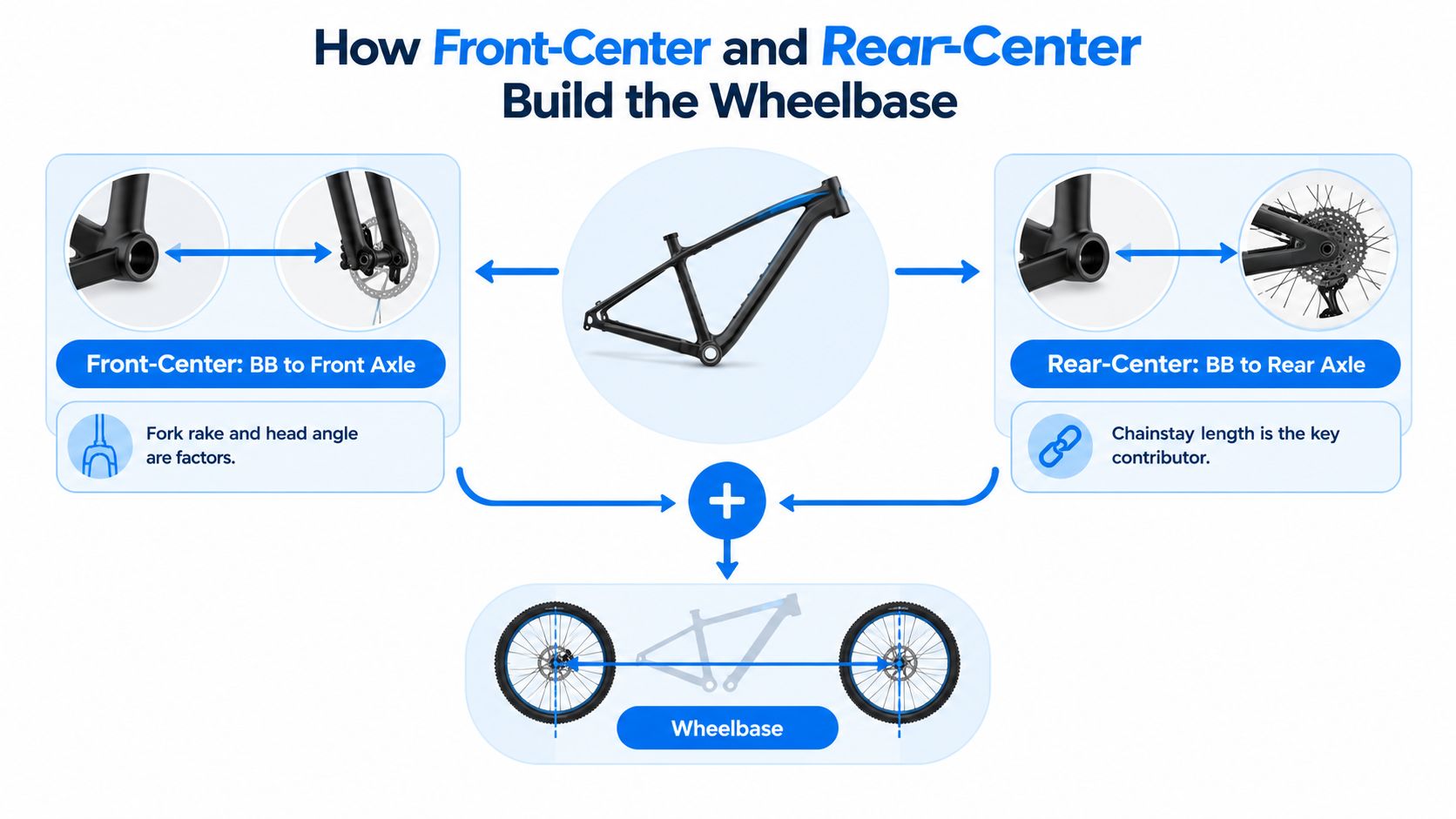
Wheelbase is related to the front and rear portions of the bike's layout. In geometry charts, this is commonly expressed as:
horizontal front-center + horizontal rear-center = wheelbase
Here, front-center refers to the horizontal distance from the bottom-bracket center to the front axle, while rear-center refers to the horizontal distance from the bottom-bracket center to the rear axle.
Rear-center is commonly represented by chainstay length, but use the terminology and measurement method shown in the exact manufacturer geometry chart.
The practical takeaway is simple. If a manufacturer provides wheelbase, front-center, and rear-center or chainstay figures, compare them together. Do not assume that any arbitrary straight-line bottom-bracket-to-axle measurements can always be added outside the manufacturer's stated geometry method.
Front-end geometry still matters
A wheelbase number does not explain itself. If two bikes differ in wheelbase, the reason may involve front-center, rear-center, chainstay length, head angle, fork offset, or several of those together. Looking only at the final wheelbase figure can hide those differences.
That is why spec-sheet comparisons work best when you check the surrounding fields, not just the axle-to-axle total. A similar wheelbase can come from different geometry combinations, and different geometry combinations can place the rider differently relative to the axles.
Wheel and tire setup do not by themselves change frame wheelbase
Wheel or tire outer diameter does not by itself change a frame's published wheelbase. Published wheelbase reflects the axle-center spacing created by the frame and fork geometry for that model and size.
Wheel and tire setup can still matter in other ways. It can affect axle height, bottom-bracket height, trail, clearance, toe overlap, and the bike's overall ride-height context. Those changes can affect ride-height and steering context, but they should not be described as changing the frame’s published axle-to-axle wheelbase.
Practical rule: When two listings show different wheelbase numbers, first confirm you are comparing the exact same model year, frame size, and manufacturer geometry source before drawing conclusions.
How Wheelbase Fits Into the Rest of Bike Geometry
Wheelbase contributes to overall geometry, but it does not operate alone. Reading it in isolation can lead to overly simple conclusions. A better approach is to interpret wheelbase with the rest of the frame's geometry and with the bike's actual setup.
Useful related fields include:
-
Trail
-
Head angle
-
Fork offset
-
Front-center
-
Rear-center or chainstay
-
Tire setup
-
Rider position
-
Load
-
Speed
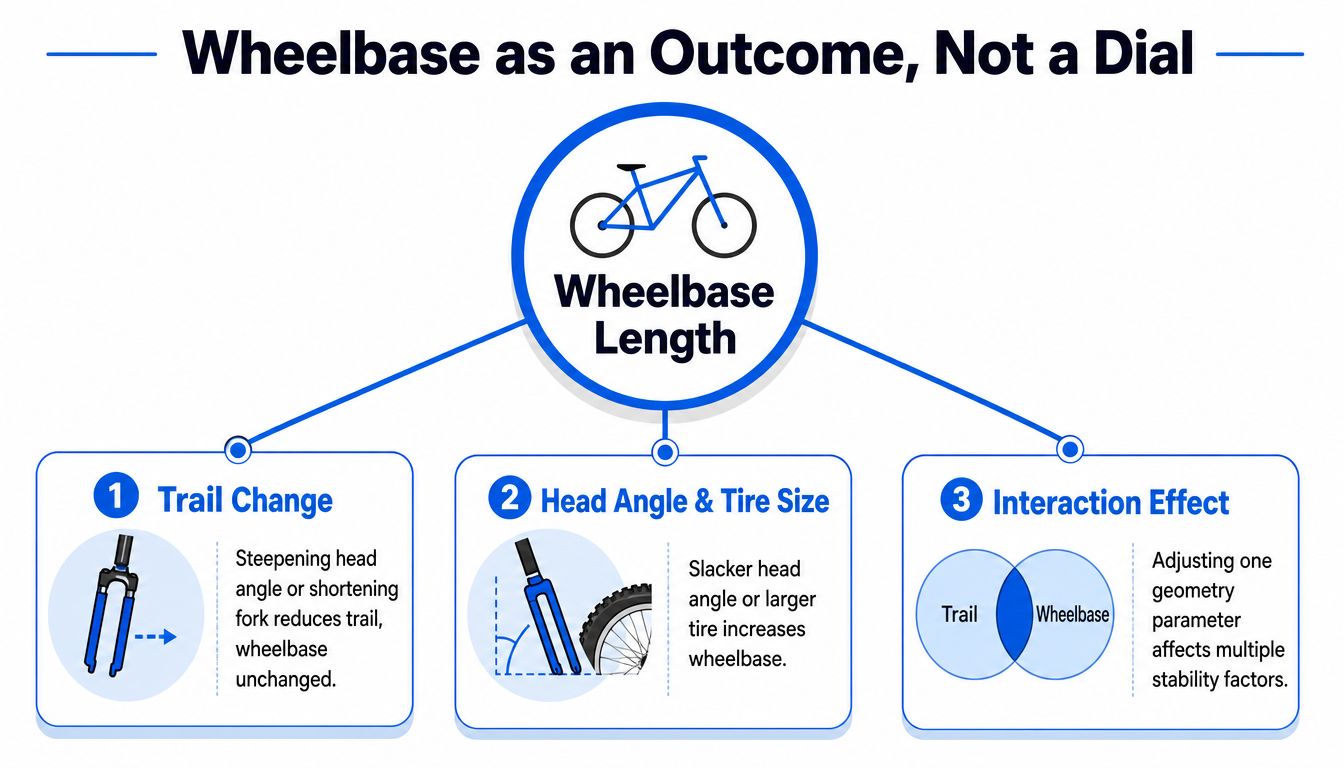
These factors overlap. Change one and the riding result may change in ways that are not obvious from wheelbase alone. The same caution applies to any attempt to treat wheelbase as a direct handling score.
Bicycle-dynamics research reinforces that wheelbase alone cannot predict self-stability or handling because steering geometry, mass distribution, speed, and other variables interact. The University of Padua research paper is useful here not as a shopping shortcut, but as evidence that one geometry number should not be used as a complete explanation.
Chainstay length is only one related input
More rear-center length contributes directly to a longer wheelbase when front-center remains unchanged. That makes chainstay useful to compare when you want to understand where part of a wheelbase difference comes from.
What chainstay length does not do is provide a reliable standalone verdict about calmness, agility, traction, or stability. Those riding traits depend on the wider geometry and setup context, not on chainstay length alone.
Why one number is not a handling verdict
A wheelbase figure can help you notice that two bikes are laid out differently, but it does not tell you how either bike will ride for a particular person in a particular setup. Rider position, tire choice, pressure, load, surface, and speed all influence what you feel.
That is the main buyer lesson. Wheelbase is worth comparing, but it should be interpreted cautiously and in context. If you want to understand geometry well, compare related fields as a group instead of ranking bikes by wheelbase alone. You can do that with SYCLR's compare bike geometry tool.
Reading Wheelbase on a Spec Sheet or Listing
Most geometry charts list wheelbase in millimeters. Start by confirming that you are looking at the exact model, model year, and size. Then compare wheelbase with the related fields the manufacturer provides.
A reliable comparison usually includes:
-
Manufacturer wheelbase
-
Front-center, if available
-
Rear-center or chainstay
-
Head angle
-
Fork offset
-
Trail, where available
Avoid using universal target numbers or category-wide wheelbase bands as a shortcut. Those broad ranges can blur important differences in design, sizing method, model year, and intended setup. The better question is whether the listing matches the manufacturer's geometry for the exact bike being sold.
What to compare instead of universal target ranges
When you are reading a listing, compare like with like:
-
Exact model
-
Exact model year
-
Exact frame size
-
Manufacturer geometry source
-
Related geometry fields in the same chart
If one listing appears unusual, that does not automatically mean the number is wrong or the bike is unsuitable. It means you should verify the source and check whether the listing reflects the correct frame, year, fork, and build context.
Use the SYCLR bike geometry chart if you want a quick reference for where wheelbase sits beside stack, reach, head angle, chainstay, and other geometry terms.
Comparing Wheelbase and Fit Signals Across SYCLR Listings
When comparing used bikes, start with fit signals, not wheelbase. Narrow the field using the frame size and rider-position details that are most relevant to you, then use wheelbase as one of several geometry signals.
A practical workflow on SYCLR looks like this:
-
Start with fit signals: frame size, stack, reach, current-bike reference, or fit-report details
-
Check geometry signals: wheelbase, front-center, rear-center or chainstay, head angle, fork offset, and trail where available
-
Add model-year context: confirm the exact generation and geometry chart
-
Review price context: compare the asking price with similar listings and specification level
-
Assess listing quality: look for complete details, coherent photos, and clear identification
-
Check condition signals where available: use the evidence in the listing without assuming a remote inspection can replace seeing the bike
-
Consider confidence signals: weigh how much of the bike's identity, setup, and condition is actually supported by the listing
Wheelbase can be useful in that process, but only as one part of the picture. A difference in wheelbase indicates a different axle-to-axle layout, but the cause and practical meaning depend on the surrounding geometry. It should not be treated as a direct verdict on fit, ride quality, or value.
Use how to compare used bike listings for the broader process around identity, condition, price context, and listing completeness. SYCLR helps you compare listings using available fit signals, geometry signals, model-year context, price context, listing quality, condition signals where available, and confidence signals. It does not perform a professional bike fit, physically inspect bikes, authenticate listings, verify ownership or seller claims, or guarantee fit or condition.
Used-Bike Checks for Wheelbase and Geometry Plausibility
Used-bike geometry mismatches can come from issues such as the wrong size row, the wrong model year, or a geometry chart copied from a different version. The first step is to confirm the listing details against the manufacturer's geometry.
Repeat the measurement if needed
If a listing's wheelbase looks questionable, repeat the measurement in a simple, consistent way. Keep the bike upright, center the steering, and measure the horizontal distance between the front and rear axle centers.
Then compare that result with the manufacturer's geometry for the exact model, year, and size. If the listing still does not line up, ask the seller to clarify the frame details and the geometry source.
Cross-check related geometry fields
Do not rely on wheelbase alone when checking whether a listing makes sense. Cross-check it with the related numbers the manufacturer publishes, especially:
-
Front-center, if available
-
Rear-center or chainstay
-
Head angle
-
Fork offset
-
Trail, where available
If the listing remains unclear, route deeper inspection, condition review, and in-person verification through your normal buying process rather than trying to settle everything from one geometry field.
Bike Wheelbase FAQs
What is wheelbase on a bike?
Wheelbase is the horizontal distance between the front and rear axle centers.
Is wheelbase a fit measurement?
No. Wheelbase is a geometry measurement, but stack and reach describe rider position more directly. Wheelbase can help compare frame layout, but it should not be used as a standalone fit answer.
Can wheelbase tell me how a bike will handle?
Not by itself. Wheelbase contributes to the bike's overall geometry, but handling depends on other factors too, including trail, head angle, fork offset, front-center, rear-center, tire setup, rider position, load, and speed.
Does a bigger tire change wheelbase?
No, not by itself. Tire or wheel outer diameter does not by itself change a frame's published wheelbase. It can affect axle height, bottom-bracket height, trail, clearance, toe overlap, and overall ride-height context.
Should I compare wheelbase across different bikes?
Yes, but only carefully. Compare the exact model, model year, size, and manufacturer geometry source, then read wheelbase together with front-center, rear-center or chainstay, head angle, fork offset, and trail where available.
Is chainstay length the same as wheelbase?
No. Chainstay length is only one related measurement. More rear-center length contributes to a longer wheelbase when front-center remains unchanged.
What should I check in a used-bike listing?
Confirm the exact model, year, and size, compare the listing against the manufacturer geometry chart, repeat the wheelbase measurement if needed, and cross-check related fields rather than relying on wheelbase alone.
SYCLR helps you compare road and gravel listings using available fit signals, geometry signals, model-year context, price context, listing quality, condition signals where available, and confidence signals. Start with your height, bike type, and budget, then add stack, reach, current-bike geometry, or fit-report details at SYCLR. For more detailed setup inputs, use Advanced Fit.