
Front Center Bike Geometry Explained and Compared
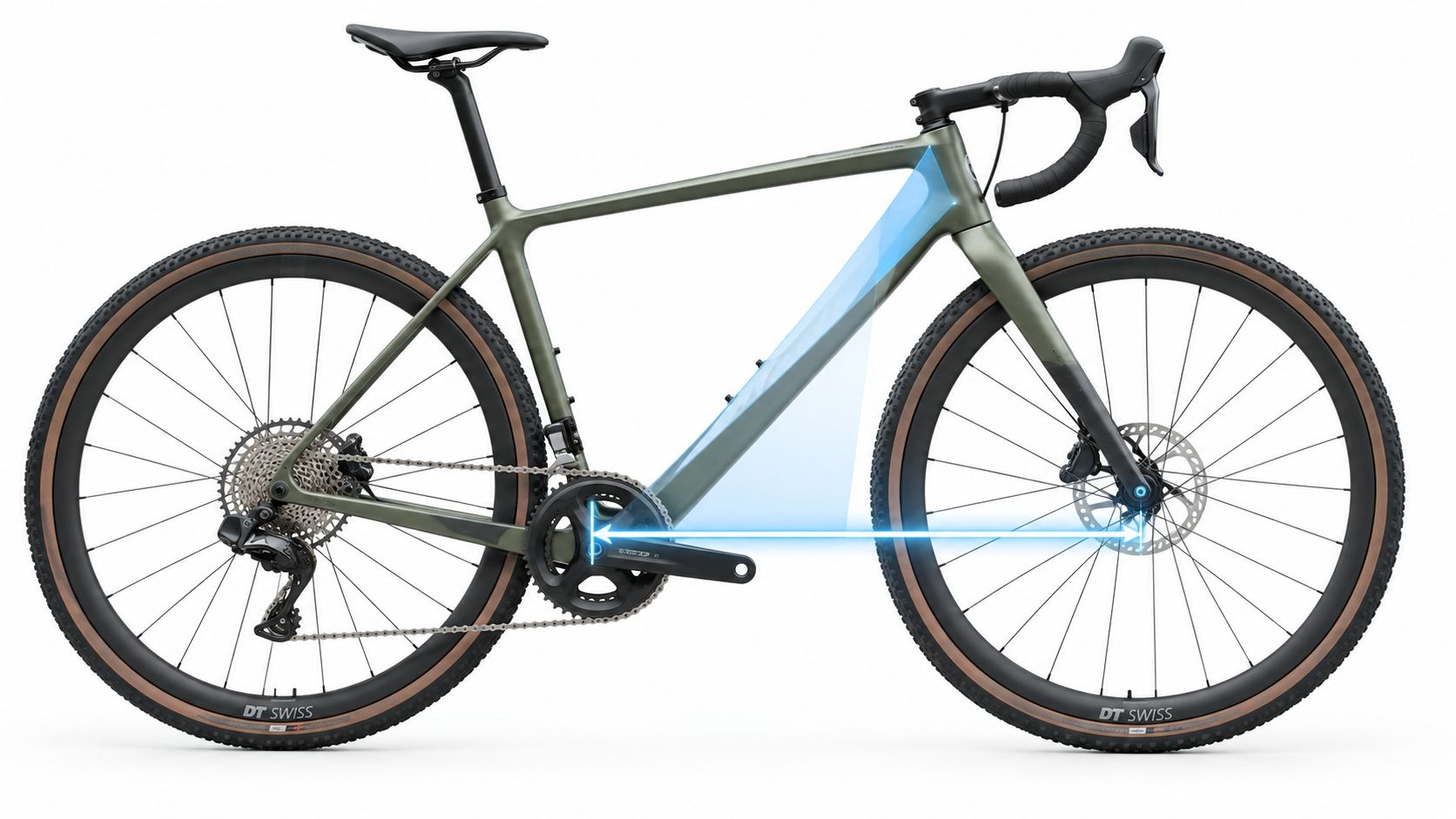
Front center bike geometry describes the distance from the bottom-bracket center to the front-axle center, but the exact meaning depends on the measurement convention used by the source. Some brands and geometry databases use front-center as a direct published dimension according to their own chart method, while others also distinguish front-center horizontal, which is the horizontal component from the bottom-bracket reference to the front axle. That distinction matters when you compare bikes, because only front-center horizontal plus rear-center horizontal equals wheelbase.
That sounds subtle, but it closes a gap in how many riders compare bikes. They'll check size labels, maybe stack and reach, maybe wheelbase, then miss the question front center helps answer: where does the front wheel sit relative to the bottom bracket and rider, according to the chart's measurement convention?
That matters for packaging, comparison, and context. It can shape toe-overlap discussions, help explain why two same-size bikes look different in front, and show why one frame places the front axle farther out without automatically meaning it fits better or handles better.
For road and gravel buyers, front center works best as a supporting geometry signal. It's useful. It's not a standalone score.
Table of Contents
- What Is Front Center in Bike Geometry
- How Front Center Is Measured Correctly
- Front Center vs Wheelbase and Rear Center Explained
- How Front Center Relates to Toe Overlap
- Does Front Center Affect Fit and Handling
- Why Front Center Changes Between Sizes and Bike Types
- How to Compare Front Center When Buying and How SYCLR Helps
- A clean comparison workflow
- A short buyer checklist
- How SYCLR helps
- Front Center Bike Geometry FAQs
- What is front center on a bike
- How is front center measured
- Is front center part of wheelbase
- Does front center affect toe overlap
- Does a longer front center make a bike more stable
- Does front center affect bike fit
- Should I compare front center when buying a bike
What Is Front Center in Bike Geometry
Why do two bikes with similar reach and the same labeled size sometimes place the front wheel in noticeably different spots? Front center helps explain part of that difference.
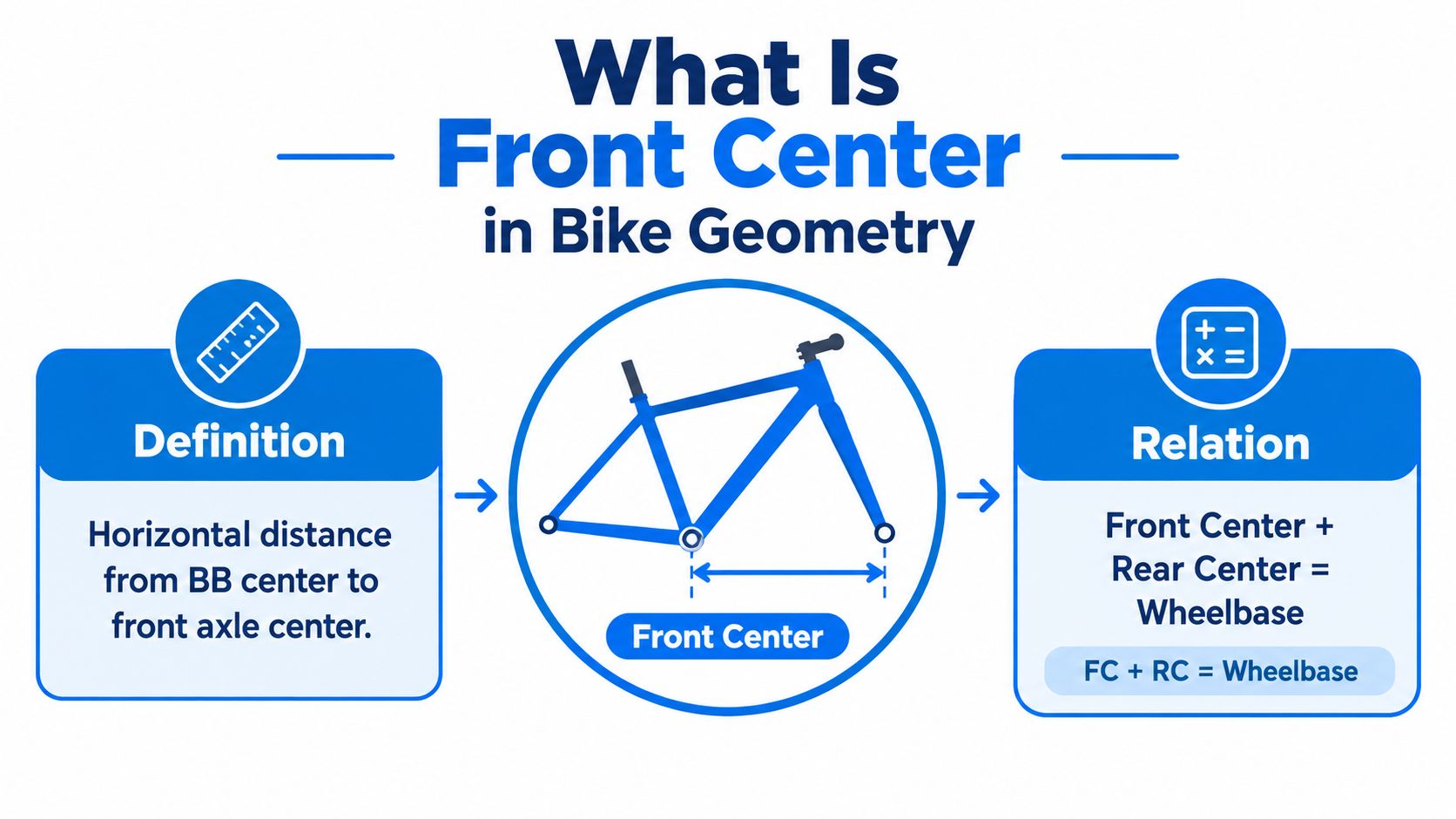
Front center is the distance from the center of the bottom bracket to the center of the front axle according to the source or manufacturer measurement convention. Some charts and databases also distinguish front-center horizontal, which is the horizontal component from the bottom-bracket reference to the front axle.
A clearer way to interpret it
The bottom bracket works as the bike's central frame reference under the rider. Front center shows where the front axle sits relative to that point, but you need to know whether the chart is describing a published front-center dimension or a horizontal front-center component.
That makes front center useful as a packaging signal. It helps you understand how the bike arranges space around the rider's feet, the front tire, and the fork. A larger published value usually means the front axle is positioned farther from the bottom bracket by that chart's method. A smaller value usually means it sits closer by that same method.
That does not make front center a universal stability score.
A longer published front-center figure can appear on a bike with a short rear center, a different trail figure, or a size-specific geometry change that shifts the overall picture. For that reason, front center makes more sense when you read it beside wheelbase, rear center, trail, and the full size chart, not as a standalone ranking.
What front center does and does not tell you
Front center gives comparison context. It can explain why one frame has more room around the front tire and rider's foot area, or why two bikes with similar reach still look different in profile.
It does not directly tell you whether the cockpit will feel long. Hand position depends far more on stack, reach, stem length, bar reach, hood placement, and saddle location. Front center also cannot predict handling by itself, because the front wheel's location is only one part of a larger geometry package.
A simple buyer rule helps here. Use front center the way you would use one dimension in a shoe last. It tells you something real about shape, but not enough to choose the whole fit or ride character on its own.
How Front Center Is Measured Correctly
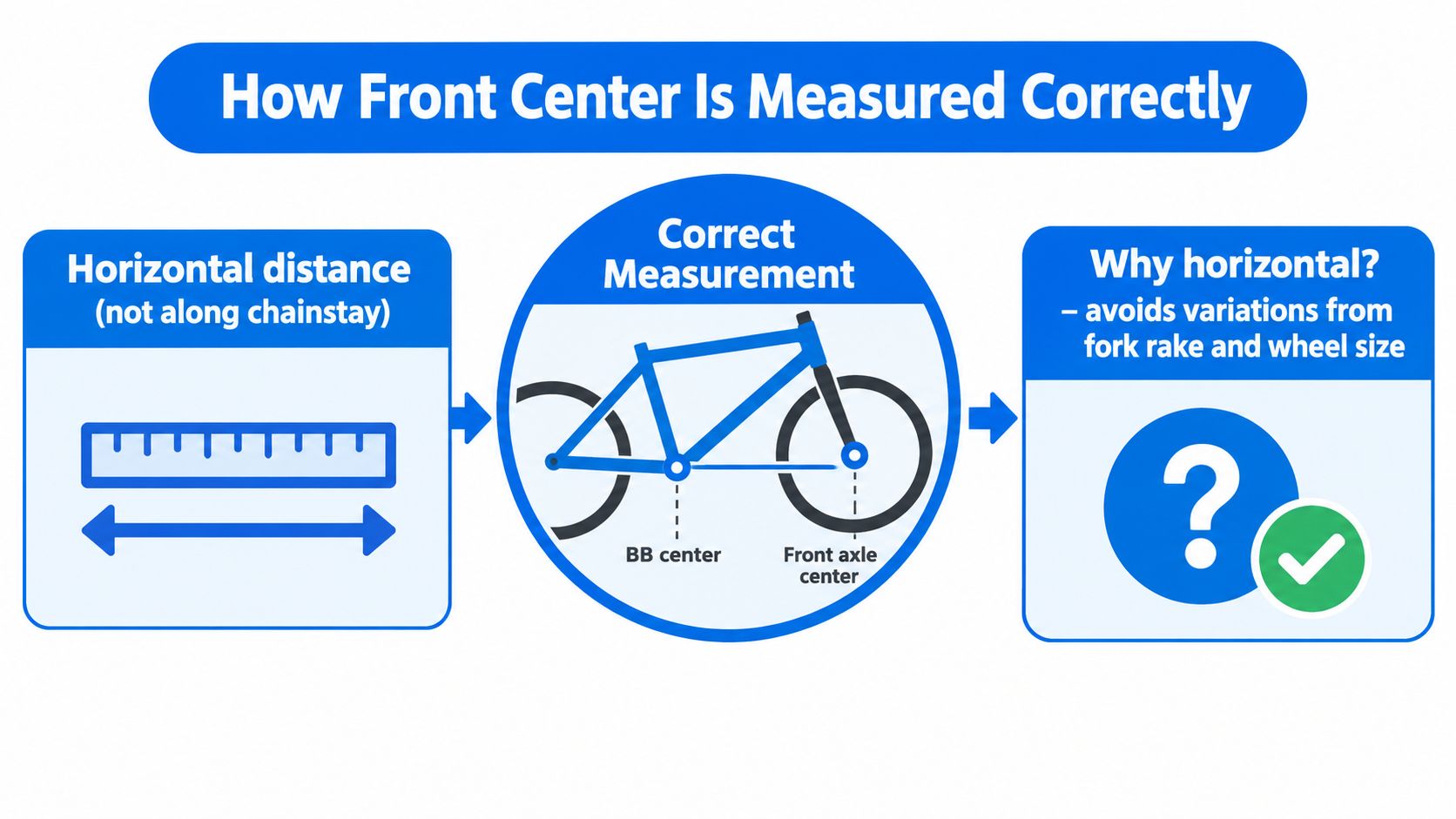
Front center is measured from the center of the bottom bracket to the center of the front axle, but the key question is how the source defines that line. Some sources publish a front-center figure under their own convention, while others also provide a distinct front-center horizontal value for axle position in horizontal geometry terms.
Measurement convention comes first
Front center isn't chainstay length, and it shouldn't be treated as a generic diagonal line you eyeball across the bike. One geometry discussion notes that the measurement is not parallel with the ground, while another explains it as a straight-line or horizontal bottom-bracket-to-front-axle measurement, which is why chart definitions matter when comparing sources in The Cycling Independent's toe-overlap discussion.
In practice, the safest move is to rely on the manufacturer chart for the exact bike. If a secondary database distinguishes front-center from front-center horizontal, preserve that distinction instead of treating the terms as interchangeable.
What to look for on a chart
If you're comparing a used listing to a geometry chart, check these in order:
Exact model name: Grizl and Grail aren't interchangeable just because they share a brand.
Exact model year or generation: geometry can change between revisions.
Exact size row: front center can move a lot across a size run.
Measurement label: note whether the chart says front-center, front-center horizontal, or uses its own definition.
Measurement method: use the chart's own convention when possible.
A good reference page should also explain its data-handling logic. If you want a cleaner framework for comparing manufacturer charts, see SYCLR's manufacturer geometry methodology.
Don't infer front center from “looks long in the front triangle.” Head angle, fork offset, wheel size, and chart conventions can fool your eye.
Why similar reach can still mean different front center
Two frames can have similar reach and different front center because reach locates the top of the head tube relative to the bottom bracket, while front center locates the front axle by the source's stated convention. Fork offset, head angle, and front-end design can shift those relationships.
That's one reason front center helps buyers compare bikes more precisely. It answers a different question than reach does.
Front Center vs Wheelbase and Rear Center Explained
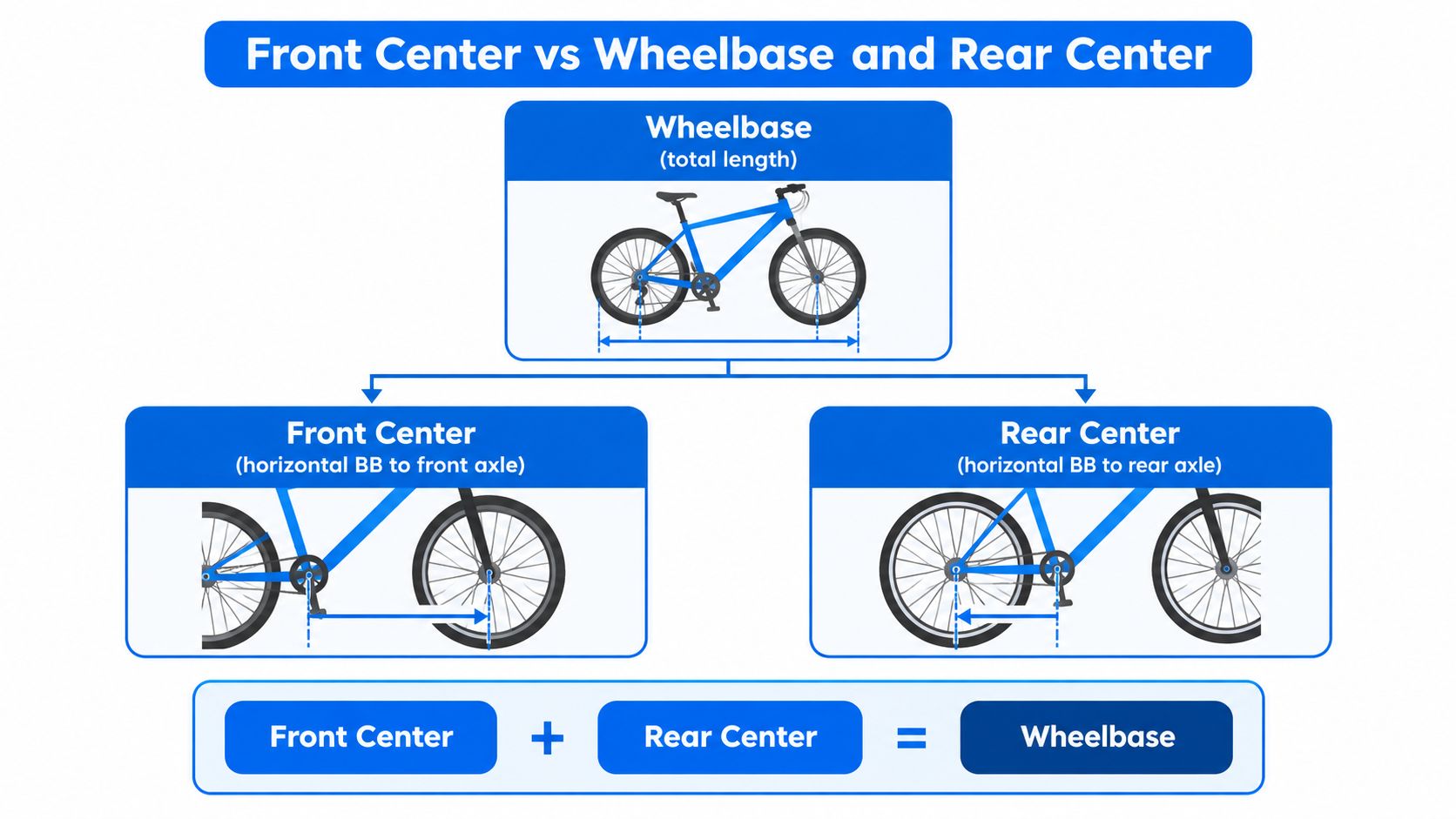
Wheelbase is the total horizontal distance between the wheel axles. To relate front axle position to wheelbase correctly, you need the horizontal components.
The relationship
In horizontal geometry terms:
Front-center horizontal = horizontal bottom-bracket reference to front axle
Rear-center horizontal = horizontal bottom-bracket reference to rear axle
Wheelbase = front-center horizontal + rear-center horizontal
That's the core relationship buyers need to remember. If you only compare wheelbase, you know the total horizontal distance between axles, but you don't know where that length was added.
A published front-center number that follows a different convention should not be treated as automatically interchangeable with front-center horizontal. Likewise, ordinary chainstay length is not automatically the same as rear-center horizontal.
For a deeper wheelbase-only explainer, see SYCLR's bike wheelbase guide.
Why the split matters
A longer wheelbase can come from more front-center horizontal, more rear-center horizontal, or both. Those versions of “longer” are not the same thing in packaging terms.
Front-center horizontal tells you more about the bike's front half in horizontal layout terms. Rear-center horizontal tells you more about the rear half. If one bike adds length mostly in front, it may create different toe-clearance context than a bike that adds more length behind the bottom bracket.
That's why wheelbase alone can hide useful information.
Rear center is not the same job
Rear center is often discussed through chainstay length, but the terms are not always identical in every measurement convention. Chainstay length usually describes the rear axle relative to the bottom bracket as a direct frame dimension, while rear-center horizontal is the horizontal component used for wheelbase math.
Here's the practical comparison logic:
| Dimension | What it locates | Why a buyer checks it |
|---|---|---|
| Front center | Front axle relative to bottom bracket, by the source's stated convention | Helps interpret front-end packaging and compare chart methods |
| Front-center horizontal | Front axle relative to bottom bracket in horizontal terms | Helps interpret wheelbase split and toe-overlap context |
| Rear center / chainstay-related measure | Rear axle relative to bottom bracket, by the source's stated convention | Helps interpret the rear half of the chassis |
| Rear-center horizontal | Rear axle relative to bottom bracket in horizontal terms | Completes the wheelbase split |
| Wheelbase | Total axle-to-axle horizontal length | Helps compare overall chassis length |
A wheelbase number answers “how long is the bike between the axles?” Front-center horizontal helps answer “how far forward is the front axle from the bottom bracket in horizontal geometry terms?”
That distinction matters when you compare bikes that look similar at first glance. One road or gravel bike can have a near-matching wheelbase to another, yet distribute that length differently between front and rear.
How Front Center Relates to Toe Overlap
How much can one geometry line really tell you about toe overlap?
More than many buyers expect, but less than they hope. Front center helps describe the space in front of the bottom bracket, so it belongs in any toe-overlap check. It does not work as a yes-or-no safety score.
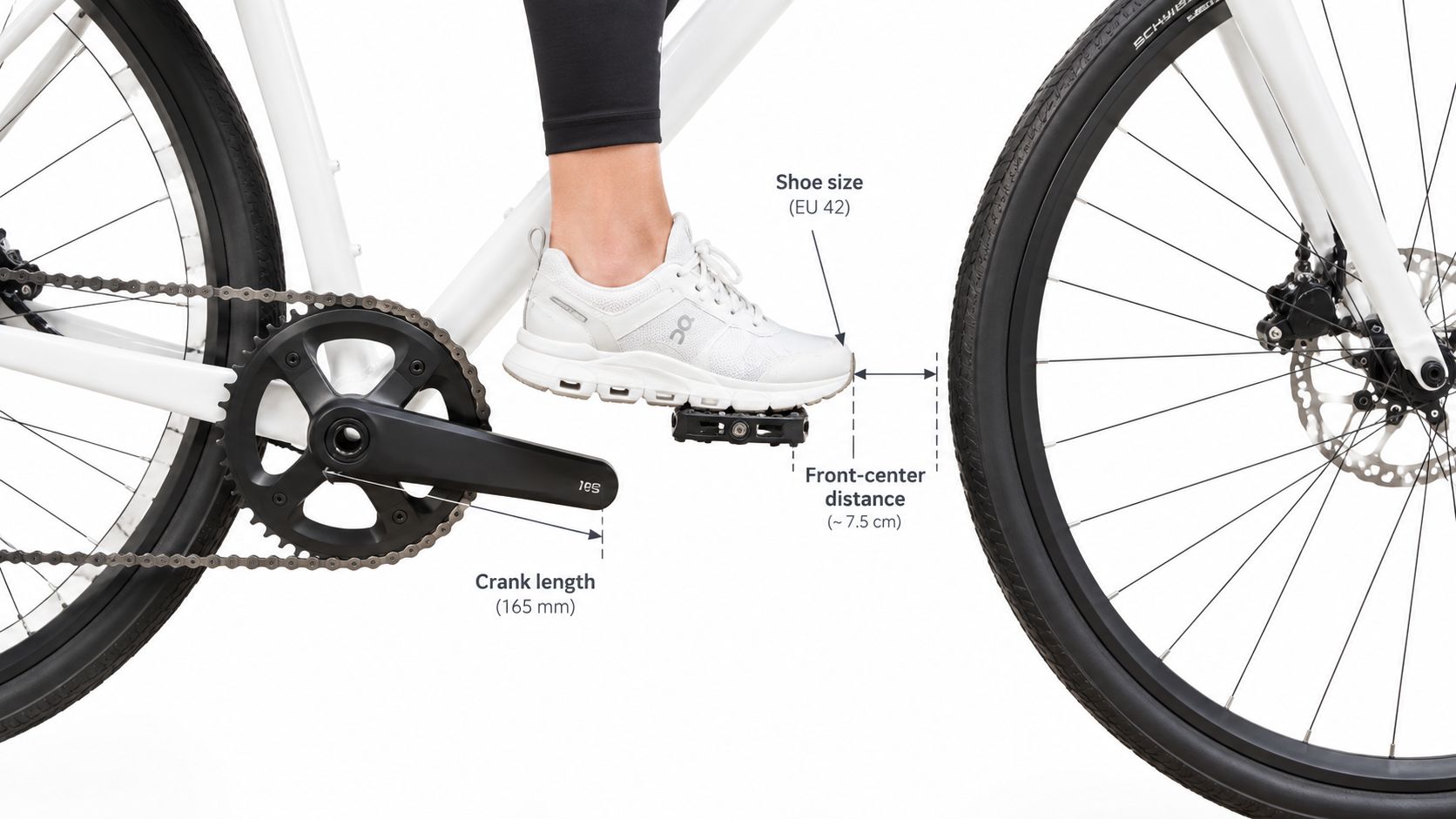
Toe overlap happens when the shoe and the front wheel, or a front fender, try to occupy the same space during steering, usually at very low speed. Front center matters because it helps locate the front axle relative to the rider's foot area. Changing axle position relative to the bottom bracket changes one part of the shoe-to-wheel clearance geometry.
Bike geometry databases such as Bike Insights' front-center reference note the same general packaging concern, especially on smaller road frames where space gets crowded. The key word is packaging. That is the useful lens here.
A simple way to read it is this: front center is one clue about how much room the bike has to arrange the bottom bracket, front wheel, fork, and rider foot without interference. It works like checking legroom in a small car. More room in one direction can help, but seat position, shoe size, and dashboard shape still matter.
That is why front center alone cannot confirm or rule out toe overlap. The outcome also depends on:
Shoe size
Cleat position
Crank length
Wheel and tire size
Fender use
Fork geometry and steering angle
Frame size
A comparison makes this clearer. Two bikes can have similar stack and reach, yet one may place the front axle slightly farther from the bottom bracket by the chart's convention while the other keeps it closer. On paper, both may fit the rider similarly at the contact points. At walking speed in a tight turn, the different front package can change the available shoe-to-wheel clearance.
That does not automatically make the bike a bad choice. Many riders only notice toe overlap in parking-lot turns, U-turns on climbs, or stop-start city riding. A rider with smaller feet may never care. A rider using large shoes, long cranks, and full fenders may care a lot.
The careful way to compare bikes is to treat front center as a supporting signal, not a verdict. Check it alongside wheelbase, rear center, trail, and the brand's size-specific geometry chart. Without that context, a single front-center number can look reassuring while the full front-end package still ends up tight.
For gravel and all-road bikes, this comparison often becomes more useful because designers may be trying to fit larger tires and maintain shoe clearance at the same time. The buyer takeaway is simple. If two bikes share a similar wheelbase, the one with more horizontal length allocated in front may offer a different toe-clearance situation than the one that gains length mostly at the rear.
Does Front Center Affect Fit and Handling
Could one geometry number tell you whether a bike will fit well and handle well? Front center cannot do that job on its own.
Start with fit. Front center sits low on the list for solving a stretched or cramped position because it does not tell you where your hands and saddle end up relative to the bottom bracket. Those questions are answered more directly by reach, stack, stem setup, bar reach, hood placement, and saddle fore-aft. If your main question is body position, bike stack and reach and a broader bike fit guide will usually get you closer to the answer.
Handling takes a little more care. Front center changes the location of the front axle relative to the bottom bracket, while actual wheel loading and handling depend on the complete rider-bike system and full geometry. A simple way to read it is as a packaging dimension. It describes how the bike allocates space in front, not a built-in score for confidence, quickness, or stability.
That distinction matters. Two bikes can share a similar rider position, yet one puts more of its horizontal chassis length in front of the rider while the other puts more of it behind. Those bikes may differ on the road or trail, but front center alone does not tell you how they will steer. Trail, head angle, fork offset, total wheelbase, rear-center length, tire size, and rider posture all shape that result.
A shopping comparison makes this easier to use. If Bike A has a longer front-center figure, ask where that length came from and what stayed the same. Did wheelbase also grow? Did the rear-center dimension stay short? Did trail rise or fall? That is the logic that keeps front center useful. For rear-half context, compare it with chainstay length and rear-center geometry, not by itself.
So yes, front center can affect fit and handling context, but mostly as a supporting signal. It can help explain differences in front-wheel placement and overall packaging. It should be read beside the full size chart, not turned into a universal rule such as “longer is more stable” or “shorter is more agile.”
Why Front Center Changes Between Sizes and Bike Types
Front center changes because manufacturers don't scale frames like photocopies. They adjust several geometry variables together.
Size rows can move more than buyers expect
Published examples show how much front-center figures can move within a size run, but the comparison only works if you keep the exact bike, exact year or generation, exact size, and exact measurement convention aligned.
For example, the 2022 Bulls Grinder 3 is documented in Bike Insights' geometry data with front-center values ranging from 605.9 mm to 673.5 mm across sizes. That is a spread of 67.6 mm within one model line. The useful point is not that this creates a category norm. It's that size-specific front-end packaging can change substantially inside a single bike family.
That's why comparing only a labeled size like 54, M, or L isn't enough.
Brands can change several things at once
Manufacturers may change:
Head angle across sizes
Fork offset to preserve steering goals
Wheel size on the smallest frames
Reach and stack while front center also changes
Some dimensions less than others depending on the platform
So the correct comparison unit isn't “brand” or even “model family.” It's the exact model, exact generation or year, exact size row, and exact measurement convention.
Category labels don't solve this
Road, endurance, race, and gravel labels don't create universal front-center rules. A label does not tell you whether the chart uses front-center, front-center horizontal, or another geometry convention, and it does not guarantee a certain ride feel.
A short table makes that easier to see:
| Example | Published value | Why it matters |
|---|---|---|
| 2022 Bulls Grinder 3 across sizes | 605.9 mm to 673.5 mm | Demonstrates size-specific variation within one model line |
| A manufacturer chart that lists front-center only | Chart-specific | Shows why you must keep the source's published definition intact |
| A geometry database that separates front-center and front-center horizontal | Database-specific | Shows why wheelbase math should use horizontal components only |
The buying takeaway is practical. If you're comparing two bikes and one has a front-center difference that looks meaningful, don't stop there. Check whether the brand also changed wheel size, head angle, fork design, or size-specific geometry strategy.
How to Compare Front Center When Buying and How SYCLR Helps
Use front center as a supporting packaging signal, not a final verdict.
A clean comparison workflow
When you're shopping road or gravel bikes, especially used listings, this order usually works best:
Confirm the exact bike identity
Match the listing to the correct model year or generation first. Front-center comparisons break quickly if the chart is wrong.Check primary fit signals first
Use stack and reach before front center. They're more useful for frame-level fit than front center is.Check the measurement convention
Note whether the source publishes front-center, front-center horizontal, or another related dimension.Compare front center with wheelbase and rear center
Don't ask whether one bike is “long” or “short.” Ask where the length sits, and use horizontal components for wheelbase logic.Use front center for packaging questions
It's especially helpful when you want more context on front-wheel placement, toe-overlap risk, and why two similar bikes may package the front end differently.Treat missing data carefully
If a seller doesn't provide the exact size or year, your geometry confidence drops. That should affect how much certainty you place in the listing.
A short buyer checklist
Exact size row: Don't compare a size M chart to a size L listing.
Model-year context: Revisions can change geometry without changing the bike's name.
Measurement convention: Front-center and front-center horizontal are not always interchangeable.
Front and rear together: Wheelbase alone hides the split.
Toe-overlap context: Look at the complete setup, not one threshold.
Fit first: Stack and reach still lead the decision.
General marketplaces may show plenty of inventory, but they usually won't interpret fit signals, geometry signals, model-year context, price context, listing quality, or confidence signals for you.
How SYCLR helps
For buyers who want a more organized comparison workflow, SYCLR is a fit-aware road and gravel bike discovery platform that helps compare listings using rider details, bike type, budget, available fit and geometry data, model-year context, price context, listing quality, condition signals where available, and confidence signals. It doesn't perform a professional bike fit, physically inspect bikes, authenticate listings, verify ownership or seller claims, or guarantee fit or condition.
If you already know your stack, reach, current-bike geometry, or fit-report details, the advanced fit entry is the more useful starting point. Otherwise, start simple and compare road and gravel listings in the SYCLR app by height, bike type, and budget so you can shortlist better-fit options with less guesswork.
Front Center Bike Geometry FAQs
What is front center on a bike
It's the distance from the bottom-bracket center to the front-axle center, but the exact meaning depends on the source's measurement convention. Some charts and databases also distinguish front-center horizontal as the horizontal component.
How is front center measured
It is measured from the bottom bracket to the front axle according to the source or manufacturer definition. The best source is the manufacturer geometry chart for the exact model, year, and size. If a database also lists front-center horizontal, keep that separate from the general front-center figure.
Is front center part of wheelbase
Only front-center horizontal is directly part of wheelbase math in horizontal geometry terms. Front-center horizontal + rear-center horizontal = wheelbase. A published front-center figure that uses another convention should not automatically be added to chainstay length and treated as wheelbase.
Does front center affect toe overlap
It can contribute to toe-overlap context because it changes one part of the shoe-to-wheel clearance geometry, but it's only one factor. Crank length, shoe size, cleat position, wheel and tire size, fork geometry, fenders, and frame size also matter.
Does a longer front center make a bike more stable
Not by itself. Front center changes the location of the front axle relative to the bottom bracket, but handling depends on the complete rider-bike system and the full geometry package.
Does front center affect bike fit
Not as a primary fit coordinate. Stack, reach, stem, bar reach, hood placement, and saddle position do far more to determine whether the cockpit feels right.
Should I compare front center when buying a bike
Yes, but as a supporting signal. It's useful when comparing front-end packaging, wheelbase split, and toe-overlap context, especially if two bikes have similar stack and reach.
If you're comparing road or gravel bikes and want more than a generic size label, SYCLR helps you sort listings by fit and geometry signals, model-year context, price context, and listing confidence. Start with height, bike type, and budget, then compare better-fit options before you click through to a seller.