
Bike Chainstay Length Explained: What Rear-Center Means
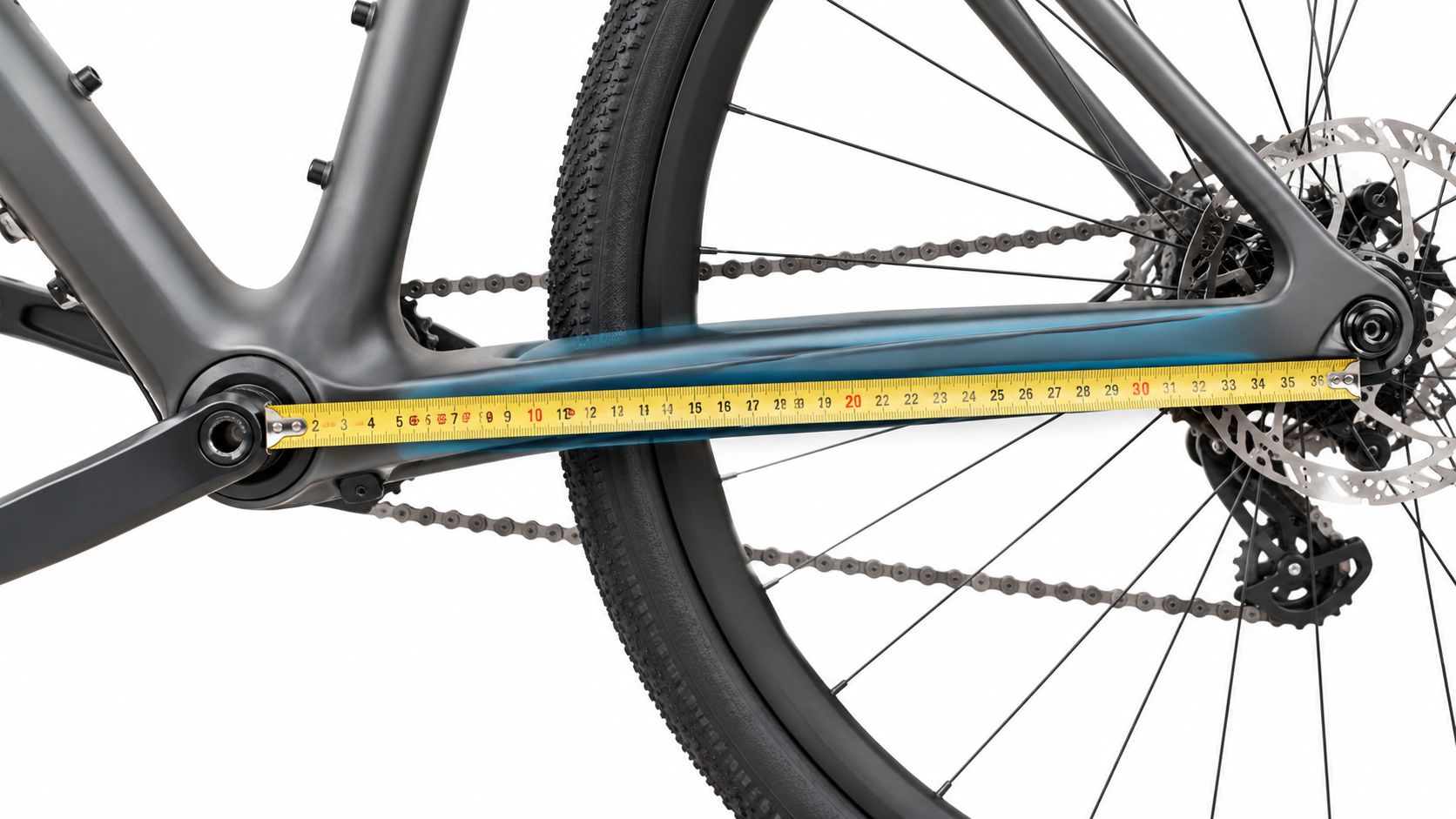
The most common advice about bike chainstay length is too simple. Buyers often hear neat one-line rules, then stop there. That skips the core issue. Bike chainstay length is one geometry signal, not a verdict on how a bike will ride. It matters because it helps define rear-center, wheelbase, clearance, and packaging, but it only makes sense when you compare it with front-center, trail, head angle, fork offset, tire setup, rider position, load, and speed.
Table of Contents
- What Bike Chainstay Length Actually Means
- Chainstay Length vs Rear Center
- How Chainstay Length Fits Into Wheelbase
- Why Bikes Use Different Chainstay Lengths
- Does Chainstay Length Change Handling
- Road vs Gravel Chainstay Length
- Why Chainstay Length Can Change Between Sizes
- How to Compare Chainstay Length When Buying
What Bike Chainstay Length Actually Means
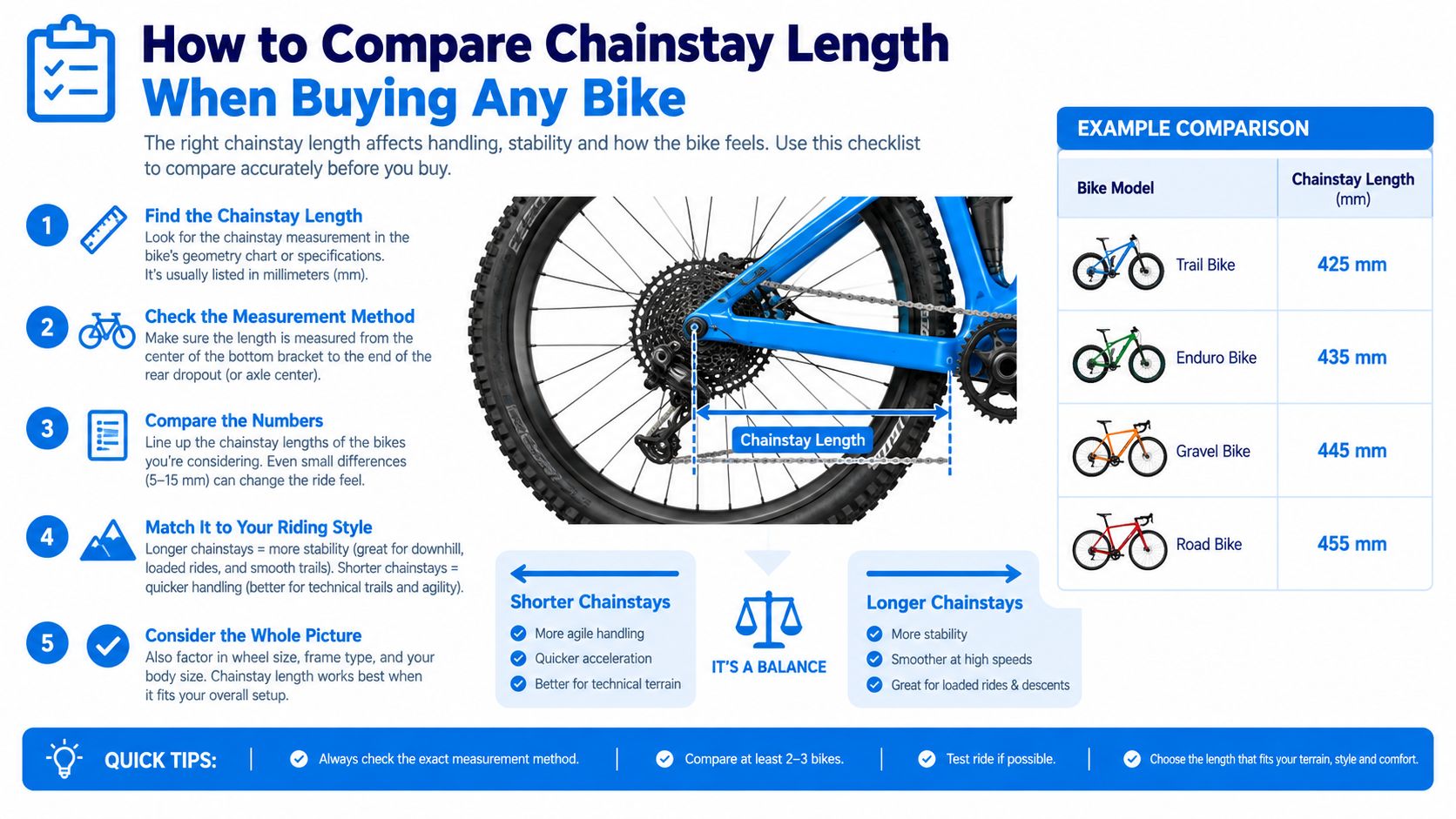
A chainstay number is less dramatic than bike marketing makes it sound. It is a simple geometry measurement: the distance from the center of the bottom bracket to the center of the rear axle. That center-to-center value is the one shown in geometry charts, and it is the number worth comparing across frames.
Confusion starts because the name points to a frame part you can see. Buyers often assume the published number follows the tube itself, tracing whatever curve, bend, or dropped shape the stay uses. In practice, the chart is usually reporting a straight reference between two fixed points.
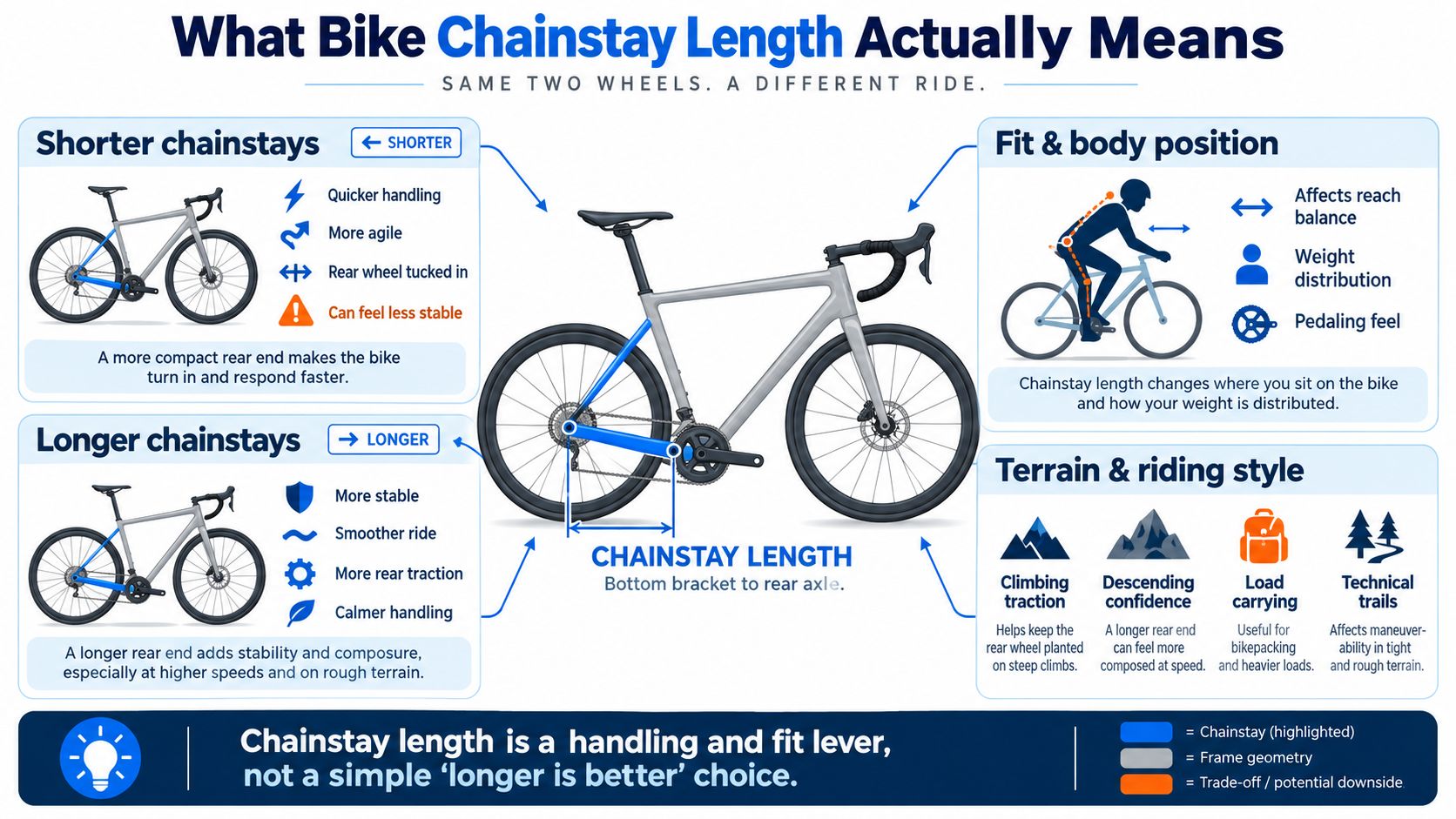
Where the measurement starts and ends
Start at the bottom bracket center. End at the rear axle center.
That sounds almost too plain to mention, but this is what makes the number repeatable. If one frame has a straight stay and another uses a heavily shaped stay for tire or chainring clearance, the visual tube length can mislead you. The center-to-center method avoids that problem.
A good way to read it is as a map coordinate, not a tape-measure path along the material. The frame tube is the structure. The published chainstay figure is the geometry reference.
Why geometry charts use this method
Geometry charts need numbers that stay consistent even when tube shapes change. Using the bottom bracket center and rear axle center gives brands, fitters, and buyers a common reference point. That is why established geometry discussions define chainstay length this way, including The Cycling Independent on chainstay length and geometry.
This also helps place chainstay length in the right context. By itself, it does not tell you how a bike will feel. It contributes to a larger layout that includes wheelbase, front-center, trail, tire size, and the space a designer needs around the crank, chainrings, and rear wheel.
Practical rule: Read chainstay length as a geometry number from bottom bracket center to rear axle center, not as the visible length of the tube.
Why this matters for buyers
Two bikes can look very different at the rear triangle and still share nearly the same published chainstay figure. One may flare outward for tire room. Another may use a dropped or flattened stay to solve packaging constraints. Photos can make those bikes seem farther apart than they are.
So compare the chart number first. Then read that number with the rest of the frame geometry, because chainstay length only becomes meaningful once it sits beside the bike's other coordinates.
Chainstay Length vs Rear Center
In most road and gravel geometry charts, chainstay length and rear-center are used almost interchangeably. For practical buying purposes, that is usually fine.
The useful distinction is this: chainstay is the frame part you can point to, while rear-center is the geometry relationship between the bottom bracket center and the rear axle center. On many bikes, those two labels end up describing the same published value.
Why the terms overlap
Rear-center works well because it does not depend on the exact shape of the frame member. That matters when a bike has dropped seatstays, unusual tubing, clearance-driven shaping, or a layout where the visual line of the stay tells you very little.
A geometry chart is not trying to describe tube sculpture. It is trying to give a repeatable number. Rear-center does that cleanly, so many catalogs keep the more familiar term chainstay length even though the chart is really reporting the rear-center dimension.
When the distinction helps
The distinction matters most when a buyer tries to measure from photos or compare marketing copy with a geometry chart. If the physical stay bends outward for tire room or uses an unusual yoke near the bottom bracket, the tube does not provide a reliable measuring path.
Rear-center is best understood as a virtual geometry line. That is why it remains useful even when frame shapes change.
For most buyers, the practical takeaway is simple. If two brands use different language, check whether both are referring to the same bottom-bracket-center to rear-axle-center measurement. Usually they are.
How Chainstay Length Fits Into Wheelbase
Chainstay length does not explain a bike on its own. It explains one coordinate in a larger layout, and wheelbase is the first place that becomes clear.
Using standard geometry definitions, front-center plus rear-center equals wheelbase. That sounds abstract until you compare two frames with similar overall wheelbase but different ways of arriving there. One can place more of that length in front of the bottom bracket. Another can place more behind it. Those bikes may share a similar axle-to-axle number while differing in front-center, rear-center, tire-clearance requirements, and the rest of the chassis geometry.
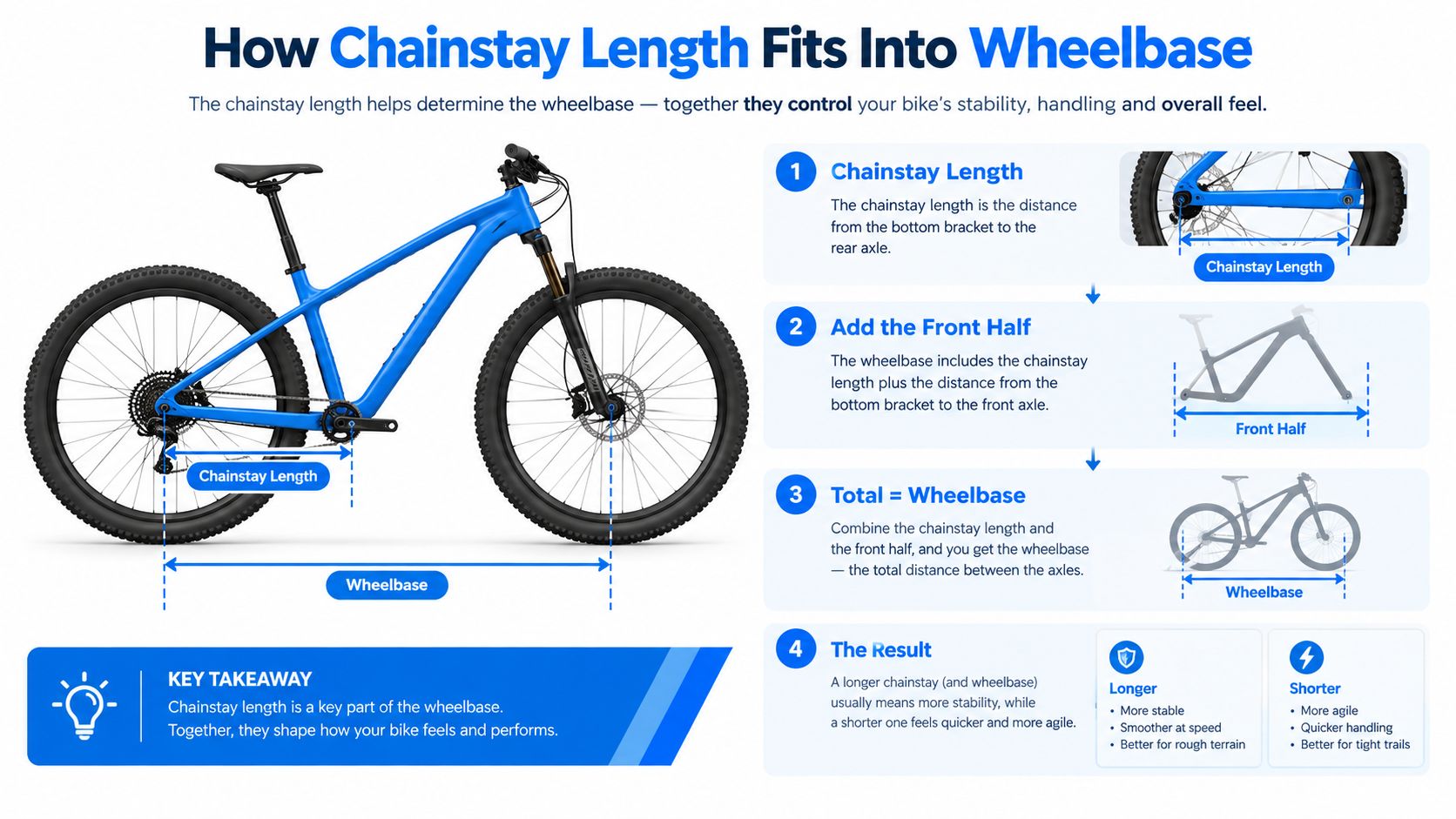
The simple geometry relationship
Viewed from the side, the bottom bracket sits between the two axles. Front-center is the horizontal distance from the bottom bracket center to the front axle center. Rear-center is the horizontal distance from the bottom bracket center to the rear axle center. Using those horizontal geometry definitions, front-center plus rear-center equals wheelbase.
The bookkeeping matters. If one brand reports a true rear-center and another description follows the visual line of a curved stay, the numbers stop matching cleanly. For comparison, use values measured from center to center in the same geometric convention.
Why buyers should care
Wheelbase, front-center, and rear-center are easiest to read as parts of one chassis layout. Front-center can grow while rear-center stays fixed. Rear-center can change because a frame needs different packaging around the bottom bracket and rear wheel while the front half changes very little.
That is why a rear-center number only becomes useful once you read it beside front-center, wheelbase, trail, and tire setup. The rear triangle is one part of the conversation, not the whole script.
If you want a clearer primer on the full axle-to-axle number, SYCLR's guide to bike wheelbase explained adds that wider context.
One comparison method that works
A useful buying comparison is to read chainstay length as one part of the total layout.
Ask:
What is the wheelbase overall
How much of that length sits in the front-center versus the rear-center
Are both bikes using the same wheel size and similar tire setup
Are you comparing the exact model year, size, and configuration
That approach keeps you from over-reading one number. A rear-center value means something different when wheel format, tire clearance, drivetrain layout, and front-end geometry differ.
Why Bikes Use Different Chainstay Lengths
A chainstay number is often the result of constraints, not a designer chasing a single ride adjective.
That matters because buyers are often taught to read rear-center length as a direct signal of personality. In practice, rear-center has to coexist with tire clearance, chainring and drivetrain packaging, mud space, wheel size, cargo requirements, frame construction, and the bike’s broader design goals. The rear triangle is less like a single tuning knob and more like a packaging problem inside a fixed area.
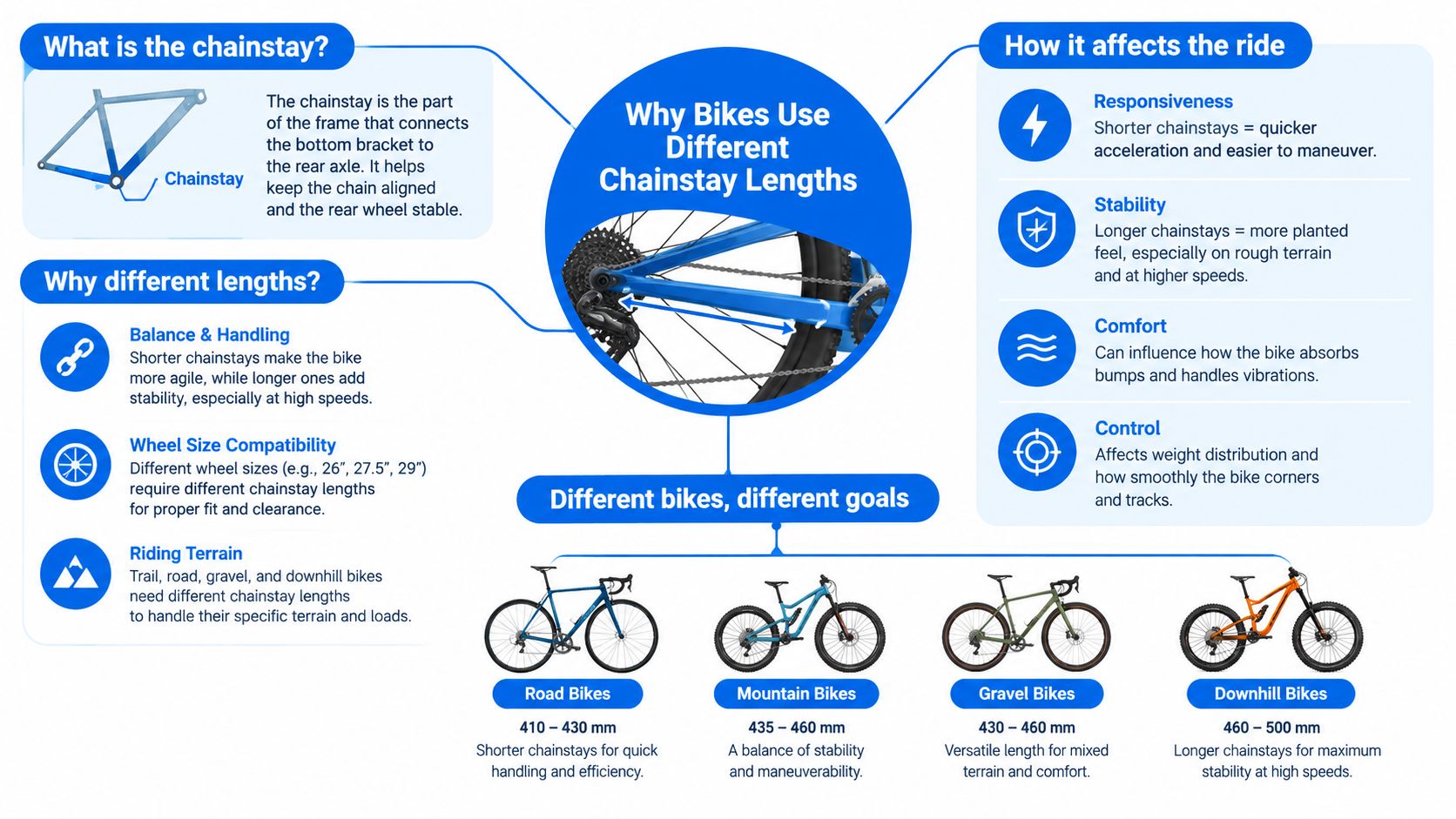
Clearance and drivetrain packaging
Rear-center can be influenced by several overlapping constraints:
Tire clearance
Mud clearance
Chainring and front derailleur packaging
Chainline
Frame shaping
Wheel size
Cargo and rack packaging
The stay itself is only part of that clearance story.
A frame can gain space through a yoke, dropped stays, asymmetric shaping, or a different chainline. It can also lose space if the design has to clear a large chainring, a front derailleur, or a wide tire on a wide rim. Rear-center is part of that packaging system, but it does not guarantee any single clearance outcome by itself.
Drivetrain choices push the same area from another direction. Wide-range cassettes, front derailleur placement, axle spacing, and crank setup all compete for a small zone around the bottom bracket and rear wheel. Change one of those pieces, and the rear-center number may need to move to keep the whole system working.
Different bikes solve different problems
Two bikes can land on different rear-center measurements even if the designers are solving similar use cases. They may simply be working around different packaging jobs.
Common reasons include:
Wheel size: 650b and 700c layouts use the rear triangle differently.
Mud space: Off-road bikes need clearance for debris, not just the tire casing.
Cargo and heel clearance: Racks, bags, and panniers can change where the rear wheel sits relative to the rider, but heel clearance also depends on rack or pannier placement, foot and shoe position, crank length, and frame design.
Frame shaping and standards: Bent stays, dropped stays, yokes, dropout design, and axle spacing all affect what is practical.
A useful way to read this is simple. Chainstay length is one coordinate in a larger geometry map, not a verdict on its own.
A rear-center number often marks the point where tire fit, drivetrain layout, and intended use finally meet.
Does Chainstay Length Change Handling
Yes, but only as part of a larger system.
A rear-center number changes one spatial relationship in the chassis: where the rear wheel sits relative to the bottom bracket. Handling depends on what that means alongside front-center, wheelbase, trail, head angle, fork offset, tire setup, rider position, load, and speed.
That is why two bikes can share a similar rear-center measurement and still feel quite different on the road or trail. The rear-center number is part of the sentence, not the full meaning.
Why the simple story falls apart
A single geometry number cannot stand in for the whole bike. Consider two frames with the same rear-center. One may have a longer front-center, different trail, a different head angle and fork offset pairing, different tire volume, and a different rider position. Another may keep the same rear-center but change wheel format, handlebar reach, or load placement. The rear triangle stayed similar, but the complete chassis did not.
A good way to picture it is a table with several legs. Change one leg and the table changes. Change more than one at the same time, and the final balance depends on the combination, not on a single cut.
What usually shapes the feeling on the bike
Buyers often fixate on chainstay length because it is easy to find on a geometry chart. In practice, it shares the job with several other numbers and setup choices.
| Signal | What it describes |
|---|---|
| Rear-center | Bottom bracket center to rear axle center |
| Front-center | Bottom bracket center to front axle center |
| Wheelbase | Front axle to rear axle |
| Trail | Steering-axis and contact-patch relationship |
| Tire setup | Mounted tire size, pressure, and casing |
| Cockpit | Hand position and steering leverage |
For a clearer view of how steering geometry fits into this, read bike trail geometry explained.
Bike chainstay length works best as one coordinate in a longer geometry sentence rather than a standalone ride-feel score.
Road vs Gravel Chainstay Length
The easy story says road bikes sit in one category and gravel bikes in another. Geometry charts are rarely that neat.
Road and gravel rear-center measurements overlap substantially. That is the useful starting point. A category label alone does not tell you enough to interpret the number, especially when frames differ by model generation, wheel format, tire clearance, drivetrain configuration, and frame size.
The overlap is the point
A rear-center measurement can appear on a road bike, an all-road bike, or a gravel bike without meaning the same thing in practice. The difference comes from the rest of the frame around it, including front-center, wheelbase, trail, wheel size, tire volume, and packaging around the bottom bracket and rear wheel.
That is why road versus gravel comparisons work best when you compare the exact bike, not the category.
Compare the exact configuration
Use the published geometry for the exact model, generation, size, wheel format, and configuration you are actually considering.
If you want examples, use specific current manufacturer geometry pages rather than universal category assumptions. A model offered in multiple wheel formats, drivetrain builds, or size-specific layouts may not keep the same rear-center across every version.
For the broader category decision, compare the full design brief in gravel bike vs road bike.
Why Chainstay Length Can Change Between Sizes
Two sizes of the same bike do not always share the same rear-center. Some brands hold it constant across the size range. Others vary it by size. Others make it adjustable or change wheel size on some sizes and build the geometry around that choice.
That matters because you are not buying a model name in the abstract. You are buying one exact size row from one exact generation.
Four common size-run strategies
| Approach | What happens to rear-center |
|---|---|
| Fixed rear-center | The number stays the same across the size range |
| Size-specific rear-center | The number changes between sizes |
| Configurable rear-center | The frame allows more than one rear-center setting |
| Wheel-size-specific geometry | Wheel size changes on some sizes, with geometry adjusted around that choice |
Manufacturers choose different strategies, and the geometry chart is the place to verify which one applies.
Why buyers get tripped up
A review may discuss the medium size. A used listing may be for a small. A manufacturer may revise part of the geometry in a new generation while leaving the product name almost unchanged. Any of those can distort the comparison if you read only a headline spec.
Read the exact geometry row for the exact size and model year you are considering. Anything less is only a rough clue.
Chainstay length also is not a primary fit coordinate. If you are deciding whether a frame suits your body, stack and reach are usually more useful frame-level fit signals. These pages go deeper on that: bike stack and reach and the broader bike fit guide. If you are choosing between adjacent sizes, compare the complete geometry and fit context rather than using rear-center as the deciding number.
How to Compare Chainstay Length When Buying
Use bike chainstay length as a supporting comparison field, not a shortcut.
Start with the geometry chart for the exact size. Find the rear-center or chainstay number, then look immediately at the wheel size, stated tire clearance, and the matching wheelbase and front-center values. That turns one number into a usable comparison.
What to compare
Use this short checklist:
Match the exact size row: Small versus medium can change the result.
Match model year and generation: Similar names can hide geometry changes.
Match wheel format: Do not compare 650b and 700c rear-center numbers as if nothing else changed.
Match configuration: Tire clearance, drivetrain layout, and frame options can affect the result.
Read wheelbase with rear-center: The rear number only makes sense inside the full axle layout.
Check the frame's clearance brief: Tire room, mud room, and cargo packaging can explain why the value moved.
Note drivetrain context: Front derailleur use, 1x packaging, chainline, and chainring clearance can all affect the design.
If you need help reading the chart itself, use SYCLR's guide to the bike geometry chart.
What to ignore
Do not give too much weight to marketing words unless the geometry chart supports the story. And do not compare raw chainstay numbers from two listings if one seller copied an incomplete spec sheet and the other used the exact manufacturer chart.
One practical tool option is SYCLR. It helps riders compare road and gravel listings using fit signals, geometry signals, model-year context, price context, listing quality, condition signals where available, and confidence signals. Chainstay or rear-center is a supporting geometry signal within that bigger picture. It does not perform a professional bike fit, physically inspect bikes, authenticate listings, verify ownership or seller claims, or guarantee fit or condition.
A calm buying process usually looks like this:
Confirm the correct size first
Check stack and reach before rear-center
Compare wheelbase, front-center, and tire setup together
Use chainstay length to explain differences, not to make the whole decision
If you are comparing road or gravel listings and want rear-center in the right context, SYCLR helps you sort options by fit-aware signals instead of reading one geometry number in isolation. Start with height, bike type, and budget, or add deeper fit details at Advanced Fit to compare stack, reach, wheelbase, and listing context before you shortlist better-fit bikes.