
Clear bike identity
The listing points clearly to a specific bike, not a family of look-alikes.
Data & Evidence
Bike geometry is only useful when it belongs to the correct bike. SYCLR evaluates manufacturer geometry with model identity, frame size, generation, and model year in mind — rather than assuming that similar names or labels refer to the same frame.
Why It Matters
Frame geometry is what lets bikes be compared across brands. A nominal size label alone is not enough — the exact dimensions are where meaningful differences show up.
But geometry only becomes valuable once it is mapped to the correct model, size, and generation. For what the individual numbers mean, see stack and reach and a road bike geometry comparison. This page is about how SYCLR decides whether that geometry can be trusted in the first place.
Identity
A model name can stay the same for years while the bike underneath it changes. That makes the name a starting point, not proof of geometry.
The same product name does not guarantee the same geometry.
Generation
Manufacturers redesign bikes, and geometry tables can change with each redesign. When the year or generation of a listing is ambiguous, that ambiguity can be enough to hold back geometry rather than risk attaching a table from the wrong bike.
Correctly unknown is better than confidently wrong.
SYCLR would rather withhold uncertain geometry than silently apply a table from a different generation of the same model.
Size
One geometry table usually holds several frame sizes, so identifying the right bike is only half the job. The listed size still has to line up with the correct row in that table.
Retailer size labels can be centimeters, letters, or a brand's own size names, and those are not always interchangeable. When the size evidence is ambiguous, geometry may stay unattached rather than be matched to a guess. For the underlying sizing references, see the road bike size chart and the gravel bike frame size chart.
Sources
Retailer listings are valuable for what is on sale right now: availability, price, size, imagery, components, and the context of the listing itself.
Manufacturer data is preferred for official geometry and spec context where it is available. Retailer copy is useful, but it is not automatically promoted into manufacturer authority.
When sources conflict, that is a signal to investigate — not something to average or guess.
A Real Comparison
In this real SYCLR comparison, both bikes are labeled 56cm, yet their geometry is not identical. That is why SYCLR treats nominal frame size as context rather than proof that two bikes are equivalent.
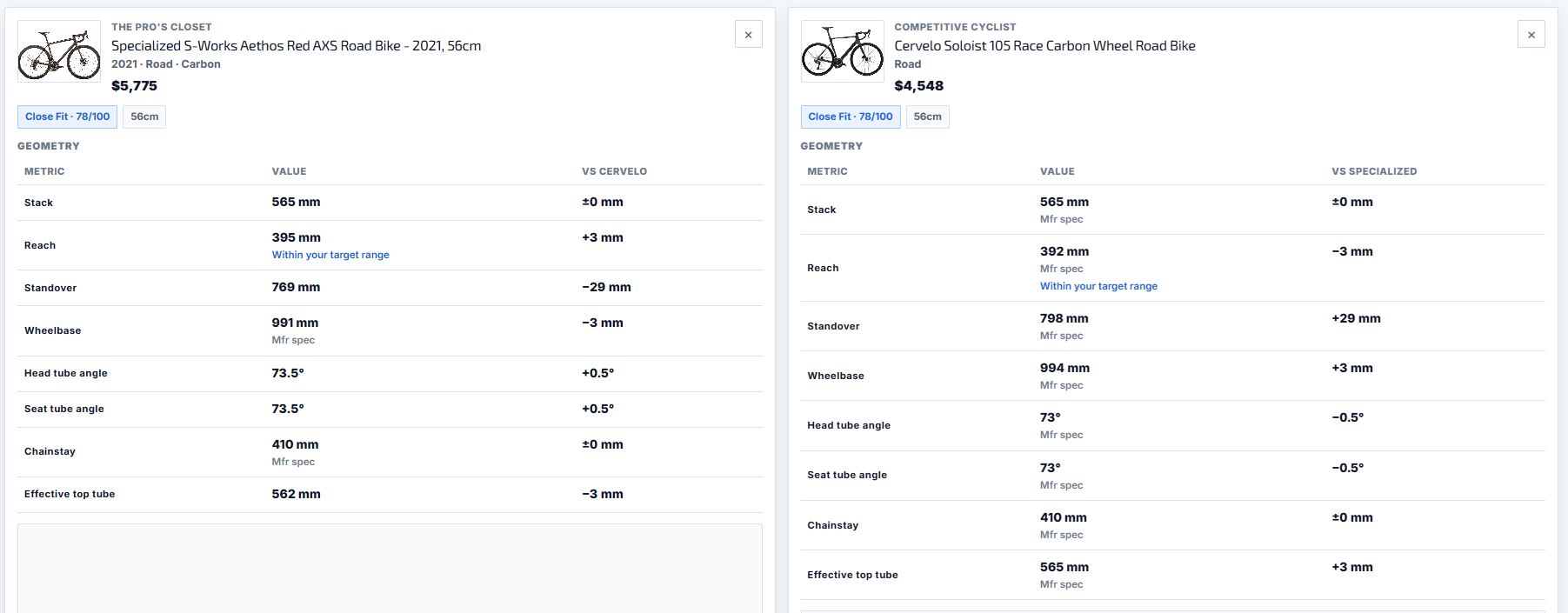
| Metric | Specialized S-Works Aethos | Cervelo Soloist | Difference |
|---|---|---|---|
| Frame label | 56cm | 56cm | Same label |
| Stack | 565 mm | 565 mm | 0 mm |
| Reach | 395 mm | 392 mm | 3 mm |
| Standover | 769 mm | 798 mm | 29 mm |
| Wheelbase | 991 mm | 994 mm | 3 mm |
| Head tube angle | 73.5° | 73° | 0.5° |
Both frames share the same 565 mm stack, but a shared stack does not mean identical frame proportions. Reach differs by 3 mm and wheelbase by 3 mm, while standover differs by 29 mm — a materially larger gap than the others. The half-degree difference in head and seat tube angle is small on its own, yet geometry is best read as a system rather than one isolated number.
Several values in this comparison are marked Mfr spec. Where manufacturer-spec geometry is available and appropriately matched, SYCLR can use it to make cross-bike comparison more informative — without changing how any bike is fit, ranked, or scored.
One evidence detail is worth noting: the Specialized listing identifies a 2021 model year, while the Cervelo listing shown here does not display a model year. This does not make the Cervelo geometry invalid. It illustrates why model-year and generation context are separate pieces of evidence that SYCLR keeps visible rather than silently infers.
The label is context. The geometry is evidence.
This comparison is not here to declare one bike better. It shows why SYCLR separates a size label from the geometry evidence behind it: both bikes can be called 56cm while still presenting different dimensions, and those differences become useful only when the geometry belongs to the correct bike and size.
Honesty About Data
If model, generation, or size evidence is too ambiguous, SYCLR may leave geometry unavailable. An unsupported field is not inferred merely because a similar model happens to exist.
Incomplete geometry is better than fabricated precision.
A listing with less geometry depth can still take part in useful comparisons. This is the same principle that governs the rest of how SYCLR works: unknown stays unknown.
Confidence
Stronger evidence allows SYCLR to compare geometry with greater confidence. Confidence tends to rise when more of these line up.
The listing points clearly to a specific bike, not a family of look-alikes.
The generation or design era of the frame is identifiable.
The listed size can be matched to the correct row of the geometry table.
Official manufacturer geometry is available rather than only third-hand copy.
The numbers agree with each other and with the bike they claim to describe.
The listing context and the manufacturer evidence tell the same story.
Evidence Over Coverage
Maximizing geometry coverage is not the same as maximizing accuracy. Forcing every listing into a manufacturer record can manufacture false certainty, and an ambiguous bike is more honestly left ambiguous.
More enriched listings are not automatically better if the enrichment is wrong.
This is the geometry-level expression of a broader commitment described on Recommendation Integrity.
For Riders
Some listings will carry richer geometry context than others, and that is expected. Missing geometry does not automatically make a listing bad — it just means there is less to compare on.
Where geometry evidence is stronger, comparisons are more useful. Nominal size labels should not be treated as universal, and exact model, year, and size information makes a listing easier to place. Pair that with your own fit knowledge from the bike fit guide.
The Standard
The commitments behind how SYCLR treats manufacturer geometry.
Geometry should belong to the correct model and generation, not a look-alike.
Geometry should correspond to the actual listed frame size.
Official manufacturer geometry is preferred when it is available.
Unclear year, generation, or size can remain unresolved.
Similar names are not treated as proof of the same bike.
More geometry is not better if the geometry is wrong.
See It In Practice