
How to Buy a Used Bike Online Without Guessing on Fit or Value
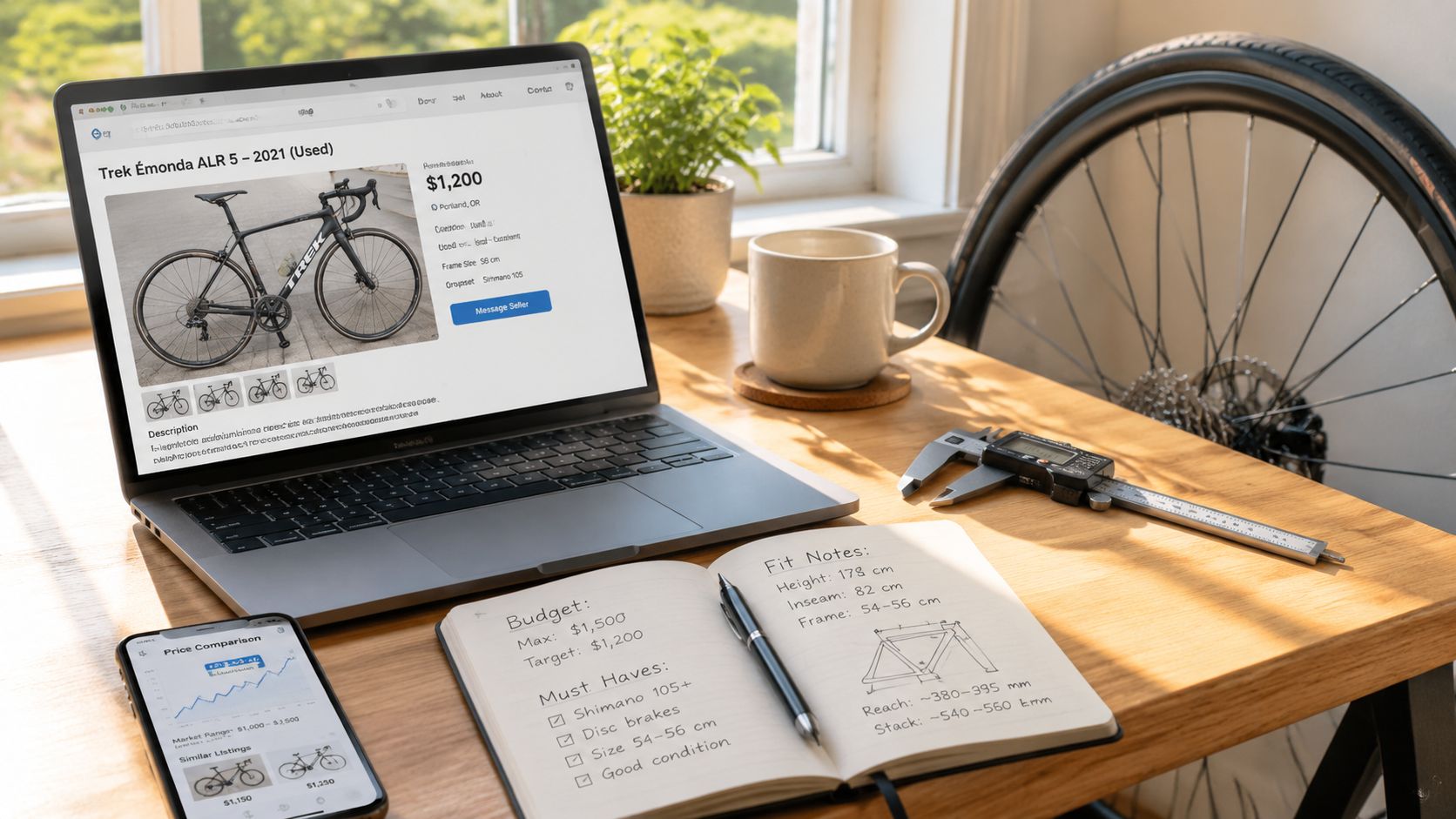
You're scrolling through used bike listings late at night, and every ad looks almost right until you notice the missing model year, the blurry drivetrain photo, or the size that never quite lines up with your fit. That's the trap. Buying a used bike online is not a race to the cheapest price, it's a process for cutting uncertainty before you message a seller, send payment, or book shipping.
The disciplined way to do it is simple: start with fit, verify the exact bike, compare price context, then test the seller’s credibility. That order matters because online listings can waste your time fast. A listing that lacks model-year details, clear photos, geometry context, or seller transparency should move down the shortlist until those gaps are resolved.
Table of Contents
Introduction to Disciplined Online Bike Buying
A cheap listing can look tempting and still be a bad buy. The size may be wrong, the photos may skip the parts that matter, or the seller may not know enough about the bike to answer basic questions. Once those gaps show up, the deal usually stops being a deal.
Use a fit-first workflow. Start with the rider, then check the bike itself, then compare value, then judge the seller and the terms. That order cuts through clutter because a used bike only makes sense when the bike, the rider, and the listing all point in the same direction.
Practical rule: If the listing cannot answer basic identity and fit questions fast, skip it.
Road and gravel buyers need that discipline even more. A bike can look clean in photos and still ride badly for the terrain, position, or handling you want. Fit-aware browsing keeps the focus on bikes that have a chance of working before you spend time chasing them.
Buyers also need to judge listing quality and source confidence with a clear eye. Listings that leave out model details, show only flattering angles, or rely on vague descriptions create wasted clicks and messy conversations. The market offers plenty of bikes. The buyer who filters hard and trusts only strong signals gets to the short list faster.
Understanding Rider Needs and Fit Signals
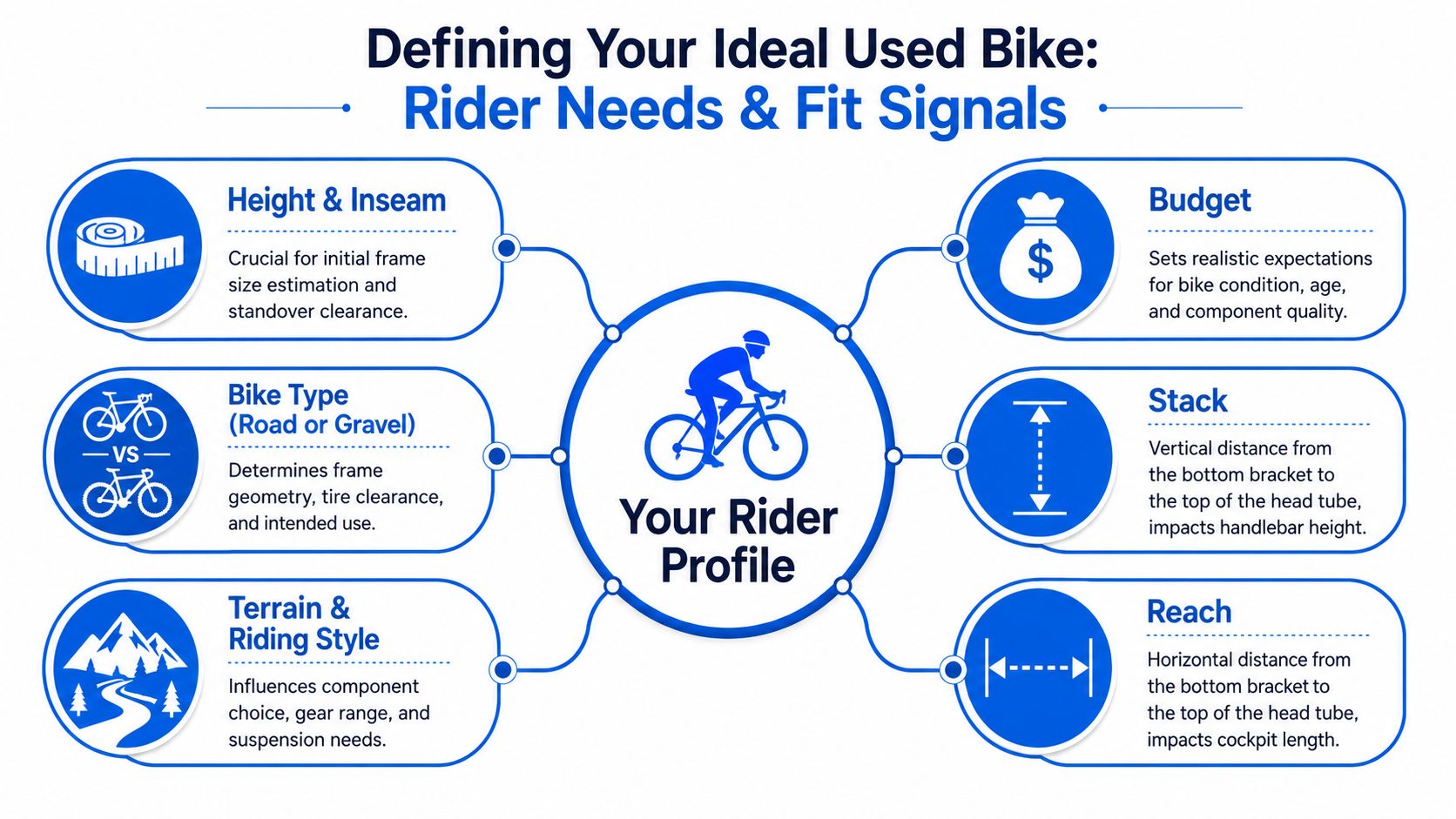
Start with the rider, not the listing. If you don't know whether you're shopping for road or gravel, what terrain you ride, and what budget you're comfortable with, you'll waste time on bikes that were never realistic. Height helps with an initial frame-size screen, but height alone is not enough for precise fit.
Lock in the rider profile first
Think in terms of bike type, terrain, riding style, and budget. A road rider looking for fast pavement efficiency shouldn't browse the same geometry pool as a gravel rider who wants stability, tire clearance, and room for mixed-surface use. Those choices shape everything that comes after, including which listings deserve a click.
The useful fit signals are stack, reach, and standover. Stack influences handlebar height. Reach influences cockpit length. Standover gives a basic clearance check, but it doesn't decide fit on its own. If you already know fit details from another bike or a fit report, use SYCLR’s fit-details flow to compare listings with a stronger starting point.
A bike that matches your riding goals but misses your position is still the wrong purchase.
Set budget expectations against the broader market, not just the first listing you see. If you're shopping used because new retail is out of range, that's fine. But if a used listing is already close to new-bike territory, the value argument gets weak fast, especially once you add shipping or replacement parts.
SYCLR's bike fit guide is the right place to keep the fit conversation separate from the listing hunt. Use it to narrow the search before you start comparing individual bikes.
Verifying Bike Identity and Geometry Signals
A frame size like 54 cm is a starting point, not a fit check. Two bikes with the same size label can ride very differently because brands use different geometry, different top-tube lengths, and different fit priorities. If you judge price before confirming the exact bike, you are comparing numbers without knowing what you are buying.
Confirm the exact bike, not just the model line
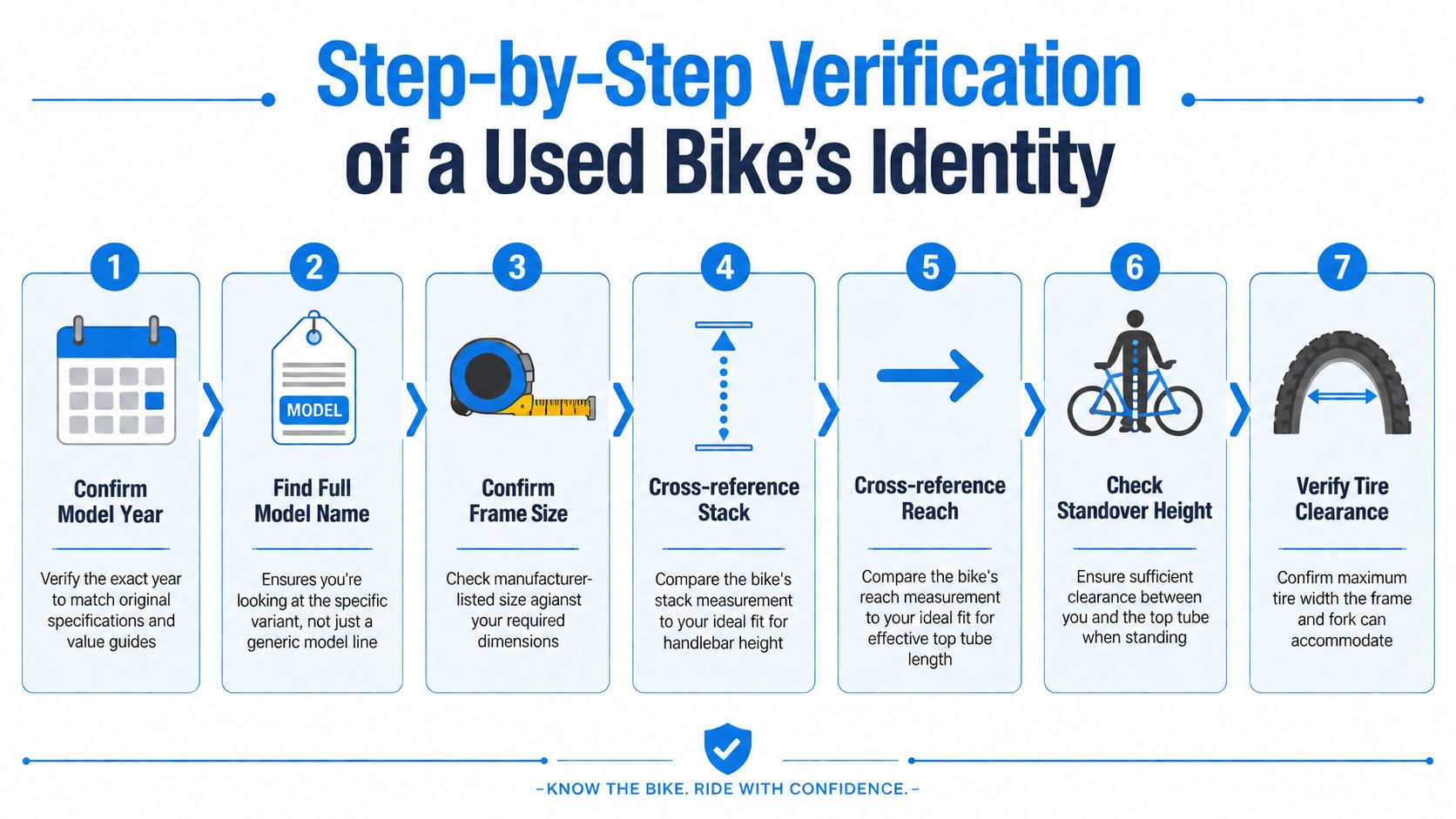
Get the full model name, the exact model year, and the frame size before you judge value. Those details matter because component spec, geometry, and even tire clearance can change across model years and trim levels. A vague listing that says “Trek road bike” or “Gravel bike, medium” is not enough to shortlist confidently.
Use published geometry charts or manufacturer archive pages when they are available, then compare the listing's claimed size against the bike's actual geometry. The point is simple, decide whether the bike belongs on your shortlist at all. If the size or geometry does not fit your target position, move on immediately.
Always perform serial checks
A serial number or frame ID check is one of the most important online buying steps because it helps connect the listing to a real bike identity. It does not guarantee a clean transaction, but it can reveal problems before payment.
Serial numbers are usually on the underside of the frame near the bottom bracket, and a stolen-bike database check should happen before payment. Use the frame number or BikeRegister number and compare it against a stolen-bike database before you commit to the sale.
Geometry tells you whether the bike belongs on the shortlist
Check stack, reach, standover, and tire clearance before you get attached to the listing. Stack and reach help you compare cockpit fit. Standover gives you a basic clearance check. Tire clearance matters because it shapes the bike's actual use case, especially for gravel or rougher-road riding.
If the listing does not provide enough geometry detail to make that call, the seller has not given you enough information yet.
Inspecting Listing Quality and Essential Photos
Photos are not decoration. They're your first real filter for listing confidence. A strong seller gives you enough image detail to inspect wear, check whether the bike has been cared for, and confirm that the bike in the photos matches the story in the description.
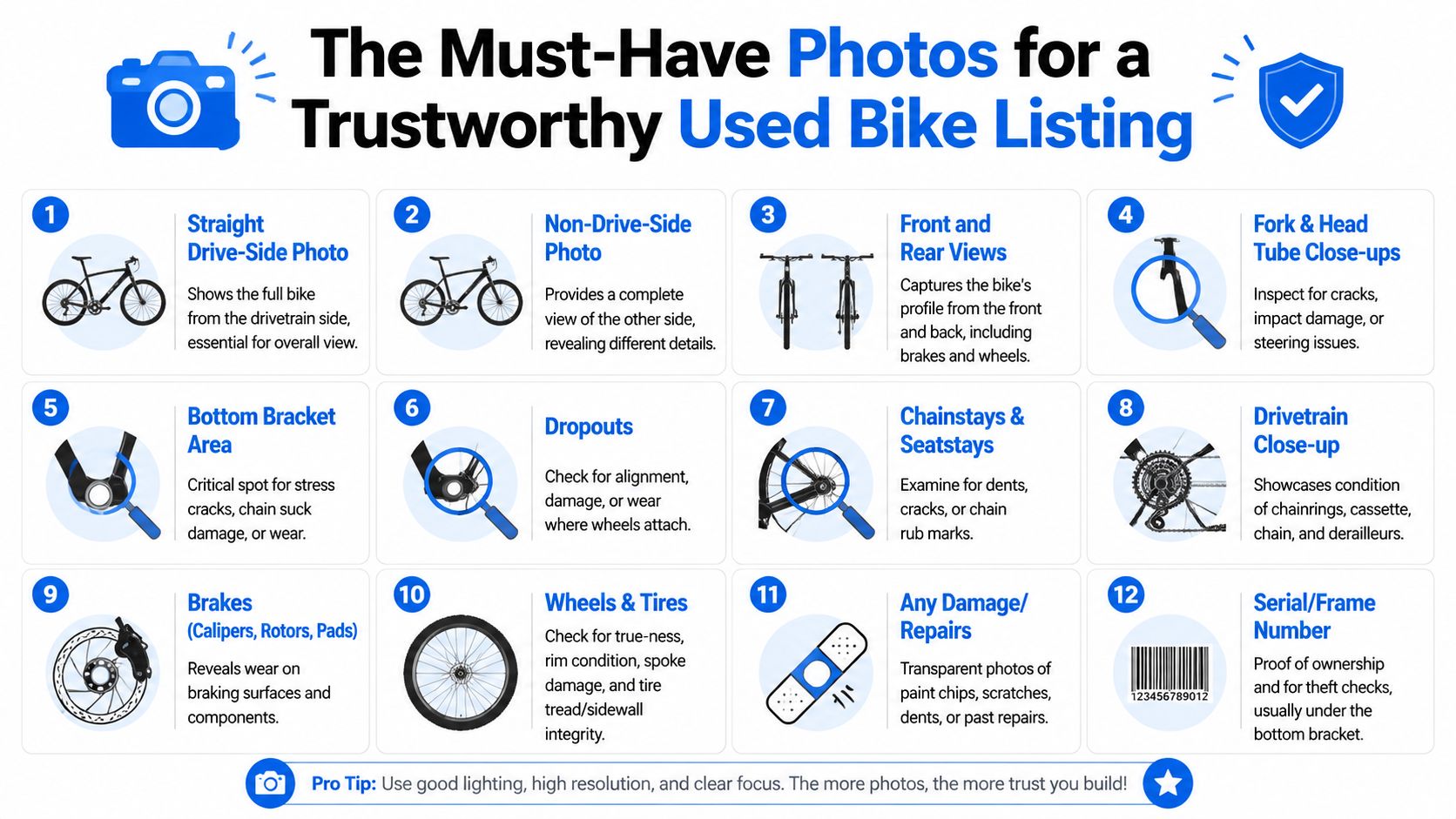
The minimum set is straightforward. Ask for a straight drive-side photo, a non-drive-side photo, front and rear views, and close-ups of the fork and head tube, bottom bracket, dropouts, chainstays and seatstays, drivetrain, brakes, wheels and tires, and any visible damage or repairs. If the seller skips those angles, the listing is incomplete.
Useful check: If a seller only sends beauty shots, the bike is still under-described.
The wear points matter because they reveal how much use the bike has seen. Chainrings, cassettes, brake tracks, pad wear, and tire sidewalls can show whether the bike is lightly used, neglected, or hiding a replacement list. You don't need to overread every cosmetic flaw, but you do need enough detail to separate normal use from unknown risk.
A robust pre-purchase inspection guide recommends treating any listing as incomplete until the seller supplies close-up photos of wear points and proof of ownership to assess mechanical and structural safety (ROUVY). That's the right standard. Don't negotiate from an incomplete listing.
For a broader pre-purchase framework, pair this with the SYCLR used bike checklist, then use the photos to confirm whether the listing deserves a reply.
A listing that looks polished but avoids close-ups is not strong. The seller may be busy, but the buyer still needs evidence.
Before you move forward, ask for:
A straight drive-side photo
A non-drive-side photo
Front and rear views
Fork and head tube close-ups
Bottom bracket area
Dropouts
Chainstays and seatstays
Drivetrain close-up
Brake calipers, rotors, and pads
Wheel and tire close-ups
Any paint chips, scratches, dents, or repaired areas
Serial or frame number area when appropriate
Comparing Price Context and Value Signals
A low price only matters after fit, identity, and condition are believable. Before that, it's just a number. The smarter move is to compare the asking price against the current new-bike price and against similar used listings, then adjust for condition, model year, and listing completeness.
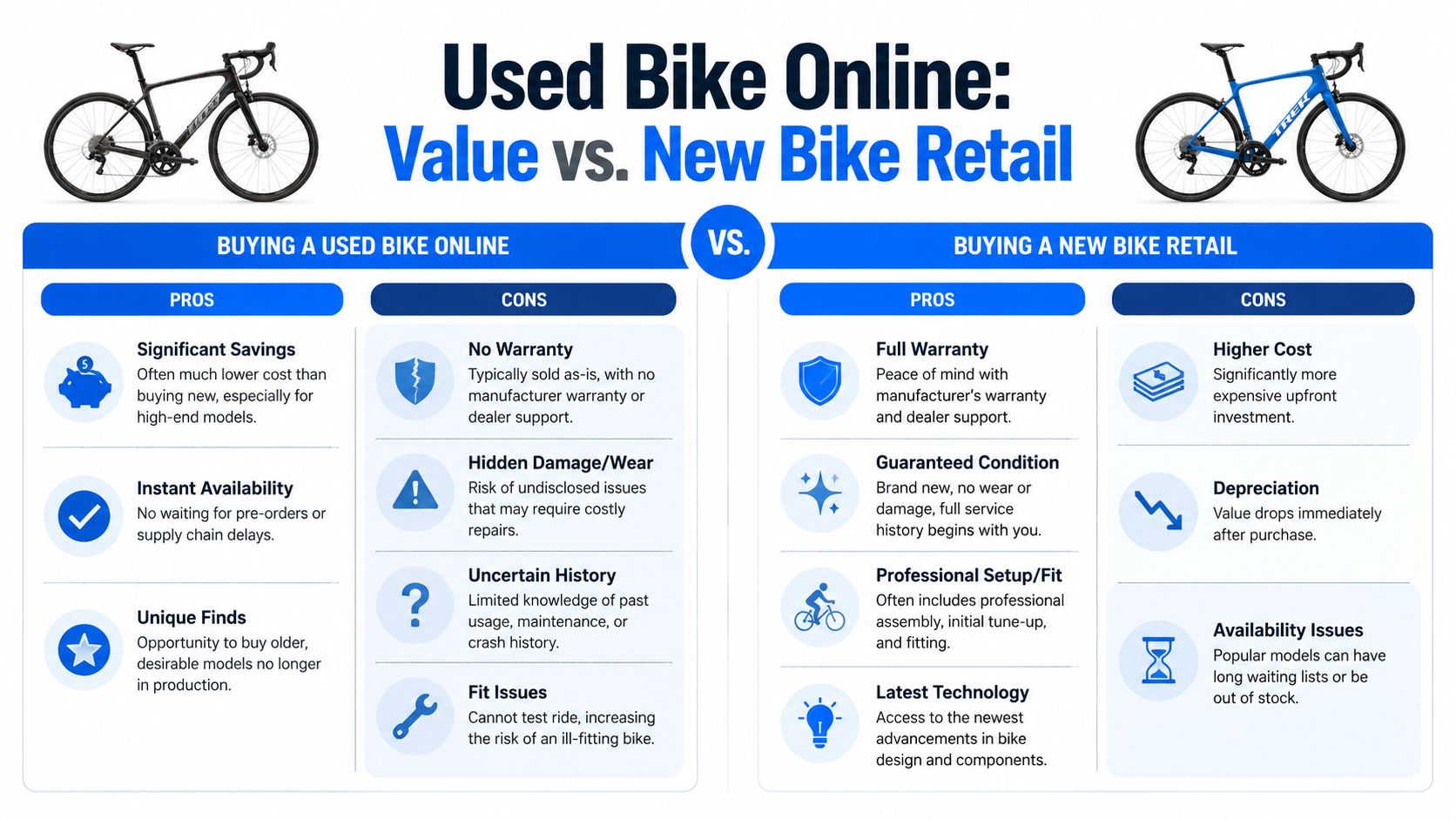
Cyclingnews recommends finding the current new-bike price first so it becomes the ceiling for your used-bike budget, since a used offer above that threshold is rarely a good value (Cyclingnews). That's a clean rule. If a used listing sits uncomfortably close to new retail, the risk and hassle need to be very small for the deal to make sense.
Price context beats headline discount
The cheapest ad is often the weakest deal because it leaves out the stuff you'll pay for later. Missing photos, vague condition, older drivetrain parts, or uncertain fit can erase the apparent savings quickly. Shipping can also change the math, especially when a local pickup alternative exists.
A better comparison is side by side. Ask whether the used bike has a clearer spec, a more believable condition story, or better geometry for your needs than the next few listings. If it doesn't, the “discount” may just be compensation for uncertainty.
Value is confidence-adjusted, not just cheap
Used bike value lives at the intersection of price, condition, and clarity. A bike with a known model year, complete photos, and honest answers usually deserves more attention than a slightly cheaper listing with missing context. That's the kind of comparison SYCLR's used bicycle value page is meant to support, because price alone doesn't tell you whether a listing is worth pursuing.
If you're deciding between two similar bikes, choose the one that gives you fewer unknowns. That usually means more confidence, fewer surprises, and a cleaner final purchase.
Engaging Sellers with Targeted Questions
A short, precise message gets better answers than a long back-and-forth. Don't ask everything at once in a messy paragraph. Ask for the details that remove the biggest unknowns first, then decide whether the listing deserves more of your time.
Start with identity and fit. You need the exact model year, full model name, and frame size. Then confirm what's installed on the bike, because original spec and current spec are not always the same.
Plain rule: Good sellers answer directly. Weak listings get vague.
Use this message and keep it tight:
“Hi, I'm interested in the bike. Before I make a decision, could you confirm the exact model year, frame size, drivetrain, brake type, and whether the components are original? Could you also send clear drive-side and non-drive-side photos, plus close-ups of the drivetrain, fork and head tube area, bottom bracket area, wheels and tires, and any scratches or damage? Thanks.”
Then add the seller-side questions that matter most:
Service history and receipts: Ask whether they have records, proof of purchase, or recent maintenance notes.
Crash or repair disclosure: Ask directly about cracks, dents, repairs, or crashes.
Packing method if shipped: Ask how the bike will be packed and whether any parts will be removed for transit.
Payment method: Ask what buyer protection is available before you commit.
Reason for selling: Keep it simple. You're checking whether the explanation matches the bike and the photos.
Tone matters. Be polite, but don't sound hesitant. Sellers who answer clearly usually make the whole process easier. Sellers who dodge basic questions are telling you something useful.
Completing the Transaction with More Caution
The last filter is transaction caution. Before money changes hands, confirm the serial number, compare the bike’s identity against available stolen-bike databases, and make sure the photos, seller answers, and claimed spec all line up. These steps do not guarantee a safe transaction, but they reduce avoidable uncertainty.
For shipping, ask how the bike will be packed, which parts will be removed, whether the seller has packed bikes before, what carrier will be used, whether insurance is included, and what happens if the bike arrives damaged.
For payment, avoid pressure to rush. Use payment methods with buyer protection when possible, and do not send money until the bike identity, seller answers, photos, shipping terms, and ownership details are consistent.
If the seller resists that step, stop there. A serious seller should have no problem sharing the frame number, basic ownership details, and clear photos that match the listing.
Online used bike buying checklist
| Check | What to verify | Why it matters | Confidence signal |
|---|---|---|---|
| Rider fit | Height, riding style, terrain, budget | Keeps irrelevant bikes out of the search | The bike matches your use case |
| Bike type and terrain | Road or gravel use case | Prevents category mismatch | Geometry matches intended riding |
| Exact model year | Full year and variant | Avoids spec confusion | Seller names the year clearly |
| Frame size and geometry | Size label, stack, reach, standover | Filters for fit before price | Geometry data matches your target |
| Stack and reach | Published numbers or archive data | Helps compare cockpit fit | Numbers are consistent with your fit needs |
| Standover | Clearance and top-tube fit | Adds basic confidence | Clearance makes sense for your body |
| Listing photos | Drive-side, non-drive-side, close-ups | Reveals condition and completeness | Photos show the whole bike clearly |
| Drivetrain and brakes | Current spec and wear | Drives repair cost and usability | Seller shows clean, current detail |
| Wheel and tire condition | Tread, sidewalls, rim condition | Flags replacement work | Wheels and tires look consistent |
| Frame and fork condition | Cracks, dents, repairs | Structural safety check | No obvious damage or mismatch |
| Seller answers | Clear responses, proof of ownership | Shows transparency | Answers line up with the listing |
| Ownership and service history | Receipts, records, serial number | Reduces uncertainty | Documents match the bike |
| Price context | Similar listings, new-bike ceiling | Prevents overpaying for uncertainty | Asking price fits the market context |
| Shipping details | Packing method, transit protection | Lowers shipping risk | Seller explains packing clearly |
| Payment caution | Buyer protection, secure method | Helps avoid bad transactions | Payment terms are sensible |
If the checklist still feels thin, slow down. A better answer now costs less than a problem later.
Seller-message template
“Hi, I'm interested in the bike. Could you confirm the exact model year, frame size, drivetrain, brake type, and whether the components are original? Please send current close-ups of the drivetrain, fork and head tube, bottom bracket, wheels and tires, and any scratches, dents, or repairs. Also, can you share the serial number or frame number, plus any service records or proof of purchase? Thanks.”
A fit-aware tool like SYCLR can help you compare used bike listings by fit signals, geometry signals, price context, model year context, listing quality, and source confidence. It will not replace a test ride or a mechanic inspection, but it can help you shortlist better-fit used bikes before you buy.
How to Buy a Used Bike Online FAQ
What should I check first when buying a used bike online?
Start with fit and bike identity. Confirm the exact model year, full model name, frame size, geometry, and bike type before judging price or contacting the seller.
Is it safe to buy a used bike online?
Buying a used bike online can work, but it requires caution. Verify the bike’s identity, ask for current photos, check seller answers, review payment protection, and understand shipping terms before committing.
What photos should I ask for before buying a used bike online?
Ask for drive-side and non-drive-side photos, front and rear views, drivetrain close-ups, fork and head tube close-ups, bottom bracket area, dropouts, wheels, tires, brakes, and any scratches, dents, or repairs.
How do I know if a used bike online will fit?
Check frame size, stack, reach, standover, model year, and category geometry. Height is only a starting point, so compare the listing against a current bike, fit report, or trusted geometry chart when possible.
What questions should I ask the seller?
Ask for the exact model year, frame size, drivetrain, brake type, whether the parts are original, service history, ownership proof, damage history, current photos, shipping method, and payment terms.
Should I buy the cheapest used bike online?
Not automatically. A low price only matters after fit, identity, condition, seller transparency, and shipping risk make sense. Cheap listings with missing details can become expensive quickly.
Can SYCLR help compare used bike listings online?
Yes. SYCLR helps riders compare used bike listings by fit signals, geometry signals, model year context, price context, listing quality, source confidence, and confidence signals before contacting sellers.
If you want to compare used bike listings before contacting sellers, start with your height, bike type, and budget in the SYCLR app. SYCLR helps you compare road and gravel listings by fit signals, geometry signals, model year context, price context, listing quality, source confidence, and confidence signals so you can shortlist better-fit used bikes before you buy.
Already know your stack, reach, current-bike geometry, or fit-report details? Use the fit-details entry to improve your recommendations.