SRAM Rival vs Force – Complete Groupset Comparison Guide
The usual shortcut in a SRAM Rival vs Force comparison is to say that Force is the better groupset. For a complete-bike buyer, that answer is incomplete. Rival AXS and Force AXS share SRAM's wireless AXS ecosystem, and many practical buying decisions come down to materials, weight, power-meter options, controls, gearing, replacement cost, road vs XPLR architecture, and the exact generation on the bike.
That matters because the groupset tier is only one part of the purchase. A Rival-equipped bike with the right fit, geometry, gearing, tire clearance, wheelset, and maintenance history can be the smarter choice than a Force bike that misses on frame size or intended use. Force may justify a higher price when its specific component differences match your priorities and the complete bike is otherwise the stronger fit for your needs. It is not automatically the right answer just because it sits higher in SRAM's lineup.
Table of Contents
- Why Force Is Not Automatically the Better Choice
- SRAM Rival vs Force Specification Overview
- Weight Differences Across Road and XPLR Configurations
- Shifting, Controls, and Drivetrain Architecture
- Compatibility and Used-Bike Inspection Checklist
- Which Buyer Should Pay More for Force
- How SYCLR Helps You Compare Better-Fit Bikes
- Frequently Asked Questions About Rival and Force
Why Force Is Not Automatically the Better Choice
SRAM positions Force above Rival in its road lineup, but current Rival AXS and Force AXS are built on the same core ideas: wireless shifting, hydraulic disc braking, and the AXS ecosystem. On a complete bike, that means the key question is not simply which tier is higher. The useful question is which differences you will actually use.
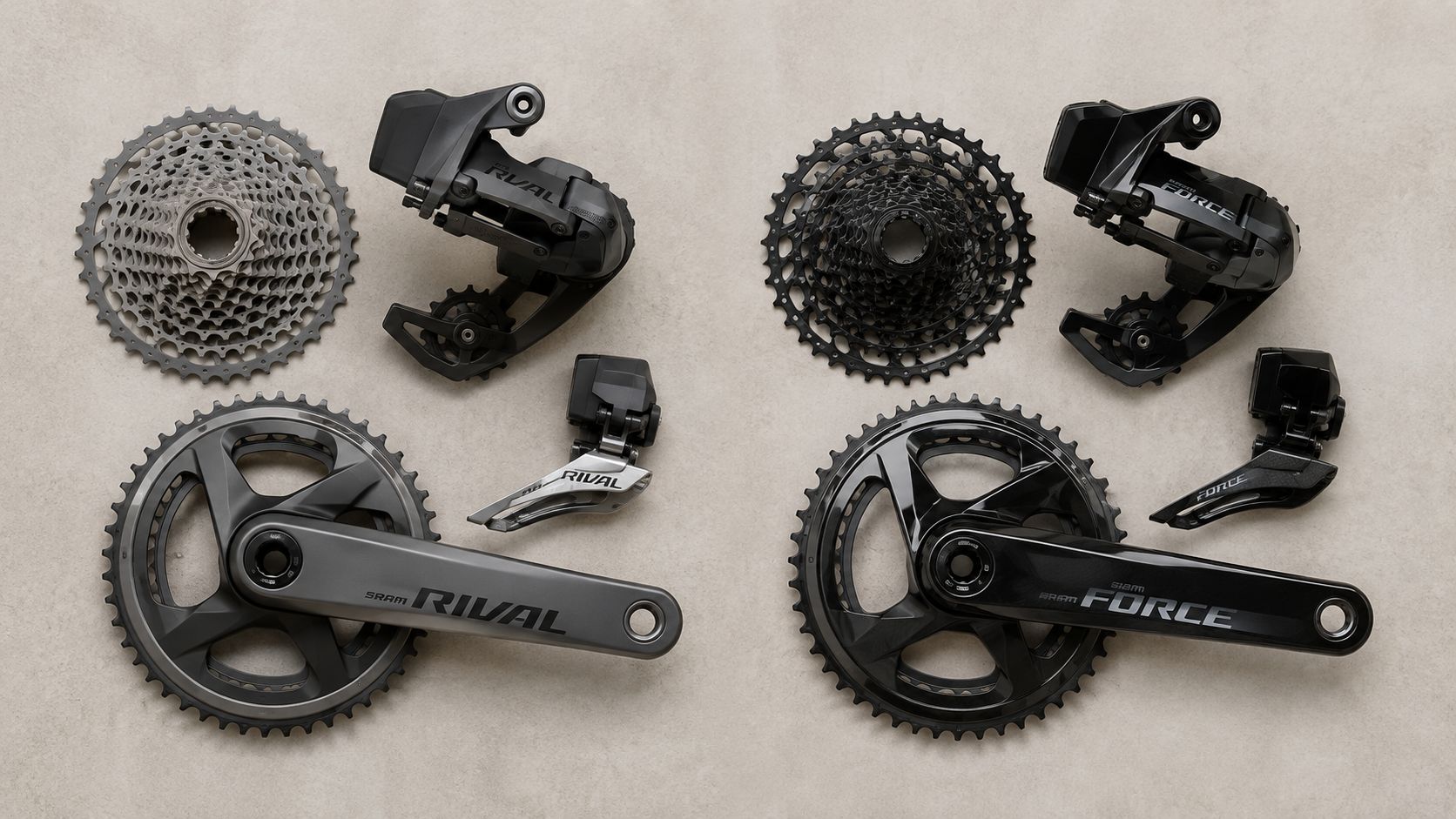
The most visible material difference is the crankset. Rival uses aluminum crankarms, while Force uses carbon crankarms in SRAM's current lineups. Force also offers a broader mix of crank and power configurations depending on whether the bike is road AXS or XPLR. But those differences only matter if they match the way you ride, train, and plan to own the bike.
Practical rule: Pay for Force when you want a specific upgrade, not just a higher badge.
For one rider, that upgrade may be lower component weight. For another, it may be a preferred power-meter format, a specific shifter shape or control feature, or simply a complete-bike build that happens to come with Force. For someone else, the right answer may still be Rival because the bike fits better, the gearing is more suitable, or replacement parts are less expensive.
That is why complete-bike context matters. Before treating Force as an automatic upgrade, compare frame fit, geometry, wheelset, tire clearance, gearing, bike purpose, model year, and maintenance history.
SRAM Rival vs Force Specification Overview
Groupset tier is a useful filter, but it is not the decision by itself. On a complete bike, confirm the exact road or XPLR setup, drivetrain format, crank, cassette, power meter, and generation before deciding that Force represents a meaningful step up.
SRAM Rival vs Force key specifications
| Specification | SRAM Rival AXS | SRAM Force AXS |
|---|---|---|
| Road shifting | Fully wireless AXS | Fully wireless AXS |
| Road drivetrain formats | 1x and 2x | 1x and 2x |
| Road rear derailleur support | 10-28T through 10-36T | 10-28T through 10-36T |
| Road brakes | Hydraulic disc | Hydraulic disc |
| XPLR format | 1x-specific 13-speed XPLR | 1x-specific 13-speed XPLR |
| XPLR cassette | 10-46T | 10-46T |
| Crankarm material example | Aluminum | Carbon |
| Power-meter options | Spindle-based left-side option available, exact configuration depends on crank | Spindle-based left-side and integrated crank-based options available; some integrated Force systems measure left/right power balance |
| Ecosystem | SRAM AXS | SRAM AXS |
This is the most useful high-level summary for buyers. Road AXS and XPLR should be treated as separate categories, and the exact build matters more than the logo on the derailleur. Two bikes labeled Force AXS can differ meaningfully in gearing, crank configuration, power setup, and riding purpose. The same is true for Rival.
Read the listing beyond the badge. Check whether the bike is road or XPLR, 1x or 2x, which cassette it uses, what crank is installed, whether a power meter is fitted, and which generation of AXS parts is actually on the bike.
Weight Differences Across Road and XPLR Configurations
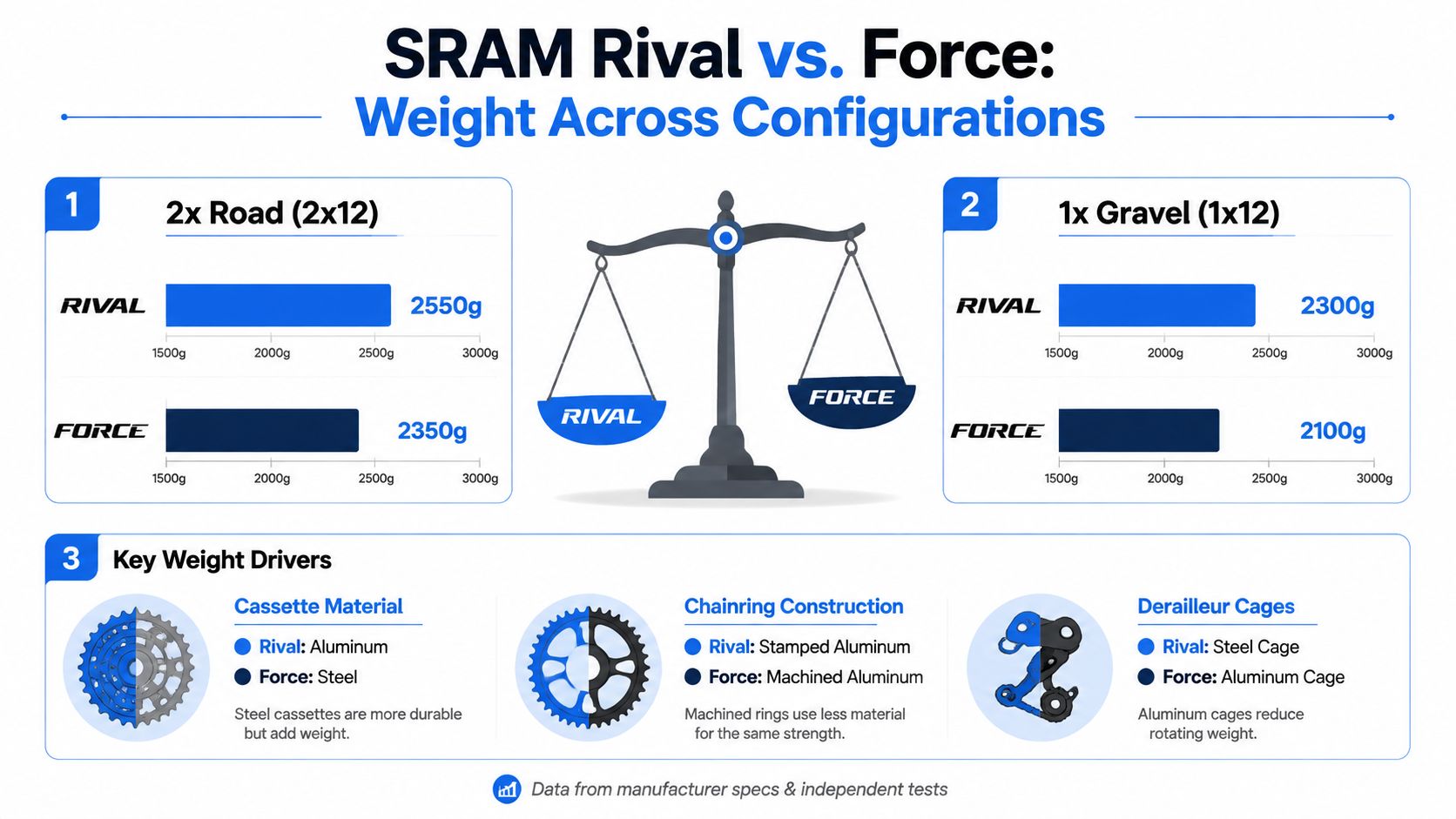
Force is lighter than Rival in current like-for-like configurations, but weight should stay in perspective. It is a measurable difference in the groupset, not a guarantee of a better-riding complete bike.
For current road 2x AXS groupsets with power meter, CyclingNews reports 2,959 g for Force and 3,206 g for Rival. For current XPLR builds with power meter, BikeRadar lists 2,686 g for Force and 2,961 g for Rival.
Those figures are claimed groupset weights. They do not account for differences in frame size, wheelset, tires, cockpit parts, pedals, bottles, or accessories. Use them to understand the component-level gap, not to assume that one complete bike will automatically be faster or more comfortable.
Where the measurable differences usually come from
The weight difference usually comes from materials and construction across several parts, not one magic upgrade. The crankset is the easiest example because current Rival uses aluminum crankarms while Force uses carbon crankarms. For the broader implications of frame material—not groupset crank material—see SYCLR’s carbon vs aluminum road bike guide. Depending on the build, differences can also come from the controls and the exact power-meter configuration.
For a buyer comparing complete bikes, the more important step is to ask whether the lighter groupset comes with trade-offs elsewhere. A Rival bike with a wheelset better suited to your use, more appropriate tires, or a better-fitting frame can still be the stronger overall purchase.
Shifting, Controls, and Drivetrain Architecture
Rival and Force share much more architecture than their price difference might suggest. In current road AXS form, both use wireless shifting, hydraulic disc brakes, and road rear derailleurs that support both 1x and 2x setups with 10-28T through 10-36T cassettes.
That shared architecture is important for complete-bike buyers. You should not assume that Force universally shifts better, brakes better, feels better, lasts longer, or performs better in every situation. Setup quality, derailleur alignment, firmware, battery condition, drivetrain wear, crash damage, and maintenance history often have a greater effect on the ownership experience than the tier name alone.
A second point matters just as much: bikes are often mixed builds. A listing described as Force may include a Rival crank, a different-generation cassette, or another power-meter setup. That is not automatically a problem. Mixed Rival and Force AXS builds can be legitimate, but the exact parts should be identified before you decide what the bike is worth.
Road AXS gearing
Current Rival and Force road rear derailleurs both support 1x and 2x configurations and work across 10-28T through 10-36T cassette sizes in the current range. For a road buyer, that means the more useful question is not whether the bike says Rival or Force. It is whether the actual cassette and chainring combination fits your terrain and preferred cadence.
A bike with a premium badge but the wrong gearing is not automatically the better choice. Confirm the exact cassette, chainrings, and derailleur generation in the listing.
XPLR gearing
Current Rival XPLR and Force XPLR should be considered separately from road AXS. Both are 1x-specific 13-speed systems built around 10-46T cassettes. The important point for buyers is that 13-speed 10-46T XPLR is not Force-only.
If you are shopping for a gravel bike, identify whether it uses current XPLR or road AXS components rather than assuming the drivetrain architecture from the bike category alone. Check the rear derailleur, cassette, crank, and chainring, then compare those details against the terrain you plan to ride.
Power-meter options and controls
Power is one of the clearest reasons to inspect the exact build instead of relying on a tier stereotype. Rival is not simply a single-sided tier and Force is not simply a dual-sided tier.
In SRAM's current lineup, Rival offers spindle-based left-side power measurement, while Force offers multiple power options, including spindle-based left-side measurement and integrated crank-based systems capable of left/right balance depending on the exact crank. That means the real comparison is not Rival versus Force in the abstract. It is which power system the bike actually has, how it measures, and whether that matters to your training.
Controls also deserve a parts-level check. Depending on generation and exact build, Force may bring different materials, lever finish, or control details. But a buyer should verify those concrete differences on the bike rather than assuming a universal ride-feel advantage.
For the ownership trade-offs between electronic and mechanical systems, see SYCLR's electronic versus mechanical shifting guide.
Compatibility and Used-Bike Inspection Checklist
Many Rival and Force AXS parts can work across the same ecosystem, but compatibility still depends on the exact components, drivetrain format, and generation. Do not reduce the question to whether the bike is wireless or whether the listing says AXS.
Start by separating road AXS from XPLR. Then identify whether the bike is 1x or 2x, which rear derailleur it uses, which cassette is installed, what crank is fitted, whether a power meter is present, and whether the parts all belong to the same intended drivetrain system.
That level of detail matters even more on the used market. A bike advertised as Force may include Rival cranks, a mixed cassette choice, or an aftermarket power meter. That can be completely legitimate. The important step is to confirm that the build is compatible, complete, and priced appropriately.
Used-bike checklist
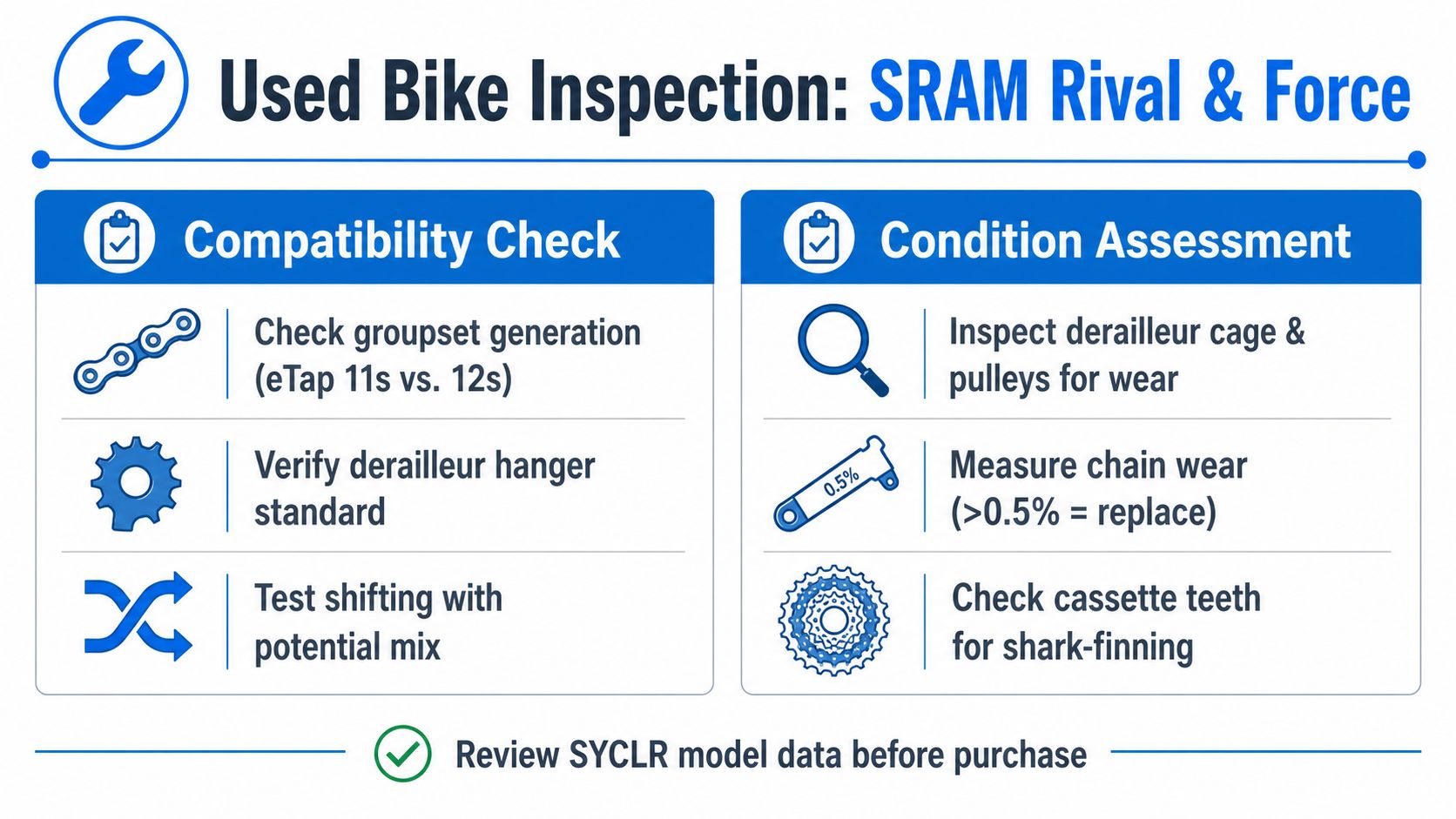
Verify the generation: Confirm whether the bike uses current road AXS or current XPLR parts, and do not compare older electronic or mechanical listings as if they were equivalent.
Confirm road or XPLR: This is the first compatibility split. XPLR is a different drivetrain purpose from road AXS.
Check 1x or 2x: Confirm the crank format, front derailleur presence or absence, and the intended drivetrain layout.
Map every drivetrain part: Record the crank, chainring or chainrings, cassette, chain, shifters, front derailleur if present, rear derailleur, and brakes.
Inspect the crank and power meter: Identify the exact crank model and whether the bike uses spindle-based left-side power measurement or an integrated crank-based system.
Ask about batteries and charger: Confirm that the AXS batteries and charger are included and working.
Inspect for crash damage: Look closely at levers, rear derailleur, derailleur cage, pulleys, crankarms, and brake calipers. Inspect crankarms closely for impact damage, deep abrasion, cracks, or other concerns, regardless of material; carbon Force crankarms should be assessed according to SRAM guidance and, when uncertain, by a qualified mechanic.
Assess drivetrain wear: Check chain wear and drivetrain performance, then inspect the cassette, chainrings, and pulley wheels for damage or abnormal wear. Consider lubrication, contamination, shifting behavior, and maintenance history rather than judging wear from tooth shape alone.
Verify compatibility in mixed builds: Mixed Rival and Force AXS builds can be legitimate, but the exact road or XPLR combination still needs to make sense.
Test shifting and braking if possible: Run through all gears and check that the system shifts cleanly and brakes consistently.
Use a structured used-bike checklist when a listing lacks detail. SYCLR does not verify compatibility, battery health, firmware status, wear, crash history, originality, or mechanical condition, so seller photos and an in-person inspection still matter.
Which Buyer Should Pay More for Force
Force earns its premium when you can point to a concrete benefit in the bike you are considering. The best way to frame the decision is not around stereotypes. It is around priorities.
When lower weight is a real priority
If you are intentionally comparing like-for-like bikes and want the lighter current groupset option, Force has a clear measurable advantage. That is a valid reason to spend more, especially if the rest of the bike already matches your fit and intended use.
The key is to keep the claim narrow and honest. Lower groupset weight is a real difference. It does not, by itself, guarantee a better complete-bike outcome.
When power data is the deciding feature
If the bike's power-meter configuration matters to your training, inspect the exact system rather than assuming a simple Rival-versus-Force split. Rival can offer spindle-based left-side measurement. Force can offer spindle-based left-side measurement or integrated crank-based options, including setups capable of left/right balance depending on the crank.
That makes this a specification question, not a badge question. If one bike gives you the exact power format you want, that may justify the higher price more clearly than almost any other difference.
When gearing and bike purpose matter more than tier
For many buyers, the decisive issue is whether the bike is set up correctly for road riding or gravel riding. A road bike with current Rival or Force AXS may be a stronger match than an XPLR bike if your use is mostly pavement. The reverse can also be true.
Likewise, on road bikes, the exact cassette and chainring pairing can matter more than the jump from Rival to Force. On gravel bikes, confirming a true XPLR 1x-specific 13-speed 10-46T setup can be more important than paying for the higher tier name.
When budget and replacement cost lead the decision
Cost should include more than the sticker price. Consider the purchase price, replacement cost, wear-part cost, and the quality of the complete-bike spec. Force may be the right answer if the bike includes the exact features you want. Rival may be the better decision if it preserves budget for a better-fitting bike, a wheelset better matched to your use, fresh tires, needed service, or a cleaner used-bike example.
The most reliable buying rule is simple: prioritize fit and complete-bike suitability first, then decide whether Force adds a feature you truly value.
How SYCLR Helps You Compare Better-Fit Bikes
A groupset comparison starts with components, but a complete-bike decision starts with fit. Height is only a starting point. Your proportions, riding position, flexibility, current-bike geometry, terrain, and intended use all affect whether a bike is a sensible candidate.
SYCLR helps riders compare road and gravel listings using fit signals, geometry signals, model-year context, price context, listing quality, condition signals where available, and confidence signals. That is useful when two bikes look similar on paper but differ in frame size, stack, reach, tire clearance, seller detail, or generation.
Start with your height, bike type, and budget, then refine your comparison with deeper fit information if you have it. Riders who know their current bike's stack and reach, or who have fit-report details, can use the advanced fit details entry to narrow the search more intelligently. Height alone should not determine a precise frame choice.
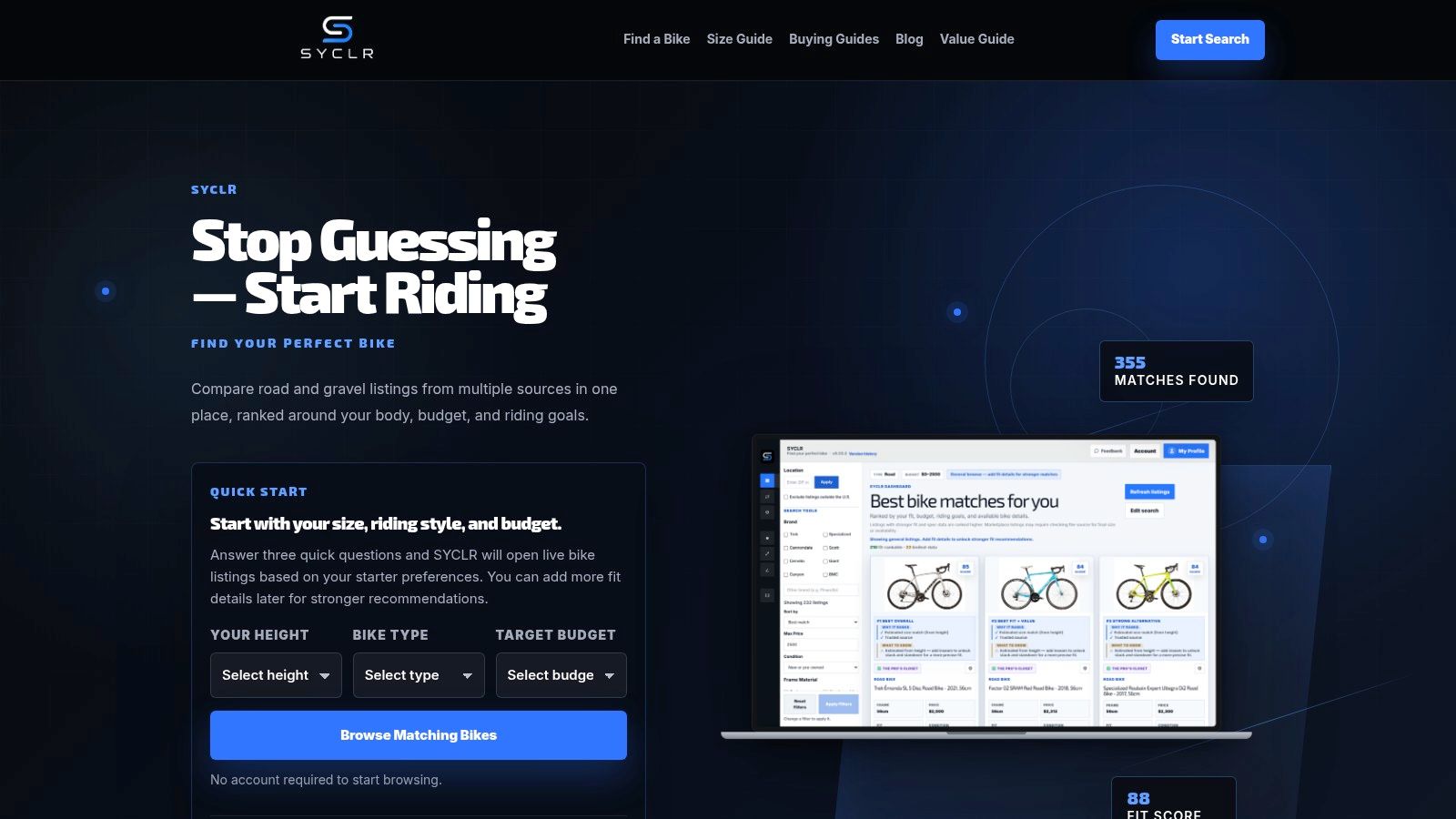
A listing platform can show inventory, but it may not interpret fit, geometry, model year, condition, price context, or listing confidence for you. SYCLR helps organize those signals so you can shortlist better-fit bikes before inspecting the Rival or Force parts in detail. It does not guarantee fit, safety, authenticity, condition, compatibility, or fair value, and it does not replace a professional fit or mechanical inspection.
If you're ready to compare road and gravel listings, start with SYCLR. Enter your rider details, bike type, and budget, then compare the bikes that remain by geometry and listing context instead of choosing the highest groupset tier automatically.
Frequently Asked Questions About Rival and Force
What's the main difference between SRAM Rival and Force?
The main difference is that Force generally uses lighter or higher-cost component construction in several areas, while Rival delivers much of the same AXS operating architecture at a lower product tier. In practice, the measurable comparison usually centers on crank material, component weight, power-meter options, control details, replacement cost, and exact build specification.
On a complete bike, that only matters if the rest of the package is right for you. Fit, geometry, gearing, wheels, and maintenance history can outweigh the tier difference.
Does Force shift better than Rival?
Do not assume a universal difference. Current Rival AXS and Force AXS share core wireless drivetrain architecture, and real-world results depend heavily on setup, alignment, firmware, battery condition, wear, and crash history. On a complete bike, actual shifting behavior, component condition, setup, and service history provide more useful evidence than the tier badge alone.
Is Force lighter than Rival?
Yes. In current like-for-like configurations, Force is lighter than Rival. The cleanest way to use that information is as a groupset-level specification difference, not as proof that one complete bike will automatically ride better than another.
Are Rival and Force power-meter options different?
Yes, but the difference should be described precisely. Rival offers spindle-based left-side power measurement in SRAM's current lineup. Force offers multiple power options, including spindle-based left-side measurement and integrated crank-based systems that can provide left/right balance depending on the exact crank. Always verify the crank and meter on the actual bike.
Are Rival and Force AXS parts compatible?
Many Rival and Force AXS parts can be mixed, but compatibility depends on the exact generation, road versus XPLR architecture, 1x versus 2x format, and the specific derailleur, cassette, chain, crank, and controls involved. Mixed builds can be legitimate, but they should be checked part by part.
Is Force worth paying more for?
Force is worth paying more for when the bike gives you a feature you specifically want, such as lower current groupset weight, a preferred power-meter setup, different control details, or a complete-bike specification that fits your use better. If those benefits are not meaningful in the bike you are actually buying, fit, geometry, condition, and total bike spec should come first.