
Carbon MTB Hardtail Guide for Riders and Buyers

Buying the lightest carbon MTB hardtail you can afford isn't a reliable strategy. Carbon can offer low frame mass and carefully tailored stiffness, but the better purchase is a complete bike that fits, suits your trails, and has credible condition evidence. Weigh any performance advantage against impact uncertainty, repair options, component condition, and service access.
Table of Contents
- Why Carbon Is Not Automatically Better
- How Carbon Hardtail Construction Shapes Performance
- Carbon Frame Weight in Historical Context
- Weigh Carbon Benefits Against Ownership Trade-Offs
- Choose Geometry for Fit and Terrain
- Set a Price Tier Before Comparing Value
- Inspect a Used Carbon MTB Hardtail
- Match the Bike to Your Riding Priorities
- Carbon MTB Hardtail Buying FAQs
- Make the Purchase Explainable
Why Carbon Is Not Automatically Better
A carbon frame doesn't make an unsuitable hardtail suitable. A bike can have an impressive specification and still leave you stretched across the cockpit, uncomfortable on rough ground, or facing maintenance you'd rather avoid.
The buying unit is the complete bicycle, not the frame. Fork, wheels, tires, drivetrain, brakes, and cockpit all affect the result. A lightweight frame with worn or unsuitable components deserves a different assessment from a coherent, well-maintained build.
Carbon's appeal is legitimate: designers can place and orient material around expected loads. That possibility does not mean every carbon hardtail is lighter, stronger, or more comfortable than every aluminum alternative.
Start with the rider's requirements
Before comparing specifications, establish what the bike needs to do:
Terrain: Distinguish relatively smooth cross-country riding from repeated rough descents.
Position: Decide whether you want a familiar riding posture or a deliberate change.
Ownership: Consider how much specialist maintenance and proprietary hardware you'll accept.
Risk: Decide whether you're comfortable investigating a used composite frame's history.
Height can narrow an initial size search, but it can't settle precise fit. Geometry, standover clearance, cockpit setup, and your current riding position are more useful together than a size label alone.
Practical rule: A good deal is only a good deal if the bike fits the rider and the job.
How Carbon Hardtail Construction Shapes Performance
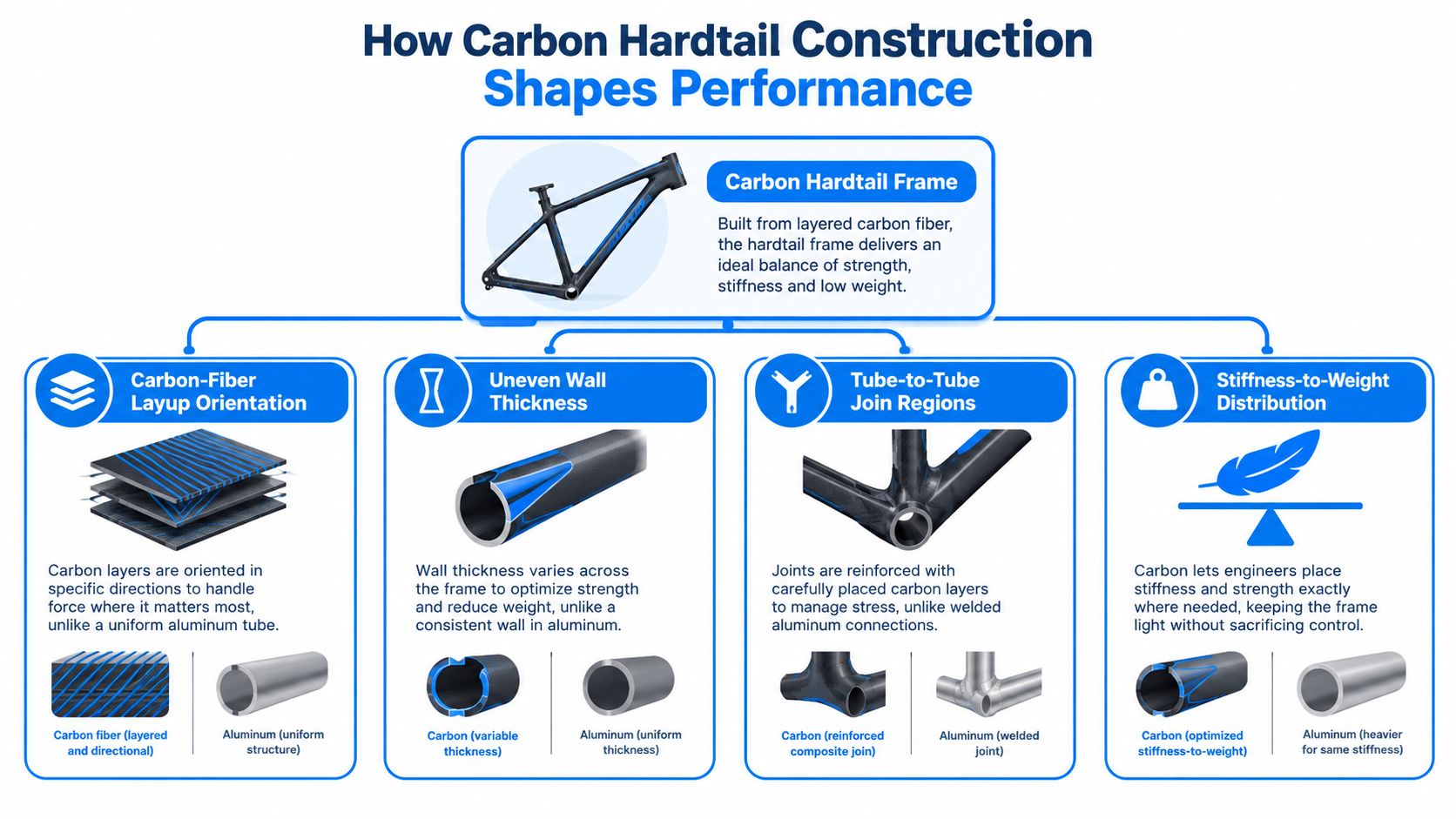
Carbon construction gives designers control over where material goes and how fibers are oriented. Carbon-fiber-reinforced polymer isn't simply a lighter substitute poured into an aluminum-shaped mold.
Manufacturers typically cut prepreg sheets, arrange them according to a layup schedule, and use heat and pressure to cure the resin. One description of carbon-frame manufacturing cites around 400 individual pieces in a frame; that is an example, not a fixed count across manufacturers or models.
The illustration shows the principle of targeted reinforcement, not a tested performance comparison with aluminum.
Material placement matters more than thinness
A layup can reinforce the bottom bracket, head tube, downtube, chainstays, and rear-axle region while using less material elsewhere. Fiber orientation, transitions, and junction quality matter more than a general claim about thin walls.
Uniformly removing material isn't the objective. The structure must suit its expected loads, be manufactured properly, and remain uncompromised in use. Neither carbon nor aluminum, as a material label, establishes a particular frame's quality or remaining condition.
A hardtail still has a rigid rear triangle
The fork provides the primary suspension; the rear triangle has no rear shock. On rough ground, the rear structure, tires, seatpost, saddle, and rider must accommodate loads that rear suspension would otherwise help manage, as described in BIKE's hardtail buying guidance.
A carbon layup isn't a substitute for suspension. Fork behavior, tire choice, and setup still matter. Judge the bike against the riding task rather than assuming a comfort or durability advantage from its frame material.
Carbon Frame Weight in Historical Context
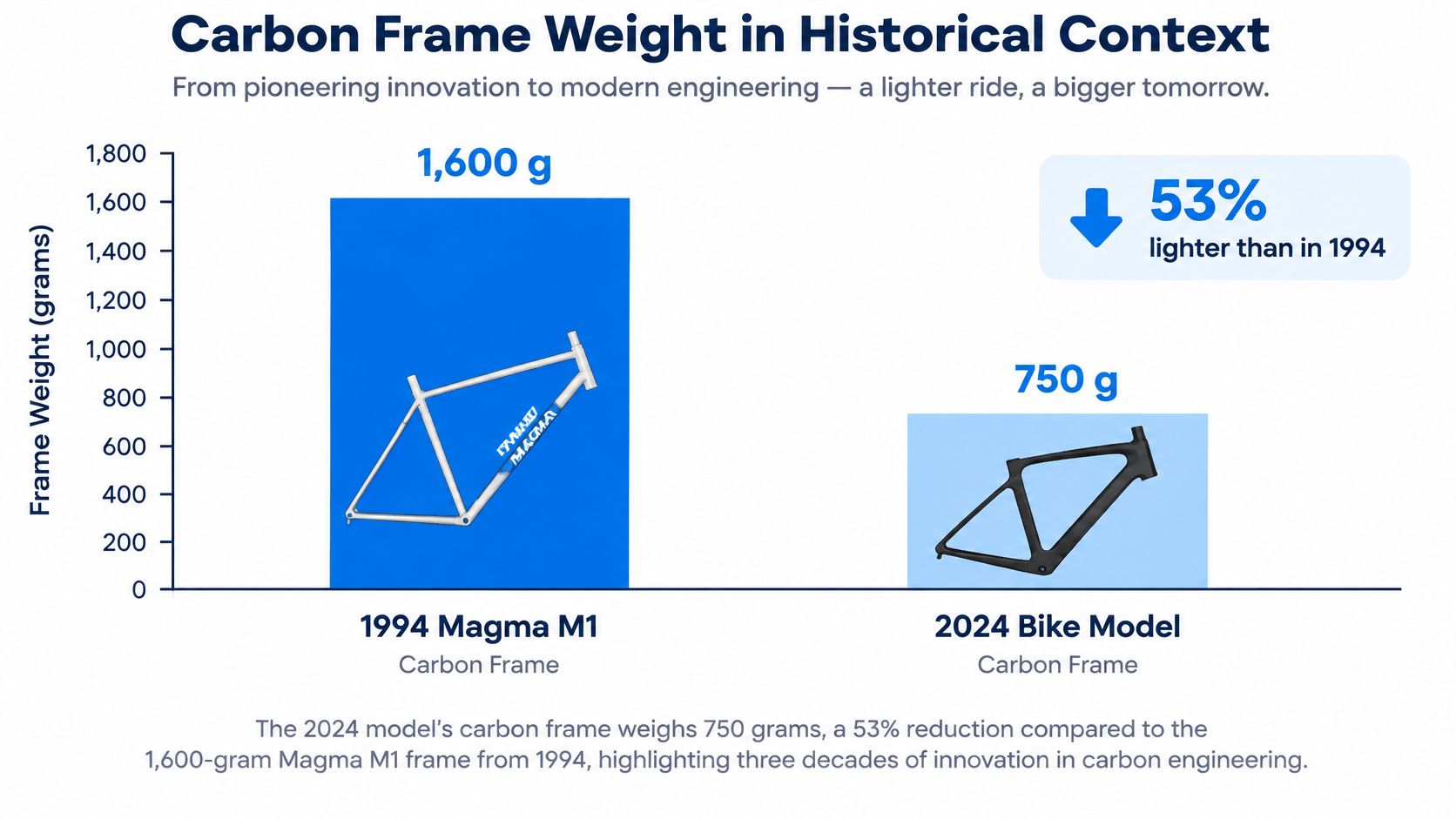
A BIKE comparison of the 1994 Magma M1 and 2024 Bike Ahead The Frame reports an approximately 1,600 g Magma frame, a 795 g claimed starting weight for the Bike Ahead frame, and a 911.7 g measured size-L Bike Ahead frame. The 795 g minimum is not the measured weight of the size-L example.
Comparing the measured size-L result with the historical 1,600 g figure gives a difference of about 688 g, or 43%. Comparing 795 g with 1,600 g gives roughly 50%, but that mixes a claimed minimum with a historical figure. These are comparisons between different historical frame examples, not controlled tests of identical configurations. Neither calculation predicts the weight difference between two complete bikes you might buy.
The graphic illustrates these published figures. Its bars should be read with the labels above in mind, not as three measurements taken under identical conditions.
Read the measurement before ranking the bike
Ask what a seller's weight figure describes:
Object measured: Bare frame, frame with hardware, or complete bike?
Size and configuration: Does the figure apply to the frame for sale?
Evidence: Manufacturer claim or a scale reading of that particular item?
A 1994 frame and a 2024 frame can also differ in geometry, interfaces, and intended use. For a used bike, check component compatibility and replacement-part availability alongside weight.
Buy the specification and condition of the actual bike, not the reputation of its material category.
Weigh Carbon Benefits Against Ownership Trade-Offs
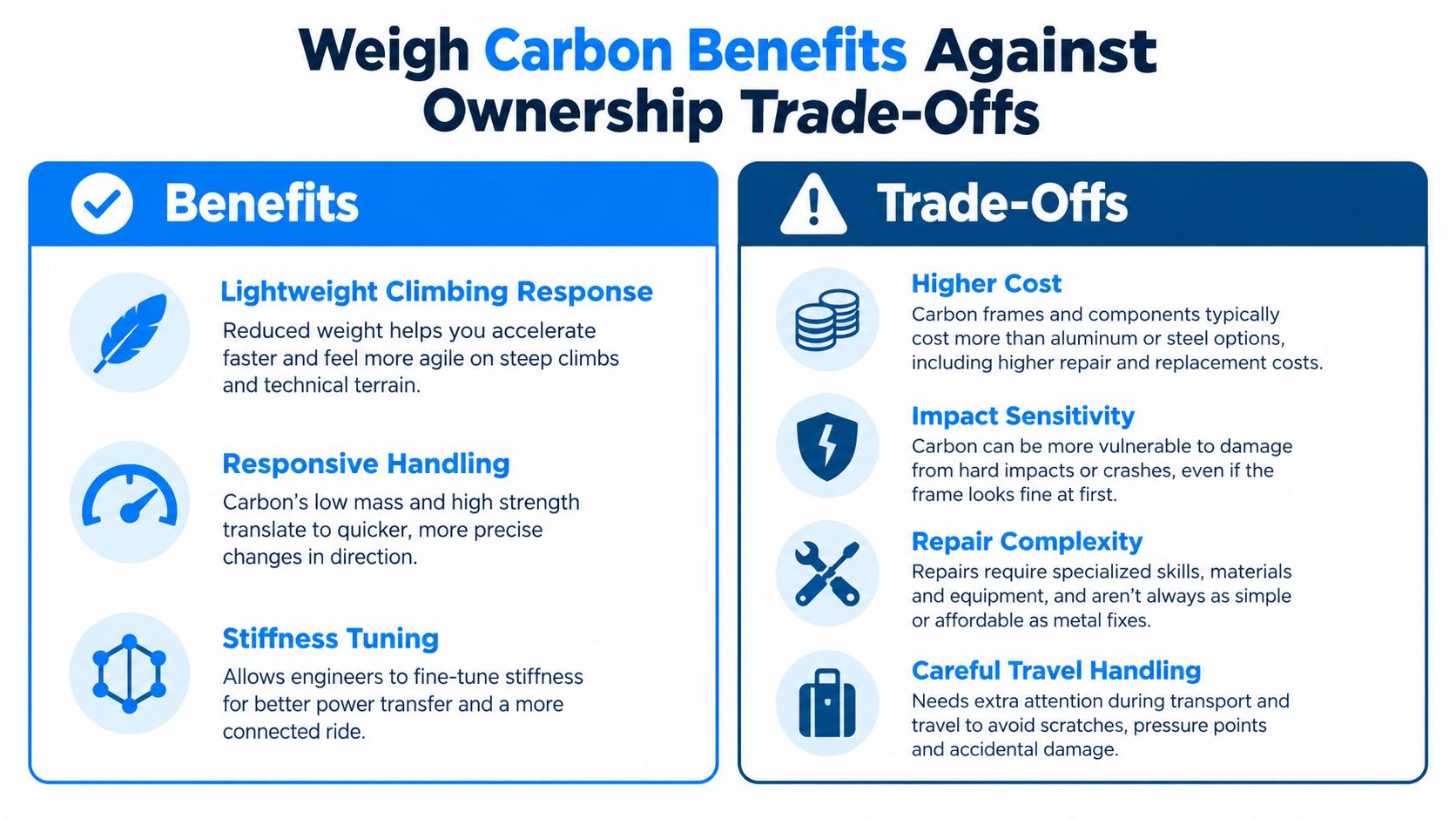
Lower complete-bike mass may help a climbing-focused rider, but a light frame doesn't guarantee a light or suitable build. Fork, wheels, tires, and accessories affect the finished bike, and the costs of owning it matter too.
This illustration is a prompt for comparison, not evidence that one frame material always outperforms another.
Durability depends on the particular structure
A published mountain-bike frame-failure case identified pre-existing wrinkles, voids, and delaminations that reduced mechanical properties and contributed to failure. It is a case study, not a failure-rate estimate for carbon hardtails or a basis for judging every carbon frame.
The buying implication is narrower: general claims about material strength cannot establish the structural condition of a particular used bike. Suspected damage needs a qualified assessment.
Service access is part of the specification
Before paying for integration, ask what routine maintenance involves:
Cockpit: Can you adjust position without replacing an expensive assembly?
Routing: What must come apart to access cables, hoses, or bearings?
Hardware: Are the correct clamping parts and replacements available?
Damage: Who can assess the frame, and what happens if repair isn't practical?
A tidy cockpit is a preference, not an exemption from service costs. If you're separately considering drop-bar bikes, the carbon versus aluminum gravel bike comparison covers that different application; it doesn't determine the right material for a mountain bike.
Choose Geometry for Fit and Terrain
Geometry links the frame's dimensions to potential fit and handling, but a premium frame can still put you in the wrong position. The 2019 Specialized S-Works Epic Hardtail specification lists 622 mm stack, 441 mm reach, a 69.8-degree head angle, 430 mm chainstays, and a 1,128 mm wheelbase for size large. These are measurements of a specific historical XC model, not modern targets for every large hardtail or rider.
Interpret the dimensions together
Frame stack and reach locate the top of the head tube relative to the bottom bracket. They don't by themselves describe your final hand position: stem, bar, spacers, grips, and saddle setup also influence how the bike feels. Compare frame measurements first, then consider the adjustable cockpit.
Head angle, chainstay length, and wheelbase help distinguish handling intentions, but interpret them together with fork travel and the frame's intended use. Standover clearance matters when you're off the saddle. Wheel size and axle standard tell you about setup and compatibility, not whether a size fits.
Carbon MTB hardtail comparison checklist
| Decision factor | Check on the candidate bike | Why it matters |
|---|---|---|
| Complete-bike weight | Measured or clearly specified build weight | Frame savings can be offset by components |
| Fit | Frame geometry, standover, and adjustable cockpit | A light bike can still put you in the wrong position |
| Terrain | Intended use, handling, tires, and fork travel | The bike must suit the trails you ride |
| Mechanical condition | Fork, wheels, drivetrain, and brakes | Overdue work changes the real purchase cost |
| Ownership | Service access and replacement hardware | A usable bike needs maintainable parts |
Compare candidates with a bike you know, noting what you'd keep or change. The guide to comparing bike geometry offers further measurement context. A chart can narrow a test-ride shortlist, not guarantee fit.
Set a Price Tier Before Comparing Value
Budget for a usable bicycle, not entry to a material category. Leave room for a qualified assessment, documented repairs, and overdue maintenance. Entry-level and premium are relative descriptions, not dependable price bands.
Compare complete builds, then account for uncertainty
Compare asking prices for genuinely comparable complete bikes of similar model year, size, build, and condition. Check the actual fork, wheels, drivetrain, and brakes rather than pricing a used bike from its frame badge or original retail specification.
Request service records and written estimates for work the bike demonstrably needs. Include realistic ownership expenses such as suspension servicing, consumables, and replacement proprietary hardware. Use the used bicycle value framework to separate an asking price from a documented case for value.
Missing serial-number or model information and suspected structural damage are not automatic bargaining chips. Investigate them before making an offer; if identity or safety-critical condition remains unresolved, walk away. A lower price doesn't establish that a frame is sound.
Testing documentation has a defined role
ISO 4210-2:2023 sets bicycle safety requirements, while ISO 4210-6:2023 covers frame and fork test methods. Published ISO 4210-6:2023 sample text specifies a 360 mm mountain-bicycle frame-impact drop in a particular standardized laboratory procedure. That figure is not an everyday riding load or a universal pass certificate for every frame.
A model's test documentation does not certify the condition or safety of an individual used frame after years of riding or impacts. Ask the manufacturer for the applicable intended-use category and rider or system-weight limits, then examine the bike's own history.
Inspect a Used Carbon MTB Hardtail
Treat a listing as evidence to investigate, not proof of structural condition. Establish the exact model, year, frame size, serial-number information, fork travel, wheel size, axle standard, and installed components before evaluating the asking price.
Request evidence at the vulnerable areas
Ask for clear, well-lit photographs and a candid history rather than relying on one distant drive-side image:
Front and underside: Head-tube junction, downtube, and bottom-bracket area.
Rear structure: Chainstays, seatstays, rear-axle interfaces, and derailleur hanger.
Clamp zones: Seatpost area and relevant cockpit interfaces.
History: Impacts, crashes, repairs, ownership records, and previous professional assessments.
Impact marks, crushed fibers, paint rippling, unexplained creaking, or an unclear crash account warrant further investigation. An unanswered question is still a risk, even if the seller isn't concealing anything.
Know what photographs can't establish
The Pro's Closet's carbon inspection explanation discusses controlled tap testing as one diagnostic aid. A dull response can prompt further examination, but neither a reassuring sound nor a clean photograph reliably certifies internal integrity. Don't treat an improvised tap test as a safety clearance.
If damage is suspected, consult a qualified carbon-frame specialist and request any existing manufacturer or repairer reports. The used carbon bike inspection guide provides additional checks, but no listing comparison replaces an appropriate physical assessment.
The outcome isn't a casual pass or fail: identify which questions have credible answers, which call for professional inspection, and which remain unresolved. A slightly heavier bike with traceable history and obtainable parts can be the more defensible purchase.
Match the Bike to Your Riding Priorities
These are representative buyer scenarios, not tested model comparisons. A climbing-focused rider might accept more specialized maintenance for a well-documented light build. Someone riding rougher trails should put intended use, fork condition, tires, and handling ahead of a frame-weight ranking.
A budget-conscious used buyer may prefer the candidate with a clearer history over one with more prestigious components. A rider who values integrated routing can accept its service requirements, provided the work and parts are understood before purchase.
Carbon MTB Hardtail Buying FAQs
Is a carbon MTB hardtail worth buying?
It can be when its weight and construction suit your riding, and the complete bike fits and is in acceptable condition. The material alone isn't enough reason to buy.
Is carbon always better than aluminum?
No. Compare the particular bikes, their builds, condition, intended use, and ownership costs rather than choosing a universal material winner.
Does a carbon frame make a hardtail comfortable?
It doesn't add rear suspension. Evaluate tires, fork, seatpost, setup, and terrain, then test-ride where possible instead of assuming a comfort outcome from the frame material.
Can I size a hardtail from height alone?
Height is a starting point. Compare geometry, standover clearance, current-bike position, and cockpit adjustment before committing.
Should I reject every repaired carbon frame?
Not automatically. Ask who performed the repair, what was damaged, and what documentation supports continued use. Have a qualified specialist review anything you cannot assess.
Should missing listing information reduce my offer?
Request the missing evidence first. If identity or structural concerns remain unresolved, reconsider the bike rather than relying on a discount.
Make the Purchase Explainable
Before proceeding, you should be able to explain why this particular carbon MTB hardtail is suitable:
Riding purpose: Its intended use and handling suit your terrain.
Fit evidence: Size and position have support beyond your height.
Mechanical suitability: Components, compatibility, and service needs are understood.
Purchase confidence: Identity, history, condition, and comparable complete-bike prices support the decision.
SYCLR's search and comparison tools cover road and gravel bikes, not MTB inventory or carbon-hardtail inspection. The same habit of comparing fit and evidence is useful here, but a mountain-bike test ride and qualified inspection must stand on their own.
Hidden damage, uncertain provenance, and a geometry mismatch aren't equivalent problems. Some require inspection; others call for a different bike. Choose the hardtail whose suitability you can explain without falling back on the word carbon.