
Best Steel Gravel Bike: A Fit-First Buyer’s Guide
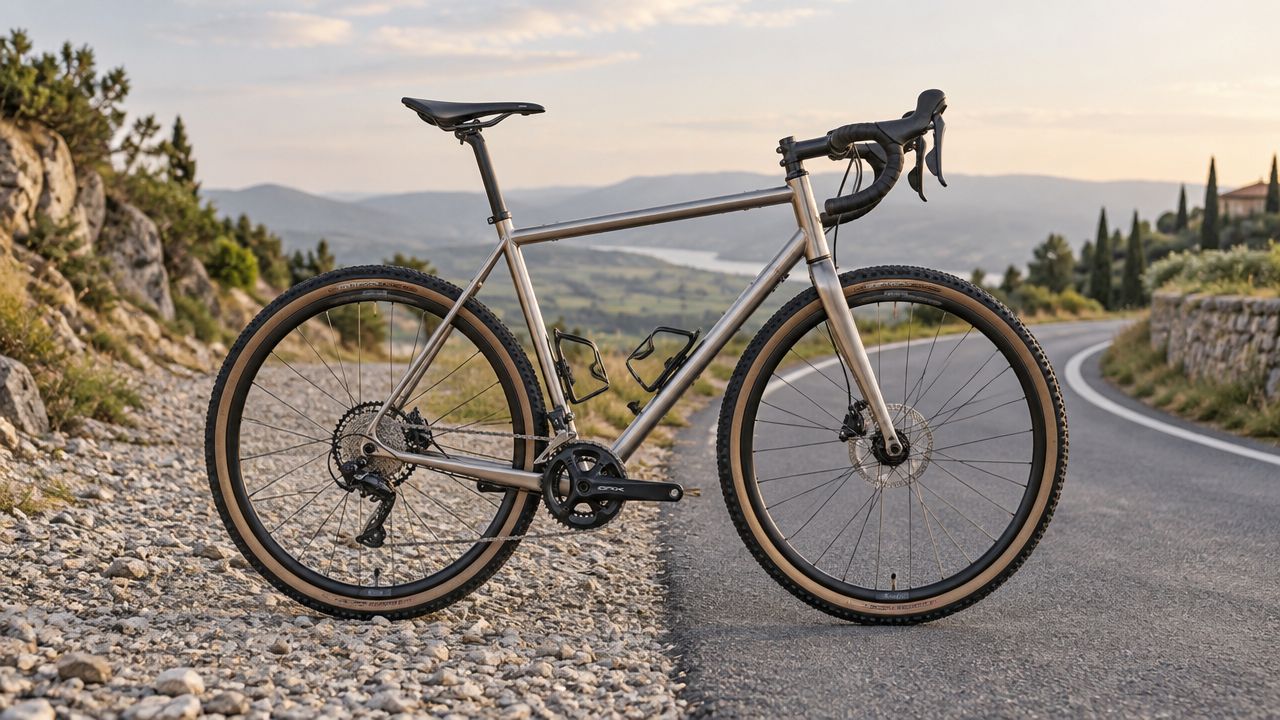
Steel is not automatically the best gravel-bike material, and the material label alone does not tell you whether a bike is a strong buy. The best steel gravel bike is the one whose stack, reach, tire clearance, component spec, and condition align with your fit needs, setup, and the surfaces you actually ride.
If you are comparing new and used bikes, start with fit signals rather than brand reputation or frame lore. Height can help narrow the search, but it cannot determine fit on its own. Final hand position also depends on the stem, spacer stack, handlebar shape, hood position, and saddle setup. A beautiful steel frame with the wrong front-end coordinates, limited clearance, or unclear condition is still a poor purchase.
Best Steel Gravel Bikes in 2026
The current picks below are included because they have an active manufacturer or retailer page with current U.S. pricing or availability information, plus enough published detail to verify frame material, spec, clearance, and size availability. They are not ranked by "best ride feel." They are shortlist candidates to compare against your fit and use case.
| Bike | Current price | U.S. availability | Frame and fork | Drivetrain | Brakes | Claimed tire clearance | Sizes |
|---|---|---|---|---|---|---|---|
| Surly Midnight Special | $3,499 complete (Surly) | Current Surly model, sold out online at time of review; local dealer availability may be available through Surly’s product locator | 4130 Chromoly steel frame, Salsa Waxwing carbon fork (Surly) | Shimano 105 R7100 2×12 (Surly) | Shimano 105 R7170 hydraulic disc (Surly) | 650b x 50 mm or 700c x 42 mm without fenders (Surly) | 40, 46, 50, 54, 56, 58, 60, 64 cm (Surly) |
| Marin Four Corners 1 | $1,299 (Marin) | Current U.S. manufacturer page active | Series 1 butted CrMo steel frame and fork (Marin) | Shimano CUES 2×9 (Marin) | Tektro Spyre-C mechanical disc brakes (Marin) | Stock 45 mm tires and published wide frame-and-fork tire clearance (Marin) | XS, S, M, L, XL (Marin) |
What these current picks do well
Surly Midnight Special
The Midnight Special remains a relevant current steel shortlist option because Surly has an active current U.S. product page with a clear complete-bike price and published frame, fork, clearance, and size details. The current U.S. listing for the complete bike shows a $3,499 price, a 4130 Chromoly steel frame, a Salsa Waxwing carbon fork, Shimano 105 R7100 2×12, Shimano 105 R7170 hydraulic disc brakes, claimed clearance for 650b x 50 mm or 700c x 42 mm tires without fenders, and sizes 40, 46, 50, 54, 56, 58, 60, 64 cm (Surly).
For this shortlist, the key point is to treat the live Surly page as the source for the exact current configuration you are evaluating, rather than combining details from older reviews, older product pages, or different variants. At the time of review, this current Surly model is sold out online, though local dealer availability may still be possible through Surly’s product locator.
Marin Four Corners 1
Marin's current U.S. Four Corners 1 qualifies as a current steel drop-bar mixed-surface option with a live manufacturer page and current U.S. price. Marin lists a $1,299 price, a Series 1 butted CrMo steel frame and fork, Shimano CUES 2×9, Tektro Spyre-C mechanical disc brakes, stock 45 mm tires, and a published description of wide frame-and-fork tire clearance. Marin also states that XS and S use 650B wheels, while M through XL use 700C (Marin).
That wheel-size split still matters because tire-clearance claims have to be read together with the intended wheel and tire combination. If this bike is on your shortlist, compare the exact size geometry and wheel format, not just the model name.
Breezer Radar X note
The Radar X is not included as a current available pick here. Breezer's current product page is marked unavailable, so it does not meet the current shortlist rule for an actively purchasable bike at the time of review (Breezer). It is still worth watching for its large claimed tire room if live U.S. stock appears again.
Table of Contents
- Best Steel Gravel Bikes in 2026
- What Buying a Steel Gravel Bike Really Involves
- Decoding Steel Gravel Geometry and Fit Signals
- Material Trade-Offs and Future-Proofing Your Ride
- Matching Steel Frame Choices to Your Riding Goals
- Evaluating Used Steel Listings and Condition Signals
- How SYCLR Helps You Shortlist Better-Fit Options
- Steel Gravel Bike FAQs
- Does steel flex waste power on gravel?
- Can an older steel frame use a modern 1x drivetrain?
- Is custom steel worth choosing over a production frame?
- Should I choose steel for rough roads?
- How should I think about wheelbase on a steel gravel bike?
- How should I compare two steel gravel sizes?
- What should I verify before buying a used steel gravel bike?
What Buying a Steel Gravel Bike Really Involves
Steel gravel bikes attract buyers for good reasons. They often overlap with classic construction, durable utility-minded designs, and broad component compatibility. Still, those qualities should not decide the purchase before fit, tire clearance, and the exact build.
Steel has a long history in rough-surface riding, but that history does not identify the right frame for your body or your routes. A steel bike can still place too much weight on your hands, miss your tire-width needs, or use a build that is expensive to change.
What the material label cannot tell you
Steel alone does not determine whether a bike handles quickly, tracks calmly, feels comfortable, or works well with bags. Tube selection, frame design, fork design, geometry, wheel and tire setup, and contact points all shape those results. Two steel gravel bikes can feel very different because they are solving different design problems.
Check the geometry chart before reacting to the frame's appearance. Compare stack and reach with a bike that already works for you, then check the current build, tire clearance, mounts, and the fork's stated limits. A frame that barely fits your current tire may limit future setup changes even if the frame material itself appeals to you.
Practical rule: Buy a steel gravel bike because the fit signals, clearance, build, and condition suit your riding. The frame story comes after that.
Decoding Steel Gravel Geometry and Fit Signals
Steel gravel geometry should be read as a set of rider-position and design choices, not as a shortcut based on frame material. Stack and reach are useful because they describe the frame's front-end reference points more consistently than brand size labels do.
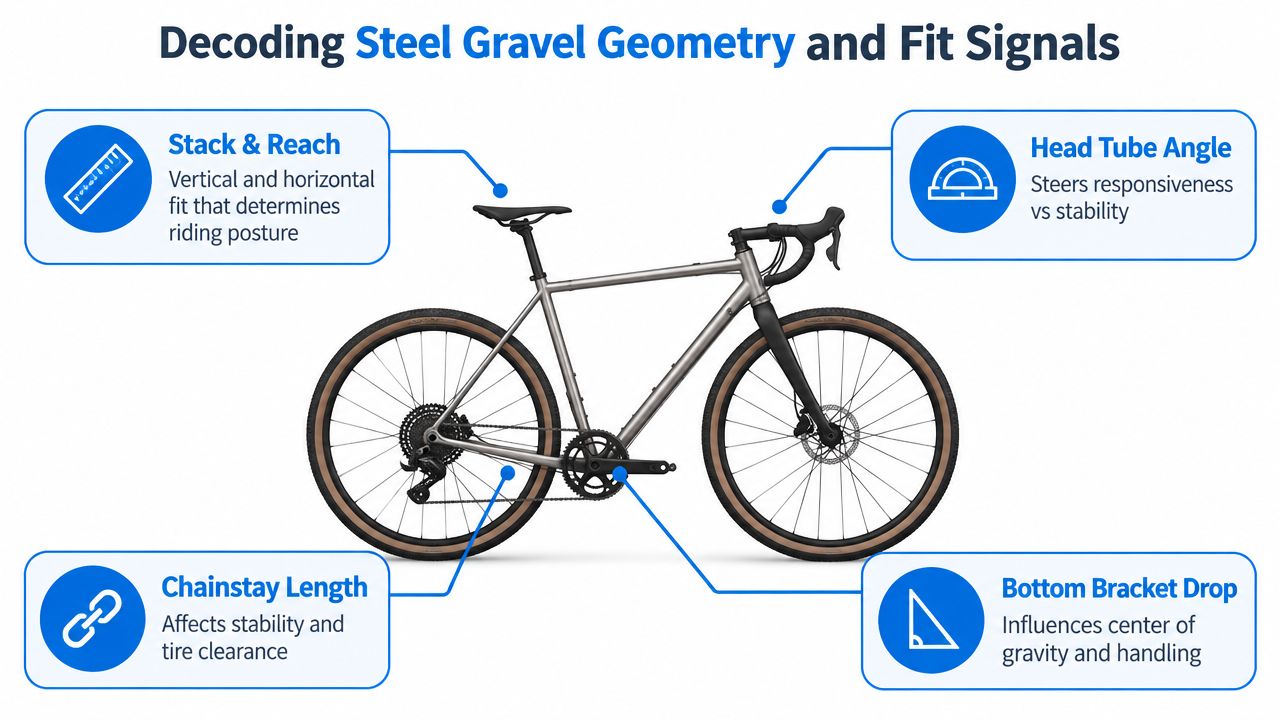
Stack and reach are reference points, not final fit
Stack and reach help you compare one frame with another, but they are not the same thing as final hand position. The actual position you ride depends on the stem length and angle, spacer height, handlebar shape and reach, hood placement, saddle height, and saddle setback.
That is why stack and reach work best as frame-level reference points. Start with a bike that already fits reasonably well, then compare the new frame's coordinates to see whether the target position looks realistic without extreme setup choices.
Adjacent sizes can differ meaningfully in both stack and reach, so compare the exact geometry chart directly instead of assuming two neighboring sizes will feel close.
Stack and reach geometry is the deeper reference to use when you are comparing a steel frame with your current bike.
How to read secondary geometry signals carefully
Wheelbase, rear-center or chainstay length, bottom-bracket drop, head angle, and trail are geometry signals, not standalone stability or agility scores. They make more sense when interpreted together with front-center, fork offset, tire size, tire pressure, rider position, load, and riding speed.
For example, a wheelbase figure by itself does not tell you how a bike will feel in corners or on descents. The same is true for chainstay length. Those numbers matter, but they should be read in the context of the whole chassis and the way the bike is set up.
Bottom-bracket drop is best treated as a description of the vertical relationship between the wheel axle line and the bottom-bracket center. In practice, that helps you think about ride height and pedal-clearance context. It is not a universal handling shortcut.
Material Trade-Offs and Future-Proofing Your Ride
Steel can be a sensible gravel-frame option, but the case for it should stay practical. Depending on the frame and tubing, steel may come with a weight penalty relative to some carbon options, and some older steel bikes use older spacing or narrower tire limits.
It is also worth being precise about repair. Steel can sometimes be repaired by a qualified framebuilder or welder, depending on the damage, the tubing, and the exact location of the problem. That does not mean every damaged steel frame is worth repairing or safe to repair.
Carbon generally offers the most freedom for low weight and shaped tube profiles. Aluminum often remains a practical option for riders prioritizing value and broad availability. The correct decision is not about material ideology. It is about the frame, the build, and the riding you actually do.
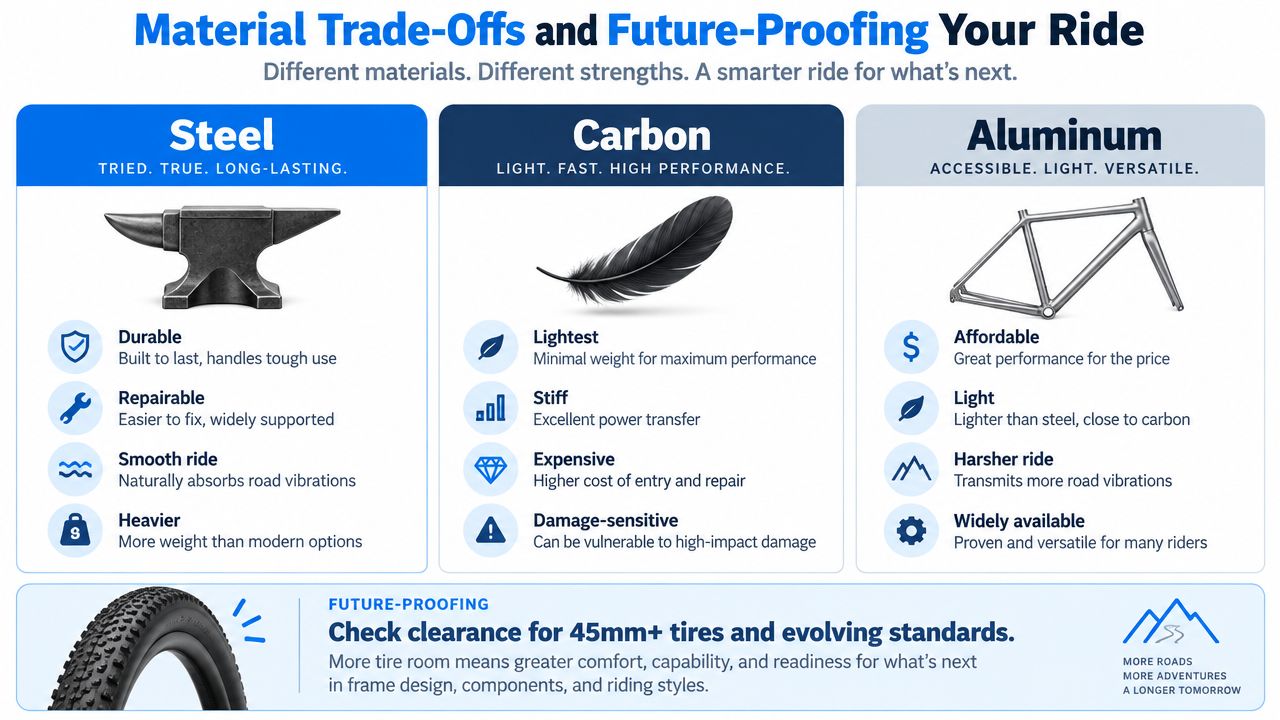
Clearance is the future-proofing question
Tire clearance changes what a gravel bike can realistically do, but there is no universal gravel-clearance target. Some current gravel designs are moving toward larger tire support, but the only number that matters for a purchase decision is the exact manufacturer-supported clearance for the frame, fork, wheel size, rim, and tire combination you plan to use.
BikeRadar notes that tire clearance should be verified carefully and that standards such as frame-to-tire spacing matter when you evaluate real-world room around the tire (gravel tire clearance guidance). The practical question is not whether a bike hits a trend number. It is whether the exact frame and fork support your intended wheels and tires with appropriate margin.
That is why current manufacturer details matter so much. Marin's Four Corners 1 uses stock 45 mm tires and publishes wide frame-and-fork tire clearance, with wheel format tied to frame size (Marin). Surly's Midnight Special references 650b x 50 mm or 700c x 42 mm without fenders (Surly). Those exact numbers are more useful than broad category assumptions.
Steel versus the alternatives
| Material | Practical strengths | Main compromises |
|---|---|---|
| Steel | Broad design variety, classic construction, good long-term service potential on the right frame | Can be heavier, and older examples may use older standards or narrower clearances |
| Carbon fiber | Low-weight potential and highly shaped frame design | Damage assessment and repair decisions can be more complex |
| Aluminum | Accessible, responsive, and widely available | Ride quality depends heavily on complete frame and fork design |
The useful comparison is not "steel feels better than carbon." It is whether the bike gives you the fit range, tire volume, mounts, standards, and complete-bike value you need. Use this carbon versus aluminum gravel-bike comparison when the material choice extends beyond steel.
Matching Steel Frame Choices to Your Riding Goals
There is no single steel gravel geometry. Useful differences show up in posture, tire capacity, mounting options, gearing, and complete-build intent.
Start with your routes and your current fit reference. Then assess whether the frame's position range, tire support, and build actually suit those routes. A bike that looks ideal on paper can still be a bad buy if the geometry is off or the stock build forces immediate changes.
Match posture before handling claims
Use your current bike, or a prior fit reference, as the benchmark. Compare the new frame’s stack and reach, then ask whether a realistic cockpit setup can place the contact points within a position you already know works well.
Avoid body-type shortcuts. Body proportions do not automatically determine reach, stack, frame size, cockpit choice, or whether you should size up or down. Those decisions depend on the whole position, not one body-description rule.
Match clearance to the actual surface
Do not choose a bike for an imaginary future route while ignoring what you ride now. If your roads are mostly smooth mixed surface, moderate tire room may be enough. If your riding includes mud, loose rock, and rough doubletrack, broader verified clearance gives you more setup options.
Check the complete build, not only the frame. A frame may clear a larger tire, but the supplied wheels, rims, fenders, or drivetrain can create practical limits. Read the frame and fork clearance notes carefully, especially when the brand distinguishes between wheel sizes or rim and tire combinations.
Evaluating Used Steel Listings and Condition Signals
Steel is not automatically a safe used buy. Keep the first pass simple and verification-focused.
Start by confirming the exact model, model year or generation, and frame size. Then check for corrosion, dents, cracks, impact evidence, fork condition, geometry, tire clearance, and component compatibility. If the seller cannot provide clear photos and accurate listing details, treat the bike as lower confidence.
SYCLR's used gravel-bike buying guide and used-bike red flags cover deeper inspection and value questions.
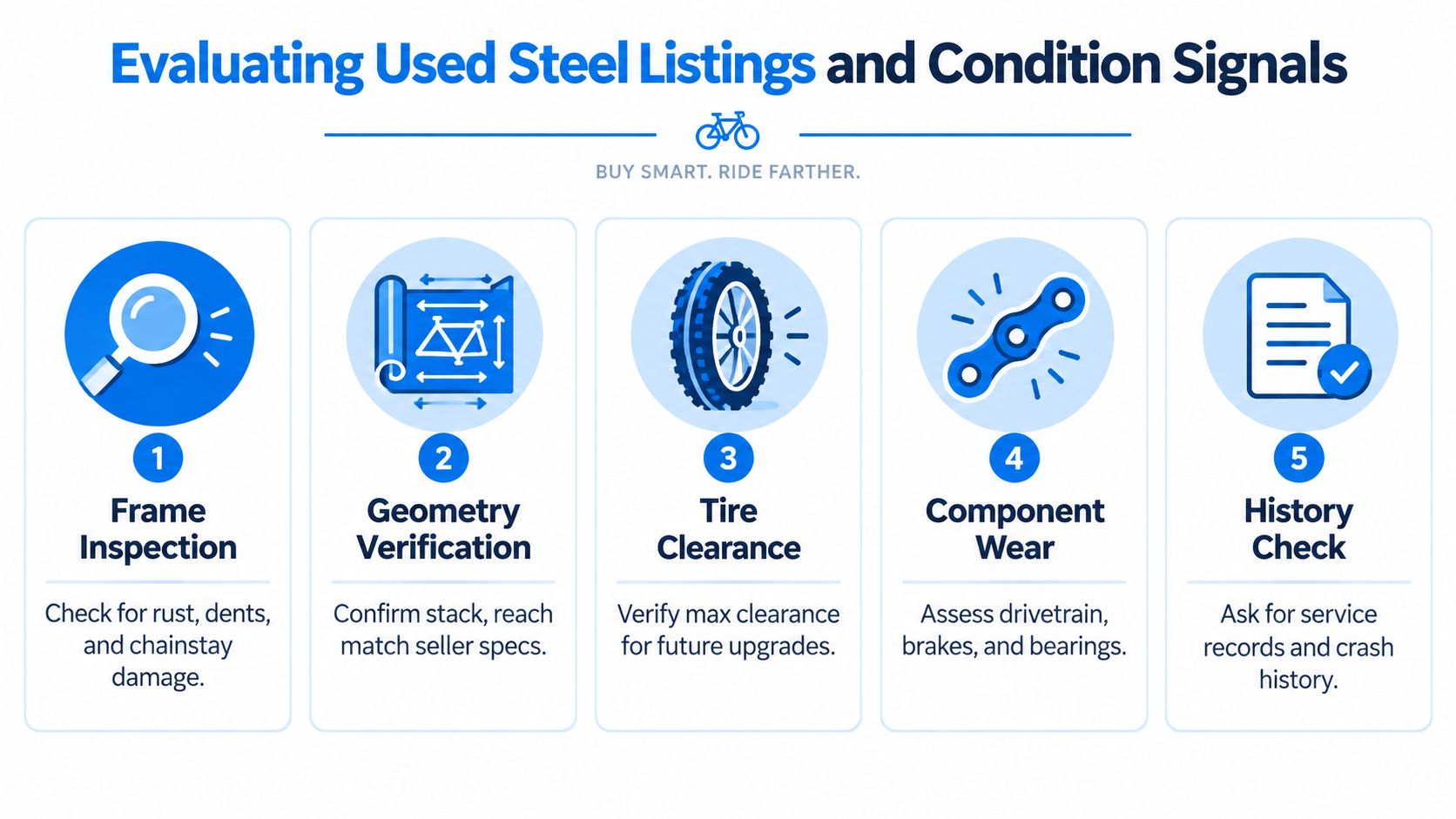
Use a simple verification workflow
Verify identity: Confirm the exact model, year, frame size, and major components.
Check the frame and fork: Look for corrosion, dents, cracks, paint damage with context, and any signs of impact.
Confirm geometry and clearance: Compare the frame with your fit reference and verify the seller is describing the correct tire room.
Check compatibility: Verify drivetrain, brake, wheel, axle, and hanger details before assuming future upgrades are easy.
Review listing evidence: Clear photos, serial area visibility where appropriate, service records, and consistent seller answers all improve confidence.
How SYCLR Helps You Shortlist Better-Fit Options
General marketplaces can show a lot of inventory without helping you compare fit signals, geometry signals, model-year context, price context, listing quality, available condition signals, and overall confidence in a structured way.
SYCLR is a fit-aware road and gravel bike discovery platform. Riders can start with height, bike type, and budget, then compare listings around fit signals, geometry signals, model-year context, price context, listing quality, condition signals where available, and confidence signals.
SYCLR does not perform a professional bike fit, physically inspect bikes, authenticate listings, verify ownership or seller claims, or guarantee fit or condition.
Use the platform to reduce avoidable guesswork
For a steel gravel search, enter the basic constraints first. Then prioritize listings with enough information to compare frame size, geometry, tire clearance, model year, price context, and condition signals.
If you already know your stack, reach, or current-bike reference points, use Advanced Fit to improve the shortlist. Start your search at SYCLR.
Buying discipline: Use a discovery tool to narrow the field, then validate the specific frame, build, and seller evidence yourself.
Steel Gravel Bike FAQs
Does steel flex waste power on gravel?
Not automatically. Frame behavior depends on the complete design, including tubing, fork, wheels, tires, and rider position. Tire pressure and tire casing can change ride feel more noticeably than the material label alone.
Can an older steel frame use a modern 1x drivetrain?
Sometimes. Check the frame generation, rear spacing, derailleur hanger, crank and chainring clearance, cassette body, chainline, shifter, and brake setup. Compatibility questions are often more complicated than removing the front derailleur.
Is custom steel worth choosing over a production frame?
Custom can make sense when you already have a known fit reference, when you need specific mounts or equipment integration, or when you have specific design goals that production frames do not meet.
A production frame is usually simpler if it already meets your fit and component-interface needs. A custom label does not fix an unclear position brief.
Should I choose steel for rough roads?
Choose the complete bike around the route, not the material alone. For rough roads, verify that the frame and fork support your intended tire size, and confirm that the wheels, gearing, and mounts suit the trip or surface.
How should I think about wheelbase on a steel gravel bike?
Treat wheelbase as one geometry signal within a bigger system. Its effect depends on how it interacts with front-center, trail, head angle, fork offset, tire setup, rider position, load, and speed. It is useful to compare, but it is not a standalone verdict on stability or agility.
How should I compare two steel gravel sizes?
Use your current bike or fit reference as the baseline, then compare where the bars, saddle, and pedals will sit once the bike is built with a realistic stem, spacer, and bar setup. Brand size labels are not consistent enough to decide this on their own.
What should I verify before buying a used steel gravel bike?
Confirm the exact model, year, size, geometry, tire clearance, component compatibility, visible frame condition, fork condition, and listing evidence. Ask for clear close-up photos of high-stress areas and verify that the seller's description matches the actual bike.
SYCLR helps riders compare road and gravel listings through rider details, bike type, budget, fit signals, geometry signals, model-year context, price context, listing quality, condition signals where available, and confidence signals. Visit SYCLR to start with your height, bike type, and budget, then shortlist steel gravel options before contacting a seller.