
Gravel Bike Fit Calculator Guide for Better Shortlists
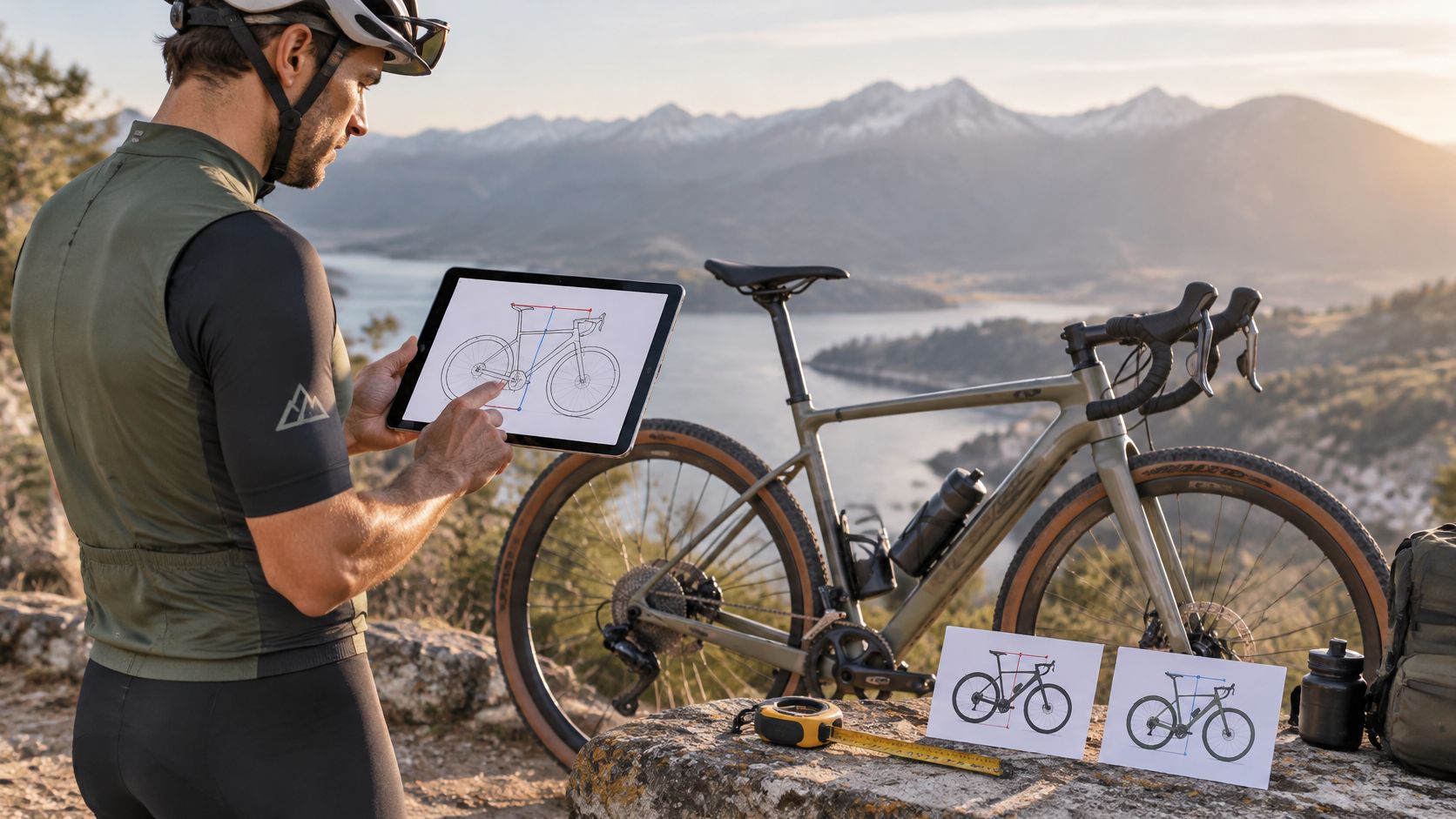
You've found several gravel bikes listed as 54, M, or medium, and the labels suggest they should fit similarly. Then the geometry charts show different numbers. Which frame is a better candidate for your position? A gravel bike fit calculator helps narrow the search, but the useful next step is to check its starting size against each listing's exact model-year geometry and visible cockpit. That is how a size suggestion becomes a defensible shortlist, not a fit verdict.
Table of Contents
- Why Height Alone Is Not Enough
- The Measurements That Make Results Useful
- How to Enter Your Details in a Fit Calculator
- Interpreting Stack Reach and Size Results
- Adjust the Target for Your Riding Scenario
- Apply the Results to Bike Listings
- Use the Calculator as a Shortlisting Filter
Why Height Alone Is Not Enough
Frame labels don't describe how a bike will position your body. A 54 cm frame from one manufacturer can have a different stack and reach from a 54 cm frame from another, and the same nominal size can change between model years. Height is an initial filter; inseam, body proportions, your existing position, and exact frame geometry make comparisons more useful.
In a study of 50 trained male cyclists, researchers examined body measurements, flexibility, and riders' chosen bicycle configurations. Leg length and flexibility helped explain differences in setup, including saddle height. The study supports considering individual measurements, but it did not test gravel bike fit calculators or validate a particular sizing tool. Its participants' setup measurements are not general saddle-height targets (cycling configuration research).
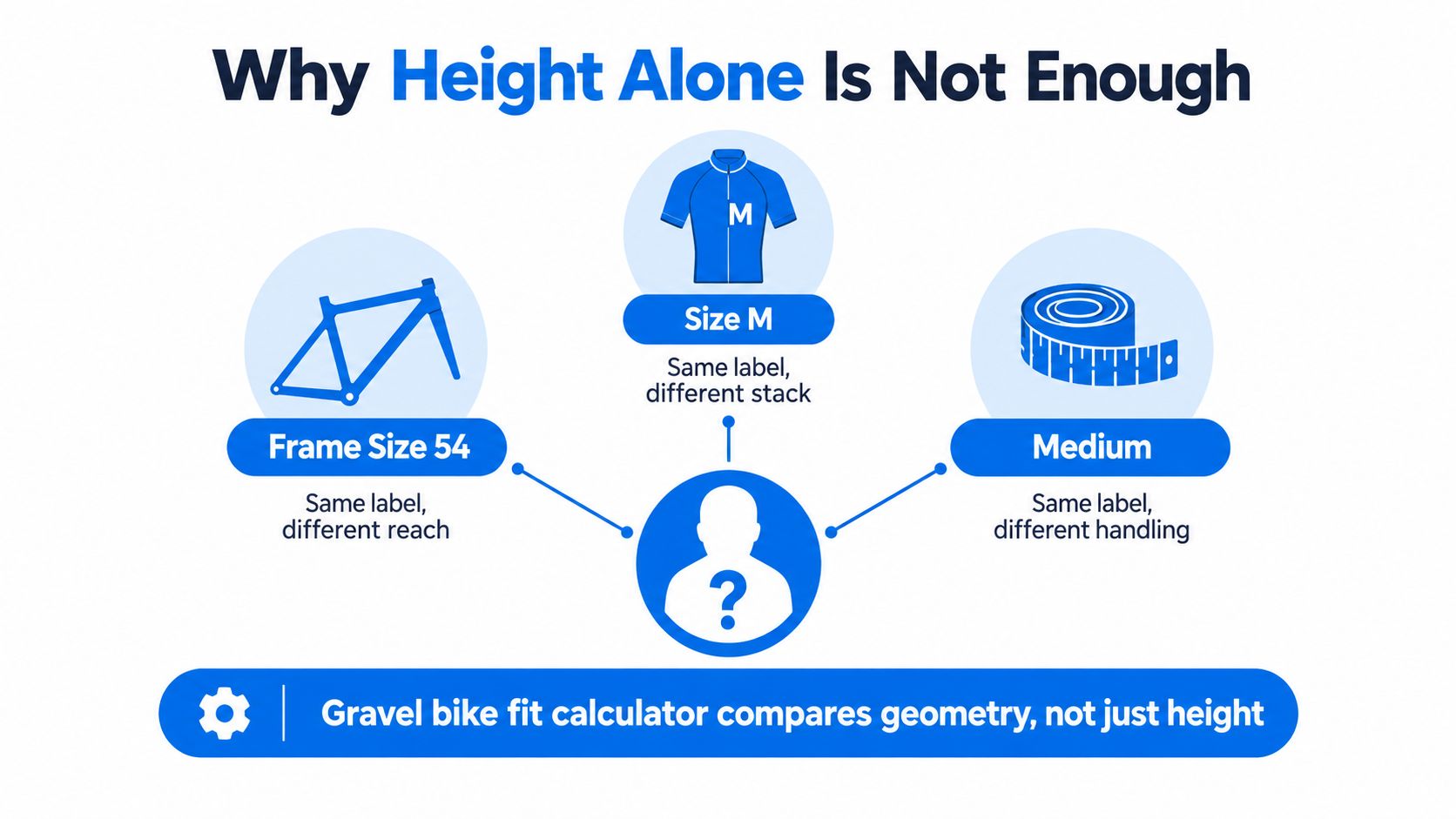
A poor frame starting point can leave you reaching for the controls or depending on a stem or spacer arrangement you haven't checked. Those changes aren't automatically wrong. They are reasons to verify the frame and cockpit rather than trust the label.
Compare your measurements and familiar riding position with the exact model-year geometry, then inspect the parts that determine where the bars actually sit. For the broader sizing and fit fundamentals, see the bike size calculator overview and bike fit guide.
The Measurements That Make Results Useful
Start with height and a measured inseam. Inseam helps you assess saddle-height context and standover; torso length and arm span can help you think about your reach to the controls. These are useful measurements to record, not a promise that a single calculator accepts all of them.
Stack and reach describe the frame's fixed geometry relative to the bottom bracket. Stack is the vertical distance from the bottom bracket to the top of the head tube; reach is the horizontal distance from the bottom bracket to that same point. These coordinates make cross-brand comparisons more meaningful than size labels, but neither is the finished saddle-to-bar measurement (frame geometry definitions).
Your current bike is a practical reference if you know what feels comfortable or what you want to change. Record saddle height and setback, bar height and position, and any known stem, spacer, and handlebar details. For a consistent starting point, measure your inseam for a bike and note how you measured it.
Collect before comparing:
Website sizing inputs: Height, optional inseam, road or gravel category, and preferred posture.
Current-bike reference, recorded manually: Saddle height and setback, bar position, and known cockpit parts.
Candidate listing: Exact model, model year, stated frame size, published stack and reach, and photographed cockpit parts.
Additional fit details: Torso or arm measurements and any fit-report coordinates you already have; use them in the app only where corresponding fields are supported, or keep them in your comparison notes.
Stem angle, spacers, handlebar shape, and hood placement affect the final position. A frame-coordinate match cannot establish that the bars will land where you want them (cockpit and frame-position guidance).
How to Enter Your Details in a Fit Calculator
Use the SYCLR website bike-size calculator for a starting size: enter your height, add inseam if you have it, choose road or gravel, and select your preferred posture. Preferred posture changes the calculator's stack and reach targets, not its nominal frame-size recommendation. Budget is not a website sizing-calculator input; it belongs to app bike discovery.
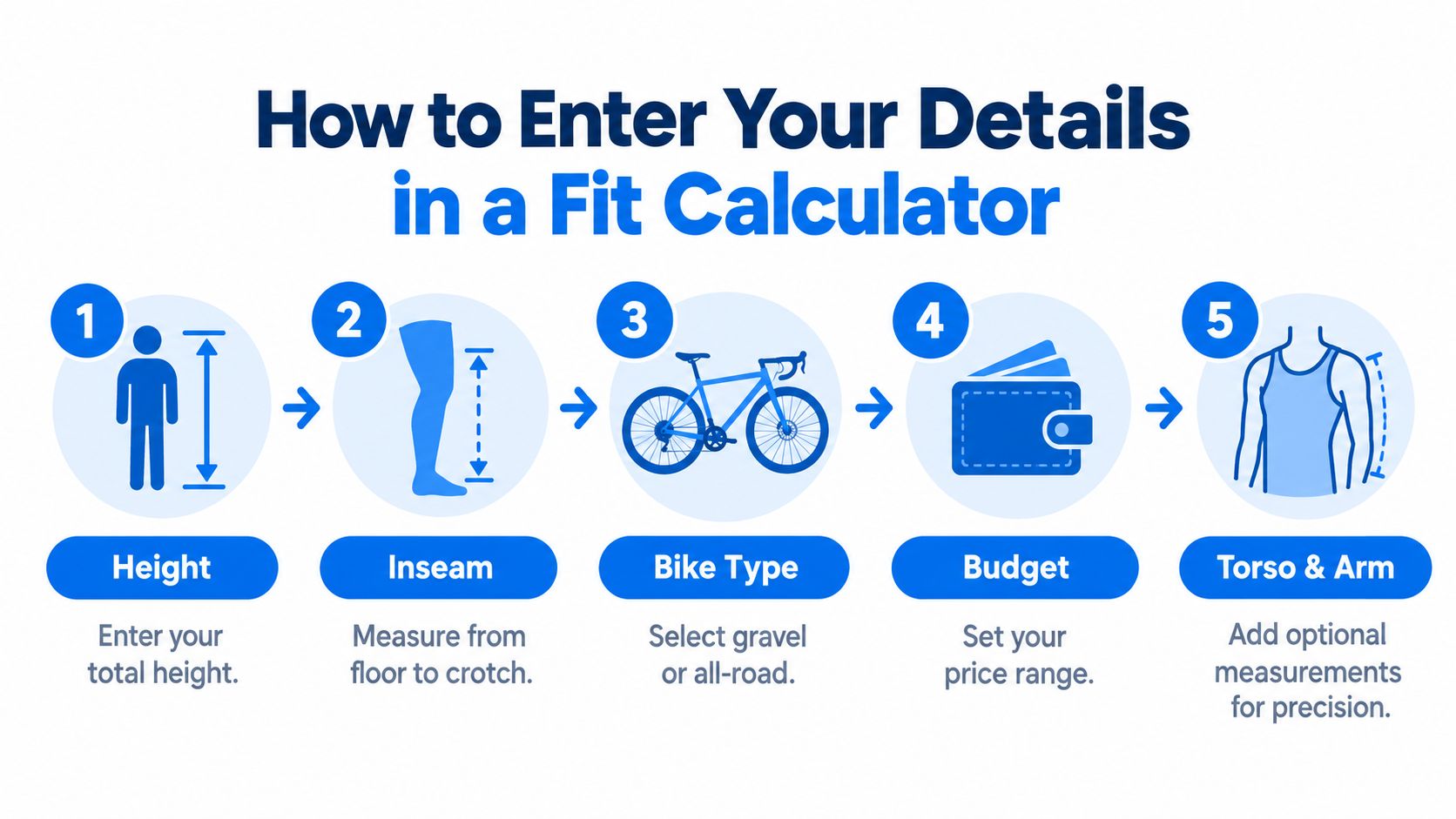
Keep three tasks separate so the result does not acquire more precision than the input supports:
| Workflow | What to do | What it does not establish |
|---|---|---|
| Website bike-size calculator | Use height, optional inseam, road/gravel choice, and preferred posture for a starting size and stack/reach targets | The cockpit settings of a particular listing; posture does not change the nominal size recommendation |
| SYCLR app bike discovery | Use height, bike type, and budget to find listings; add more detailed fit information where supported | A professional fit or automatically verified components |
| Manual buyer comparison | Record current-bike contact points and inspect a candidate's model-year chart, stem, spacers, and bars | A measured position on a bike you have not examined |
Check your inputs before comparing:
Use consistent units. Geometry charts typically give stack and reach in millimeters.
Name the measurement. Frame reach, a calculator reach target, and saddle-to-bar reach are different references.
Note your reference points. Saddle-height figures are only comparable when measured the same way.
Separate measured facts from estimates. If the listing omits a stem length or the model year is uncertain, mark that information as missing.
Your current bike is a reference, not necessarily a target to copy. If you're trying to change an uncomfortable position, say what you want to change before ranking frames. A calculator's size output is a first filter; the listing comparison is a separate step.
Interpreting Stack Reach and Size Results
A suggested frame size is a starting point. Stack describes head-tube height relative to the bottom bracket; reach describes its horizontal position. Compare calculator stack and reach targets with published frame geometry, then inspect saddle placement, stem, spacers, bars, and hood placement to assess the possible saddle-to-bar position. See bike stack and reach for the underlying geometry; here, the question is how to apply it to a listing.
Radmarkt describes 530-560 mm stack and 380-400 mm reach as illustrative ranges for a 54 cm race-gravel frame (race-gravel geometry ranges). These are not universal dimensions for 54 cm gravel bikes, and they do not describe anyone's final handlebar position.
Hypothetical comparison, illustrative numbers only: Two listings both say 54 cm. Frame A's published model-year chart lists 550 mm stack and 385 mm reach; Frame B's lists 535 mm stack and 400 mm reach. On the chart, A's head-tube reference point is 15 mm higher and 15 mm less forward than B's. Neither number tells you which bike fits: confirm each frame's year, then check its actual stem, spacers, bars, and hood position before judging whether it could support your intended position. These are invented example coordinates, not real-bike specifications or fit recommendations.
Practical rule: Ask what the suggested size would require you to change, and whether the listing gives you enough evidence to check it.
| Result | What to verify | Buyer implication | Confidence signal |
|---|---|---|---|
| Suggested frame size | Exact model-year stack and reach | The label is only an initial filter | Higher when the geometry chart matches the listing |
| Stack and reach near your target | Saddle and bar coordinates, plus cockpit parts | The frame may be a promising starting point | Higher when measurements and model year are confirmed |
| Match depends on a stem or spacers | Available adjustment and component details | Check whether the required setup is practical | Lower when the seller hasn't shown the cockpit |
| Geometry information is missing | Model identity and source of any claimed measurements | Don't substitute a universal size conversion | Lower until the frame can be identified |
A chart can help you reject a weak lead or prioritize a promising one. It cannot measure the contact points on a used bike from a frame-size label alone.
Adjust the Target for Your Riding Scenario
There is no universal stack increase or reach reduction that turns a road fit into a gravel fit. Your riding goals, existing position, rider needs, and available component adjustments determine what is worth trying. Use any suggested posture as a question to test against your current bike, not as a fixed millimeter prescription (gravel fit starting range).
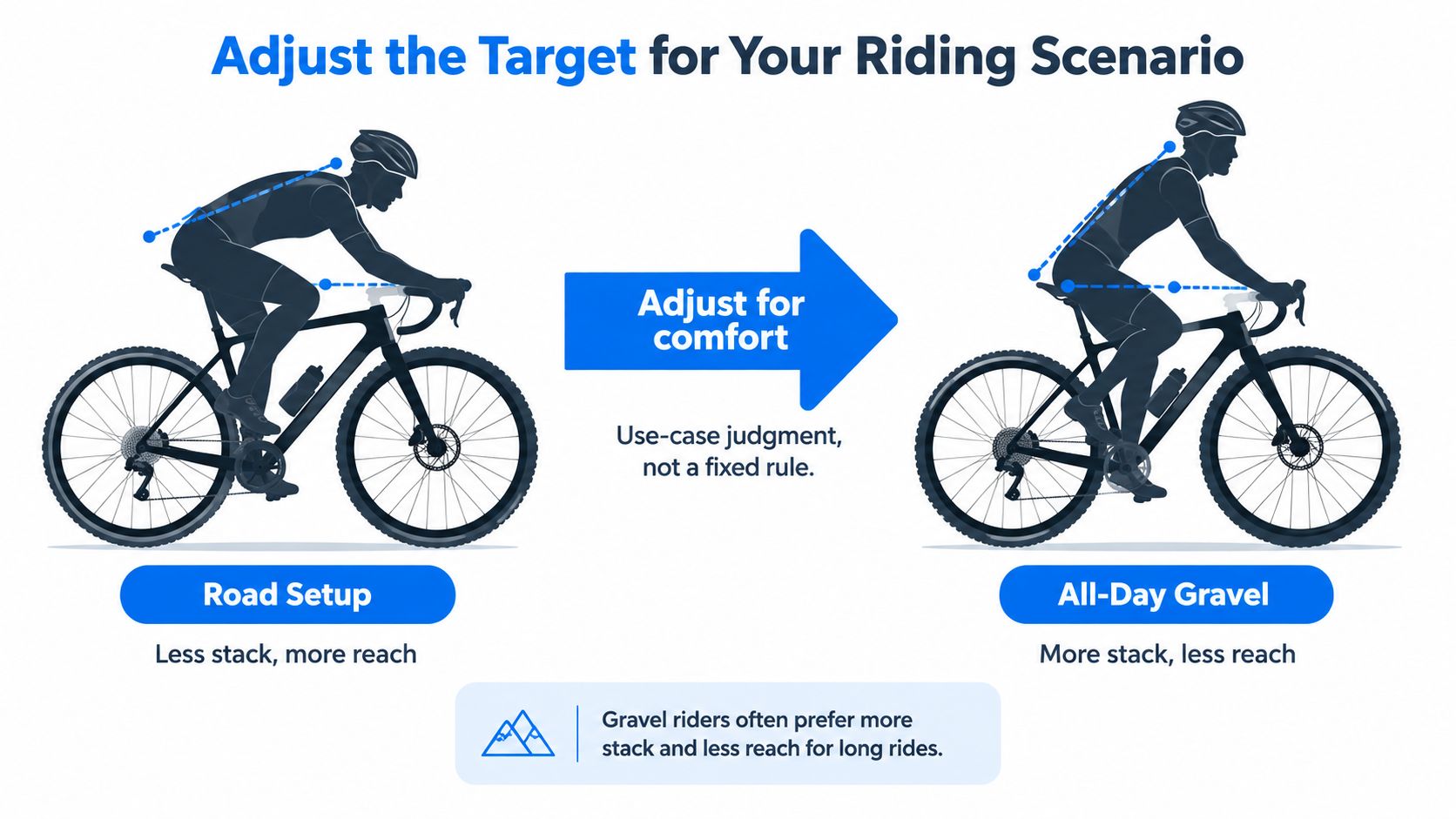
Consider how you intend to ride:
Fast gravel riding: Decide whether a lower or longer position remains comfortable on your usual rough surfaces.
Long mixed-surface rides: Compare any proposed bar position with one you can sustain, rather than assuming taller is always better.
Rough trails and descents: Check whether you have room to move and reach the controls comfortably.
Loaded bikepacking: Consider how bags and luggage affect handling and contact points.
Frequent stop-start riding: Check standover and ease of handling alongside cockpit position.
Check planned tires separately from fit. Frame and fork clearance depend on the exact bike, wheel and rim, mounted tire, and room for debris; a promising geometry chart does not confirm that your intended tires will clear. The gravel bike tire clearance guide covers that inspection in more detail.
A candidate is more compelling when its frame geometry, available cockpit adjustment, and intended use all make sense together. Don't force a posture target onto a listing whose component limits you cannot establish.
Apply the Results to Bike Listings
Now take a candidate that appears to match your website size result. Before promoting it to the shortlist, confirm the exact frame model and year. Compare its published stack and reach with the calculator targets or your current-bike frame reference, then inspect the advertised stem, spacer arrangement, and bars. A close geometry comparison alone does not establish cockpit compatibility. Photos may show what's installed; ask the seller when a part or measurement is unclear.
A missing geometry chart is a confidence gap, not permission to infer dimensions from a generic "medium" or "54" label. Model-specific sizing guidance likewise points buyers to the particular frame's geometry rather than treating nominal labels as interchangeable (model-specific sizing guidance). For condition and identity checks beyond fit, see how to compare used bike listings.
If you already have current-bike geometry or fit-report numbers, keep them available for app fit-detail fields where supported and for your own comparison. For help reading a chart or evaluating used gravel bikes, see how to read a bike geometry chart, used gravel bike considerations, and how to buy a used gravel bike.
Rank candidates by evidence, not by the size suggestion alone:
Confirm the model, year, and frame size.
Compare the published geometry with the calculator targets or current-bike frame reference.
Check whether the visible cockpit and available adjustment support further investigation.
Review condition, listing completeness, and seller answers.
Weigh price after accounting for fit and listing uncertainty.
SYCLR provides fit-aware road and gravel bike discovery, using bike geometry where available alongside rider details, budget, and listing context. It helps you compare leads; it does not professionally fit you, verify every installed component, or guarantee sizing or value.
Use the Calculator as a Shortlisting Filter
A useful shortlist has three piles: frames with confirmed model-year geometry and a plausible cockpit, frames worth asking the seller about, and frames whose evidence or geometry does not justify more time. The gravel bike fit calculator starts that sorting process. The listing's measurements and parts determine how far you can take it.

Compare road and gravel listings in the SYCLR app using your height, bike type, and budget, then inspect the model-year geometry and cockpit evidence for the candidates that make your shortlist.