Bike Head Tube Angle Explained: What It Means for Steering Geometry
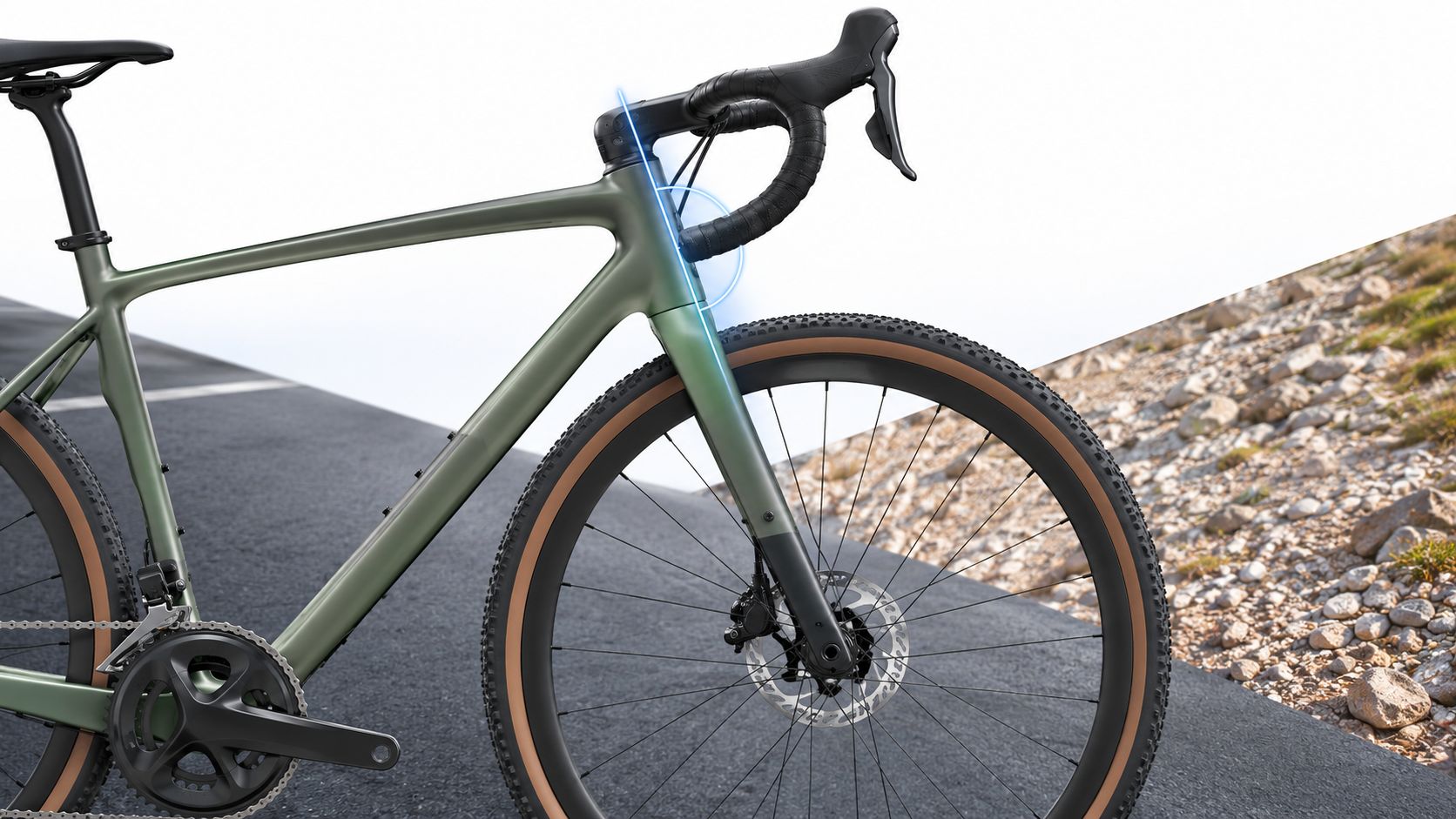
A bike's head tube angle is the steering-axis angle measured from horizontal. It matters, but it is only one part of front-end geometry. It should not be used as a standalone handling score or a terrain prescription.
When you compare two listings and see different head-angle numbers, the useful question is not which number is better in isolation. The better question is how that number works with fork offset, mounted wheel-and-tire radius, trail, front-center, wheelbase, cockpit setup, rider position, speed, and surface.
That is why a lower price or a familiar bike category does not automatically make one listing the better choice. This guide explains what head tube angle means, why trail is the technical center of the conversation, how to read geometry charts without over-interpreting one field, and how to compare road and gravel listings with more context.
Table of Contents
- What Bike Head Tube Angle Means for Your Ride
- How Head Tube Angle Is Measured and Why It Matters
- How Head Angle Works With Fork Rake and Trail
- Road vs Gravel Head Tube Angles, Why Overlap Matters
- How to Read Head Tube Angle on Listings and Geometry Charts
- Common Misconceptions and Troubleshooting Handling Issues
- How SYCLR Helps You Compare Better Fit Geometry
- Bike Head Tube Angle FAQs
- What is a bike head tube angle?
- Is head tube angle enough to predict handling?
- Why is trail more useful than head angle alone?
- What is the trail formula?
- If trail is missing from a listing, what should I do?
- Do road and gravel head angles overlap?
- Can head tube angle tell me which frame size to buy?
- Should terrain decide the head angle I want?
- Can handling problems be diagnosed from head angle alone?
What Bike Head Tube Angle Means for Your Ride
If one listing shows a 71.5° head angle and another shows 73°, that difference is real. But it does not work as a simple ranking system. Head tube angle describes the direction of the steering axis, not the complete behavior of the bike.
Draw a line through the fork steerer toward the ground, then compare that line with a horizontal reference. The angle between those lines is the head tube angle. It is one steering-geometry input, not a complete handling verdict. BikeTips' geometry explanation discusses the relationship between front-end geometry and handling.
The main reason the number matters is that it changes the geometry behind trail. Trail connects head angle, fork offset, and wheel radius into a more useful technical relationship. That still does not make trail a standalone handling score, but it gives you a better starting point than head angle alone.
The number in a buying decision
In a buying decision, head angle is most useful as a prompt to look deeper. It should lead you to the full geometry chart, especially the fork offset, wheel and tire setup, and published trail when available. A geometry comparison reference can help show how multiple dimensions change together.
Road and gravel head angles overlap. That means category labels do not reliably tell you how a bike will feel from the head-angle number alone. Compare the exact model, model year, size, and geometry instead of assuming one category follows a single steering template.
Practical rule: Use head tube angle as one geometry signal. Do not use it as a standalone handling score.
What you should pay attention to
When two listings differ in head angle, compare these next:
Fork offset
Mounted wheel-and-tire radius
Published trail, if the manufacturer provides it
Front-center
Wheelbase
Rear-center
Cockpit setup
Rider position
Speed and surface context
Fit also matters separately from steering geometry. Head angle does not determine fit. Stack and reach are frame-level fit signals, and your current-bike position or a professional-fit reference can provide stronger context. When comparing sizes or listings on SYCLR, the bike fit guide is a useful starting point.
How Head Tube Angle Is Measured and Why It Matters
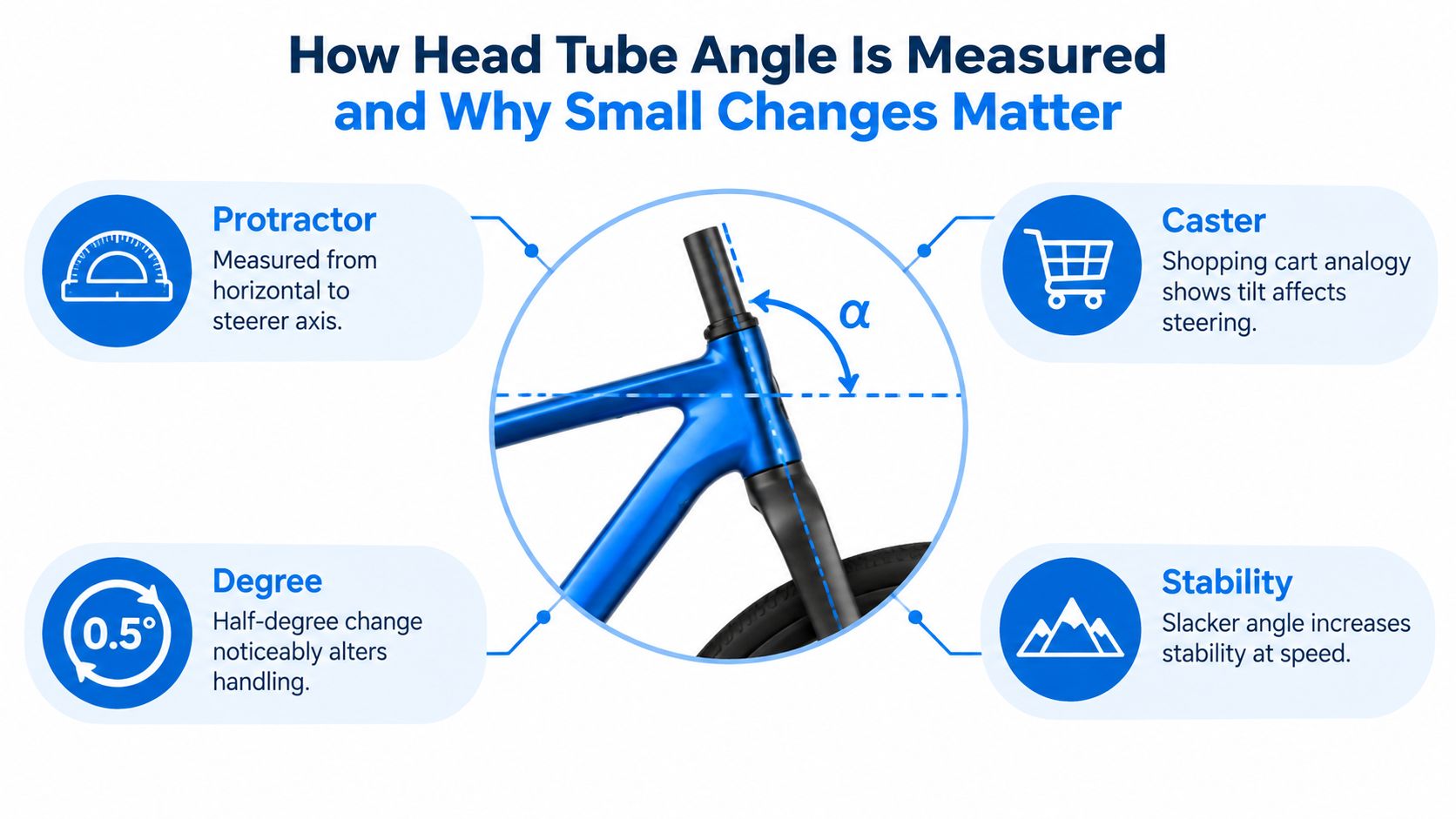
Head tube angle is measured from a horizontal line to the steering axis. It is not the same thing as head tube length, frame size, top-tube length, or stack. Cycling Independent's geometry overview also defines it as a steering-axis angle measured from horizontal.
What the number actually describes
The number tells you the orientation of the steering axis. That matters because it changes where the steering axis meets the ground relative to the front contact patch, which is part of the geometry behind trail.
By itself, though, head angle does not tell you enough to predict real-world handling. The same advertised angle can behave differently with a different fork offset, a different mounted tire radius, a different front-center, or a different rider position.
Why the number needs context
A useful way to think about head angle is that it changes a relationship, not a verdict. Once you change the steering axis, you also change how trail is calculated. But geometry is only one part of what you feel at the bars.
Handling is also affected by the complete system, including:
Fork offset
Mounted wheel-and-tire radius
Trail
Front-center
Wheelbase
Rear-center
Cockpit
Rider position
Speed
Surface
That is why it is better to interpret head angle in context than to treat it as a shortcut.
How Head Angle Works With Fork Rake and Trail
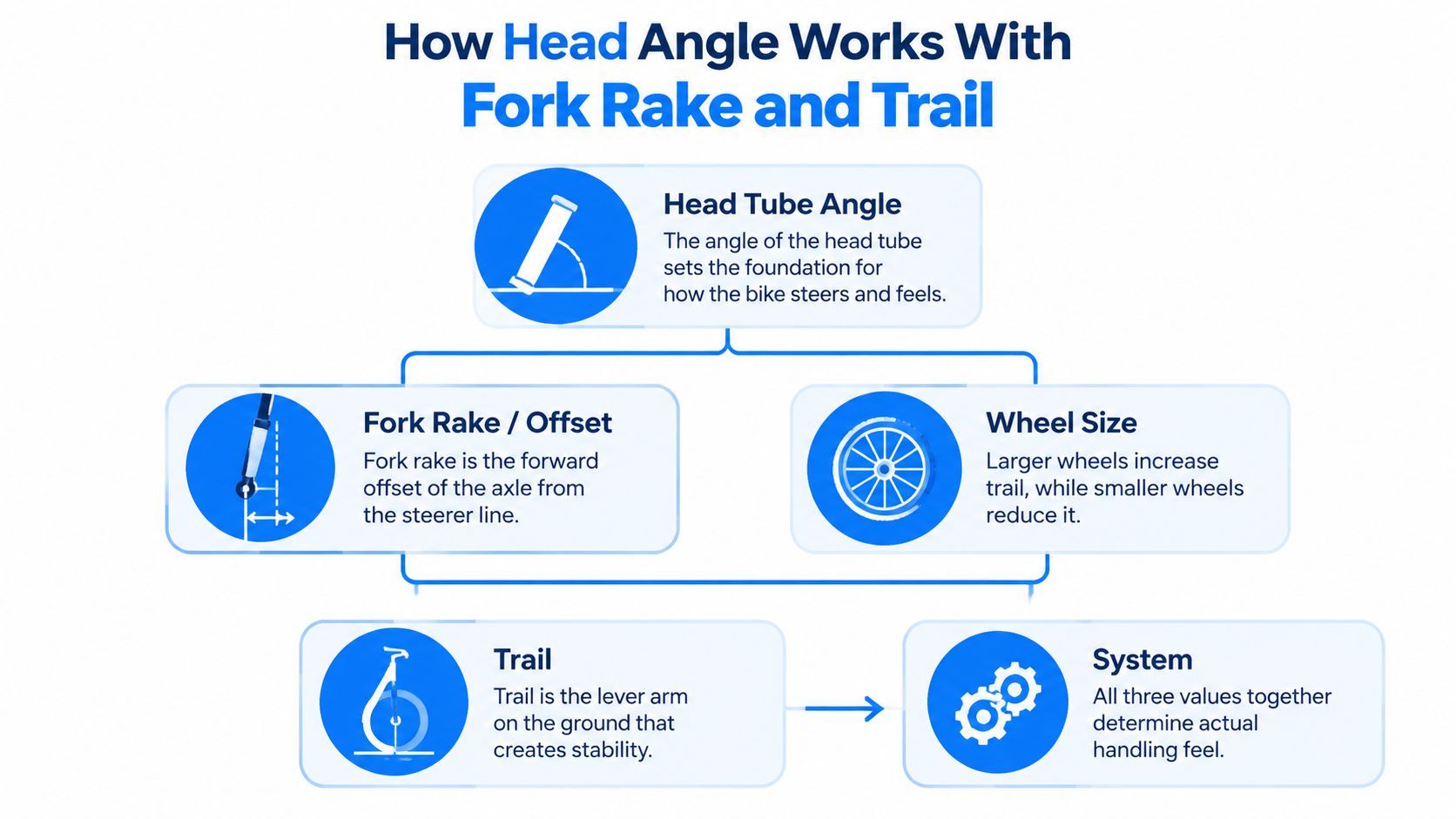
If head angle is the steering-axis direction, trail is the more useful technical center of the front-end discussion. Trail is the horizontal distance between the steering axis's ground intersection and the tire contact patch. This geometry comparison highlights why front-end feel depends on more than one published number.
Fork offset, also called fork rake, moves the front axle forward relative to the steering axis. Wheel and tire size matter too, because the relevant dimension is the mounted wheel-and-tire radius, not a category label.
The trail formula
A common geometric expression for trail is:
trail = (R × cos(HA) – offset) / sin(HA)
Where:
R = mounted wheel-and-tire radius
HA = head angle measured from horizontal
offset = fork offset or rake
From that relationship, you can say the following, all else equal:
A steeper head angle reduces calculated trail.
A slacker head angle increases calculated trail.
More fork offset reduces calculated trail.
A larger mounted wheel-and-tire radius increases calculated trail.
These are geometric relationships, not complete handling verdicts.
Geometric changes and what they mean
| Variable changed | All else equal | Geometric effect |
|---|---|---|
| Head angle becomes steeper | Fork offset and mounted wheel radius unchanged | Calculated trail decreases |
| Head angle becomes slacker | Fork offset and mounted wheel radius unchanged | Calculated trail increases |
| Fork offset increases | Head angle and mounted wheel radius unchanged | Calculated trail decreases |
| Mounted wheel-and-tire radius increases | Head angle and fork offset unchanged | Calculated trail increases |
This table is useful because it stays inside geometry. It does not pretend that one variable can fully predict handling in every speed range, rider setup, or surface condition.
A trail geometry explainer can help you compare these fields together.
A practical comparison
Suppose two bikes have the same published head angle, but one uses more fork offset. Its calculated trail will differ. Suppose two bikes have the same head angle and fork offset, but one runs a meaningfully larger mounted tire radius. Its calculated trail will also differ.
That is the main reason not to infer too much from head angle alone. The number is real, but it only becomes more informative when you interpret it with the other inputs.
For riders who want to see the mechanics in motion, this video provides a visual explanation of front-end geometry:
When a listing gives you only head angle, record it, then pause. Look for fork offset, wheel and tire setup, and published trail next. If trail is missing, do not infer handling from head angle alone.
Road vs Gravel Head Tube Angles, Why Overlap Matters
Road and gravel bikes often overlap in head angle. That overlap is exactly why category labels are limited. A road bike is not defined by one head-angle number, and a gravel bike is not defined by a different universal number.
Compare the exact bike, not the label
Instead of looking for category target ranges, compare the exact model, model year, size, and geometry chart. The bike's front end only makes sense when you read head angle together with:
Fork offset
Mounted wheel-and-tire radius
Trail
Front-center
Wheelbase
Rear-center
Cockpit
Rider position
Speed
Surface
Front-center is the horizontal distance from the bottom bracket center to the front axle center. It can be useful context, just like wheelbase and rear-center, but none of these numbers should be used as standalone handling scores.
Terrain is context, not a shortcut
Terrain still matters, but as context only. It does not create a universal head-angle prescription. The same head-angle number can feel different depending on tires, pressure, rider position, speed, cockpit setup, and the rest of the geometry.
That is why the better comparison method is not to ask which head angle suits a terrain category in the abstract. It is to compare exact bikes, with exact specs, in the size you are actually considering.
Use the road bike geometry comparison when a listing's category label is too vague to be useful.
How to Read Head Tube Angle on Listings and Geometry Charts
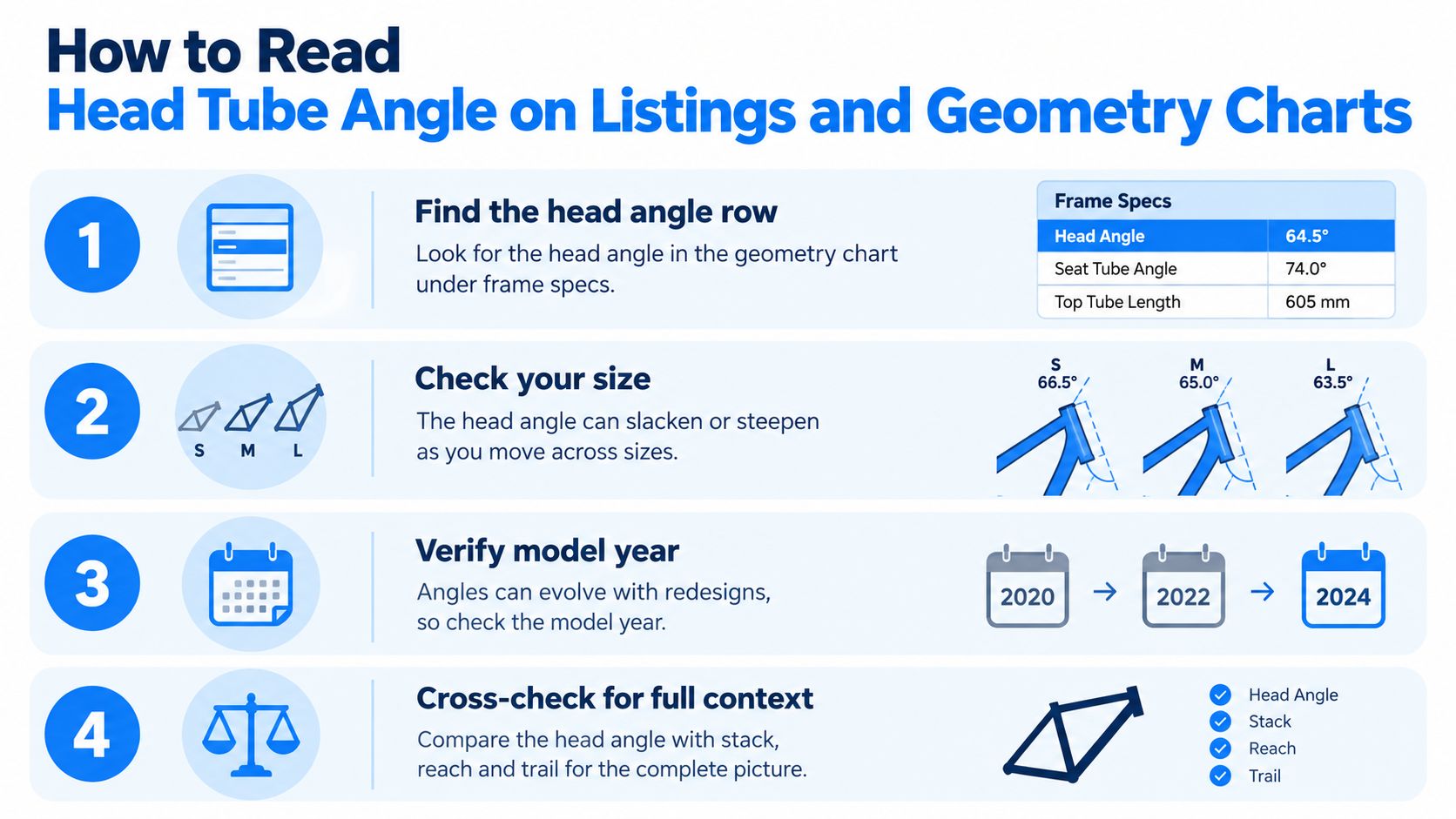
A geometry chart is only useful if you match it to the exact model, model year, and size. Do not assume a medium from one brand or generation matches another. Front-end numbers can change across redesigns and sometimes across sizes.
A listing that shows 73° next to one frame and 71.5° next to another gives you a real point of difference, but not a complete answer. You still need the manufacturer geometry chart, fork offset, and published trail where available.
What to prioritize before you compare
Prioritize these checks first:
Exact model. Confirm the bike's full model name.
Model year. A redesign can change the whole front end.
Size. Compare the exact frame size you may buy.
Manufacturer geometry chart. Use the original source when possible.
Fork offset. Check the actual fork specification.
Published trail. Use it when the manufacturer provides it.
Wheel and tire setup. Mounted tire size changes the effective radius used in the trail relationship.
Also separate fit from steering. Stack and reach are frame-level fit signals, and your current-bike position or a professional-fit reference can provide stronger context than a head-angle number. If you need a refresher, bike stack and reach explains how to read those fields.
When the listing leaves out trail
Many marketplace listings omit trail. If that happens, do not infer handling from head angle alone.
Instead, ask for:
Exact model name
Model year
Frame size
Manufacturer geometry chart
Fork model and offset
Wheel and tire setup
Any changes to the fork, headset, cockpit, or wheels
The bike geometry comparison tool is useful for placing two charts side by side. It can help you see whether the difference is isolated to head angle or part of a broader geometry change.
Common Misconceptions and Troubleshooting Handling Issues
One of the biggest mistakes in bike comparison is treating head angle, trail, front-center, wheelbase, or rear-center as if any one of them can function as a complete handling score. They cannot.
Head angle does not determine fit. Trail does not determine fit either. For fit, start with stack and reach, then compare your current-bike position or a professional-fit reference. The bike geometry chart is a useful reference for reading those fields together.
What head angle does not tell you by itself
Do not diagnose a handling complaint from head angle alone. Handling complaints can involve:
Geometry
Tires
Cockpit
Mechanical condition
Rider position
Speed
Surface
That means a bike that feels odd at the bars may have a geometry explanation, but it may also have a tire-pressure issue, a cockpit mismatch, a headset or wheel problem, or a rider-position problem. Use the full context before drawing conclusions.
Treat a handling complaint as a system question, not a one-number diagnosis.
How SYCLR Helps You Compare Better Fit Geometry
A useful buying process separates fit signals from geometry signals, then adds model-year context, price context, listing quality, condition signals where available, and confidence signals.
SYCLR helps organize listings around those factors so you can compare more than price or category label. You can start with your height, bike type, and budget, then add more detail if you know your current-bike measurements or fit information. Riders who already have that information can use the Advanced Fit entry.
A strong shortlist should help you answer practical questions:
How does the exact frame size compare with the available fit signals and any known-good current-bike or professional-fit reference?
Is the model year clear enough to trust the geometry chart?
Are fork offset and trail published, or is key data missing?
Does the wheel and tire setup change the context of the front-end numbers?
Do price, listing quality, condition signals, and confidence signals justify the next step?
You can compare listings directly in SYCLR. SYCLR does not perform a professional bike fit, physically inspect bikes, authenticate listings, verify ownership or seller claims, or guarantee fit or condition.
Bike Head Tube Angle FAQs
What is a bike head tube angle?
It is the steering-axis angle measured from horizontal. It describes the orientation of the steering axis, not the complete handling behavior of the bike.
Is head tube angle enough to predict handling?
No. Head angle is one steering-geometry input. To interpret it properly, compare fork offset, mounted wheel-and-tire radius, trail, front-center, wheelbase, rear-center, cockpit, rider position, speed, and surface.
Why is trail more useful than head angle alone?
Trail combines head angle, fork offset, and mounted wheel-and-tire radius into one geometric relationship. That still does not make trail a complete handling verdict, but it gives more context than head angle by itself.
What is the trail formula?
A common geometric expression is:
trail = (R × cos(HA) – offset) / sin(HA)
Where R is mounted wheel-and-tire radius, HA is head angle measured from horizontal, and offset is fork offset or rake.
If trail is missing from a listing, what should I do?
Look for the exact model, model year, size, manufacturer geometry chart, fork offset, and wheel and tire setup. If trail is missing, do not infer handling from head angle alone.
Do road and gravel head angles overlap?
Yes. That is why it is better to compare exact models, model years, sizes, and geometry charts than to rely on category assumptions.
Can head tube angle tell me which frame size to buy?
No. Head angle does not determine fit. Stack and reach are frame-level fit signals, and your current-bike position or a professional-fit reference can provide stronger context.
Should terrain decide the head angle I want?
Terrain is useful context, but it should not be used as a shortcut to prescribe a head-angle direction. Compare the complete geometry and setup of the specific bike instead.
Can handling problems be diagnosed from head angle alone?
No. Handling complaints can involve geometry, tires, cockpit, mechanical condition, rider position, speed, and surface.
SYCLR helps you compare listings using fit signals, geometry signals, model-year context, price context, listing quality, condition signals where available, and confidence signals. Start comparing at SYCLR.