
Short Torso Long Legs Bike Fit: How to Compare Geometry
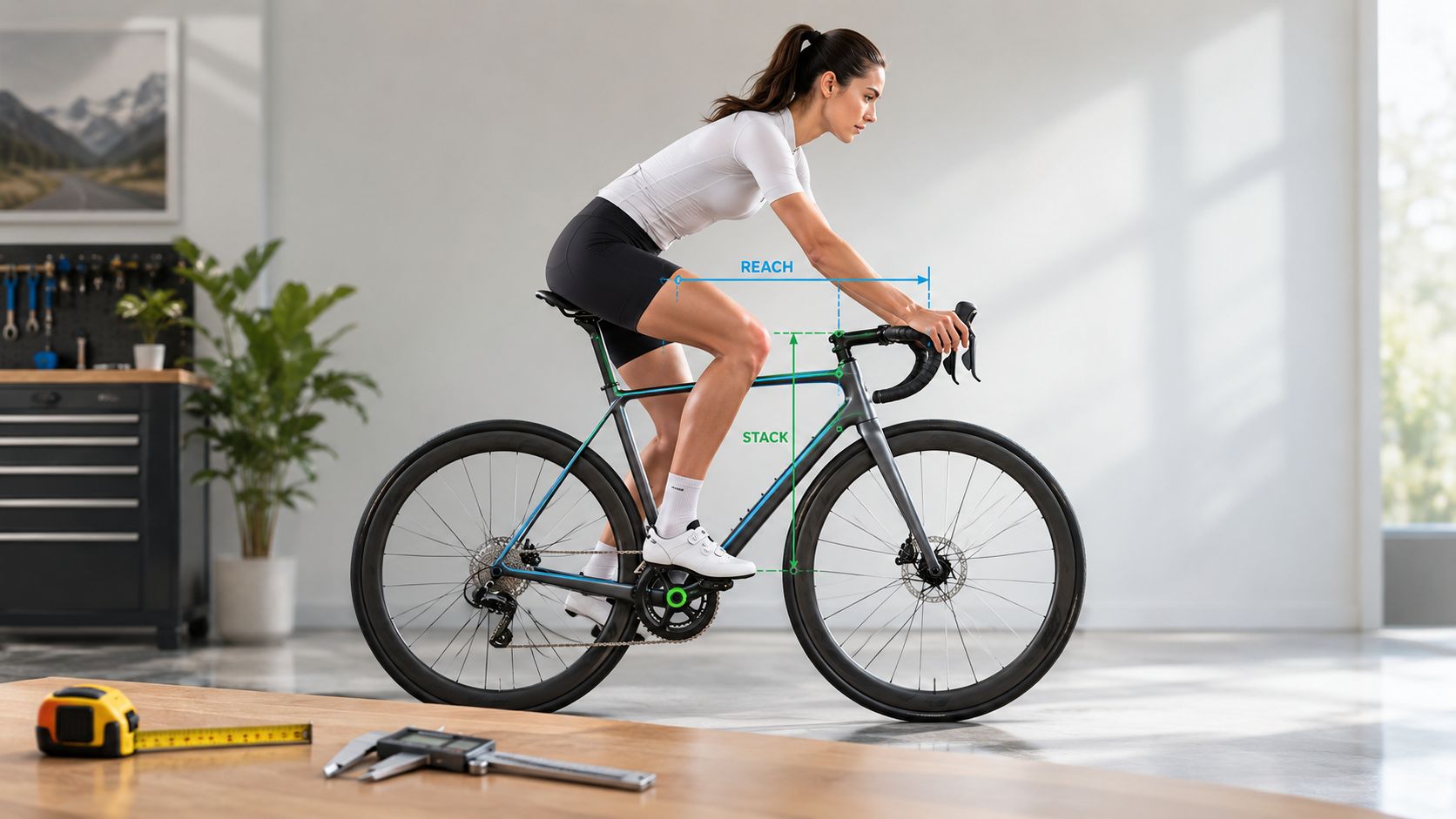
You're standing over two bikes with the same nominal size, and neither one feels right. One seems promising because it offers enough saddle height for your legs, but the front of the bike feels long and awkward. The other feels easier to hold at the bars, yet the overall fit still seems unresolved. That is the familiar problem behind short torso long legs bike fit. Height can narrow the search, but it does not settle the fit. Body proportions are one reason to distrust height-only sizing and inspect the exact bike geometry more carefully.
The practical approach is to compare the real frame, not the size label. For riders with a shorter torso and longer legs, that means paying closer attention to stack, reach, standover, seat-tube angle, cockpit configuration, and adjustment range. It does not mean that your proportions automatically determine frame size, required reach, required stack, crank length, stem length, seatpost setback, or whether you should size up or down. Those decisions depend on the complete bike and the position you are trying to achieve.
Table of Contents
- Why Height Charts Fail Riders With Short Torsos and Long Legs
- Measure Your Body and Current Bike Before You Open a Listing
- Reading Stack, Reach, and Standover Through a Short Torso Lens
- Choosing Frame Size, Crank Length, Stem, and Seatpost
- Translating Your Numbers Into Road and Gravel Bike Filters
- Common Shopping Pitfalls on New and Used Listings
- Fit-First Decision Rule and How SYCLR Shortlists Smarter
- Short Torso Long Legs Bike Fit FAQs
- Does a short torso and long legs automatically mean I need a smaller frame?
- Does this body type tell me exactly what stack and reach I need?
- Should I size up for leg length or size down for torso length?
- Is standover the main fit issue for riders with long legs?
- Can I choose crank length from my inseam or torso proportions alone?
- Does a short stem prove the frame is too long?
- Are endurance or gravel bikes automatically better for short-torso riders?
- How should I use my current bike when shopping?
- What should I compare first when two sizes both look close?
- Can SYCLR tell me exactly which bike fits me best?
Why Height Charts Fail Riders With Short Torsos and Long Legs
Height charts are useful for an initial shortlist, not a buying decision. They assume riders of the same height can usually share a similar starting size. In practice, that breaks down quickly. Two riders can be the same height and still need different frame shapes, different bar positions, and different component setups.
For a rider with a shorter torso and longer legs, the main takeaway is simple: height alone becomes less trustworthy. A bike that looks correct by label may still use geometry or cockpit dimensions that differ meaningfully from what the rider intends to reproduce. That does not mean your body type automatically points to one exact solution. It means you should inspect geometry more carefully before assuming the chart got it right.
Practical rule: Use height to start the search, then compare the actual frame and setup.
Modern fit guidance has moved away from judging a bike by seat-tube size alone. Stack and reach help separate vertical and horizontal frame dimensions, which makes cross-brand and cross-model comparisons more useful. For a short torso and long legs, those measurements matter because they reveal whether two bikes with the same nominal size are actually shaped the same way.
What geometry can solve
A geometry-led approach can help you manage:
-
Frame comparison, by showing how two bikes with the same nominal size can differ.
-
Cockpit starting point, by showing the frame-level stack and reach before cockpit components change the final hand position.
-
Saddle-position context, by showing how seat-tube angle and seatpost setup relate to the complete position.
-
Adjustment potential, by clarifying what can realistically be changed with stem, spacers, bars, and saddle setup.
It cannot solve every fit problem. A history of significant injury, unusual mobility limits, custom frame requirements, or a highly specific professional racing position deserves a qualified fitter's assessment. A stock frame can offer a strong starting point, but geometry has limits.
Standover still matters for confidence and clearance, especially when comparing a larger frame. Use the bike standover height guide to separate clearance from cockpit fit. Evaluate standover clearance separately from seated fit and cockpit position rather than allowing one measurement to stand in for the others.
Measure Your Body and Current Bike Before You Open a Listing
Start with basic measurements and any reliable current-bike or professional-fit reference you already have. A listing can look attractive, but without your own reference points, frame-size labels and seller descriptions will pull you toward whatever sounds familiar.
Take the body measurements
Record your height and cycling inseam as basic context. For a consistent cycling inseam, stand barefoot on a hard floor, place a book firmly between your legs, and keep the book level. Measure vertically from the floor to the top of the book. Then measure your height separately.
These numbers are useful for broad context and for checking whether a listing is even in the right neighborhood. They are not enough to derive the geometry you need. Do not treat body measurements alone as a shortcut to frame stack, frame reach, crank length, stem length, or category choice.
Measure the bike that already works
Your current bike is valuable only if the position actually works well or if you know exactly what you want to change. If its position works well and is worth preserving or deliberately changing, it can serve as a practical comparison reference. If the current position does not work well, treat its measurements as background rather than as targets for the next bike.
When the current setup is worth preserving or deliberately changing, measure:
-
Saddle height, from the center of the bottom bracket to the saddle top.
-
Saddle setback or saddle position, using a repeatable bottom-bracket reference.
-
Stem and bar setup, including stem length, spacer arrangement, and bar type.
-
Hand position, such as the hoods or your primary grip point.
-
Bar drop or bar height, relative to the saddle and your actual riding position.
-
Standover clearance, measured with the bike level and your shoes on.
Also note what you like and dislike. Record what works well and what you would deliberately change. If the current position is already compromised, treat its measurements as background rather than as targets.
Reading Stack, Reach, and Standover Through a Short Torso Lens
Stack is the vertical distance from the bottom bracket to the top of the head tube. Reach is the horizontal distance between those same reference points. These are useful frame-level comparison signals because they isolate the frame before stem length, spacer setup, handlebar reach, hood placement, and saddle setup change the final hand position. The distinction between these measurements is explained clearly in this stack and reach guide.
For a rider with a short torso and long legs, stack and reach are worth extra attention because they often expose where a height chart is too blunt. That does not mean stack and reach alone determine fit, and it does not mean you should chase a ratio target. A frame can look similar on paper and still produce a different result once cockpit parts and saddle position are considered.
Compare the frame shapes, not just the labels
When you are between sizes, or comparing two bikes with the same nominal label, inspect the exact model, model year, and frame size. Then compare:
-
Stack
-
Reach
-
Standover
-
Seat-tube angle
-
Head-tube length
-
Cockpit configuration, including bars and stem
-
Adjustment range, including spacer allowance and seatpost options
-
Manufacturer limits for cockpit and spacer changes
This matters more than trying to assign the smaller frame to your legs or the larger frame to your torso. Proportions are a reason to compare the real numbers more carefully, not a formula that automatically picks the direction.
Standover is a constraint, not the whole fit
Standover matters most as a practical clearance check. Compare the geometry chart's standover measurement with your real shoes-on clearance and comfort expectations. If clearance is too tight, the frame may be a poor choice even if other numbers look promising.
But standover is not the primary determinant of seated fit. A bike can clear comfortably and still place the bars poorly. For most road and gravel buyers, seated position depends more on the frame's overall geometry and the final cockpit setup than on standover alone.
Choosing Frame Size, Crank Length, Stem, and Seatpost
Do not chase every fit variable at once. Start by deciding whether the frame itself is a plausible candidate, then assess whether the components can refine it without forcing the bike outside normal adjustment limits.
For short-torso, long-legs riders, that means avoiding simplistic rules. Your proportions do not automatically determine frame size, whether you should size up or down, what stem length you need, how much setback you need, or which crank length is correct. Those outcomes depend on the full system: frame geometry, saddle position, cockpit parts, mobility, riding goals, and what position you are actually trying to create.
Crank length affects the complete setup, but it should not be prescribed from inseam or torso proportions alone. Stem changes can refine a suitable frame, but there is no universal stem-length cutoff that proves a bike fits or does not fit. The same is true of seatpost setback. Evaluate the complete setup and the manufacturer's stated limits rather than treating any single part as a universal rule.
The geometry approach described in this bike-fit geometry resource is more useful than relying on nominal size alone.
Translating Your Numbers Into Road and Gravel Bike Filters
Your measurements become useful when they help you compare real bikes consistently. Start with the current bike only if its position is worth preserving, or if you have a clear reason to change it. Then compare each candidate by model, year, size, and actual geometry rather than assuming one category has a built-in fit answer.
Build the road shortlist
For a road bike, compare the exact frame and size you are considering. Look at stack, reach, seat-tube angle, head-tube length, standover, cockpit specification, and how much adjustment remains within the manufacturer's limits. If two adjacent sizes are both plausible, use the comparison guide for bikes between two sizes as a framework, but make the decision from the actual geometry and setup options rather than the size label.
Road category alone does not determine the required stack or reach. A race bike, endurance bike, or all-road bike may each work or fail depending on the exact model and your target position.
Build the gravel shortlist
For gravel, use the same discipline. Compare the exact model, year, and size rather than assuming gravel geometry automatically solves a short-torso fit. Tire clearance, front-end design, and intended handling can affect the bike's overall behavior, but they do not create a universal stack or reach requirement.
The same rider may prefer a different overall position on gravel than on road, but that is a position choice, not a universal body-type rule. Compare the frame's geometry, cockpit setup, and available adjustment range, then decide whether the bike supports the posture and control you want.
Enter height, cycling inseam, torso information, bike type, and any known fit details through SYCLR's fit-aware workflow. Then compare geometry signals, frame size, model-year context, price context, listing quality, condition signals where available, and confidence signals instead of sorting by size label alone.
Bottom-bracket drop, wheel-and-tire setup, and head-tube dimensions can add useful geometry context, but they do not determine the rider's required stack or reach. Treat the numbers as a filtering system, not a promise that every returned bike will fit without a test ride or further setup.
Common Shopping Pitfalls on New and Used Listings
Short-torso riders often get bad advice because the seller sees the rider's height first. "Size up and use a shorter stem" sounds simple, but it assumes the complete bike can be corrected that way. Sometimes it can. Sometimes it cannot. The point is to inspect the exact frame and adjustment range before accepting generic advice.
Deal-breakers deserve priority
Reject a frame when the geometry or component constraints make a reasonable setup unlikely, not because it violates an internet rule of thumb. A stem change, seatpost change, or cockpit swap may be completely normal on one bike and unrealistic on another. Evaluate what the frame needs, what the manufacturer allows, and what the complete setup would look like when finished.
Integrated cockpits deserve extra caution because they can limit adjustment and raise replacement cost. That does not make them proof of poor fit. It simply means you should verify compatibility, available sizes, and the cost of changing parts before buying.
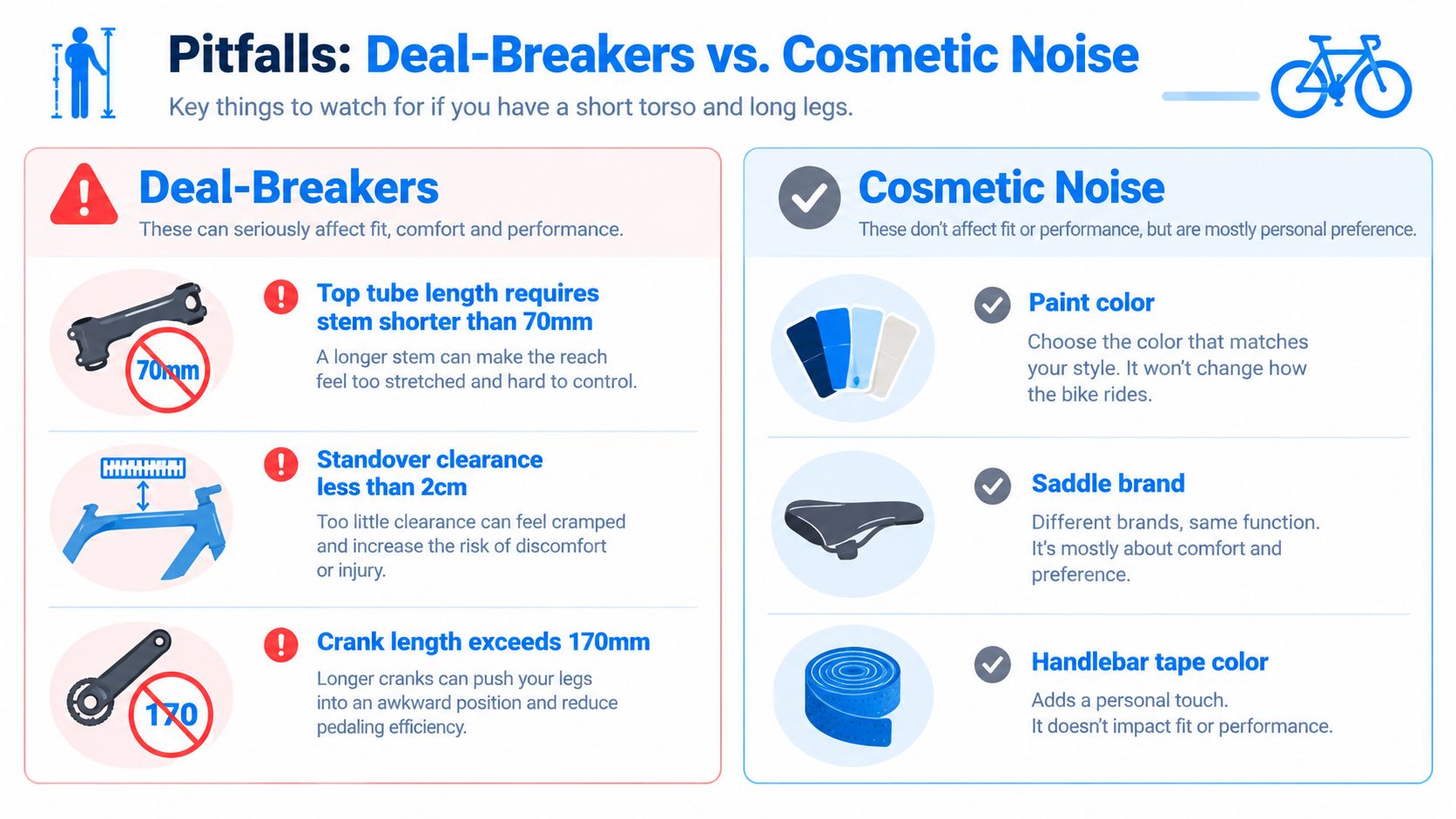
Some visible details should not be confused with fit evidence:
-
Paint color: Cosmetic preference does not change fit.
-
Saddle brand: A replaceable saddle is not a reason to reject a frame, though its position remains relevant.
-
Handlebar tape color: Tape is noise unless it hides damage or signals poor maintenance.
-
External routing: It can limit certain upgrade paths, but it is not automatically a fit problem.
-
Chainstay length: It is part of the bike's overall geometry, but it should not be used alone to judge fit or handling.
-
Matte finishes: Inspect carefully because surface appearance can make damage harder to judge.
Before buying, verify the frame identity, model year, geometry chart, cockpit configuration, crank length where relevant, seatpost setup, and available adjustment range. For used bikes, listing completeness and seller-provided evidence matter when comparing used bikes. SYCLR can organize fit signals, geometry signals, model-year context, price context, listing quality, condition signals where available, and confidence signals.
Fit-First Decision Rule and How SYCLR Shortlists Smarter
A rider with a short torso and long legs should not ask, "What size does my body type always need?" A better question is, "Which exact bike gives me the best chance of reaching my intended position within normal adjustment limits?"
That means comparing the frame's geometry, checking standover as practical clearance context, reviewing cockpit and saddle setup, and then weighing model year, price, and condition. A low-priced bike can still be a poor candidate if its geometry and setup are poorly matched to the intended position. A less exciting listing with compatible geometry and cleaner setup options may be the better choice.
Keep this short checklist on your phone:
-
Check the exact model, year, and size: Do not rely on the label alone.
-
Compare stack and reach separately: Use them as frame signals, not as a ratio target.
-
Review standover for clearance: Useful context, but not the main seated-fit answer.
-
Inspect the cockpit and saddle setup: Final hand position depends on more than frame numbers.
-
Check adjustment range and manufacturer limits: Especially for integrated or proprietary parts.
-
Review listing details carefully: Use geometry, price, condition, and seller information together.
For deeper geometry reading, use SYCLR's resources on stack and reach, road bike size charts, gravel frame sizing, and bike geometry charts. If the available bikes do not provide a plausible setup within their adjustment limits, do not force a match. A professional fitter may be the right next step, especially if you have persistent discomfort, injury history, or a highly specific position goal.
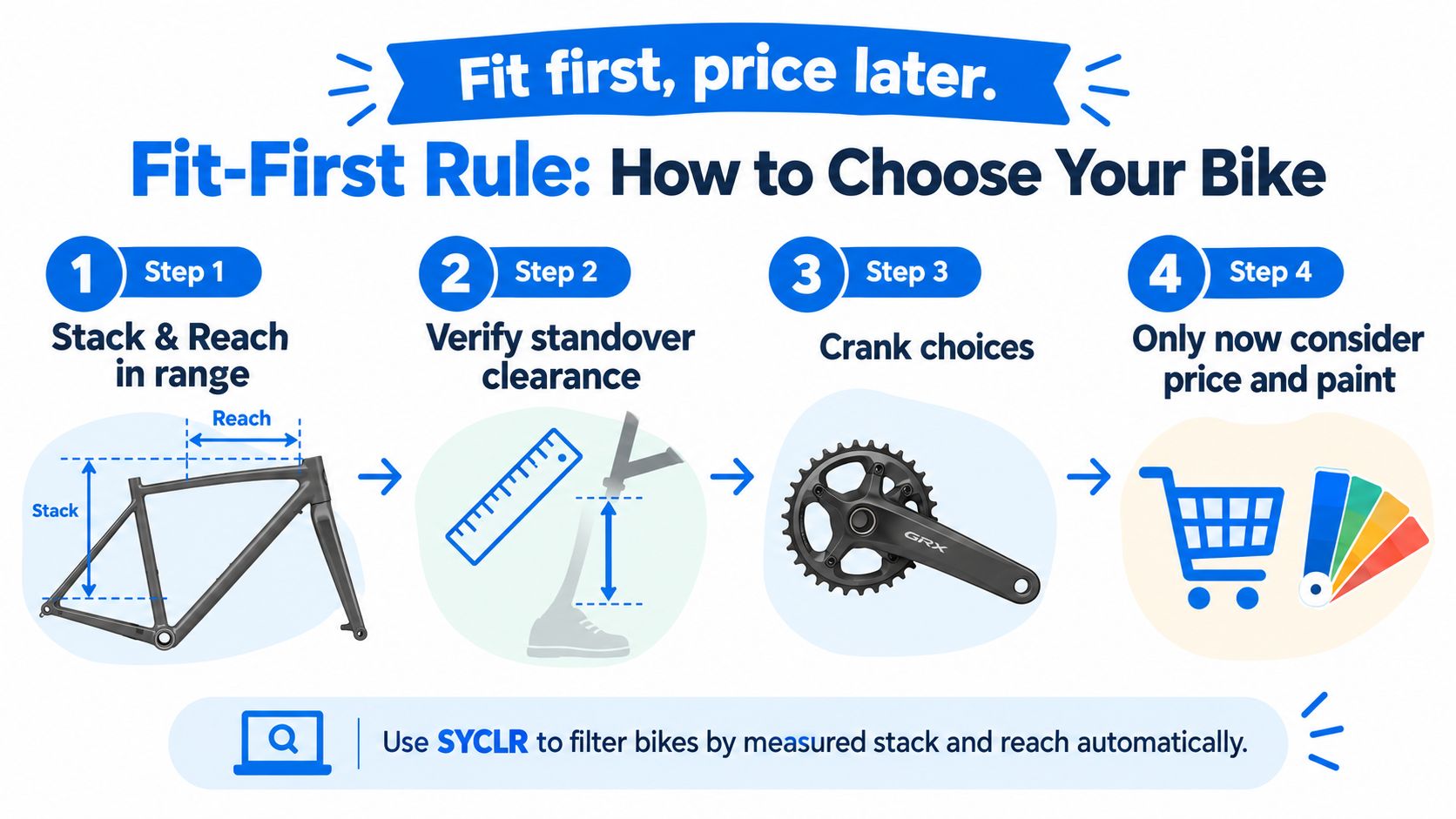
SYCLR's app lets you compare road and gravel listings using rider details, bike type, budget, geometry signals, model-year context, price context, listing quality, condition signals where available, and confidence signals. Riders who already know stack, reach, current-bike geometry, or fit-report details can use the fit-details entry point to make the shortlist more specific.
SYCLR does not perform a professional bike fit, physically inspect bikes, authenticate listings, verify ownership or seller claims, or guarantee fit or condition.
Short Torso Long Legs Bike Fit FAQs
Does a short torso and long legs automatically mean I need a smaller frame?
No. It means you should be more cautious with height-only sizing and more careful with exact geometry. The right answer depends on the specific bike, size, cockpit, saddle setup, and the position you are trying to achieve.
Does this body type tell me exactly what stack and reach I need?
No. Stack and reach are useful comparison signals, but your body type does not automatically produce a target number. Final hand position also depends on stem, bars, hood placement, spacers, saddle setup, and the bike's overall configuration.
Should I size up for leg length or size down for torso length?
Not by default. When you are between sizes, compare the exact model, year, and size, then review stack, reach, standover, seat-tube angle, cockpit setup, adjustment range, and manufacturer limits. Do not assign one size direction to legs and the other to torso.
Is standover the main fit issue for riders with long legs?
Usually not. Standover is important for practical clearance and confidence, but it is not the primary determinant of seated fit. A bike can have acceptable standover and still miss the mark once you are riding.
Can I choose crank length from my inseam or torso proportions alone?
No. Crank length affects the complete setup, but it should not be prescribed from inseam or torso proportions alone. Consider the full riding position, comfort, mobility, and the rest of the bike.
Does a short stem prove the frame is too long?
Not on its own. Stem length must be judged within the complete setup and within manufacturer limits. A stem can refine a suitable frame, but it can also mask a mismatch if the frame shape itself is wrong.
Are endurance or gravel bikes automatically better for short-torso riders?
No. Category labels do not guarantee fit. Some race, endurance, road, and gravel bikes may all work well or poorly depending on the exact model, size, geometry, and cockpit setup.
How should I use my current bike when shopping?
Use it as a benchmark only if the current position works well or if you clearly know what you want to change. If the bike is already compromised, copying its numbers can repeat the mistake.
What should I compare first when two sizes both look close?
Compare the exact model and year first, then stack, reach, standover, seat-tube angle, cockpit setup, adjustment range, and manufacturer limits. Adjacent sizes can differ in ways that matter more than the nominal label.
Can SYCLR tell me exactly which bike fits me best?
SYCLR can help you compare fit signals, geometry signals, model-year context, price context, listing quality, condition signals where available, and confidence signals. It does not perform a professional bike fit, physically inspect bikes, authenticate listings, verify ownership or seller claims, or guarantee fit or condition.
Start with SYCLR to compare road and gravel listings using your height, bike type, budget, and available fit details. If you already know more about your current position or target setup, use Advanced Fit to make the shortlist more specific.