
Endurance Bike vs All Road Bike: Which Should You Buy?
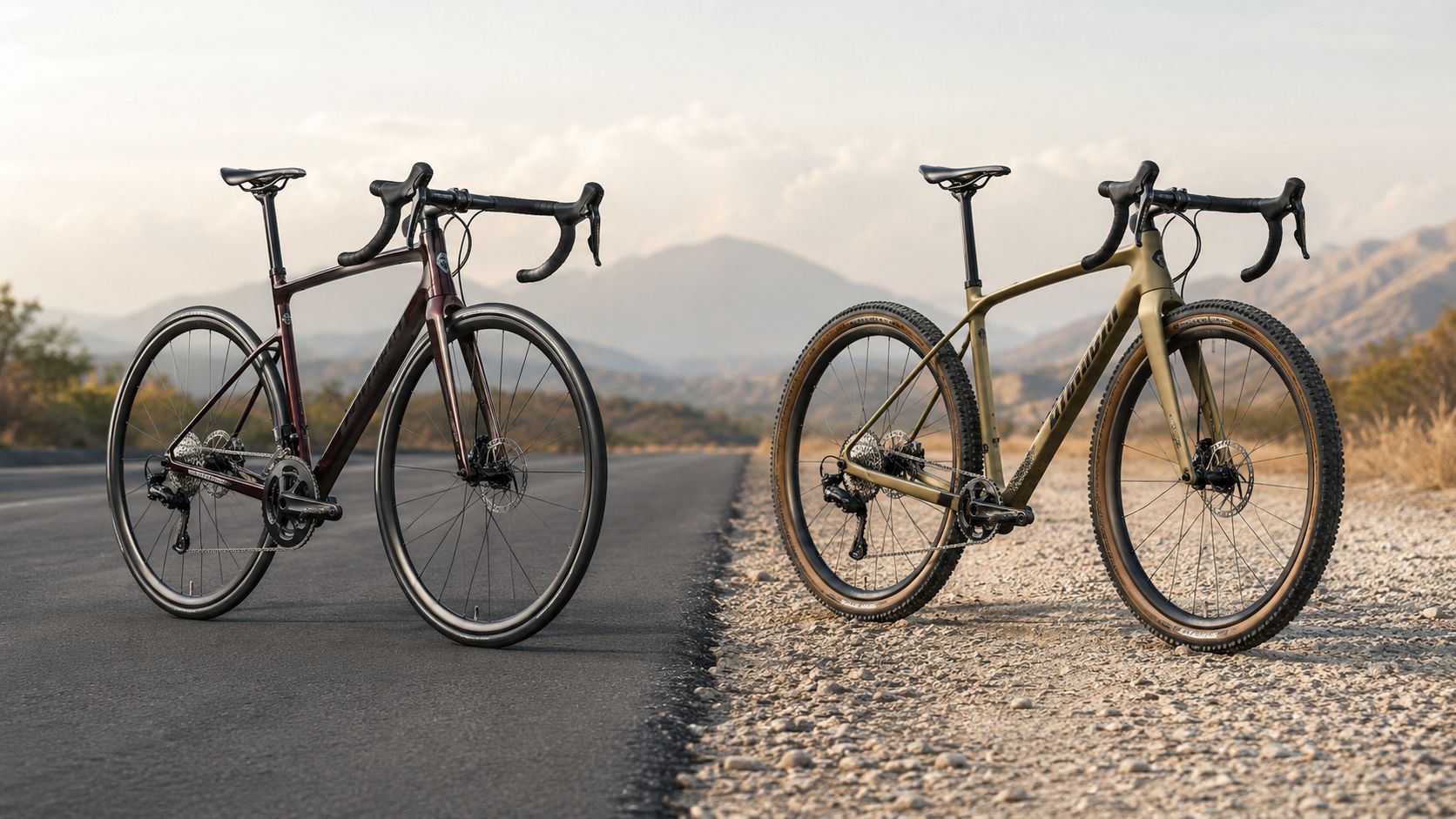
You're probably staring at two listings that look close enough to confuse things. One says endurance, the other says all-road, both look like road bikes, and both could be a bad buy if the fit is off. The right choice comes down to geometry, tire clearance, gearing, and the riding you do, not the label on the top tube. Choose endurance for long paved rides, road efficiency, and road-focused handling. Choose all-road for rough pavement, wider tires, light gravel, and greater route flexibility. Neither label guarantees the correct fit.
Table of Contents
Endurance Bike vs All Road Bike Quick Answer
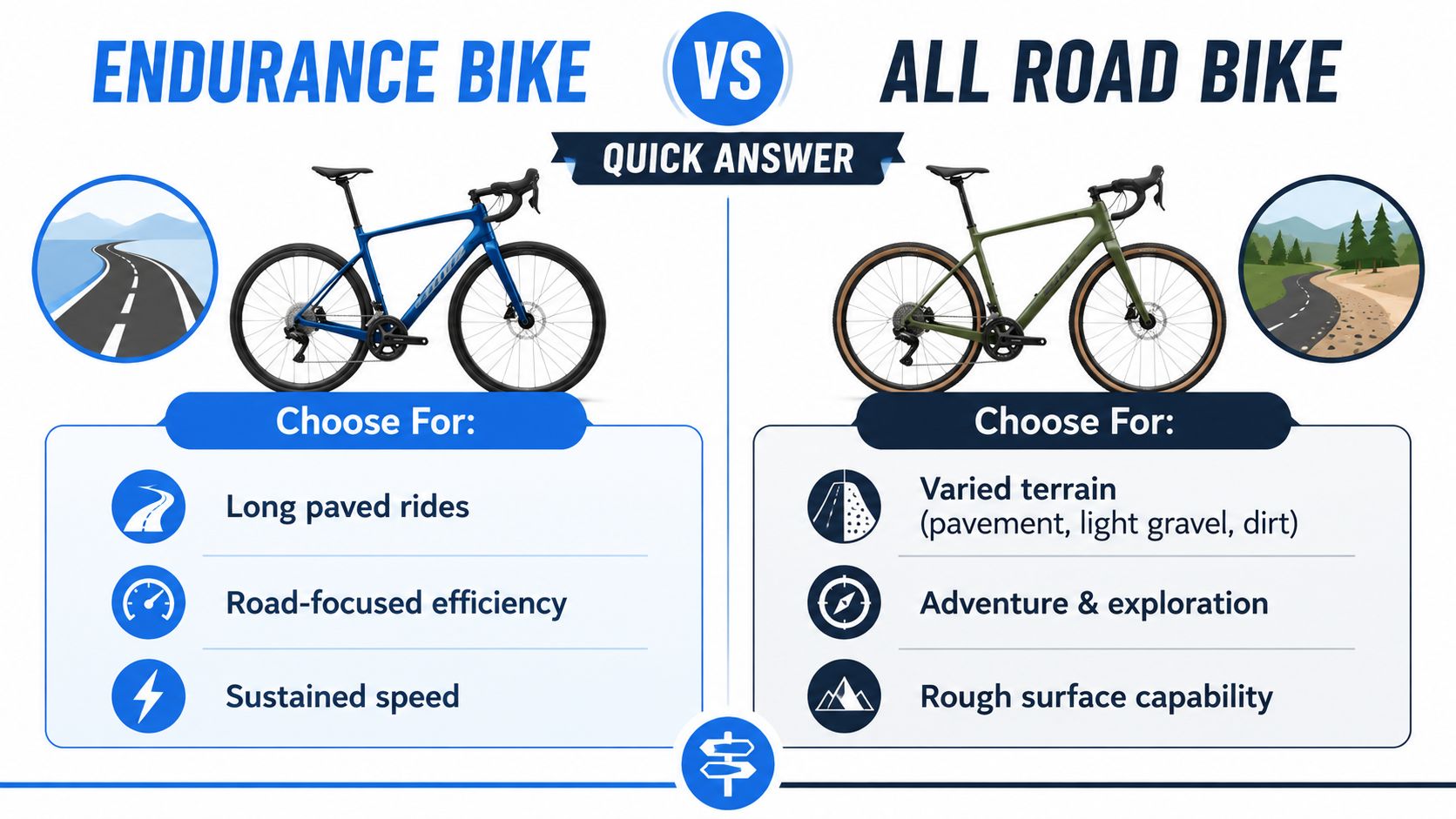
Choose endurance if your riding stays mostly on pavement, your priority is long road mileage, and you want a bike that feels calm and efficient over hours in the saddle. Choose all-road if your routes regularly include broken asphalt, hardpack, or light gravel, and you need more tire room plus a little more tolerance for rough surfaces. That is the clean decision.
The category names help, but they do not choose the bike for you. Endurance road bikes are built for long paved rides, stable road handling, a sustainable position, and efficient road performance. All-road bikes add mixed-surface capability and more tire clearance. In practice, the difference usually comes down to geometry and clearance, not marketing language, and the details on the spec sheet matter more than the badge on the frame.
A representative comparison shows how close these bikes can be. An endurance bike may sit at 580 mm stack and 385 mm reach, while an all-road bike may land at 585 mm stack and 382 mm reach. That kind of overlap is the point. The label alone does not tell you whether the bike fits your body or matches your routes.
Practical rule: If the bike does not support your position, your tires, and your roads, it is the wrong bike even if the category sounds right.
For fit analysis, the Bike Stack and Reach guide gives the clearest framework. For a broader look at how road geometry varies across frames, the Road Bike Geometry Comparison is the right reference. If your decision is really between endurance and mixed-surface versatility, the broader context in Endurance Road Bike vs Gravel Bike helps separate road comfort from true gravel capability.
When an Endurance Road Bike Makes More Sense
The rider profile that fits endurance
Choose endurance when most of your riding is on pavement and you care about long road mileage, group rides, and steady-effort training. This is the bike for riders who want road efficiency without a race-bred position that turns every long ride into a compromise. If you don't need wider mixed-surface tires, don't pay for the extra room.
Endurance bikes often use geometry intended for sustained road riding, but the exact fit varies substantially by brand, model, size, and year. Compare stack, reach, wheelbase, front-center, trail, cockpit dimensions, and available adjustment rather than assuming every endurance bike is tall, short, or relaxed.
The stronger choice is the bike whose position matches the rider’s proportions, flexibility, current-bike fit, and preferred handlebar drop.
An endurance bike with the wrong fit is still the wrong bike.
What to prioritize on a listing
Focus on the contact points and the fit cues before you get distracted by the build kit. A good endurance listing should give you enough geometry data to judge whether the cockpit will work for your torso, arms, and flexibility, not just your height. The right frame size on one brand can still feel wrong on another.
For a closer look at position differences, the Road Bike vs Endurance Bike guide is the better companion piece. If you're unsure how a bike will feel on paper, the Bike Fit Guide is the next stop. That's where you decide whether the bike matches your body before you worry about the gruppo.
When an All Road Bike Makes More Sense
The rider profile that justifies the extra clearance
Choose all-road when your routes mix pavement with rough roads, hardpack connectors, or light gravel. That's the bike for riders who want one machine to handle road mileage and occasional surface changes without feeling underbiked the moment the tarmac ends. If your weekend routes change with weather, construction, or season, all-road starts to make more sense fast.
All-road bikes often provide additional tire clearance and may offer gearing better suited to rough pavement, hardpack, or steeper mixed-surface routes. Those features are useful only when they match the rider’s real terrain.
What to check before you commit
Verify the manufacturer’s stated clearance, front and rear limits, rim-width assumptions, wheel-size compatibility, and exact model year. Some all-road bikes support 650b wheels, but compatibility should never be assumed from the category label alone.
All-road capability only helps if the frame still fits your body and your preferred position.
If you're weighing all-road against something closer to true gravel, the All-Road Bike vs Gravel Bike guide is the better boundary line to study. Clearance is a frame- and fork-specific specification, not a promise created by the category label.
Fit and Geometry Overlap Between Categories
Why the label doesn't tell the whole story
A buyer can compare two bikes on paper and still miss the real fit difference. Endurance and all-road frames often overlap in stack and reach, and that is why the category name alone does not settle the choice. Endurance does not automatically mean upright, and all-road does not automatically mean gravel geometry.
Front-end geometry can influence steering, but no single measurement explains how a bike will handle. Head tube angle, fork offset, trail, wheelbase, front-center, tire size, wheel choice, and rider weight distribution all work together.
The geometry details that change the ride
Compare stack and reach first for position, then review wheelbase, front-center, trail, chainstay length, bottom-bracket drop, standover, and cockpit dimensions. These measurements help explain differences between exact bikes, but they should not be used as universal endurance-versus-all-road cutoffs.
That is why fit-aware shopping beats category guessing. A bike can look like an endurance model and still ride with a sharper front end, or look like an all-road bike and still keep a road-like position. If you want a clean way to compare those numbers, the road bike geometry comparison page is the right starting point. A used listing with partial geometry data is still usable, but you should treat it as a higher-uncertainty decision.
Tire Clearance and Wheel Compatibility Decisions
Read the clearance number like a mechanic, not a marketer
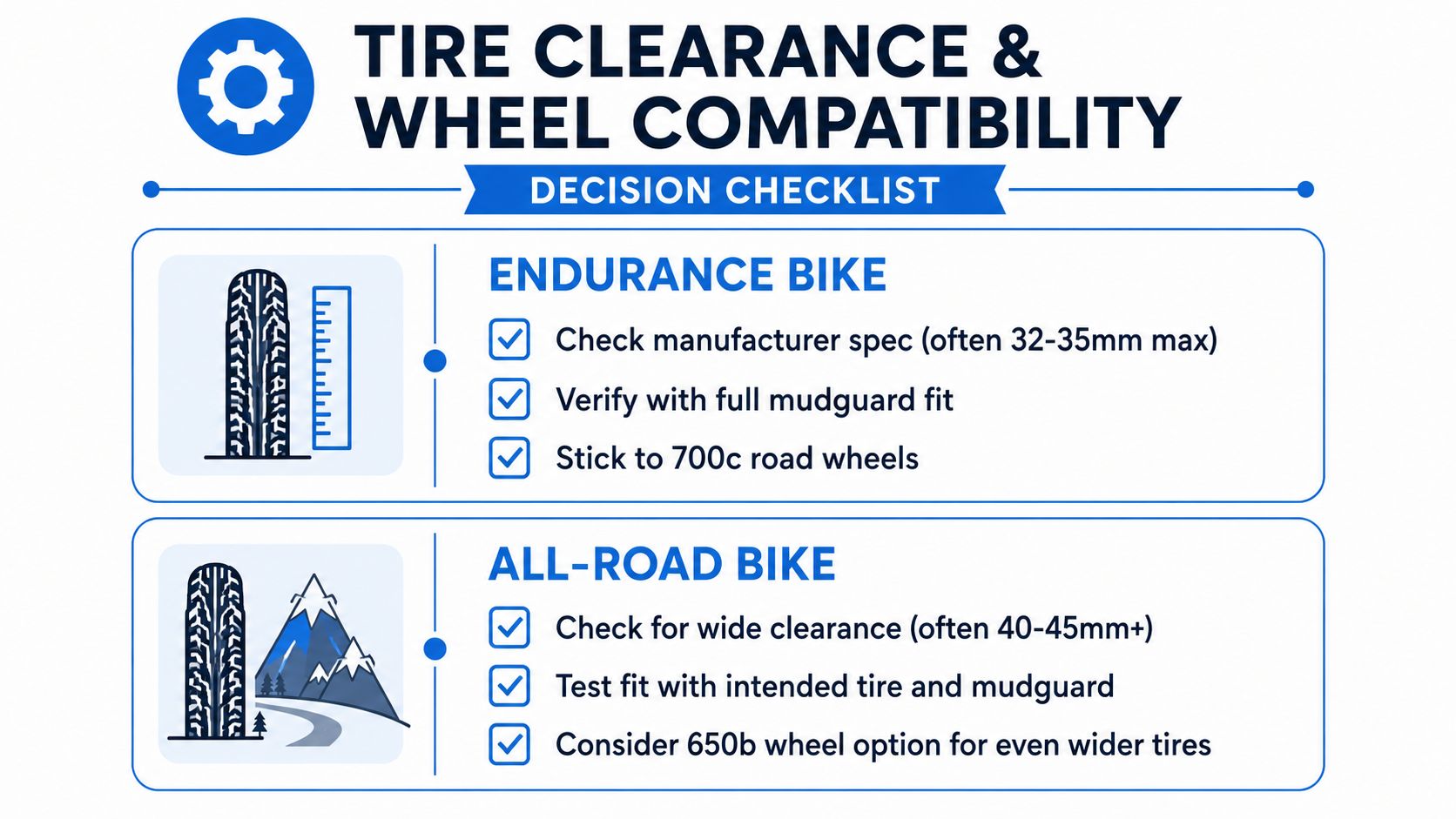
Tire clearance often helps distinguish endurance and all-road bikes, but there is no universal category cutoff. Some endurance bikes now support relatively wide road tires, while some all-road bikes approach narrower gravel-bike territory.
Verify the exact manufacturer specification for the model, size, and year. Check front and rear clearance separately, confirm rim-width assumptions, and account for the tire’s measured width rather than relying only on the printed size.
Check the front and rear limits separately. A frame can accept one width in the rear and a slightly different one up front, especially once you factor in rim width, mud space, and whether the tire measures true to labeled size. If you want 700c or 650b compatibility, verify the exact model year and frame size before you assume anything. A useful way to compare those details side by side is the Compare Bike Geometry page, especially when a seller leaves out part of the spec.
What to verify on the listing
Manufacturer spec: Confirm the stated maximum tire width for the exact model year.
Front and rear clearance: Look for both, not just one blanket number.
Mud and debris room: Tight clearance can turn a theoretical fit into a practical headache.
Wheel standard: Check whether the bike is designed around 700c only or can work with 650b.
Rim width: Wider rims can change how a tire sits and how much space it uses.
If a listing leaves out the exact clearance data, treat that as missing fit information, not a minor detail. That omission tells you the seller is asking you to guess at one of the most important parts of the bike.
Gearing, Handling, and Terrain Matching
Gearing should follow the road in front of you
If your routes stay paved and your pace changes often, endurance bikes usually make more sense with road-focused gearing. If your rides regularly include rough pavement, steeper climbs, or short loose connectors, an all-road bike often benefits from a lower gear range or a wider spread. That decision matters more than the category sticker. Gearing should match terrain first, category second.
Do not overread the drivetrain label. A 2x setup gives smaller jumps between gears, which keeps cadence changes smooth on fast road rides. A broader all-road setup gives you more range, but it usually gives up some of that tight spacing. Choose the setup that fits how often you climb, how picky you are about cadence gaps, and whether your rides stay clean and paved.
Handling is where endurance and all-road part company
Endurance and all-road bikes can overlap heavily in position and handling. Some endurance bikes use taller front ends and stable road geometry, while some all-road bikes add tire clearance without changing the rider position dramatically.
Compare the exact geometry, tire setup, wheelbase, trail, and cockpit rather than assuming one category is always calmer, more upright, or more stable.
Speed and comfort come from the whole build, not the category name. Speed depends on position, tires, pressure, wheels, gearing, wind, surface, and the exact bike, while comfort depends on fit, tires, saddle, cockpit, seatpost, and road surface. A well-set-up endurance bike with fast tires can feel quicker than a poorly chosen all-road build. The reverse happens too.
A rider who trains mostly on pavement but keeps running into broken roads and hardpack connectors is a clear all-road candidate. Extra clearance and more surface tolerance matter more than a small road-efficiency edge when the route changes what you can ride. For pricing context and uncertainty, the used bicycle value guide is the right place to compare listings more carefully.
Used-Market Value and Model Year Context
Value depends on more than the asking price
Do not assume endurance bikes are always more common or that all-road bikes hold value better. Used-market availability and pricing depend on brand, model, year, size, frame material, groupset, wheels, brakes, condition, fit, compatibility, and listing completeness.
Compare like-for-like listings rather than applying a category-wide resale trend.
Use an uncertainty-adjusted view of the listing. Comparable value minus condition risk minus fit uncertainty minus compatibility risk minus listing uncertainty equals a more realistic offer range. That framework is more useful than chasing a sticker price, because a bike can be cheap and still be wrong for your body, your wheels, or your route needs.
Model year changes matter
Frame standards, brake types, and tire clearance have changed enough over time that model year can flip the decision. A newer all-road bike may have better clearance and compatibility, while an older endurance bike may still be the better road tool if it fits you better and the spec matches your riding. The category label is only the starting point.
For pricing context and uncertainty, the used bicycle value guide is the right place to compare listings more carefully. Don't let a clean cosmetic condition hide a geometry mismatch or a compatibility problem.
Comparison Table and Representative Rider Scenarios
Endurance Road Bike vs All Road Bike Decision Table
| Decision factor | Endurance road bike | All-road bike | Better choice when |
|---|---|---|---|
| Primary purpose | Long paved rides and road-focused use | Road riding with added rough-road and light-gravel flexibility | Pavement specialization or route versatility matters more |
| Rider position | Varies by model and size | Varies by model and size | The exact stack, reach, and cockpit match the rider |
| Geometry | Often road focused, but not universally upright | May overlap heavily with endurance geometry | Compare exact size, year, and complete geometry |
| Tire clearance | Often road oriented, but increasingly broad | Often wider, but model dependent | Verify official front and rear limits |
| Wheel compatibility | Commonly 700c | May support 700c and sometimes 650b | Alternative wheel setups are genuinely useful |
| Gearing | Often road focused | May offer broader or lower gearing | Rougher or steeper routes are common |
| Paved efficiency | Strong | Can also be highly efficient | Road mileage and group riding dominate |
| Rough pavement | Capable depending on tires and setup | Often a stronger design priority | Road quality is inconsistent |
| Light gravel | Possible when clearance and setup support it | Often a stronger match | Mixed-surface connectors are frequent |
| Handling | Model dependent | Model dependent | Compare wheelbase, trail, tires, and cockpit |
| Group rides | Often a natural match | Can work well when the setup remains road focused | Pace and road use dominate |
| Carrying options | Often limited, but model dependent | May offer more mounts or utility | Bags, bottles, or route flexibility matter |
| Used compatibility | Depends on year, brakes, axles, wheels, and parts | Depends on the same factors | Standards and replacement parts are clear |
| Used-listing risk | Verify fit, condition, and compatibility | Verify fit, clearance, wheels, and compatibility | Favor the clearer, better-documented listing |
| Overall value | Strong when road specialization will be used | Strong when mixed-surface capability solves a real need | The complete bike better matches the rider and routes |
Representative rider scenarios
A rider who spends weekdays on solo road miles, joins group rides on weekends, and rarely leaves pavement should lean endurance. The bike stays efficient, the handling stays calm, and the setup stays simple. That rider doesn't need to pay for unused clearance.
Another rider trains on pavement but keeps routing through broken shoulders, hardpack connectors, and the occasional light gravel detour. That rider should lean all-road because clearance and route flexibility matter more than a small road-only advantage. The bike still needs to fit, but the extra surface room changes the decision.
SYCLR helps by combining rider details, bike type, budget, available geometry data, model-year context, price context, listing quality, and confidence signals so you can shortlist better-fit options before you contact a seller. Start with height, bike type, and budget, then move to the advanced fit details if you already know stack, reach, or have a current-bike geometry report. It doesn't guarantee fit, safety, authenticity, condition, or fair value, and it doesn't replace a professional fit or mechanical inspection.
How SYCLR Helps
When you're deciding between an endurance and an all-road bike, the problem is usually not the category name. It's sorting through incomplete listings, missing geometry, and sellers who don't explain the bike well enough. SYCLR is built to compare road and gravel listings around fit signals, geometry signals, model-year context, price context, listing quality, and confidence signals so you can reduce guesswork before you reach out.
If you already know your fit numbers, go straight to the advanced fit view at the fit details page. If you want the simpler starting point, begin with your height, bike type, and budget, then compare what shows up. Used-bike shoppers get the most value when they stop judging bikes by category alone and start shortlisting by fit and listing quality.
FAQ
What is the main difference between an endurance and all-road bike?
An endurance bike is built for long paved rides and stable road handling, while an all-road bike adds more tire clearance and mixed-surface capability. The difference is mostly about geometry and clearance, not just the sticker on the frame.
Is an all-road bike slower on pavement?
Not automatically. Road speed depends on position, tires, pressure, wheels, gearing, wind, surface, and the exact bike, so a well set up all-road bike can still move quickly on pavement.
Can an endurance bike ride on gravel?
Only light, smooth gravel if the frame's official clearance and the tire choice make sense. If the route gets rougher, all-road is the safer category to consider.
Which bike has wider tire clearance?
All-road bikes often provide wider tire clearance, but the difference varies significantly by model and year. Check the official front and rear limits, rim-width assumptions, wheel-size compatibility, and the tire’s measured width before deciding.
Do endurance and all-road bikes fit differently?
They can, but not always as much as buyers expect. Both categories can share similar stack and reach, so the exact model, size, and year matter more than the label.
Which bike is better as a one-bike solution?
All-road is usually the better one-bike choice if your routes shift between pavement and light gravel. Endurance is the better one-bike choice if your riding is overwhelmingly paved and you value road behavior more than extra clearance.
Can SYCLR help compare endurance and all-road bikes?
Yes. It can help you compare listings using rider details, bike type, budget, geometry data, model-year context, price context, listing quality, and confidence signals, so you can shortlist better-fit bikes faster.
If you are comparing endurance and all-road bikes, start with your height, bike type, and budget in the SYCLR app. Compare available fit signals, geometry signals, tire-clearance information, model-year context, price context, listing quality, and confidence signals before building your shortlist.
Already know your stack, reach, current-bike geometry, or fit-report details? Use the advanced fit entry to improve your recommendations.